

FUE vs DHI Hair Transplant: Choosing the Superior Path for Restoration in 2026

The ultimate success of your hair restoration isn't decided by how donor follicles are extracted; it's determined entirely by how each individual hair is placed back into your scalp. If you're weighing up a fue vs dhi hair transplant, you've likely wondered whether Direct Hair Implantation is genuinely superior or merely an expensive rebrand of familiar techniques. It's completely natural to feel cautious. Nobody wants to gamble on an unnatural, pluggy hairline, telltale surgical scarring, or the disappointment of transplanted hairs that fail to grow.
In this guide, you'll discover the clinical differences between traditional channel incisions and direct placement, revealing why meticulous implantation technique is the deciding factor in achieving permanent, natural hair density. We'll explore how planning your procedure around individual hairs rather than ambiguous graft bundles protects your donor area, examine why direct implantation safeguards follicle survival rates above 90%, and help you choose the ideal restoration path for seamless, lifelong results.
Table of Contents
Understanding the Evolution: What is the Difference Between FUE and DHI?
The Technical Breakdown: How Extraction and Implantation Methods Differ
Comparing Clinical Outcomes: Survival Rates and Aesthetic Precision
Personal Suitability: Which Technique Aligns With Your Hair Loss Pattern?
The DHI Advantage in South Africa: Why Technique Trumps Quantity
Understanding the Evolution: What is the Difference Between FUE and DHI?
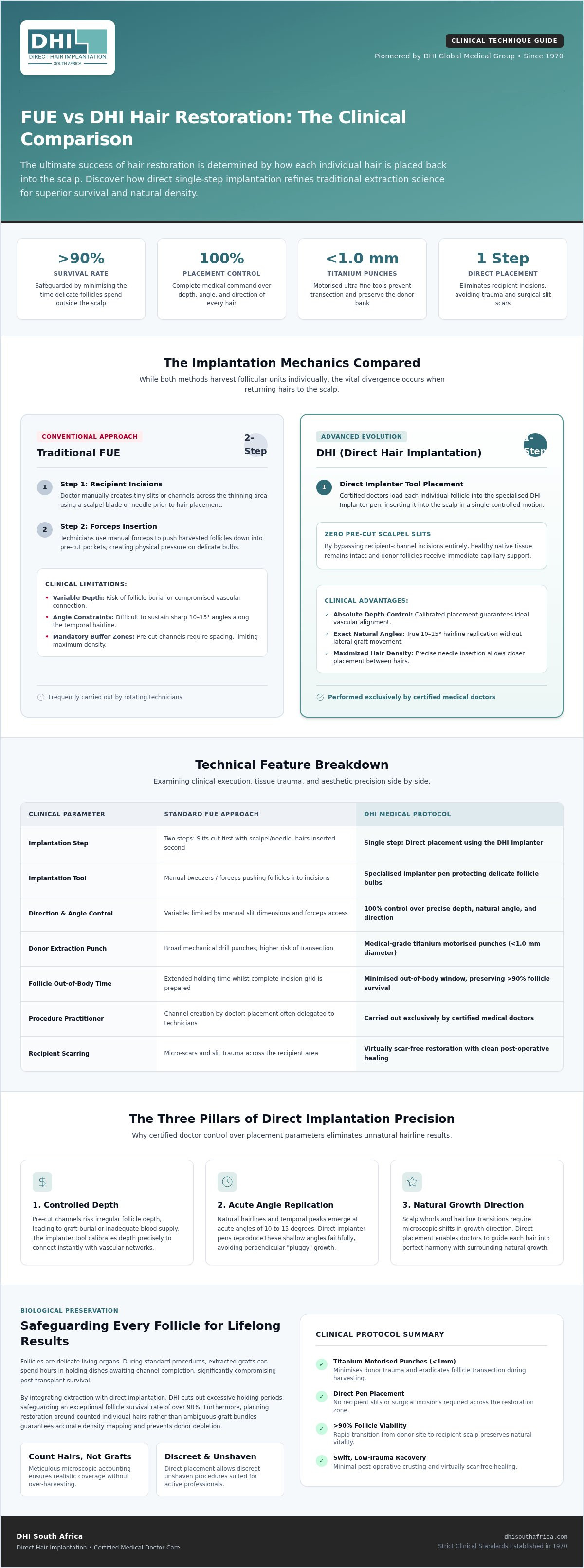
To make sense of the debate around a fue vs dhi hair transplant, we have to clear up a common misconception. Many clinics market these as entirely competing surgeries. In reality, Direct Hair Implantation (DHI) represents the sophisticated evolution of traditional extraction science. While standard Follicular Unit Extraction fundamentally changed donor harvesting by removing follicular units individually rather than cutting a strip of scalp, it left the implantation stage open to significant human error.
The primary technical distinction lies in how the hair returns to your scalp. Traditional approaches rely on manual incisions created before placement, whereas DHI utilises a patented medical implanter to insert each follicle directly. If you want seamless, high-density results that blend imperceptibly with existing growth, the precision of the implantation tool makes all the difference. For patients researching an advanced hair transplant, understanding this shift from two-step cutting to single-step placement provides absolute clarity.
To see how clinical specialists evaluate the practical realities of these two approaches, watch this helpful comparison video:
The Traditional FUE Method Explained
Standard protocols operate as a rigid, two-step procedure. First, a doctor makes tiny slits or recipient channels across the thinning area using a scalpel or needle. Next, technicians use manual forceps to push extracted follicles down into those pre-cut pockets. This manual process introduces distinct aesthetic compromises:
Inconsistent depth control: Slits made by hand vary in depth, which can risk follicle burial or poor vascular connection.
Variable angles: Forceps insertion makes it difficult to maintain the acute, 10-to-15-degree angle required along the temporal peaks and frontal hairline.
Spacing limits: Scalpel channels require buffer zones to avoid trauma to surrounding tissue, restricting how closely hairs can sit together.
How DHI Elevates the Restoration Process
Direct Hair Implantation replaces recipient-site incisions entirely. Using the specialised DHI Implanter, certified medical doctors load each follicle and introduce it into the scalp in a single, controlled motion. This specialised pen-like instrument provides 100% control over the depth, angle, and direction of every individual hair. Pioneered by the DHI Global Medical Group, which has set strict clinical standards since 1970, this refined technique delivers superior density without pre-cut slits or visible scars.
The Technical Breakdown: How Extraction and Implantation Methods Differ
To truly evaluate a fue vs dhi hair transplant, one must look closely at the mechanical handling of each delicate follicle. Both protocols harvest donor hairs using the foundational principles of follicular unit extraction. The critical divergence lies in the precision instruments deployed during removal and the immediate pathway those hairs take back into the scalp. As recognised by the International Society of Hair Restoration Surgery (ISHRS), the core mechanical distinction centres on the specialised instruments used to place the hair rather than a fundamentally separate biological harvest.
Every phase of a DHI procedure is carried out exclusively by certified medical doctors rather than rotating technicians. This doctor-led approach ensures that biological tissue is treated with the gentle clinical care it demands from start to finish.
Follicle Extraction: The First Step to Success
Donor preservation begins by eliminating transection (the accidental cutting or tearing of a hair follicle during extraction). While standard clinics often use broad, mechanical drill bits, DHI employs single-use, motorised punches coated in medical-grade titanium, measuring less than one millimetre in diameter:
Minimal donor trauma: The ultra-fine diameter ensures the extraction points heal without visible linear scarring.
Reduced transection rates: The rotating titanium tip glides cleanly around the follicular unit, keeping the vital dermal papilla intact.
Superior tissue preservation: Intact surrounding tissue protects the root structure, giving each hair the biological support it needs to thrive.
The Implantation Phase: Slit-and-Place vs. Direct Implantation
Standard slit-and-place surgery cuts recipient canals across the thinning scalp hours before hair insertion begins. This creates avoidable bleeding, triggers scalp trauma, and extends the time donor hairs spend outside their natural environment. Delicate follicles slowly lose vitality while resting in holding trays, compromising their long-term survival.
Direct Implantation bypasses pre-cut channels altogether. Loaded directly into the patented DHI Implanter, each hair enters the scalp immediately, minimising out-of-body time and eliminating forceps handling on the delicate root. The tool allows the doctor to navigate seamlessly amongst existing hairs, matching the precise 10 to 45 degree angle and natural radial flow of your current growth. If you want to see how this technical precision restores density without disrupting native hair, you can explore our full range of specialised hair restoration treatments to view real clinical outcomes.
Comparing Clinical Outcomes: Survival Rates and Aesthetic Precision
When weighing a fue vs dhi hair transplant, the decisive metric isn't how many follicles leave the donor area, but how many thrive in their new location. Historically, conventional restoration methods have yielded an industry average survival rate of 50-60%. In contrast, the global DHI protocol consistently delivers a survival rate of >90%. This stark difference stems directly from the mechanical handling of individual hairs during the transfer process.
Hairs survive far better when physical manipulation is kept to an absolute minimum. Because direct implantation bypasses the harsh, manual pinching associated with forceps placement, the delicate root structures remain undamaged and biologically primed for permanent growth.
The Science of the >90% Survival Rate
To understand clinical longevity, we have to look at graft survival (the proportion of transplanted hairs that successfully take root, secure blood flow, and produce lifelong growth). Under traditional protocols, follicles face prolonged dehydration and physical stress while awaiting placement. The DHI Total Care System protects the hair bulb (the vital base of the follicle housing active stem cells) through specialised holding solutions and direct, gentle transfer. By ensuring every procedure is carried out under strict medical protocols, follicle viability remains exceptionally high from extraction to implantation.
Aesthetic Artistry: Designing a Natural Hairline
A successful procedure isn't merely about hair survival; it's about artistry. Traditional channel creation often struggles with depth calibration, which can cause cobblestoning (an uneven, bumpy skin texture that occurs when follicles are placed at inconsistent depths). The DHI Implanter eliminates this risk by giving the physician absolute control over vertical depth and insertion angles.
This level of precision delivers several distinct aesthetic benefits:
High-density placement: Certified doctors can place individual hairs exceptionally close together without disrupting neighbouring capillary blood flow.
Lifelike directionality: Every hair follows the delicate, multidirectional swirl patterns unique to your scalp.
Undetectable blending: New growth integrates seamlessly alongside thinning native hair without harsh transitions.
Achieving this seamless, authentic finish represents the gold standard for medical hair restoration across South Africa. If you want visual proof of how direct placement translates to dense, undetectable hairlines, take a moment to explore the DHI results page to see verified patient transformations.
Personal Suitability: Which Technique Aligns With Your Hair Loss Pattern?
A common misconception across the aesthetic industry suggests that direct implantation only suits minor touch-ups or small receding patches. In truth, choosing between a fue vs dhi hair transplant comes down to your personal lifestyle, the texture of your existing thinning zones, and your tolerance for visible surgical signs. If your career requires public discretion, having to shave your head completely can feel just as stressful as the thinning itself.
Because direct placement does not require open channel slits, it makes an unshaven hair transplant completely viable. Certified doctors can thread individual hairs directly into areas of diffuse thinning without clipping your existing hair. This approach shields your scalp from social scrutiny while protecting your daily schedule.
When DHI is the Clear Choice
Direct implantation proves unmatched when pinpoint control determines aesthetic success. It represents the primary choice for targeted hairline refinement, delicate crown spirals, and specialised beard restoration where rogue growth directions look instantly artificial. You should strongly consider this direct methodology if:
You need complete privacy: Unshaven techniques let you step back into personal and work commitments without signalling you've had clinical surgery.
You are working between existing hair: Direct implanters slip between delicate native follicles without slicing into neighbouring roots or blood vessels.
You want maximum aesthetic density: The ultra-fine footprint allows doctors to pack hairs tightly to reconstruct natural temples, hairlines, or patchy facial growth.
Evaluating the FUE Option
For individuals dealing with extensive scalp coverage, such as advanced stages on the Norwood scale (a standardised clinical classification system measuring the severity of male pattern baldness), traditional slit approaches are often raised. Standard procedures can move large surface areas quickly because pre-cut slits allow rapid manual placement. However, speed often trades off the exact directional control necessary for organic hairlines.
In select scenarios, surgical teams might combine these methodologies. They may utilise broader channel incisions across the deep crown where raw bulk coverage is the sole objective, while reserving direct placement for the frontal hairline where microscopic artistry matters most. Making this decision requires a comprehensive diagnostic evaluation rather than guessing your hair count online.
The DHI Advantage in South Africa: Why Technique Trumps Quantity
When assessing a fue vs dhi hair transplant, true clinical value isn't measured simply by raw volume; it centres on safety, doctor accountability, and medical excellence. Across South Africa, every stage of your DHI procedure is executed personally by certified medical doctors who have completed rigorous training under the DHI Global Medical Academy. Unlike standard facilities that delegate extraction and placement to rotating surgical assistants, our doctor-led approach ensures patient safety through 18 mandatory clinic checks across every single session.
For executive patients requiring targeted hairline reinforcement, smaller sessions can function as a refined "lunch-hour transplant". Because our direct methodology requires no stitches and leaves no visible linear scarring, you can complete a focused procedure and return to professional duties almost immediately. Evaluating a DHI hair transplant cost in South Africa means viewing your procedure as a permanent, lifetime investment in pristine follicle survival rather than a recurring corrective expense.
Beyond the Surgery: The DHI Total Care System
Achieving lifelong density requires a comprehensive 360-degree approach covering diagnostic, preventive, and restorative solutions. Transmitted hairs thrive when the surrounding scalp microenvironment receives clinical support. Incorporating supportive biological therapies like PRP hair loss treatment (platelet-rich plasma therapy, which concentrates growth factors from your own blood to nourish struggling follicles) accelerates tissue healing and activates dormant roots.
Our commitment extends well beyond the procedure room through structured 18-month post-procedure monitoring. Certified physicians conduct scheduled evaluations and standardized digital photographic tracking, ensuring that every transplanted hair develops along an ideal growth trajectory.
Choosing Local Excellence Over Medical Tourism
The temptation of low-cost offshore medical tourism often obscures devastating clinical risks. High-volume overseas clinics frequently operate as assembly lines where unsupervised technicians overharvest donor reserves, leaving irreparable bald patches and fragile hairs with poor survival rates. Once you return home, seeking medical recourse or routine aftercare becomes practically impossible.
Opting for world-class standards within South Africa provides unmatched reassurance. You benefit from international protocol standards backed by UK CQC and ISO accreditations, paired with ongoing, in-person medical guidance throughout your recovery. You can begin with a transparent, diagnostic consultation by booking a specialised digital scalp analysis to map out your personalised restoration strategy.
Taking the Next Step Towards Lifelong Hair Density
Deciding between a fue vs dhi hair transplant ultimately comes down to the clinical precision, recovery comfort, and natural density you expect. Direct Hair Implantation replaces manual recipient slits with complete control over follicle depth, angle, and direction. This protects delicate roots to maintain survival rates above 90% without visible linear scarring. Backed by over 250,000 satisfied patients globally and a 99% customer satisfaction rate accredited by IMRB, our medical team brings world-class hair restoration directly to South Africa. Every procedure is performed exclusively by DHI Academy certified doctors, ensuring your donor area receives unmatched care.
You don't have to accept progressive thinning or settle for uncertain results. Taking control of your hairline is an empowering step towards renewing your everyday self-assurance, and our specialists are here to guide you through every stage of your restoration journey.
Frequently Asked Questions
Is DHI more painful than FUE hair transplantation?
No, both procedures utilise local anaesthesia, but DHI typically causes less post-procedural discomfort. Because direct implantation eliminates the need to create recipient channel slits before placement, scalp trauma is significantly reduced. Patients experience less swelling and faster tissue recovery. Certified doctors administer local anaesthetic gently, ensuring you remain comfortable throughout the session without feeling sharp pain during extraction or placement.
Can I get a DHI hair transplant without shaving my head?
Yes, DHI is exceptionally well suited for unshaven procedures. The specialised implanter allows doctors to place hairs directly amongst long, existing strands without needing to shave the recipient area. This makes it an ideal choice for women or professionals who want to keep their procedure discreet. Only a small, easily concealable window in the donor zone is trimmed to harvest the required follicles.
How long does the recovery take for DHI vs FUE?
Recovery after DHI is generally faster than standard FUE due to the absence of pre-cut channel incisions. When comparing recovery in a fue vs dhi hair transplant, DHI patients usually see initial healing within three to five days. Redness and minor crusting subside swiftly because tissue disruption is minimal. Most individuals feel confident returning to work and light routines within two days, provided they follow standard post-operative washing instructions.
Why is the survival rate higher with DHI than traditional FUE?
Follicle survival is higher with DHI because hairs spend far less time outside the body and undergo minimal mechanical handling. The single-step implantation process bypasses the manual forceps grip used in standard surgeries, protecting the delicate hair bulb (the active cellular root of the follicle). By transferring follicles directly and storing them in specialised preservation solutions, DHI consistently secures a follicle survival rate of >90%.
Does DHI leave any visible scarring in the donor area?
No, DHI does not leave visible linear scarring in the donor area. Certified medical doctors extract follicles individually using single-use punches coated in titanium with diameters under one millimetre. These microscopic circular puncture points heal rapidly, blending imperceptibly into the surrounding scalp. Even with closely cropped hairstyles, your donor area retains an undisturbed, natural appearance without the noticeable linear marks left by older strip harvesting methods.
How many hairs can be transplanted in a single DHI session?
Up to several thousand hairs can be transplanted in a single full-day session, depending on your donor availability. Because planning focuses on counting individual hairs rather than ambiguous graft bundles, our doctors calculate density with exact precision. Smaller sessions for temple or hairline refinement can be performed in a few hours, whereas extensive restoration requiring 4,000 hairs or more is carefully managed across structured sessions to protect donor health and ensure optimal follicle viability.
Is DHI suitable for women with diffuse thinning hair?
Yes, DHI is one of the most effective restoration methods for women experiencing diffuse thinning. Female pattern hair loss often involves thinning spread across the crown rather than distinct bald spots. The patented implanter allows certified doctors to insert hairs carefully between existing, native strands without damaging surrounding healthy follicles. Combined with the option to avoid shaving the thinning area, it offers an exceptionally discreet, confidence-restoring solution.
How much does a DHI hair transplant cost in South Africa?
The cost of a procedure in South Africa depends entirely on your specific pattern of hair loss and the total number of hairs required. When evaluating a fue vs dhi hair transplant, pricing reflects individual clinical needs, session duration, and whether an unshaven protocol is selected. Every treatment is performed by certified doctors under rigorous medical safety checks. A personal digital scalp analysis is the best way to receive an exact, transparent quote tailored to your restoration goals.


Comments