%20(1).jpg)
%20(1).jpg)
Am I a Good Candidate for a Hair Transplant? Your 2026 Eligibility Checklist
- Dhesan Moodley

- Jul 15
- 13 min read
What if the success of your hair restoration depends less on how much hair you've lost and more on the health of the "bank" you have left? Many people spend years staring in the mirror, wondering, am I a good candidate for a hair transplant, whilst feeling overwhelmed by contradictory advice and the fear of a failed investment. It's natural to feel anxious about whether you have enough donor hairs or if you're simply too late for a permanent solution. Generally, eligibility rests on the quality of your donor follicles and the stability of your hair loss pattern; it is about the precision of the plan, not just the extent of the thinning.
You deserve a clinical perspective that moves beyond marketing hype to provide honest answers about your unique situation. This guide breaks down the essential 2026 criteria, from understanding the "hairs vs grafts" distinction to the specific medical indicators that determine if a procedure will yield a natural, lasting result. We'll explore exactly what makes a successful candidate and provide a transparent look at the alternatives if surgery isn't the right path for you today. Our goal is to replace confusion with a methodical roadmap, ensuring you feel fully informed rather than overwhelmed.
Table of Contents
What Defines a Good Candidate for a Hair Transplant?
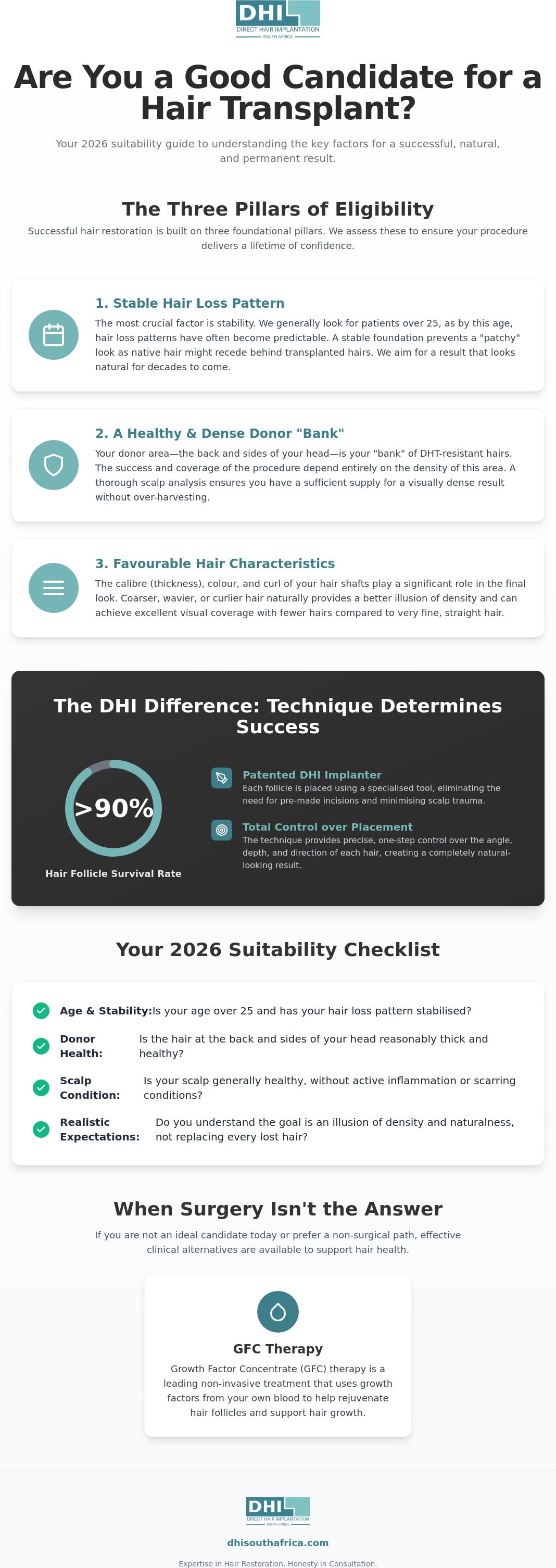
Determining eligibility for a permanent procedure is a process that requires both clinical precision and personal honesty. When you ask yourself, "am I a good candidate for a hair transplant," the answer often lies in the stability of your hair loss pattern. We generally look for patients over the age of 25 because, by this stage, the trajectory of androgenetic alopecia (the most common form of hair loss) has typically stabilised. If we perform a procedure whilst your loss is still aggressive and unpredictable, you may find yourself with a patchy appearance as your native hair continues to thin behind the newly placed hairs. A stable foundation is the first step toward a result that looks as good in ten years as it does on day one.
The primary goal of the procedure is the strategic redistribution of healthy follicles. We aren't creating new hair out of thin air; we're moving your most resilient hairs to the front or crown where they can make the most impact. This means you need a sufficient supply of donor hair to achieve the coverage you desire. A good candidate approaches the process with realistic expectations, understanding that we are working with a finite biological resource. It's a journey of restoration, not a miracle, and we're here to ensure you have the data needed to make an informed choice.
The Importance of the Donor Area
The success of any restoration depends entirely on the quality of your donor area. This is the region at the back and sides of your head where follicles are genetically resistant to Dihydrotestosterone (DHT), the hormone responsible for thinning. We strategically harvest these resilient follicles and place them in thinning zones. The density of this region is paramount. Since we are working with a finite supply, the volume of available follicles determines how much coverage we can achieve. Consider this donor area as your personal hair bank for future restoration. Understanding various hair transplantation techniques helps clarify why this "safe zone" is so vital for longevity. If your donor area is too thin, the results may appear sparse, which is why a thorough scalp analysis is non-negotiable.
Realistic Expectations vs Miracle Claims
It is vital to distinguish between achieving "fullness" and returning to your "original density." A successful transplant is an artistic illusion of density created by the meticulous placement of hairs. Whilst we understand the emotional weight of wanting a "full head of hair," we maintain a policy of absolute candour. We cannot replace every single hair you have lost since your teenage years. Instead, the DHI technique focuses on high survival rates and precise control over the angle, depth, and direction of each hair. This ensures that the results look seamless and natural amongst your existing hair. We aim to restore your confidence through science, not through over-promising. A good candidate understands that restoration is a partnership between medical expertise and biological limits.
The Three Pillars of Hair Restoration Eligibility
When you ask, "am I a good candidate for a hair transplant," we look beyond the visible thinning to evaluate three foundational pillars. These criteria ensure that your investment leads to a lifetime of confidence rather than a temporary fix; for those looking to manage the costs of such a procedure, QuickCashDirect offers access to short-term financial solutions. The first pillar is stability. We need to determine if your hair loss has reached a predictable pattern or if it is still in an aggressive phase. Ideally, we want to transplant hairs that are in the anagen phase, which is the active growth stage of the follicle cycle. This ensures the highest level of resilience during the transition to the new site.
The second pillar involves your scalp health. We must ensure there is no active inflammation or conditions like scarring alopecia, which could compromise the survival of the transplanted hairs. Adhering to the clinical criteria for hair transplant candidates is essential for safety and aesthetic success. Finally, we assess your hair characteristics. The colour, curl, and calibre (the thickness of the individual hair shaft) all play a role in the final visual result. Coarser or curlier hairs often provide better visual coverage with fewer hairs than very fine, straight hair.
Assessing Your Hair Loss Pattern
We use standardised tools like the Norwood Scale for men and the Ludwig Scale for women to categorise your hair loss. These scales help us predict future thinning and plan the placement of hairs strategically. For those identified as "diffuse thinners," where hair thins evenly across the entire scalp, surgery might not be the immediate answer. In these cases, we often recommend Direct Hair Implantation: The Science of Natural Hair Restoration in 2026 as a way to understand how we combine surgical precision with follicle stimulation. Some patients may even benefit from GFC therapy to revitalise existing follicles before committing to a transplant.
Medical and Lifestyle Factors
Your lifestyle choices directly impact the "take rate" of your procedure. Smoking, for instance, constricts blood vessels and reduces the vital oxygen supply reaching your scalp. Chronic conditions like uncontrolled diabetes can also slow the healing process and affect the longevity of the results. To get an accurate picture of your potential, we utilise digital trichoscopy. This is a modern, non-invasive diagnostic method using high-magnification cameras to measure your hair density and scalp health with mathematical precision. If you are curious about your own hair density, a personalised scalp assessment is the most reliable way to receive an expert opinion tailored to your biology.
Your 2026 Hair Transplant Suitability Checklist
While a clinical consultation is the gold standard for diagnosis, you can begin your journey by asking yourself a few critical questions. Determining am I a good candidate for a hair transplant often starts with a simple self-assessment of your current hair loss trajectory and overall scalp health. This checklist reflects the latest 2026 medical protocols we use to ensure patient safety and aesthetic success.
Are you over the age of 25? We look for a predictable hair loss pattern that has stabilised to avoid future "gaps" in coverage.
Is your donor area healthy? You need thick, resilient hair growth at the back and sides of your scalp to act as your "hair bank."
Have you tried medical therapies? Most specialists recommend using treatments like minoxidil or finasteride for at least six months to stabilise native hair before surgery.
Is your scalp clear? Your skin should be free from active inflammation, psoriasis, eczema, or infections that could interfere with healing.
Are you seeking a permanent solution? A transplant is a lifelong commitment to redistributing your existing hairs for a natural look.
Self-Evaluating Your Donor Density
You can perform a simple "mirror test" at home to check your donor potential. Hold a hand mirror and look at the hair at the back of your head; if you can easily see your scalp through the hair whilst it is dry, your donor density may be lower than ideal. Compare the texture of the hair in this "safe zone" to the thinning areas. If the hair at the back feels significantly coarser and stronger, it is likely a good candidate for relocation. In a DHI procedure, the strategic placement of 4,000 hairs often creates a more natural, dense appearance than older methods because we have total control over the angle and direction of every single hair.
Just as the angle and direction of every hair are critical for a natural look, the framing of a photograph is essential for capturing a property's true potential; those interested in professional visual standards can learn more from Houzpics | Real Estate Photographers in Hilton Head, SC.
Timing Your Procedure Correctly
Rushing into surgery too early is a common mistake that can lead to "island" hair growth. This happens when transplanted hairs remain in place whilst the surrounding native hair continues to recede, leaving a visible gap between the two. Waiting for your hair cycle to settle ensures that the design we create today will still look seamless as you age. If you are ready to move from self-evaluation to a professional plan, exploring a hair transplant in South Africa with a qualified specialist is the next logical step. Taking the time to get the timing right is what separates a good result from a world-class transformation.
When Surgery Isn’t the Answer: Alternative Solutions
If your self-evaluation or a clinical assessment suggests that the answer to am I a good candidate for a hair transplant is "not right now," please know that this is not a dead end. Many patients find that their hair loss is either too early for surgery or their donor area lacks the density required for a full restoration. In these instances, we pivot to clinical alternatives designed to preserve your native hair and revitalise the follicles you still have. These non-surgical options focus on biological stimulation rather than physical redistribution.
One of the most effective paths for early-stage thinning is GFC (Growth Factor Concentrate) therapy. This advanced treatment uses a high concentration of your own growth factors to directly target and revitalise dormant follicles. Similarly, PRP (Platelet-Rich Plasma) offers a multitargeted approach to alopecia by improving scalp health and encouraging thicker hair growth. For those with significant loss and insufficient donor hairs, Scalp Micropigmentation (SMP) provides an artistic solution. It creates the appearance of a densified "shaven look" by placing specialised pigments into the dermal layer of the scalp.
Regenerative Therapies for Thinning Hair
Our regenerative approach often includes Regenera Activa, a procedure that uses your own progenitor cells to curb miniaturisation. Miniaturisation is the process where hair follicles shrink over time until they stop producing hair altogether. This treatment is often referred to as a "lunch-hour" procedure because it is quick, minimally invasive, and requires no downtime. You can explore our full range of hair loss treatments to see which clinical path aligns with your current needs.
Combining Treatments for Maximum Impact
We often find that the best results come from a synergistic approach. We frequently recommend GFC alongside a transplant to improve the survival rates of the newly placed hairs. This "pre-habilitation" of the scalp can actually make you a better candidate for a procedure later by strengthening the surrounding native hair. Combining medical products with surgical restoration ensures that your scalp is in the best possible condition for long-term success. If you're ready to see which of these options fits your profile, you can book a digital scalp analysis to get started.
The DHI Difference: Why Our Standards Are Higher
When you consider the question, "am I a good candidate for a hair transplant," the method of implantation is just as vital as the initial diagnosis. Traditional techniques often involve handling follicles in a way that can compromise their viability before they reach the recipient site. At DHI South Africa, we maintain a verified hair survival rate of over 90% by ensuring follicles spend minimal time outside the body. This protocol protects every hair we move, giving it the best possible chance to thrive in its new location.
Our patented DHI Implanter provides a level of control that older methods simply cannot match. Unlike other surgeries that require pre-cut slits in the scalp, our tool allows for the simultaneous creation of the site and the placement of the hair. This gives us absolute authority over the depth, angle, and direction of each hair. The result is a natural finish that blends seamlessly with your existing growth. It is a discreet, scar-free solution that fits the demanding schedule of busy South African professionals who require minimal downtime.
We believe that your restoration should be handled by a medical professional, not a technician. Every procedure at our clinic is performed by certified medical experts who understand both the science and the artistry required. This "safe pair of hands" approach ensures that your safety and aesthetic outcome are never compromised for the sake of volume. We focus on the long-term health of your donor area whilst achieving the most dense, natural-looking results possible.
A Scientific Approach to Restoration
We adhere to the DHI Total Care System, which is the only set of restoration protocols globally to be ISO and UK CQC-accredited. Our extraction method utilises single-use titanium-coated punches to ensure the highest hygiene standards and minimal tissue trauma. You can see the impact of this precision for yourself by viewing our hair transplant results. These meticulous standards are why our patients see such consistent, life-changing transformations.
Your Next Step: The Professional Consultation
A digital scalp analysis is the only way to move from general curiosity to clinical certainty. During this session, we use high-definition imaging to measure your donor density and assess your scalp health with mathematical precision. This report provides a transparent roadmap for your journey, helping you decide if you are ready for a permanent change. Book your assessment today to reclaim your confidence with a plan built specifically for your biology.
Take the Next Step Toward Lasting Restoration
Deciding to address hair loss is a significant step toward reclaiming your self-assurance. As we've explored, the answer to am I a good candidate for a hair transplant depends on a clinical balance of donor density, scalp health, and the stability of your thinning pattern. Whether you are ready for a permanent procedure or require regenerative therapies to strengthen your native follicles, the key is a personalised, data-driven approach. By choosing DHI, you join over 250,000 satisfied patients globally who've benefited from our specialised protocols. Every procedure is performed by certified medical specialists, ensuring a result that's both safe and aesthetically seamless.
With a guaranteed hair survival rate of over 90% per our strict protocols, you can move forward with absolute trust in the outcome. Your journey to a fuller head of hair starts with clarity; we're here to provide the expert guidance you need. To get a definitive answer tailored to your unique biology, we invite you to take the first step today. It's time to stop wondering and start your transformation with a team that values your results as much as you do.
Book Your Digital Scalp Analysis and Suitability Assessment
Frequently Asked Questions
How many hairs do I need for a successful transplant?
The total number of hairs required depends on the size of the thinning area and your specific goals for density. A minor refinement of the hairline might require 1,500 to 2,000 hairs, whilst more extensive coverage for the crown could involve the placement of 4,000 hairs or more. We determine this precise number during a digital scalp analysis to ensure we achieve a natural look without over-harvesting your donor area.
Can I have a hair transplant if I am completely bald on top?
It is possible to have a procedure if you are bald on top, provided your donor "bank" at the back and sides is dense enough to provide coverage. When the recipient area is large, we focus on strategic placement to create the most impactful visual result, such as a strong frontal hairline. If your donor hair is also limited, we might suggest a combination of a transplant and Scalp Micropigmentation (SMP) to create the illusion of a fuller head of hair.
Is there an age limit for getting a hair transplant in South Africa?
There is no strict upper age limit, but we generally recommend that patients are at least 25 years old before undergoing surgery. At a younger age, hair loss patterns are often still evolving and unpredictable; waiting ensures that we can design a hairline that remains natural as you age. For older patients, eligibility depends more on your general health and the quality of your remaining donor follicles than the date on your birth certificate.
What medical conditions might stop me from being a candidate?
Conditions that cause active scalp inflammation, such as certain types of scarring alopecia or untreated discoid lupus, can prevent you from being a suitable candidate. When you ask, "am I a good candidate for a hair transplant," we also evaluate chronic conditions like uncontrolled diabetes or heart disease that might affect your ability to heal. Our medical experts always conduct a thorough health screening to ensure the procedure is safe and that the transplanted hairs have the best environment to thrive.
Will my transplanted hairs fall out later in life?
The transplanted follicles are taken from the genetically resistant "safe zone" at the back of your head, meaning they don't possess the receptors that cause them to thin and fall out. These hairs will continue to grow naturally for the rest of your life. Whilst your native hair around the transplant might continue to thin over time, the relocated hairs stay in place, which is why we often recommend medical maintenance to protect your original hair. For instance, clinics like Terra Medical provide specialised supplements to support long-term follicle health.
Can women be good candidates for hair transplants?
Women can be excellent candidates, especially if they have distinct thinning at the hairline or part line rather than diffuse thinning across the entire scalp. Because female hair loss often follows a different pattern, we use specialised diagnostic tools to ensure a transplant is the most effective path. If surgery isn't the right fit, we often see brilliant results in women using non-surgical regenerative therapies like GFC or PRP to revitalise thinning follicles.
What happens if I don’t have enough donor hair?
If your donor density is too low for a full transplant, we won't perform a procedure that would leave you with a sparse or patchy result. Instead, we'll explore alternatives like Scalp Micropigmentation (SMP) to add the appearance of density or clinical treatments to strengthen your existing hair. We'll always be candid about what is biologically possible to ensure you don't waste your investment on a result that doesn't meet your expectations.
How do I know if my hair loss has finally stabilised?
Stabilisation is typically reached when you haven't noticed any significant change in your hair pattern or density for at least 12 to 18 months. We use digital trichoscopy to measure miniaturisation, which is the process where hair follicles shrink before they stop growing. If our analysis shows that your hair loss has slowed to a predictable rate, it's a strong sign that you're ready for a permanent restoration procedure.


Comments