%20(1).jpg)
%20(1).jpg)
Am I Too Old for a Hair Transplant? Age, Health and Suitability

Being older doesn’t automatically rule out a hair transplant. If you’re asking, “am I too old for a hair transplant?”, there’s no universal upper age limit. Suitability depends on more than your age.
It’s understandable to wonder whether surgery could be safe or worthwhile, whether you have enough donor hair for a natural-looking result, or whether your hair loss might continue afterwards. Age alone can’t answer those questions. A specialist considers your overall health, the condition and availability of donor hair, how your hair loss is changing and what you hope to achieve.
This article explains which factors matter in an individual suitability assessment, how future hair loss may affect planning, and when non-surgical options such as GFC or PRP may be worth discussing alongside Direct Hair Implantation. You’ll also find practical ways to prepare for a consultation and questions to help you weigh your options without assuming that age either qualifies or disqualifies you.
Table of Contents
Am I too old for a hair transplant? The direct answer
Chronological age alone doesn’t determine whether a hair transplant is suitable. If you’re asking, “am I too old for a hair transplant?”, there’s no single age cut-off that can answer the question for everyone. It’s a personal decision, and it’s understandable to want a clear answer before considering treatment.
A specialist considers your overall health, the amount and condition of hair in the donor area, the pattern of your hair loss and your expectations. Together, these factors help shape an individual recommendation rather than assuming that a particular age automatically qualifies or rules you out.
For a patient perspective on the hair-restoration journey, watch the video below.
Is there an upper age limit for a hair transplant?
A universal age threshold would overlook how much people’s health and hair characteristics can vary. Age is one part of your medical background, but it can’t show whether your donor hair is suitable, how your hair loss is progressing or which treatment may be appropriate. A qualified clinician needs to assess your personal suitability before recommending surgery.
Why age is only one part of the decision
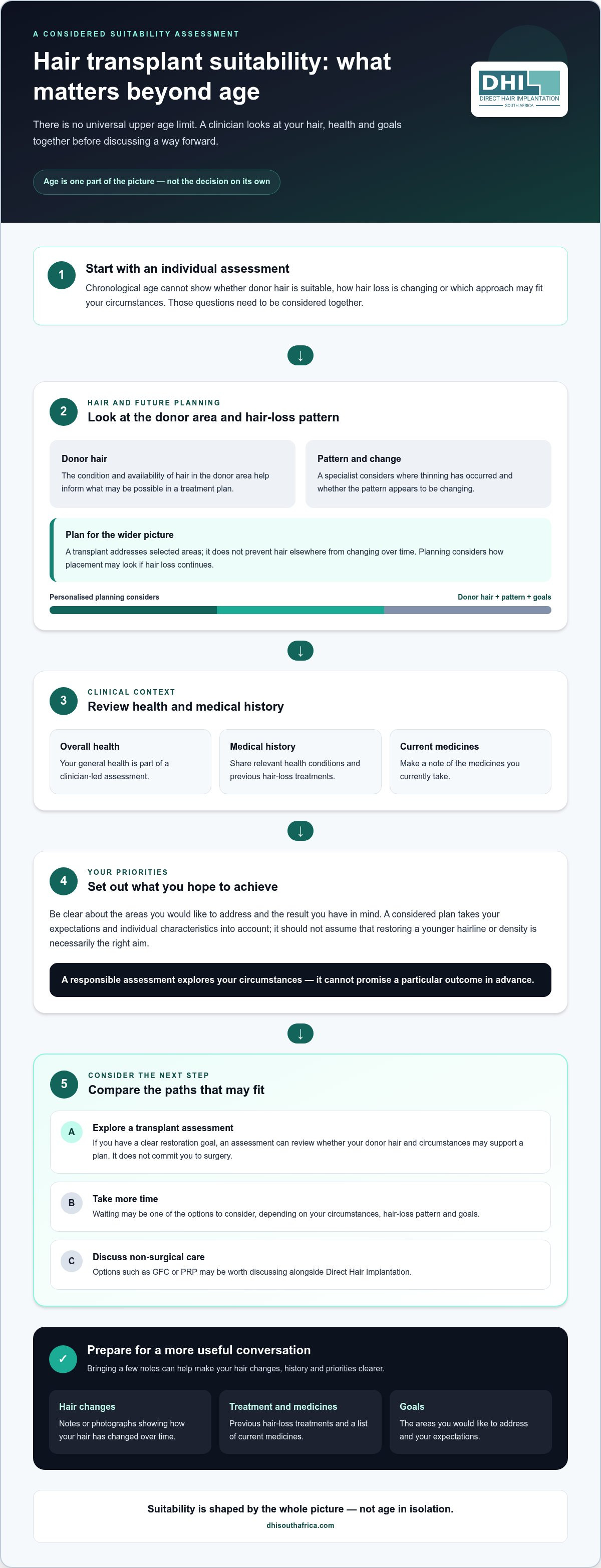
The donor area matters because the condition and availability of its hair help inform what may be possible in a treatment plan. A clinician will also consider your overall health and examine the pattern of hair loss, including whether it appears to be changing. The aim is to understand your circumstances, not to make a decision based on age in isolation.
Your goals matter, too. You might want to address a particular area or be hoping for a broader change. A considered plan takes your expectations and individual characteristics into account. It shouldn’t assume that restoring the hairline or density you had when you were younger is necessarily the right aim. Chronological age is a number; clinical suitability is an individual assessment.
If you’d like a neutral introduction to the procedure, read about Hair transplantation. For information about hair transplant treatment at DHI South Africa, explore the approach and arrange a personalised suitability assessment. This can help clarify whether Direct Hair Implantation, another approach or taking more time best fits your needs.
What matters more than age when assessing hair-transplant suitability?
An age-aware assessment looks beyond your date of birth. It considers your hair and scalp, medical background and what you hope treatment may achieve. These details help a clinician decide whether Direct Hair Implantation is appropriate or whether another course may better suit your circumstances.
Donor hair, hair-loss pattern and future planning
The donor area is the part of the scalp assessed for follicles that may be used in a transplant. The condition and availability of hair there help inform a realistic plan. A specialist also considers where thinning has occurred and whether the pattern appears to be changing, so placement can be planned with the wider picture in mind.
A transplant addresses selected areas; it doesn’t prevent hair elsewhere from changing over time. Planning should therefore consider how today’s placement may look if hair loss continues, rather than focusing only on the area you’d like to improve now. The number and distribution of hairs considered for treatment should reflect your donor area and goals, not a generic target.
Health, medicines and expectations
Your overall health and medical history are part of a clinician-led assessment. Before an appointment, make a note of relevant health conditions, previous hair-loss treatments and medicines you currently take. Share this information accurately, including changes that may seem unrelated to your hair.
Be open about the result you have in mind, too. Discussing expectations can clarify what you want to address and whether a surgical or non-surgical approach should be considered. No assessment can promise a particular outcome in advance; its purpose is to understand your circumstances and plan responsibly. Bernstein Medical offers a separate discussion of age and hair-transplant suitability, while your recommendation should come from an individual clinical assessment.
Beyond age, suitability depends on donor hair, the pattern of hair loss, general health, medical history and realistic goals.
To prepare, it may help to gather:
Notes or photographs showing how your hair has changed over time.
A list of previous hair-loss treatments and current medicines.
A clear description of the areas you’d like to address and your expectations.
A personalised assessment brings these factors together and helps you consider what to do next. Explore hair transplant treatment at DHI South Africa for more information about the procedure.
Hair transplant or another approach: how age and timing affect the choice
Choosing what to do next isn’t simply a matter of age. If you’re asking, “am I too old for a hair transplant?”, a more useful question is which option best fits your hair-loss pattern, donor hair, health and goals. A specialist assessment can help you compare possible paths without treating surgery as the automatic answer.
When a transplant assessment may be worth exploring
If you have a clear restoration goal and want to understand whether your donor hair could support a plan, an assessment is a practical place to start. It doesn’t commit you to surgery. A clinician can review your hair and circumstances, explain what Direct Hair Implantation involves and discuss whether it may suit you.
Surgical planning considers where hairs may be placed in relation to the areas you want to address. It also takes your broader hair-loss pattern into account. The discussion should focus on a considered plan for your situation, not a promised result or an age-based rule.
When another approach or a later decision may suit better
You may prefer to take more time, or a clinician may discuss non-surgical care as part of your options. GFC, Regenera Activa and PRP are treatments available at DHI South Africa for specialist discussion. They aren’t guaranteed substitutes for a transplant, and the appropriate choice depends on individual assessment. Postponing a decision can also be reasonable if you’re still clarifying your goals or want to understand your options first.
This comparison can help you frame the conversation:
These are starting points, not rankings. Your hair-loss pattern and clinical assessment help determine which conversations are most relevant. Age alone shouldn’t decide whether you proceed, wait or explore another approach.
For an overview of restoration options, read DHI South Africa’s advanced hair-loss solutions guide. You can also explore hair-loss treatment options as you consider what to discuss with a specialist.
How to prepare for an age-aware hair-transplant assessment
A little preparation can make a suitability discussion more useful. If you’re still wondering, “am I too old for a hair transplant?”, use the appointment to understand how your hair, health and goals will be assessed, rather than expecting age alone to provide an answer. A specialist evaluates suitability first, then discusses a personalised plan if appropriate.
Before your consultation, clarify what you’d like to address. You might be concerned about a receding hairline, thinning at the crown or a broader change in coverage. You don’t need to arrive with a fixed treatment choice. Describe what matters to you and ask how the clinical team views your options.
What to bring and discuss at a consultation
Think through when you first noticed hair loss and how it has changed. A simple timeline, notes about previous hair-restoration treatments and photographs taken over time can help the clinical team review those changes. Bring details of your health history and current medicines, and mention relevant conditions or changes openly.
Be candid about your expectations, too. Explaining what you hope to achieve helps the specialist understand your priorities and discuss whether they are realistic for your circumstances. DHI South Africa uses structured photographic documentation as part of its approach to monitoring, helping document the hair-restoration journey.
Questions that can help you make an informed decision
It’s reasonable to bring questions and take time to understand the answers. For example, you could ask:
How will the condition of my donor area and my hair-loss pattern inform the proposed plan?
How does the plan account for possible changes in my hair over time?
If surgery isn’t recommended for me, which alternatives might be appropriate to discuss?
What after-care and follow-up monitoring should I expect?
These questions can help you understand the reasoning behind a recommendation, including whether to consider Direct Hair Implantation, discuss non-surgical options or wait before deciding. For more information about the procedure, explore DHI South Africa’s hair-transplant information.
A thoughtful assessment should leave you with a clearer understanding of your situation, not pressure to proceed. You can also read this advanced hair-loss solutions guide to learn more about approaches to restoration.
How DHI South Africa approaches hair-transplant suitability at any age
If you’re still asking, “am I too old for a hair transplant?”, a personalised specialist assessment is a measured next step. It doesn’t assume surgery will be recommended. The purpose is to understand your hair, goals and clinical suitability, then discuss which approach, if any, makes sense for your circumstances.
What an individualised DHI discussion can cover
At DHI South Africa, the discussion considers your pattern of hair loss, donor area and the changes you hope to address. If Direct Hair Implantation is appropriate to explore, planning can include how the hairline and placement of hairs should be tailored to your features and goals. Your individual circumstances still matter; a technique doesn’t remove the need to consider health and other clinical factors.
You can read more about the method in this Direct Hair Implantation science guide. Information about a technique can help you understand the process, but only an individual assessment can establish whether it may be suitable for you.
Structured photographic records help document the hair-restoration journey, and DHI South Africa’s post-procedure monitoring is described as lasting up to 18 months. These records and follow-up support monitoring; they aren’t a promise of a particular result. Explore the clinic’s hair-transplant information to learn more about the treatment.
A measured next step, without pressure
An assessment is an opportunity to gain clarity, not an obligation to proceed. You can ask how your donor hair informs planning, whether your goals are realistic for your situation, what alternatives may be worth discussing and how follow-up is organised. If surgery isn’t the right recommendation, understanding why can still help you make a considered decision about what to do next.
Bring your questions, share relevant health and treatment history, and take time to consider the information you receive. A thoughtful conversation can help replace uncertainty with a clearer understanding of your options.
Arrange a hair-restoration consultation
Take a considered next step towards hair restoration
If you’re still asking, “am I too old for a hair transplant?”, remember that age alone doesn’t determine suitability. Donor hair, your hair-loss pattern, overall health and personal goals all inform whether Direct Hair Implantation or another approach may be appropriate.
A specialist assessment can help you understand your options without assuming that surgery is the answer. DHI South Africa’s approach includes structured photographic documentation and post-procedure monitoring, supporting a considered view of your hair-restoration journey without promising a particular result.
You deserve clear information and space to make a decision that feels right for you. A personalised conversation is a sensible place to begin.
Take the next step at your own pace, with a clearer understanding of what may suit your circumstances.
Frequently Asked Questions
Am I too old for a hair transplant?
Not necessarily. Age alone doesn’t decide whether a hair transplant is suitable. If you’re asking, “am I too old for a hair transplant?”, the answer depends on an individual assessment of your health, donor hair, hair-loss pattern and goals. A specialist can explain whether Direct Hair Implantation may suit your circumstances or whether another option, or waiting, deserves consideration.
Can people over 60 have a hair transplant?
People over 60 can seek an assessment, but age alone can’t determine whether surgery is suitable. A specialist considers factors such as donor-area hair, the pattern of hair loss, health history, current medicines and personal goals. The assessment may lead to a discussion of Direct Hair Implantation, another approach or postponing a decision. Only a clinician can advise on individual suitability.
What matters more than age when considering a hair transplant?
Donor hair, the extent and pattern of hair loss, overall health, medical history and realistic expectations all inform an assessment. The clinician considers how these factors relate to your goals and whether a personalised treatment plan is appropriate. Share details of current medicines and previous hair-loss treatments, too. Together, this information helps guide a discussion about surgery or other options without relying on age alone.
Can a hair transplant help if my hair loss is still progressing?
Possibly, but ongoing hair loss needs to be considered in the treatment plan. A transplant places hairs in selected areas; it doesn’t prevent hair elsewhere from changing over time. A specialist can assess your current pattern and discuss how it may affect planning and expectations. Depending on your circumstances, they may also discuss non-surgical options or whether it would be sensible to wait before deciding.
Is a hair transplant safe for older adults?
Safety can’t be determined by age alone, and no general answer can replace a clinician-led review. An assessment should consider your health, medical history, current medicines and the details of the proposed procedure. Be open about relevant conditions or treatments so the specialist can discuss your circumstances and suitability. They can explain the considerations that apply to you before any treatment decision is made.
What happens if I am not suitable for a hair transplant?
If surgery isn’t recommended, the assessment can still clarify your options and the reasons behind that advice. Depending on your needs, a specialist may discuss non-surgical treatments such as GFC, Regenera Activa or PRP, or suggest taking more time before making a decision. These treatments aren’t guaranteed substitutes for surgery; what may be appropriate depends on your individual assessment, goals and hair-loss picture.


Comments