%20(1).jpg)
%20(1).jpg)
DHI Hair Transplant Recovery Timeline: Your Month-by-Month Guide to Results
- Dhesan Moodley

- 2 days ago
- 12 min read
What if the most alarming part of your hair restoration journey, the sudden shedding of your new hairs, was actually the clearest sign that your procedure was a success? It's completely natural to feel a flutter of anxiety when you look in the mirror during those first few weeks. You've invested in your self-assurance, and now you're navigating a sea of aftercare instructions whilst worrying about visible scabbing or 'shock loss'. Most of our patients find they can return to their social routines within just a few days, but understanding the full dhi hair transplant recovery timeline is essential for your peace of mind.
We understand that you want a roadmap that's as precise as the implantation itself. This guide provides a clear, predictable path for your healing, from the meticulous first 24 hours to the final reveal of your dense, natural hairline. You'll discover exactly what happens during each biological phase, including why shedding is a necessary step for permanent growth. We will also share how our 18-month monitoring protocol and patented tools lead to hair survival rates of over 90 per cent, giving you total confidence in managing your results at home.
Table of Contents
The First Seven Days: Initial Healing and Scalp Care
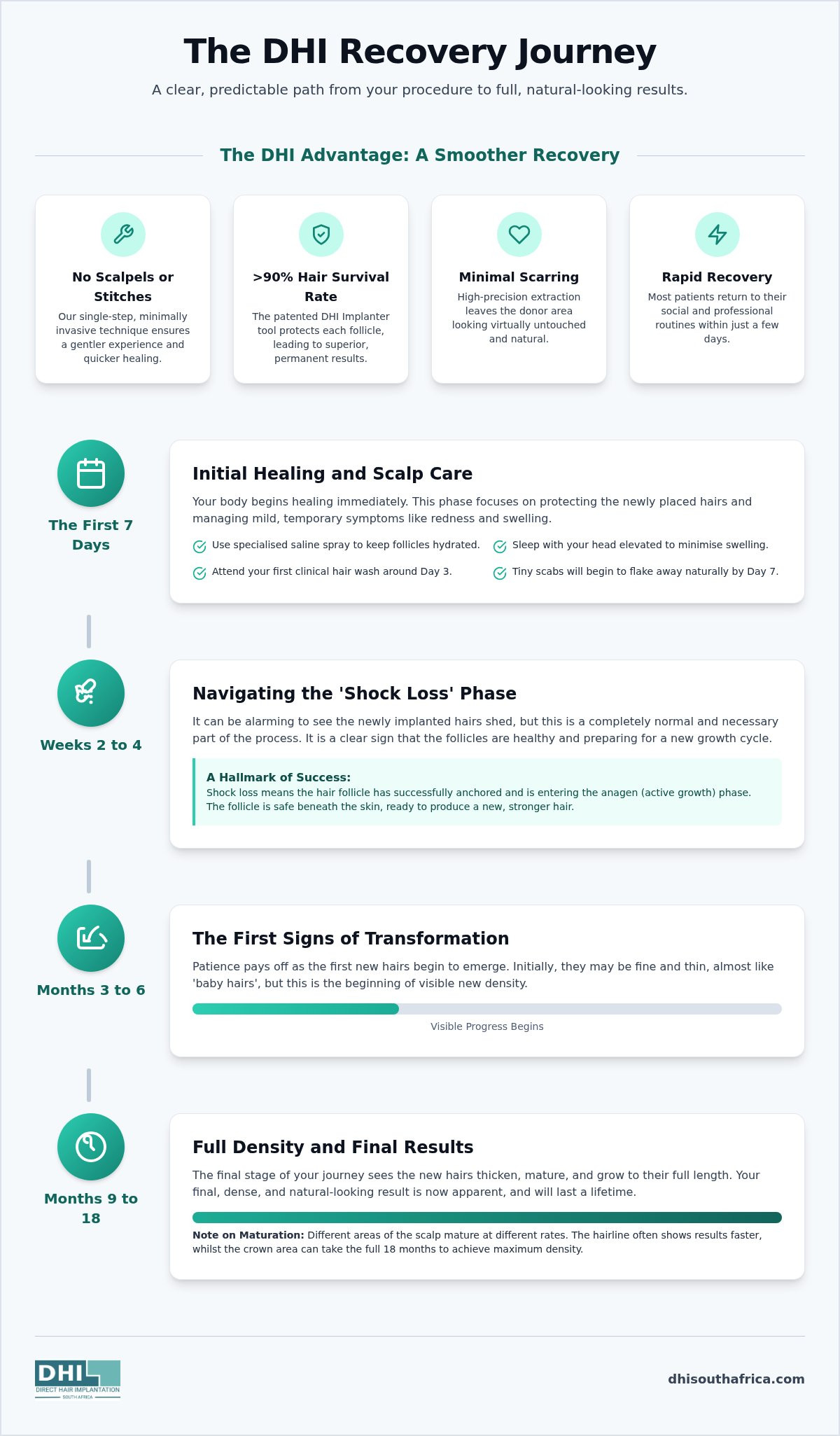
The moment you step out of the clinic, your body begins a remarkably efficient healing process. Because DHI is a minimally invasive technique that avoids scalpels and stitches, the initial phase of your dhi hair transplant recovery timeline is often described as a "lunch-hour" experience. You won't feel like a surgical patient, but your scalp requires specific, gentle care to ensure those newly placed hairs thrive in their new environment.
During the first 24 hours, it's common to notice mild redness and a slight "tight" sensation across the treated area. This is simply the skin's natural response to the precise placement of hairs. We provide a specialised saline spray that you'll use frequently during these early stages. This spray keeps the follicles hydrated and creates the optimal biological environment for the high survival rates we expect from our patented technique.
By days two to four, you might experience some swelling, particularly around the forehead or eyes. This is a normal part of the inflammatory response. Sleeping with your head elevated at a 45-degree angle helps fluid drain naturally and prevents you from accidentally rubbing the delicate treatment area against your pillow whilst you rest. By the time you reach day seven, the tiny scabs that formed around the insertion points will begin to naturally lift and flake away.
Managing the First 48 Hours
Your primary job during the first two days is to protect your investment. Whilst you'll likely feel well enough to resume light activities by day two, you must avoid touching, scratching, or picking at the scalp at all costs. Even though DHI is a more refined, direct version of Follicular Unit Extraction (FUE), the follicles still need time to anchor firmly into their new positions. Most patients find that any initial discomfort fades quickly, leaving them with a clear, manageable roadmap for the week ahead.
Your First Clinical Hair Wash
We typically schedule your first hair wash for day three. This is a critical milestone where we prefer to guide you through the process to ensure the scalp is cleansed without disturbing the newly implanted hairs. We use specialised DHI hair loss products designed to be exceptionally gentle and free from harsh chemicals. These products help soften the scabs and soothe the skin. Once we've shown you the correct technique, you can confidently transition to home-based washing, knowing exactly how to maintain your results.
Weeks Two to Four: Navigating the 'Shock Loss' Phase
One of the most emotionally challenging stages of the dhi hair transplant recovery timeline occurs between the second and fourth week. You may notice that the hairs we so carefully placed begin to fall out. Whilst this can feel alarming, it is actually a hallmark of a successful procedure. This phenomenon is known as "shock loss," and it signals that your follicles are transitioning through a natural biological reset.
By this point, any lingering redness on your scalp will have significantly faded. The donor area, where the hairs were originally harvested, typically becomes virtually indistinguishable from the surrounding hair. Because our patented tool allows for such high precision, the skin heals without the visible scarring often associated with older methods. You are moving out of the acute healing phase and into a period where the real work happens beneath the surface of the skin.
Understanding the Hair Cycle
To understand shock loss, it's helpful to view the hair follicle as a highly specialised factory. During the procedure, the "factory" is moved to a new location. Shock loss is a temporary biological reset where the hair follicle enters a resting phase before producing a new, stronger hair shaft. Even though the visible hair falls away, the follicle itself remains healthy and firmly anchored in the scalp. It is simply preparing to enter the anagen phase, which is the active growth stage of the hair cycle. This shedding is a necessary step that clears the way for permanent, robust growth.
Returning to Your Routine
As you reach the one-month mark, you can begin to reintroduce more of your normal activities. Most patients feel comfortable returning to a professional office environment within just a few days, but the three-week mark is when you can typically resume more strenuous habits. If you're unsure about your progress, you can always view our results gallery to see how other patients looked during this transition.
Exercise: You can usually return to the gym for light cardio after 14 days, but wait until the end of week four before resuming high-intensity weightlifting or contact sports.
Sun Protection: For our South African patients, avoiding direct sun exposure is vital. The harsh UV rays can damage the delicate skin of the recipient area; we recommend wearing a loose-fitting clean hat if you need to be outdoors for extended periods.
Swimming: Avoid chlorinated pools and salt water until at least week four to prevent irritation or infection of the scalp.
Headwear: You may wear a cap or hat from day ten, provided it does not sit too tightly against the newly implanted hairs.
Months Three to Six: The First Signs of Transformation
After navigating the shedding phase described in the previous section, you'll finally see the first tangible signs of your investment paying off. Between months three and four, fine, thin hairs begin to sprout across the recipient area. We call this the "baby hair" stage of restoration. These hairs are the pioneers of your new hairline; whilst they may look sparse at first, they indicate that the follicles have successfully anchored and are now producing new shafts. This is a pivotal moment in the dhi hair transplant recovery timeline where the anxiety of the shedding phase is replaced by the excitement of visible progress.
Don't be surprised if these early hairs feel slightly wiry or appear different in colour compared to your existing hair. This is a normal part of the maturation process. As the hairs thicken over the coming months, their texture will soften and blend seamlessly with the rest of your hair. By the four-month mark, most of our patients notice a significant change in their profile. Whilst the density isn't at its peak yet, the foundation of your new look is firmly in place and your scalp will have completely returned to its natural state.
You might notice small, red spots that look like tiny pimples during this period. In the medical world, we call this folliculitis. While it might feel like a minor setback, it's actually a very positive sign that new hairs are successfully breaking through the skin's surface. If these spots become uncomfortable, a warm compress usually provides quick relief, but they typically resolve on their own as the hair emerges.
Patience and Early Growth
Many patients call this the "ugly duckling" phase because the growth can be uneven or patchy. It's a test of patience, but remember that every follicle operates on its own internal clock. To support this stage, we often recommend GFC Treatment or PRP therapy. These regenerative treatments provide a concentrated boost of growth factors to the scalp, helping those new hairs grow thicker and faster. Your 6-month follow-up consultation is vital here, as it allows us to document your progress and ensure your results are developing as expected.
Scalp Health and Maintenance
As new hairs emerge, your scalp might feel itchy or dry. Resist the urge to scratch, as the skin is still adjusting to the increased activity beneath the surface. Continue using your prescribed DHI nutraceuticals; these supplements provide the essential vitamins and minerals your follicles need to sustain this high-energy growth phase. Avoid any chemical dyes or harsh salon treatments until at least month six. Your scalp is still in a delicate state of restoration, and it's best to let the natural maturation process continue undisturbed for a few more months.
Month Nine to Eighteen: Full Density and Final Results
By the ninth month, the "baby hair" stage is a distant memory. You are now entering the maturation phase of the dhi hair transplant recovery timeline. This is where the true density of your restoration becomes apparent. The hair shafts, which may have initially appeared fine or slightly wiry, begin to thicken and adopt the natural characteristics, colour, and texture of your donor hair. It is a period of refinement where the artistry of the procedure finally meets its full biological potential.
It is important to distinguish between different areas of the scalp during this final stretch. Whilst the hairline often looks complete and robust by month twelve, the crown (or vertex) frequently requires more time. The skin on the crown is thicker and the blood supply is slightly different compared to the frontal scalp. Consequently, it can take up to 18 months for the hairs in the crown to reach peak density and maturation. We always encourage our patients to maintain their patience; the wait is rewarded with a result that is virtually indistinguishable from a natural, untouched head of hair.
The DHI promise is rooted in total control. Because our specialists use a patented implanter tool to dictate the exact angle, depth, and direction of every hair, the final result avoids the "pluggy" or artificial look associated with older methods. These transplanted follicles are harvested from the permanent zone at the back and sides of your head. These specific hairs are genetically resistant to the hormones that cause thinning, meaning your new hairline is designed to remain robust for a lifetime.
The Twelve-Month Milestone
The one-year mark is a significant occasion for a photographic review. We use this time to compare your current growth with the initial digital trichoscopy report, which is the high-magnification scalp analysis we performed before your procedure. This data-driven comparison provides objective proof of your transformation. To see what is possible at this stage, you can view our natural hair transplant results and explore 12-month transformations from our previous patients.
Beyond One Year: Protecting Your Investment
Whilst your transplanted hairs are permanent, your original, non-transplanted hair may still be susceptible to the natural progression of hair loss. Maintaining the surrounding hair is vital for a consistent, long-term aesthetic. We often integrate advanced hair loss solutions, such as medical-grade topical treatments or GFC therapy, to support the health of your existing follicles. Scheduling annual check-ups ensures we can monitor your scalp health and adjust your care plan as your needs evolve over time.
The DHI Advantage: Why Our Recovery is Different
Whilst many hair restoration methods follow a similar long-term growth pattern, the dhi hair transplant recovery timeline is unique because of the minimal trauma inflicted during the procedure itself. Traditional techniques often require the surgeon to create recipient channels with a scalpel before placing the hairs. In contrast, our specialists use the patented DHI Implanter tool to place hairs directly into the scalp in a single, fluid motion. This elimination of incisions and stitches is why many of our patients describe the experience as a "lunch-hour" procedure, often returning to their professional lives the very next day with minimal visible evidence of surgery.
The precision of this single-step technique does more than just speed up your social recovery; it significantly reduces deep-tissue inflammation. By having total control over the depth of every hair placement, we ensure that the follicle is positioned perfectly without disturbing the underlying scalp layers. This meticulous approach is a primary reason why we achieve hair survival rates of over 90 per cent. Because the hairs spend less time outside the body and are handled with extreme care, they remain robust and ready to thrive from the moment of implantation.
Our methodology focuses on the restoration of your self-assurance through clinical excellence. By avoiding the trauma associated with older methods, we prevent the extensive swelling and scarring that can often prolong the healing journey. You aren't just waiting for your hair to grow; you're benefiting from a scientifically phased recovery that respects the biological needs of your scalp.
Scientific Rigour and Safety
Your safety and the longevity of your results are our highest priorities. Every procedure we perform is governed by 18 mandatory safety checks that protect both the patient and the delicate follicles. These protocols are standardised across our 75+ global clinics, ensuring that whether you are in London or Johannesburg, you receive world-class care. You can learn more about our hair restoration safety protocols to understand how we maintain these rigorous standards. Our certified DHI doctors are specifically trained to manage every nuance of your healing speed and aesthetic outcome.
Total Care System
We believe in a 360-degree approach to hair health that extends far beyond the day of your procedure. Our total care system integrates advanced diagnostics, preventative treatments, and meticulous restoration to ensure consistent results. This methodical progression ensures you feel fully informed rather than overwhelmed at every stage of your transformation. If you're ready to see a clear roadmap for your own restoration, the first step is a comprehensive digital scalp analysis to assess your unique needs and follicle health.
Your Journey to Restored Confidence Starts Here
We've detailed how the DHI technique minimises physical trauma, allowing you to return to your routine whilst ensuring that over 90 per cent of implanted hairs thrive. By understanding the dhi hair transplant recovery timeline, you can transform the anxiety of temporary shedding into the quiet confidence of knowing your follicles are simply resetting for permanent growth. This roadmap provides the predictability you need to manage your aftercare with ease and precision.
As a global leader with over 75 clinics, we provide a safe pair of hands through our certified medical specialists and IMRB-accredited 99 per cent customer satisfaction rate. You aren't just choosing a procedure; you're choosing a partnership with experts who value clinical rigour as much as your personal aesthetic goals. We look forward to helping you reveal a dense, natural hairline that stands the test of time.
Take the first step towards your transformation today and reclaim the self-assurance you deserve.
Frequently Asked Questions
When can I wash my hair after a DHI hair transplant?
You can typically wash your hair for the first time three days after your procedure. We prefer to perform this first wash at our clinic to ensure the newly implanted hairs are handled with extreme care and precision. Once we've demonstrated the correct technique using specialised DHI hair loss products, you'll be able to continue your gentle cleansing routine safely at home.
Is it normal to see hairs falling out two weeks after the procedure?
Yes, it is perfectly normal and expected for the hair shafts to shed between two and four weeks following your session. This "shock loss" is a temporary biological reset where the follicles enter a resting phase before producing new, stronger growth. The follicle itself remains firmly anchored and healthy beneath the skin, so there's no need for alarm during this phase.
How soon can I return to work after my DHI session?
Most of our patients return to work within one to two days because the DHI technique is so minimally invasive. Since there are no scalpels or stitches involved, you won't have to manage the extensive swelling or discomfort associated with traditional methods. If your professional role involves heavy physical labour, we may recommend a slightly longer break to protect your results during the initial healing.
When is it safe to exercise or go to the gym?
You can resume light cardiovascular exercise, such as walking, after 14 days of healing. However, you should avoid high-intensity workouts, heavy weightlifting, and contact sports for at least four weeks. This prevents any sudden increases in blood pressure or physical trauma from affecting the delicate follicles whilst they are still maturing in their new positions as part of your dhi hair transplant recovery timeline.
Will people be able to tell I’ve had a hair transplant during the recovery?
Any visible signs, such as mild redness or tiny scabs, typically resolve within the first seven to ten days. Because our patented tool allows for such precise placement, you won't have the large, tell-tale scars often left by older techniques. Once the initial healing is complete, your recovery becomes very discreet until the new growth begins to sprout a few months later.
How do I protect my newly implanted hairs from the South African sun?
Protection from harsh UV rays is vital for South African patients, especially during the first month when the skin is most sensitive. You should avoid direct sun exposure on the recipient area; if you must be outdoors, we recommend wearing a clean, loose-fitting hat after day ten. This prevents the delicate skin from burning and ensures the healing process remains undisturbed and healthy.
What should I do if I notice small spots or pimples in the treatment area?
Noticing small red spots, or folliculitis, is actually a positive sign that new hairs are beginning to break through the skin's surface. They usually appear between months three and six as your growth cycle accelerates. You don't need to take any drastic action; applying a gentle, warm compress to the area for a few minutes often helps them resolve naturally without any intervention.
When will I see the final, permanent results of my DHI procedure?
You will see a significant transformation at the 12-month mark, but the final density often takes up to 18 months to fully mature. The crown area, in particular, requires more time due to its thicker skin and different blood supply compared to the hairline. Following the full dhi hair transplant recovery timeline ensures that every hair has reached its peak thickness and natural texture for a seamless result.


Comments