%20(1).jpg)
%20(1).jpg)
Hair Transplant Candidacy Checklist: Are You Ready for Treatment?

Could the area you want to restore be only one part of the decision? A hair transplant candidacy checklist can help you organise your thoughts, but suitability also depends on your hair-loss pattern, donor area, health and goals. It’s understandable to wonder whether thinning is too advanced, whether there’s enough donor hair or whether the timing is right. A checklist is a useful starting point, not a verdict.
This guide explains the factors a specialist considers and the personal and medical details to prepare for a consultation. You’ll learn why ongoing hair loss, donor supply and realistic expectations matter, and what to ask about your goals. DHI is one treatment pathway to discuss, with suitability determined through an individual assessment. The aim is clarity: a considered conversation about options that takes your circumstances into account, rather than a generic yes-or-no test.
Table of Contents
Hair transplant candidacy checklist: the essentials to assess first
Hair loss can affect how you feel about your appearance, so considering treatment may bring hope, hesitation or both. A hair transplant candidacy checklist can help you prepare for a consultation, but it can’t confirm whether surgery is right for you. That takes an individual assessment of four connected factors: the cause and pattern of your hair loss, your donor area, your health and your expectations.
There isn’t one threshold that determines suitability. A clinician weighs these factors together: the extent of thinning alone, for example, doesn’t show whether the donor area can support a plan or whether the likely outcome matches your goals. Candidacy is an individual medical and aesthetic assessment, not a pass-or-fail result from a checklist. You can read a general overview of hair transplantation, but your own assessment needs to take your circumstances into account.
The quick self-screen: what can you assess before a consultation?
You don’t need to diagnose yourself. Simply noting what you’ve observed can make the conversation more focused. Record where thinning occurs, when you first noticed it and whether it seems stable, is changing or is difficult to assess. Include previous hair-loss treatments or procedures, along with relevant health information and medications to discuss.
Mark the areas that concern you most, such as the hairline, crown or more general thinning.
Note changes you’ve noticed over time, without assuming what’s causing them.
Prepare a list of past treatments, procedures and health details you want to raise.
Why a checklist cannot diagnose hair loss
Similar-looking thinning can have different causes, and the cause can affect which treatment is appropriate. Androgenetic alopecia means pattern hair loss influenced by genetics, but a checklist can’t establish whether this explains your hair loss. A specialist assessment helps clarify the diagnosis and considers it alongside your donor area, health and desired result.
Preparation helps you explain your experience, while clinical assessment informs the recommendation. If transplantation is appropriate, the clinician can discuss DHI hair transplant treatment in light of your individual findings.
Hair loss pattern and donor area: two central candidacy checks
A transplant plan has to make sense both for the areas you want to address and for the follicles available to use. As part of your hair transplant candidacy checklist, note where you’re losing hair and how that pattern has changed. The clinician will assess its distribution, extent and apparent progression, then examine the donor area, the region from which suitable follicles may be taken for transplantation.
These checks are connected. Donor supply is assessed alongside the recipient area because a plan must balance the follicles available with the coverage and appearance you hope to achieve. The aim is to understand what may be feasible for you, not to assume that a particular hair-loss pattern automatically points to treatment.
Does the pattern and progression of hair loss support treatment planning?
Keep a simple record of changes you’ve noticed: for example, whether thinning is concentrated at the hairline, crown or across a broader area, and whether it seems stable or is still changing. These observations aren’t a diagnosis. They give the clinician useful context when discussing timing and treatment planning. There’s no single age or hair-loss-stage cut-off that can determine suitability for everyone.
Understanding the cause matters too. The American Academy of Dermatology explains why an accurate diagnosis is an important first step in addressing hair loss. A clinician’s assessment helps distinguish the pattern from its possible causes and consider whether transplantation is appropriate.
What does a specialist assess in the donor area?
The donor area is examined for characteristics such as the distribution and density of available follicles, as well as how much suitable supply may be available for planning. The recipient area is considered at the same time: its size, the coverage sought and the intended design all affect how the available follicles might be used.
Planning also needs to take possible future hair loss into account. Addressing current thinning without considering how the pattern may change could affect how balanced a result appears over time. A clinician therefore weighs present needs against the longer-term plan, rather than focusing only on the area of concern today.
For an overview of the clinical approach, explore the DHI hair transplant treatment information. An individual assessment can put your hair-loss pattern, donor supply and goals into context.
Health, expectations and timing: when candidacy needs a closer review
Your health and the reasons behind your hair loss matter as much as the areas you hope to restore. Include them in your hair transplant candidacy checklist, but don’t use the list to decide whether a condition or medication rules treatment in or out. A clinician needs to interpret your individual circumstances before making a recommendation.
It’s also helpful to understand what transplantation can and can’t do. It redistributes suitable follicles from one area to another; it doesn’t address every cause of hair loss or prevent all existing hair from continuing to thin. Treatment suitability is a clinical judgement about whether a procedure may be appropriate, not a promise of a specific result.
If further assessment is needed, or the clinician recommends waiting or considering a different plan, that doesn’t mean you have no options. It means the next step should reflect what’s appropriate for your health, hair and goals.
Which health details should you prepare to discuss?
A concise, honest overview helps the clinician understand the wider picture. Before your consultation, make a note of:
Relevant health conditions, current treatments and medications.
Previous hair-restoration procedures or other treatments for hair loss.
Scalp concerns, including changes you’ve noticed or questions you’d like assessed.
Share the details even if you’re unsure whether they matter. Don’t stop or change any medication based on a general checklist; only the clinician assessing you can interpret your medical information and advise you for your particular case.
Are your expectations and timing realistic?
Consider what you hope treatment might change. Is your main priority the hairline, coverage in a particular area or a more balanced appearance? Being specific helps the clinician discuss what may be achievable and where expectations might need adjusting.
Planning depends on several factors, including your hair characteristics, the follicles available in the donor area and whether hair loss is still changing. These details can influence the design and timing of a possible procedure, so a decision shouldn’t rest on a general age guideline or a single photograph.
A transplant can offer a cosmetic change, but it can’t recreate the full density of an earlier stage of life or guarantee that surrounding hair will remain unchanged. Ask what a proposed plan is intended to address, what it cannot address and whether the timing makes sense for you. Clear answers help you weigh the decision without pressure.
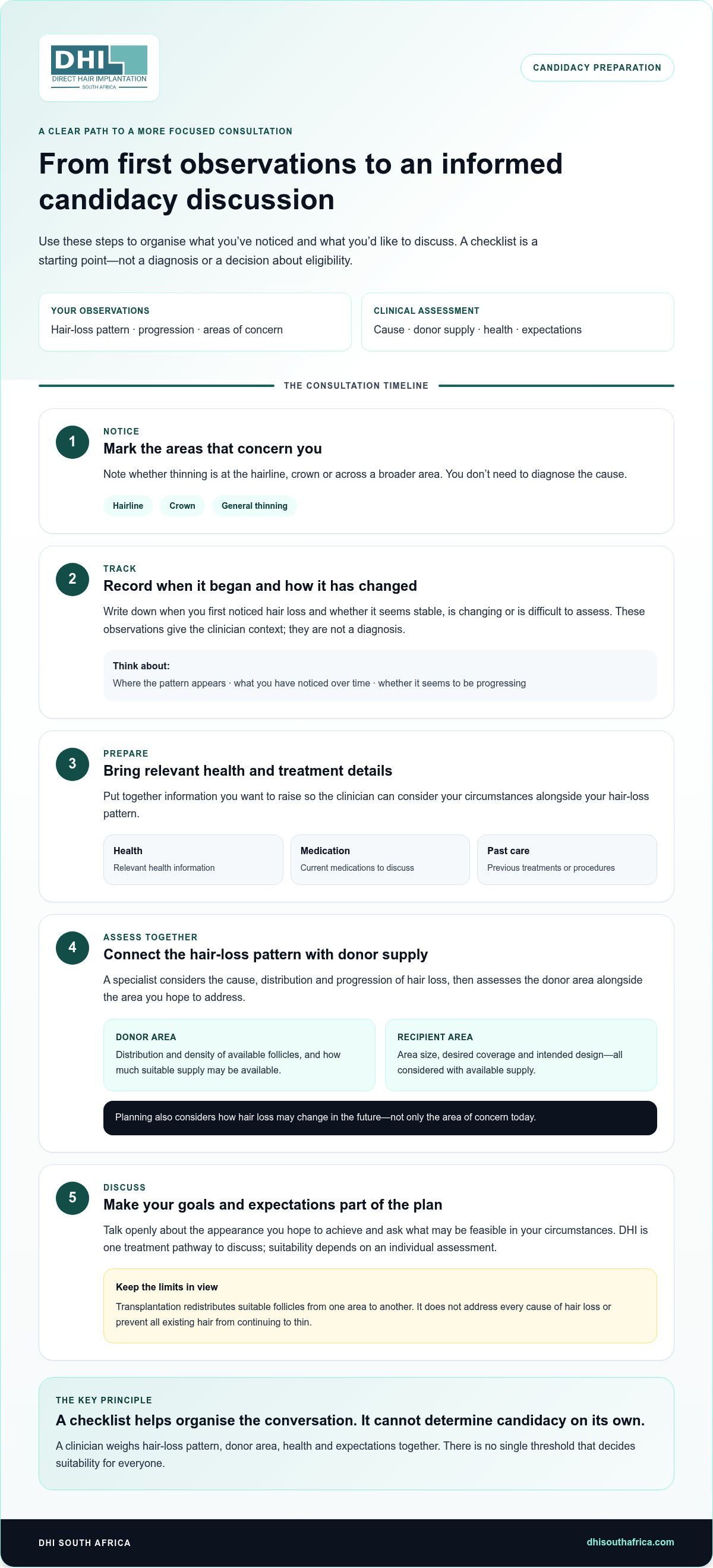
Before your consultation: a practical hair transplant readiness checklist
A little preparation can make your assessment more useful and help you explain what you’ve noticed without arriving with a diagnosis. Use this hair transplant candidacy checklist to gather information and questions. Your notes support the discussion; they don’t determine whether treatment is suitable.
Record when the hair loss began. Note roughly when you first noticed a change and which areas were affected first.
Describe how it has changed. Write down whether thinning seems stable, gradual or more noticeable over time. If you’re unsure, say so rather than trying to interpret the pattern.
Identify your areas of concern. Be specific about what you’d most like to discuss, such as your hairline, crown or overall thinning.
Gather relevant health and treatment details. Prepare a concise history of health conditions, medications, previous hair-restoration procedures and treatments you’ve tried, including how you responded.
Clarify your goals and questions. Note what changes matter most to you and what you want to understand about assessment, planning, follow-up and possible non-surgical options.
What information and photographs can help the assessment?
Clear, recent photographs can help you describe the areas you’re concerned about. Take them from consistent angles and in similar lighting where possible, so you can compare like with like. Bring earlier photographs if you have them, along with notes on changes over time and responses to previous treatments. Pictures are useful context, not a substitute for clinical evaluation.
You can also review the clinic’s hair loss assessment information to understand how a hair-loss discussion fits into the wider assessment. Use it to prepare questions rather than drawing conclusions about your suitability from photographs alone.
Questions to ask about a personalised treatment plan
Ask how the diagnosis, donor supply, hair characteristics and your goals inform the recommendation. You might also ask what follow-up involves and whether photographic records are used to document your care. These questions can help you understand the reasoning behind a proposed plan, including whether DHI is appropriate to discuss.
Hair transplant results and patient examples may offer context, but another person’s experience cannot predict your outcome. Individual factors shape every assessment.
Bring your notes, photographs and questions to a personalised assessment.
Your next step: get an individual DHI candidacy assessment
A hair transplant candidacy checklist can help you prepare, but it can’t weigh every factor in your case. Diagnosis, donor supply, health, expectations and readiness need to be considered together. A certified medical expert can review these details and explain whether Direct Hair Implantation (DHI) is an appropriate treatment pathway for you.
DHI uses the patient’s own follicles and a patented, single-step implantation approach. Whether it’s suitable depends on your individual assessment, not simply on how much hair you’ve lost or how closely your situation matches someone else’s. You can read more about the DHI hair transplant approach, then discuss how it relates to your findings.
How a personalised DHI assessment connects the checklist
During a professional consultation, the clinician considers your hair-loss presentation, donor area, health information and goals as a connected picture. Hair-loss diagnosis helps clarify what may be causing the change you’ve noticed; assessing the donor area and your goals helps inform what, if anything, could be planned. Bring your notes and questions so the discussion can address your circumstances directly.
A useful assessment should leave you with a clearer understanding of the reasoning behind a recommendation, including its aims and limitations. If DHI is recommended, the proposed plan should reflect your individual findings rather than promise a particular appearance or level of density.
What happens if transplantation is not the right next step?
An assessment doesn’t commit you to surgery. It can clarify whether further review, monitoring or a different treatment plan is more appropriate at this stage. DHI South Africa also offers non-surgical hair-restoration treatments, such as PRP and GFC, which a clinician may discuss where clinically appropriate.
Ask what follow-up may involve and how your hair-loss changes can be monitored over time. The aim is an informed next step, whether that means considering DHI, discussing another suitable treatment or taking time to review your options. You’re entitled to understand the recommendation before deciding how to proceed.
If you’re ready to discuss your checklist and personal findings, arrange an individual hair transplant consultation.
Take the next step with a personalised assessment
The hair transplant candidacy checklist can help you prepare, but it can’t determine your eligibility. A sound recommendation brings your diagnosis, donor supply, health, expectations and timing together. Your notes and questions give the clinician a clearer picture of what matters to you.
At a professional consultation, certified medical experts assess your hair loss and discuss whether treatment may suit your individual circumstances. If DHI is considered, the approach uses your own follicles and a patented implantation technique. Photographic records and post-procedure monitoring form part of the documented care pathway. These details support an individual plan, not a promise of a particular result.
You don’t need to have every answer before arranging an assessment. The conversation can help clarify your options and give you a considered basis for deciding what to do next.
A clearer understanding of your options is a meaningful place to begin.
Frequently Asked Questions
Is a hair transplant suitable for everyone?
No, a hair transplant isn’t suitable for everyone. Suitability depends on the cause and pattern of hair loss, donor-area characteristics, your health history and your expectations. A hair transplant candidacy checklist can help you prepare for a consultation, but it can’t diagnose hair loss or confirm eligibility. A certified medical expert needs to review your circumstances and explain whether transplantation, another treatment or further assessment is the most appropriate next step.
How do I know if I have enough donor hair for a transplant?
A clinician assesses the donor area by examining its characteristics and how many suitable follicles may be available for planning. They also consider the recipient area and possible future hair loss, rather than assessing donor supply in isolation. There’s no reliable self-test based on appearance alone. An individual assessment is needed to understand whether your available follicles can support a plan suited to your hair and goals.
Can I have a hair transplant if my hair loss is still progressing?
Ongoing or changing hair loss doesn’t automatically determine whether you’re a candidate, but it can affect timing and long-term planning. A clinician will review your hair-loss pattern and history alongside donor supply and your goals. Avoid making a decision based only on photographs or online rules. Before choosing treatment, discuss how a proposed plan takes possible future changes into account and whether further assessment is needed.
What medical information should I disclose before a hair transplant assessment?
Share relevant health conditions, medications, previous procedures and hair-loss treatments with the clinician. This information helps the medical team understand your circumstances and identify anything that needs closer review. Be open about previous treatment responses and scalp concerns, too. Don’t stop or change prescribed medication based on general online advice. The clinician assessing you can explain how your health information relates to possible treatment and whether any further steps are appropriate.
Are women candidates for hair transplantation?
Some women may be suitable for hair transplantation, but candidacy depends on the cause and distribution of hair loss, donor-area characteristics, health and personal goals. Different patterns of thinning can call for different assessments or treatment approaches. A specialist should establish the likely cause before recommending a procedure. A personalised consultation gives you the opportunity to discuss your individual pattern and whether transplantation is an appropriate option for you.
What happens if I am not currently a suitable hair transplant candidate?
An assessment that doesn’t recommend surgery now can still offer useful clarity. The clinician can explain what needs further review and discuss an appropriate treatment or monitoring pathway. DHI South Africa provides hair-loss diagnosis and offers other hair-restoration treatments that may be considered when clinically suitable. Your next step should be guided by an individual medical assessment, not a generic checklist, so you can understand the options relevant to your circumstances.
Does passing a hair transplant candidacy checklist guarantee a successful result?
No, a checklist is a preparation tool, not a diagnosis or guarantee. Even if your circumstances appear to match common candidacy considerations, a clinician must assess your individual case and discuss realistic expectations, limitations and follow-up. Hair characteristics, donor supply, health and the pattern of hair loss all inform planning. Use your consultation to ask about potential benefits and uncertainties, rather than treating a checklist as a prediction of your result.


Comments