%20(1).jpg)
%20(1).jpg)
Signs of a Successful Hair Transplant: A Clinical Guide to Your Recovery
- Dhesan Moodley

- 8 hours ago
- 12 min read
What if the sight of your newly transplanted hair falling out was actually the most reassuring signal that your restoration is working exactly as it should? It's perfectly normal to feel a wave of anxiety when you notice shedding a few weeks after your procedure. You've invested in your confidence, and seeing those hairs in the wash can feel like a setback. However, understanding the clinical signs of a successful hair transplant is the key to maintaining peace of mind whilst your scalp heals and the new follicles take root.
In this clinical guide, we'll walk you through the physiological and aesthetic markers that indicate your recovery is on the right path. You'll discover the specific month-by-month milestones of the growth cycle and learn why the DHI technique offers a survival advantage of over 90% for your transplanted hairs. From distinguishing between healthy redness and potential infection to identifying the first signs of permanent density, we'll provide the clarity you need to navigate your transformation with total certainty.
Table of Contents
Immediate Clinical Success Markers: The First 48 Hours
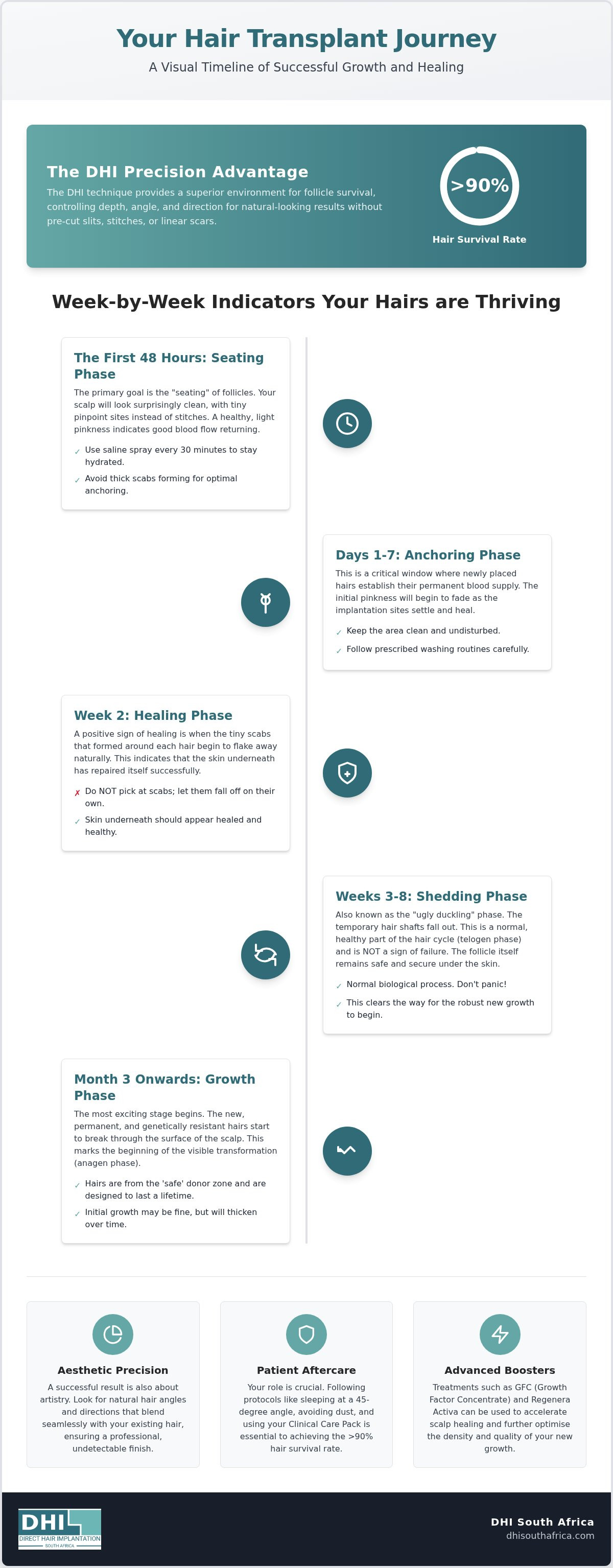
The first 48 hours after your procedure are often the most surreal. You've finally taken the step to restore your hair, and now you're likely peering into the mirror, looking for reassurance that the process has begun correctly. One of the most immediate signs of a successful hair transplant using the DHI method is how surprisingly clean the scalp looks. Unlike traditional hair transplantation techniques like FUT, there are no linear scars or rows of stitches to manage. Instead, you'll see tiny, pinpoint entry sites where your new hairs have been placed with microscopic precision.
During this foundational window, your primary focus is the "seating" of the follicles. These hairs are currently held in place by the natural clotting process of your scalp. To support this, you'll use a physiological saline spray provided by your specialist. Mist your scalp every 30 minutes whilst awake; this keeps the area hydrated and prevents the formation of thick scabs. This simple act ensures the newly placed hairs remain in an optimal environment for anchoring and long-term health.
The DHI Precision Advantage
The hallmark of DHI is the use of our patented implanter tool. This device allows your specialist to control the depth, angle, and direction of every hair without needing to create pre-cut slits in the skin. Our "no-touch" implantation phase is vital because it protects the delicate follicle from unnecessary trauma during placement. You might notice a light pinkness or minimal redness across the treated area. This is actually a positive indicator of healthy blood flow returning to the follicles, which is essential for their survival.
Managing the Immediate Recovery Environment
Success isn't just about what happened in the clinic; it's about how you protect those results in the hours that follow. We provide every patient with a bespoke Clinical Care Pack containing specific instructions for your first few days. It's best to avoid public transport or crowded spaces immediately after your session to prevent any accidental bumps or exposure to dust. You may feel a sense of tightness across the scalp as the local anaesthetic wears off. This is perfectly normal and shouldn't be confused with genuine sharp pain; it's simply your skin beginning the natural healing response. By resting in a controlled, clean environment, you're giving your new hairs the best possible start.
The Growth Timeline: Week-by-Week Indicators Your Hairs are Thriving
Patience is perhaps the most vital component of your recovery journey. Whilst you may want to see a full head of hair immediately, the biological reality of hair restoration involves distinct phases of healing and rest. During the first seven days, your primary focus is anchoring. This is a critical window where the newly placed hairs establish their blood supply. You'll know things are progressing well if the initial pinkness begins to fade and the implantation sites remain clean and undisturbed. Recognising these early signs of a successful hair transplant helps alleviate the natural anxiety that follows any medical procedure.
By the second week, you'll notice the tiny scabs that formed around each hair beginning to flake away. This is a positive indicator that the skin underneath is healing. It's essential to let these fall off naturally during your prescribed washing routine rather than picking at them. From month three onwards, the journey becomes truly exciting. This is when the permanent, genetically resistant hairs begin to break through the surface. These hairs are harvested from the "safe" donor zone at the back of the head, meaning they are designed to last a lifetime.
Understanding the Shedding Phase (Shock Loss)
Between week three and week eight, many patients experience what is colloquially known as the "ugly duckling" phase. You might notice the newly implanted hair shafts falling out. Don't panic. This is a perfectly normal biological process called the telogen (resting) phase. According to a Clinical guide to hair transplantation, the follicle remains safely tucked beneath the skin whilst only the temporary hair shaft is shed. With DHI precision, the risk of actually losing the follicle is exceptionally low. Your scalp is simply clearing the way for the robust anagen (growth) phase to begin. If you're concerned about your specific progress, you can always reach out to our clinical team for reassurance.
The 18-Month Monitoring Protocol
Our relationship with you doesn't end when the procedure is over. Because hair grows in cycles, we track your progress at 1, 3, 6, 12, and 18-month intervals to ensure you are meeting every clinical milestone. We use digital trichoscopy, a high-magnification imaging tool, to scientifically measure density and hair survival rates. This data-driven approach allows us to confirm that your restoration is on track for the natural, dense result you expect. We provide a detailed DHI Hair Transplant Recovery Timeline: Your Month-by-Month Guide to Results to help you navigate each stage with confidence. This rigorous monitoring is one of the key signs of a successful hair transplant journey, providing you with clinical proof of your transformation.
Aesthetic Precision: Evaluating the Artistry and Density of Your Results
True success in hair restoration is measured by more than just the presence of new growth; it is defined by how that growth integrates with your existing features. Whilst the early stages of recovery focus on healing, the long-term signs of a successful hair transplant are found in the subtle details of artistry and precision. A result that looks "surgical" or unnatural fails the test of clinical excellence. Instead, your new hairline should appear as if it has always been there, mimicking the unique flow and character of your natural hair.
The secret to this longevity lies in the donor area. We exclusively harvest follicles from the "permanent zone" at the back and sides of the scalp. These hairs are genetically resistant to the hormone Dihydrotestosterone (DHT), which is responsible for male pattern baldness. By relocating these resilient follicles, we ensure that your results aren't just a temporary fix but a permanent restoration that will last a lifetime. Whilst you monitor your progress according to the hair transplant recovery timeline, your focus should eventually shift from "is it growing?" to "how naturally does it sit?"
The Artistry of Hairline Design
Our specialists use the patented DHI implanter to achieve a level of detail that traditional methods simply cannot match. This tool allows for total control over the angle, depth, and direction of every single hair. We don't just place hairs in a straight line; we mimic your natural growth patterns, ensuring the transition from the forehead to the scalp is soft and irregular. This approach avoids the "dolls hair" look common in older techniques. You can explore how this precision translates into real-world confidence by viewing our Natural Hair Transplant Results: Artistry in Medicine gallery.
Measuring Success Through Density
Density is a critical marker of success, but it must be balanced with follicle health. The DHI method allows us to place hairs much closer together than traditional FUE because we don't need to create large incisions first. For example, the placement of 4,000 hairs via DHI results in a much higher visual density because the survival rate of those hairs is significantly higher. The survival of hairs is more critical than the total number moved; high-volume transplants are meaningless if only half the hairs survive the journey. A successful result looks seamless even under close clinical inspection, providing a thick, robust appearance that stands up to any styling choice.
Aftercare Protocols: The Patient’s Role in Achieving a 90% Survival Rate
While DHI provides the technical foundation for your restoration, your commitment to aftercare is what secures the final result. We've mastered the clinical side of the procedure, but the next few weeks depend on how you protect your investment. Diligent adherence to these protocols is one of the most reliable signs of a successful hair transplant in the making. It transforms a medical procedure into a lifelong aesthetic success.
Gravity is your ally during the first five nights. We recommend using a neck pillow to keep your head at a 45-degree angle whilst sleeping. This position is essential to minimise post-operative swelling and ensures you don't accidentally rub the delicate implantation sites against your bedding. It’s a small adjustment that provides a massive safety net for your new hairs during their most vulnerable stage.
Maintaining hygiene requires a gentle touch. The "pat-dry" technique is non-negotiable for the first seven days. You shouldn't rub the scalp; instead, press a clean towel against the skin to absorb moisture. Our South African sun is particularly harsh, so you must shield your scalp from direct UV rays for at least six months. This protects the healing tissue and prevents pigmentation issues in both the donor and recipient areas.
Your 14-Day Recovery Template
Following a structured timeline helps remove the guesswork from your recovery. This progression ensures that you reintroduce activities only when the follicles are sufficiently anchored.
Day 1-3: Prioritise absolute rest. Use your saline spray every 30 minutes whilst awake to maintain follicle hydration and prevent heavy scabbing.
Day 4-7: Begin gentle washing with our clinic-approved products. You should avoid any strenuous movement or bending over that could increase blood pressure in the scalp.
Day 14+: You can gradually reintroduce light cardio. However, contact sports like rugby or football should be avoided for at least a month to prevent physical trauma to the newly anchored hairs.
Lifestyle Adjustments for Optimal Success
Your internal environment matters just as much as your external one. Smoking and alcohol can restrict blood flow to the newly placed hairs, potentially compromising the survival rate. Focus on a nutrient-rich diet high in vitamins and proteins to provide the building blocks your follicles need during the early healing stages. Seeing your scalp health improve through better lifestyle choices is one of the encouraging signs of a successful hair transplant process. To understand how we maintain these world-class standards, you can view our Hair Restoration Safety Protocols: A Patient's Guide to Clinical Excellence.
Advanced Boosters: How GFC and Regenera Activa Optimise Success
Achieving a world-class result involves more than just the technical placement of hairs. It requires creating a biological environment where those follicles can thrive from the very first hour. Whilst the surgery itself provides the structure, regenerative boosters act as a catalyst for healing and density. One of the most encouraging signs of a successful hair transplant is a scalp that recovers quickly with minimal prolonged inflammation. By integrating advanced therapies into your recovery plan, we ensure that your new hairs have the best possible foundation for growth.
We prioritise autologous treatments, which means we use your own biological material to stimulate healing. This approach is the gold standard in modern hair restoration because it eliminates the risk of allergic reactions and works in harmony with your body's natural repair mechanisms. Combining these clinical procedures with our specialised DHI hair care products provides a comprehensive system for long-term maintenance. This synergy between surgical precision and regenerative science is what allows us to consistently achieve hair survival rates exceeding 90%.
Regenerative Medicine as a Success Multiplier
Growth Factor Concentrate (GFC) therapy is a cornerstone of our advanced aftercare protocol. We begin by collecting 15-18ml of your blood, which is then processed to isolate high concentrations of growth factors. When these are reintroduced to the scalp, they revitalise the follicles and accelerate the anchoring process. Similarly, Regenera Activa uses progenitor cell therapy to reduce post-operative inflammation and boost overall density. These treatments are essential for patients who want to see results faster and ensure the highest possible survival rate for every hair moved. You can Explore our advanced GFC and PRP treatments to see how these boosters fit into your journey.
Final Reassurance: The DHI Total Care System
Your safety and your results are protected by our rigorous 6-volume Standard Operating Procedures (SOPs). These ISO-accredited protocols ensure that every step of your journey, from the initial analysis to the final 18-month check-up, meets global medical standards. We don't just perform a procedure and part ways; your DHI specialist remains your partner for years to come, monitoring your progress with scientific tools like digital trichoscopy. Recognising the signs of a successful hair transplant becomes much easier when you have a dedicated clinical team validating every milestone. Ultimately, a successful restoration does far more than just change your appearance. It restores the quiet confidence that comes from knowing you've placed your care in the safest possible hands.
Secure Your Aesthetic Future
Your journey to a full head of hair is a clinical partnership that relies on both the precision of our Certified DHI Specialists and your dedication to the recovery process. Recognising the signs of a successful hair transplant requires looking beyond the temporary shedding phase to see the foundation of permanent, natural growth beneath. By combining the world's most advanced implantation technique with regenerative boosters like GFC, you ensure that your restoration meets the highest global standards.
As a Global Leader in Hair Restoration, we are committed to delivering results where hair survival rates exceed 90%. This level of excellence is why we monitor your progress for up to 18 months, providing the clinical oversight you need to move forward with absolute certainty. Restoring your hair is about more than just aesthetics; it's about reclaiming the self-assurance that comes with looking and feeling your best.
We look forward to guiding you through every milestone of your transformation, ensuring your new hair remains a robust, natural, and permanent part of your life for years to come.
Frequently Asked Questions
How long do I need to take off work after a DHI hair transplant?
Most patients return to desk-based work within two to three days. Since DHI doesn't involve scalpels or stitches, the physical recovery is exceptionally swift and manageable. If your role involves heavy lifting or high-intensity activity, we suggest waiting a full week. Many of our South African clients schedule their procedure on a Thursday or Friday to be back in the office by Monday with total confidence.
Is it normal to experience swelling on my forehead after the procedure?
Mild swelling on the forehead or around the eyes is a common physiological response that usually peaks between days two and four. It's simply the local anaesthetic and fluids from the procedure moving down due to gravity. You can manage this effectively by sleeping at a 45-degree angle and using a cold compress on your forehead, ensuring you don't touch the newly implanted hairs.
When can I wear a hat or a helmet after my hair transplant?
You can wear a loose-fitting, clean hat three days after your procedure to protect the area from the sun. However, anything that puts pressure on the scalp, such as a motorcycle or cycling helmet, must be avoided for at least four weeks. This window ensures the follicles are fully anchored and won't be displaced by the friction or weight of heavy headwear.
Will people be able to tell I have had a hair transplant after two weeks?
By the end of the second week, most of the visible signs of a successful hair transplant are subtle enough that others won't notice. The initial pinkness typically fades by day ten, and the tiny scabs will have naturally shed during your washing routine. Your hair will simply look like a short buzz cut, allowing you to resume social activities without feeling self-conscious about your appearance.
Does the shedding phase mean the hair transplant has failed?
Shedding is actually a sign that your follicles are transitioning into the next stage of the growth cycle. It doesn't mean the transplant has failed; rather, the hair shafts are making way for new, permanent growth. This "shock loss" is a temporary hurdle that precedes the robust anagen phase, where your genetically resistant hairs begin to emerge from the scalp permanently.
When can I start using Minoxidil or Finasteride again after surgery?
You can typically resume oral medications like Finasteride the day after your procedure. However, topical treatments like Minoxidil should be paused for at least fourteen days to avoid irritating the healing implantation sites. Always confirm your specific timeline with your DHI specialist during your first week's check-up to ensure your scalp environment remains perfectly balanced for the new hairs.
How soon can I cut or dye my hair after a DHI procedure?
You can have a gentle scissor cut four weeks after your procedure, but you should avoid using electric clippers on the recipient area for six months. If you wish to dye your hair, we recommend waiting at least six weeks. The chemicals in hair dye can be harsh on a healing scalp, so it's vital to wait until the skin has fully recovered its natural barrier.
What are the signs of an infection versus normal redness?
Normal redness is a light pink hue that fades within a week, whereas an infection usually presents with increasing pain, localised heat, or yellow discharge. Whilst rare with our sterile DHI protocols, monitoring your scalp is one of the important signs of a successful hair transplant recovery. If you experience a fever or the redness begins to spread after the first few days, contact our clinic immediately for a professional assessment.


Comments