%20(1).jpg)
%20(1).jpg)
Facial Hair Restoration: The Clinical Guide to a Fuller Beard and Moustache
- Dhesan Moodley

- 11 hours ago
- 13 min read
You've likely spent months, perhaps years, standing in front of the mirror, attempting to 'fill in' the gaps of a patchy beard with oils and balms that promised the world but delivered very little. The truth is that whilst topical treatments often fail to stimulate new growth, medical-grade facial hair restoration offers a permanent, scientifically backed path to the dense, masculine profile you've been looking for. It's frustrating to feel that your facial hair doesn't quite reflect the man you are, especially when the fear of surgical scarring on your face keeps you from seeking a clinical solution.
We understand that anxiety, which is why we've designed this guide to show you that a fuller beard doesn't have to come at the cost of visible marks or a long recovery. You'll discover how the patented Direct Hair Implantation (DHI) technique allows for the precise placement of individual hairs with no stitches and no scars, achieving a survival rate that exceeds 90%. We will walk you through the medical science of facial hair design and how we customise every procedure to improve your facial symmetry and confidence naturally.
Table of Contents
What is Facial Hair Restoration? More Than Just a Grooming Trend
Whilst the term 'facial' often brings to mind a relaxing afternoon of skincare and steam at a spa, such as the high-performance skin therapy offered by Beauty on Latrobe, facial hair restoration is a entirely different discipline. It's a permanent medical procedure designed to relocate healthy, active hairs from a donor area to your beard, moustache, or sideburns. We aren't just talking about a temporary fix or a grooming style; we are talking about a clinical solution that changes the underlying architecture of your face. For many men, the inability to grow a full beard isn't just a minor annoyance. It can feel like a missing piece of your identity, leading to genuine frustration when you see patches or 'holes' in your profile that simply won't fill in regardless of which oils or vitamins you try.
The process is autologous, which means we use your own biological material to achieve the result. By carefully moving your own hairs, we ensure that the colour, texture, and growth rate match your existing facial hair perfectly. This medical approach moves beyond the surface to rebuild self-assurance. When you look in the mirror and see a dense, even beard, it changes how you carry yourself. It's about restoring not just the hair, but the masculine symmetry of your face through a sophisticated hair transplant methodology specifically adapted for the delicate skin of the jaw and cheeks.
The Difference Between Scalp and Facial Restoration
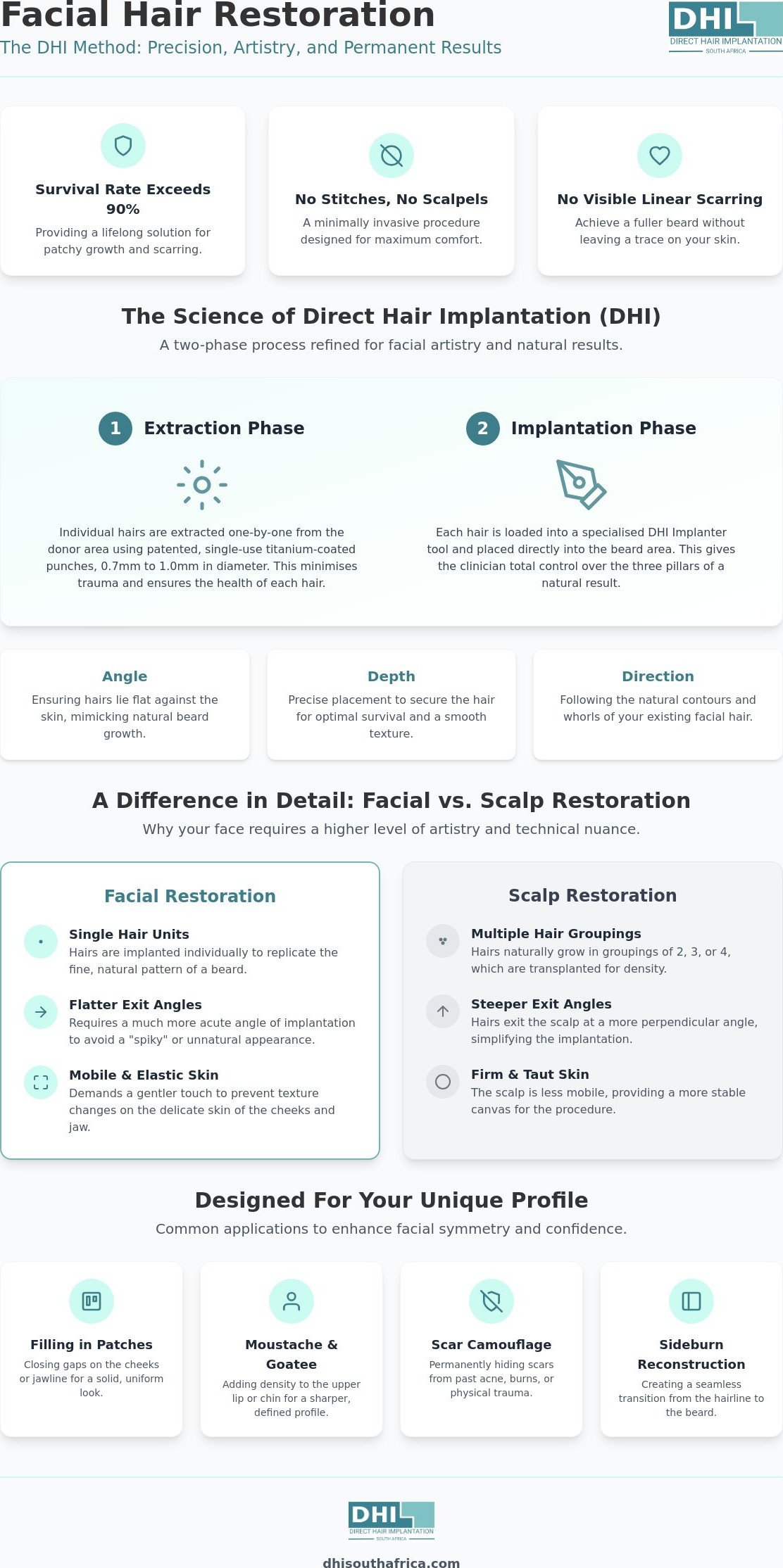
You might wonder if a beard transplant is the same as a procedure for the top of the head. In truth, the face requires a much higher level of artistry and technical nuance. On the scalp, hairs often grow in groupings of two, three, or even four. However, facial hairs typically grow as single units. To create a look that is indistinguishable from nature, we must implant single hairs with extreme precision. The skin on your face is also far more mobile and elastic than the scalp, which means it requires a gentler, more specialised touch to avoid any visible texture changes.
Most importantly, the exit angles of beard hair are much flatter than those on the head. If a clinician doesn't account for this, the hair will look 'spiky' or unnatural. This is where the foundation of Follicular Unit Extraction (FUE) is refined into something more precise. We use specialised tools to ensure the hair lies flat against the skin, following the natural contour of your jawline. This level of detail is what makes modern facial hair restoration so successful for our patients.
Common Areas for Restoration
Every man's face is unique, and our clinical approach reflects that individuality. Some patients require a full beard reconstruction because genetics have left them with almost no natural growth, whilst others simply want to refine what they already have. Common applications include:
Filling in Patches: Closing the gaps on the cheeks or jawline to create a solid, uniform look.
Moustache and Goatee Refinement: Adding density to the upper lip or chin area for a sharper, more defined profile.
Scar Camouflage: Using facial hair restoration to permanently hide scars from past acne, burns, or physical trauma.
Sideburn Reconstruction: Creating a seamless transition from the hairline to the beard.
Whether you're looking for a rugged, full-coverage beard or a precisely sculpted moustache, the goal is always a result that looks like you were born with it.
The Science of Direct Hair Implantation (DHI) for Beards
The success of facial hair restoration depends entirely on the precision of the medical tools and the expertise of the clinician. We begin the process by using patented, single-use titanium-coated punches. These specialised tools, ranging from 0.7mm to 1.0mm in diameter, allow us to extract individual hairs with minimal trauma to the surrounding tissue. Because we don't use scalpels or traditional incisions, there are no stitches required and no visible linear scarring. This meticulous approach ensures the donor area remains healthy whilst providing the high-quality hairs needed for a dense beard reconstruction.
Once extracted, we focus on the three pillars of a natural result: angle, depth, and direction. Unlike standard hair transplant methods, the DHI technique gives our specialists total control over how each hair is positioned. This level of detail is why the procedure is considered a safe and effective medical practice for men seeking permanent results. By managing the placement so precisely, we ensure that the new growth integrates seamlessly with your existing facial hair, creating a profile that looks entirely authentic from every viewpoint.
Why Single Hair Placement is Critical
The most common mistake in lower-quality restoration is a 'pluggy' or artificial appearance. This happens when multiple hairs are placed into a single opening, which rarely occurs in a natural beard. In facial hair restoration, we exclusively use single hair units to mimic the fine, individual growth patterns of the jaw and cheeks. Our specialists carefully select hairs in the anagen phase, which is the active growth stage of the hair cycle. By choosing follicles in this peak condition, we significantly improve the long-term survival and vitality of the transplanted hair.
The Role of the DHI Implanter
The DHI Implanter is the cornerstone of our methodology. This tool allows the clinician to place the hair follicle directly into the skin without the need for pre-made holes or 'slits'. This protects the delicate follicle from unnecessary handling and ensures it remains viable during the transition. For a beard to look natural, the hairs must be placed at a very shallow 10 to 20-degree angle. The implanter allows for this extreme precision, ensuring the hair grows flat against the skin rather than pointing outwards. You can learn about the science of Direct Hair Implantation and how this technology sets a new standard for facial aesthetics.
Understanding the technical side of the procedure often helps alleviate the concerns many men have about the 'surgical' nature of the process. If you're curious about the kind of transformation this precision can achieve, we invite you to view our facial restoration results to see the DHI difference for yourself.
Patchy Beards vs. Full Restoration: Managing Expectations
Many men spend their twenties and thirties waiting for a beard to 'fill in', only to realise that their genetic blueprint has other plans. Natural beard density is primarily dictated by your inherited follicle count and how your body responds to specific hormones. If those follicles don't exist in certain areas of your cheeks or jawline, no topical oil or supplement can conjure them out of thin air. This is where facial hair restoration changes the narrative, allowing us to bridge the gap between your DNA and the profile you want to see in the mirror.
Beyond genetics, we often see patients who use restoration to reclaim their confidence after physical trauma. Areas of the face affected by acne scarring, burns, or surgical marks often stop producing hair entirely because the follicles have been damaged. By carefully placing healthy hairs into this scar tissue, we can effectively camouflage these areas and restore a uniform, rugged appearance. It is a process of reclamation that goes far beyond simple grooming.
The success of this journey begins with a professional consultation. During this session, we don't just look at the patches; we calculate the exact number of hairs required to match the density of your existing growth. We typically source these from the back of your head, known as the 'donor area'. These specific follicles are genetically resistant to hair loss, meaning that once they are transplanted to your face, they retain that lifelong resilience. It's a permanent relocation of your body's most durable biological assets.
Designing the Perfect Beard Line
Creating a beard isn't just a medical task; it's an exercise in facial artistry. We work with you to design a symmetrical, masculine jawline that complements your unique bone structure. Our specialists ensure the density of the transplanted hairs matches your natural growth patterns perfectly, avoiding an artificial or 'too perfect' look. For a deeper look at how we plan these procedures, you can read our Beard Restoration Surgery: The Definitive Buying Guide.
Realistic Growth Timelines
Patience is a vital part of the clinical process. Shortly after your procedure, you'll likely experience 'shock loss', which is the temporary shedding of the transplanted hairs. This is a completely normal part of the follicle's transition. By the three-month mark, fine new hairs begin to emerge, and by six months, you'll see a significant increase in density and coverage. A typical timeline for full, mature results is usually 12 to 18 months post-procedure.
The Recovery Journey: Life After a Facial Transplant
After your facial hair restoration procedure, the most common question is how soon you can step back into your daily routine. Because the DHI technique is minimally invasive, the recovery period is remarkably swift compared to older, more aggressive methods. During the first 48 hours, you might notice very slight swelling and tiny, pinpoint crusts around the newly placed hairs. These are a natural part of the healing response and usually flake away within a week, leaving no visible trace of the medical intervention.
We often refer to the 'lunch-hour' nature of this treatment because it doesn't require general anaesthesia or hospital stays. Most of our patients find they can return to their professional responsibilities within a few days. To ensure your safety, DHI South Africa follows rigorous clinical protocols for facial hair restoration, with every procedure performed by certified medical experts using single-use, titanium-coated tools to maintain the highest sterile standards. This precision ensures that the trauma to the skin is kept to an absolute minimum.
Immediate Post-Procedure Care
Protecting the integrity of the newly placed hairs is your priority during the first week. We will provide you with specific instructions on how to gently wash your face to keep the area clean without dislodging the follicles. It's also vital to avoid direct sunlight and strenuous exercise for at least 7 to 10 days, as excessive sweating or UV exposure can irritate the healing skin. These small adjustments to your routine protect your investment and ensure the follicles settle perfectly into their new environment.
Long-Term Maintenance
Once the initial healing phase is complete, your transplanted facial hairs will begin to behave exactly like natural beard hair. They don't require any 'miracle' products or special grooming routines beyond what you'd normally use for a healthy beard. Since these hairs are sourced from the donor area at the back of the head, they are genetically programmed to grow for a lifetime. They retain their resistance to loss, even after relocation.
You can shave, trim, and style your new beard just as you would any other facial hair once the follicles are fully established. If you're looking for ways to enhance the visual density of your profile without further surgery, you might also explore non-surgical density options like Scalp Micropigmentation. This combination of medical science and long-term care ensures that your results remain as sharp and dense as the day they first grew in.
Why DHI South Africa is the Leader in Facial Hair Restoration
Choosing a provider for facial hair restoration is a significant decision that involves both your clinical safety and your long-term appearance. DHI South Africa isn't just another clinic; we are part of the DHI Global Medical Group, which carries a legacy of over 50 years in the field of hair restoration. This heritage means we've refined our techniques across decades of research and thousands of successful procedures. You aren't just getting a treatment; you're benefiting from a global standard of excellence that has pioneered many of the advancements used in the industry today.
Our commitment to safety and results is underpinned by our Total Care System and ISO-accredited safety standards. Whilst many clinics rely on technicians to perform the delicate work of implantation, we insist that every procedure is performed entirely by certified medical doctors. This clinical oversight is why we can confidently report a hair survival rate exceeding 90%. We prioritise the longevity of your results and the health of your skin above all else. The results speak for themselves.
The DHI Specialist Advantage
Every doctor at our clinic has undergone rigorous training at the DHI Academy to ensure that our world-class results are consistent across every patient. We focus on a compassionate, patient-centric experience where your comfort and goals are the primary concern. We understand that the decision to undergo facial hair restoration is personal, and we treat it with the gravity it deserves. You can view our facial restoration results to see the level of artistry our specialists bring to every jawline and moustache we design.
South Africa's Premier Choice
DHI South Africa provides a national presence that brings the same high standards found in medical hubs like London or Paris directly to your doorstep. We reject the 'miracle' claims often found in the grooming industry, opting instead for transparent, data-driven medical science. Our goal is to provide you with a permanent solution that looks natural and lasts a lifetime. Whether you are looking to fill a small patch or reconstruct a full beard, we offer the expertise and technology to achieve your vision.
If you're ready to move beyond temporary oils and take a clinical step toward a thicker profile, we invite you to take the first step. Book a diagnostic consultation with our team to receive a professional analysis of your facial hair and a personalised restoration plan.
Take the First Step Toward Your Permanent Profile
Your journey to a fuller, more defined beard is more than a matter of aesthetics; it's about restoring the confidence that comes with a permanent, masculine profile. By choosing facial hair restoration through the DHI technique, you're opting for a procedure backed by over 55 years of global medical expertise. You can move forward with the peace of mind that every placement is performed by a certified DHI doctor, ensuring that the final result is both medically safe and artistically precise.
With hair survival rates exceeding 90%, the density we create today is designed to last a lifetime. You've seen that modern medical science can bypass the limitations of genetics and scarring without the need for stitches or visible marks. It's time to stop settling for patchy growth and start investing in a permanent solution that reflects the man you are. To complete this transformation, you might also consider professional oral care from GLI GLI to ensure your smile is as bright and confident as your new beard.
For those seeking comprehensive aesthetic dentistry or considering dental tourism to further refine their appearance, you can visit Implantološki centar Smile for expert care and specialised treatments.
Additionally, for those interested in refining their skin's appearance or dealing with pigmentation issues, it is worth your time to check out Dr. Sankeerth Reddy's Clinic for comprehensive skin health guides.
Furthermore, for patients looking beyond facial aesthetics to other specialised procedures such as augmentation mammaire Montréal, Dr. Arie Benchetrit’s practice provides comprehensive plastic surgery options for a complete aesthetic renewal.
For those also prioritising their general dental health and wanting to understand common post-operative experiences, you can find out more from All Stars Dental regarding recovery timelines.
We look forward to helping you design a beard that enhances your features and restores your self-assurance. Your new profile is closer than you think.
Frequently Asked Questions
Is facial hair restoration permanent?
Yes, the results of facial hair restoration are permanent. We use follicles harvested from the back of your head, which are genetically programmed to resist loss for a lifetime. Once these hairs are successfully transplanted and settle into their new position on your jaw or cheeks, they retain that resilience and grow naturally forever.
How many hairs are typically needed for a full beard?
The exact number of hairs depends on your current density and the look you wish to achieve. A standard moustache transplant might require between 300 and 800 hairs, whilst a more comprehensive beard reconstruction can involve several thousand hairs. We calculate the precise count during your consultation to ensure the new growth integrates seamlessly with your existing features.
Does a beard transplant leave visible scars on the face?
No, the DHI technique does not leave any visible scarring on your face. Because our doctors use specialised, high-precision tools rather than scalpels or stitches, the tiny entry points heal into nothing more than natural-looking skin pores. This allows you to wear your beard at any length without worrying about surgical marks being exposed.
Can I choose the shape and style of my new beard?
You have full creative control over the design and symmetry of your new profile. Our medical specialists work with you to map out a masculine jawline and beard shape that complements your natural bone structure. We combine your aesthetic goals with our clinical expertise to ensure the final result looks authentic and enhances your facial symmetry.
Is the procedure painful?
The procedure is very comfortable because we perform it under local anaesthetic. You won't feel any pain whilst our doctors are working, and many of our patients find the experience relaxing enough to watch a film or nap. Any minor sensitivity after the anaesthetic wears off is usually manageable with standard over-the-counter care and subsides within a day or two.
How long do I have to wait before I can shave my new beard?
You should wait at least 14 days before you use a razor on the transplanted area. It's vital to give the follicles enough time to firmly anchor themselves into their new environment without being disturbed. After this two-week healing window, you can resume your normal grooming routine, including shaving and trimming, without any restrictions.
Can hairs be taken from other parts of the body if I am bald?
If the donor area on your scalp is insufficient, we can sometimes source hairs from other body areas, such as the chest or back. However, the hair on the back of the head is almost always the first choice because its texture and growth rate are the best match for facial hair. We will evaluate all your donor options during your initial diagnostic consultation.
What is the cost of facial hair restoration in South Africa?
The investment for facial hair restoration is calculated based on the total number of hairs required to achieve your desired density. Since every patient's needs are different, ranging from filling small patches to full reconstructions, we provide a customised quote after a thorough clinical assessment. This ensures you only pay for the specific treatment required to reach your goals.


Comments