

Hair Loss Myths and Facts: What’s True About Hair Loss

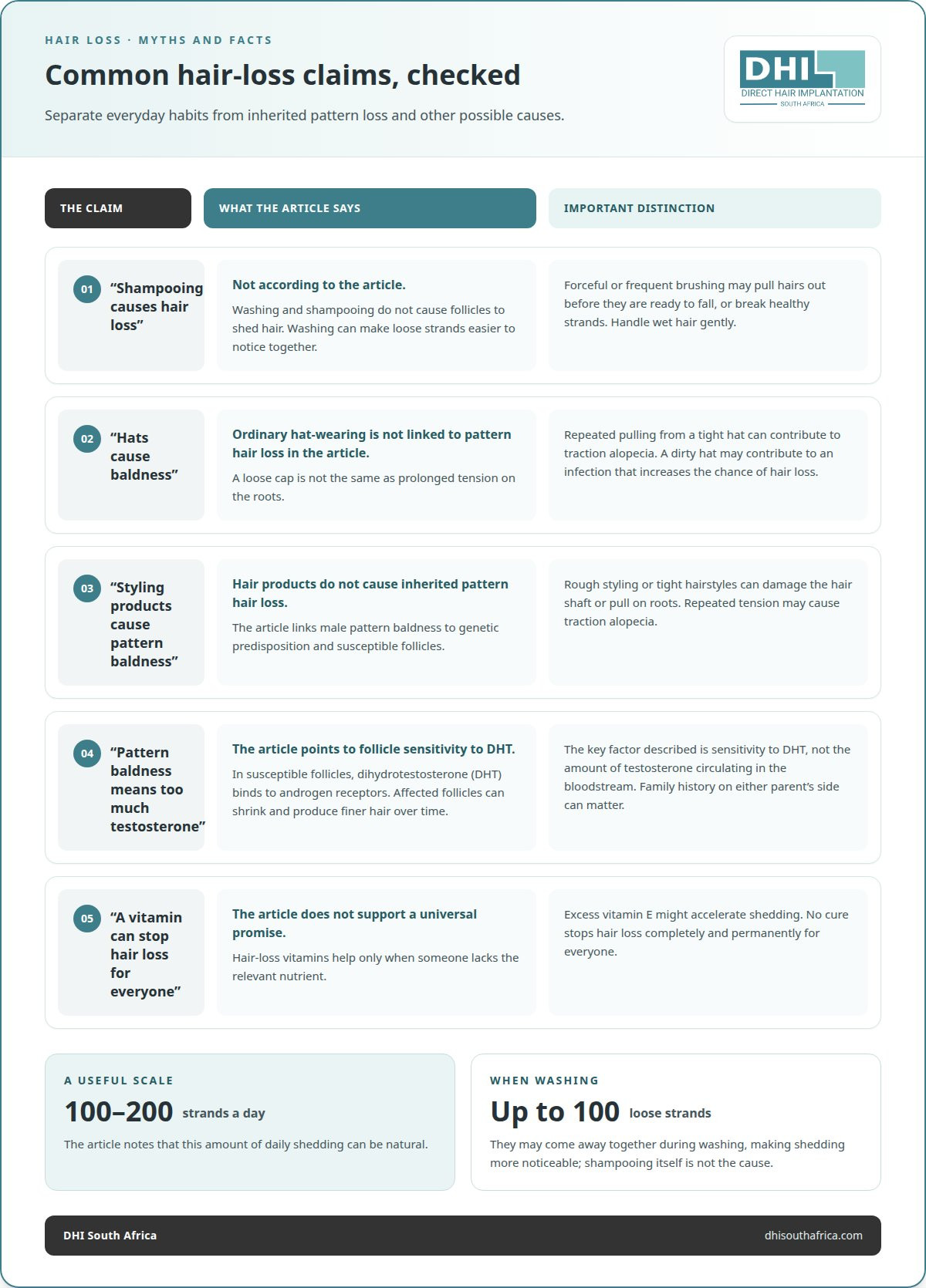
Hair loss can run in your family from either your mother’s or father’s side, but genetics isn’t the only factor. The hair loss myths and facts are clearer once you know that stress, some health conditions and nutritional deficiencies can also contribute, while shampooing doesn’t cause hair loss. Hair shedding can be unsettling, especially when familiar explanations don’t seem to fit.
It’s understandable to wonder whether everyday habits, stress or family history are behind a change in your hair. The cause varies, and separating myths from evidence is a useful first step towards understanding what may be happening.
Here, you’ll learn which common claims are true, what can cause hair loss, and how stress, sex and genetics may influence it. We’ll also explain why hair-loss patterns can differ between men and women, and why family history on either side can matter.
Table of Contents
What is the main cause of hair loss?
Hair loss doesn’t have one universal cause. Inherited pattern loss can involve follicles’ sensitivity to dihydrotestosterone, while stress, restrictive diets, nutritional deficiencies, some medicines and health conditions can also contribute. The likely cause depends on the pattern, timing and changes in your health or routine.
Some shedding is normal: people can naturally lose about 100 to 200 strands of hair per day. During washing, up to 100 strands may come away as loose hairs become visible together. Shampooing doesn’t cause hair loss, and cleansing helps keep the scalp and hair healthy.
Does shampooing, brushing or washing too often cause hair loss? Washing and shampooing don’t cause follicles to shed hair, but frequent or forceful brushing can pull out hairs before they’re ready to fall or break healthy strands. Wash as needed, handle wet hair gently and brush for styling rather than repeatedly pulling through it.
Stress can disrupt the hair growth cycle and contribute to telogen effluvium, a form of temporary shedding. Once a stressful event or threat has passed, follicles that paused their cycle can resume it. Increased shedding may appear after a difficult period, rather than on the day the stress began.
Other possible causes include rapid weight loss, restrictive eating, nutritional deficiencies and certain medicines. Chemotherapy and radiation can also cause hair loss. A change in diet or a new medicine is useful context to share with a healthcare professional when discussing recent shedding.
In South Africa, seek medical assessment if hair loss is rapid, widespread or patchy, or comes with hair breakage. According to MedlinePlus, these are reasons to contact a healthcare provider. Note when the change began and where it appears, then share those details and any recent health or medication changes with a doctor or dermatologist.
Common hair loss myths: true or false?
Myth: wearing hats causes baldness. There’s no evidence that ordinary hat-wearing damages follicles or causes pattern hair loss. A loose cap for work or sun protection isn’t the same as prolonged tension on the roots. A tight hat that repeatedly pulls on hair can contribute to traction alopecia, a form of loss caused by tension. Understanding hair loss myths and facts helps distinguish normal headwear from repeated pulling.
Cleanliness matters for a different reason. A dirty hat may contribute to an infection that increases the chance of hair loss, so washing and rotating hats is sensible. This doesn’t mean hats cause male pattern baldness. Scalp irritation or infection is a separate concern from inherited follicle sensitivity.
Myth: styling products cause male pattern baldness. Hair products don’t cause this inherited pattern, although rough styling or tight hairstyles can damage the hair shaft or pull on roots. Repeated tension from a tightly secured style, for example, may cause traction alopecia. Gentle handling reduces avoidable physical stress on hair.
Male pattern baldness is linked to genetic predisposition, and inheritance can come from either parent’s side. In people with susceptible follicles, dihydrotestosterone (DHT) binds to androgen receptors in the follicles. Over time, affected follicles shrink and produce finer hair, then may stop producing hair. The resulting pattern varies between individuals.
Myth: male pattern baldness simply means someone has too much testosterone. The key factor is follicle sensitivity to DHT, not the amount of testosterone circulating in the bloodstream. Reduced scalp circulation is described as a result of pattern baldness, not its cause. A small 2009 study of college rugby players found slightly elevated DHT among players taking creatine, but it didn’t measure hair loss.
In South Africa, options used for hair loss include minoxidil, finasteride, dutasteride and hair transplants. Clinic-based treatments such as PRP and GFC are also available. Finasteride can help prevent further loss, while topical minoxidil is applied twice daily. Results vary, and ongoing use is often needed.
Be cautious of claims that a vitamin or product can permanently stop hair loss for everyone. Hair-loss vitamins help only when someone lacks the relevant nutrient, and excess vitamin E might accelerate shedding. No cure stops hair loss completely and permanently for everyone. Understanding the evidence can help you question sweeping promises and distinguish them from explanations based on causes such as inherited follicle sensitivity.
Stress-related temporary hair loss
Stress can disrupt the hair growth cycle and contribute to telogen effluvium, a type of temporary shedding. A serious illness, bereavement or major upheaval can place strain on the body. Some follicles may pause their usual cycle, then shed hairs later. The connection can be difficult to spot because the stressful event may have passed before thinning becomes noticeable.
With telogen effluvium, the change may appear as diffuse shedding rather than one clearly defined bald patch. You might notice more loose strands on your pillow, in your brush or on the shower floor. This pattern differs from loss in a single area, although appearance alone cannot establish the cause. Record where shedding seems greatest, such as around the parting or across the scalp.
Timing is useful context. Write down when the shedding began and note any preceding stressful events or major health changes, such as an operation or a period of intense work pressure. Also record whether the change is widespread, patchy or accompanied by breakage. These details can help distinguish a possible cycle disruption from other causes, including inherited pattern loss or a scalp problem.
As the traumatic event or threat passes, follicles that paused their cycle can resume normal activity. That doesn’t mean every shed strand returns immediately, or that stress explains every case. Ongoing thinning despite easing pressure, for example, may point to another contributing factor. A simple record of shedding and life events gives a clearer account than relying on memory alone.
Stress and anxiety can also worsen trichotillomania, a compulsion to pull out one’s own hair. Repeated pulling can leave broken hairs or uneven areas, particularly where someone frequently reaches. This differs from passive shedding because the hair is pulled deliberately, sometimes without full awareness. Noting where and when pulling happens can help identify triggers and explain the pattern to a healthcare professional.
Stress management may support general wellbeing, but it cannot identify the cause of hair loss by itself. If shedding continues, spreads, becomes patchy or includes breakage, seek medical assessment rather than assuming stress is responsible. A clinician can consider the pattern, timing, health history and medicines together. That broader view matters because temporary stress-related shedding and other forms of hair loss can overlap.
Hair loss in women and men
Hair loss affects both men and women, although patterns can differ. Research suggests up to 25% of women show signs of female-pattern hair loss by age 49. About 12% see hair loss by age 29. Men can begin losing hair in their late teens, and thinning also affects people in their twenties and thirties.
Women may notice widening partings or reduced density across the scalp rather than a receding hairline. Thinning often starts after menopause, but age isn’t the only factor. Nutritional deficiencies, including low iron, vitamin D or zinc, can contribute. Some medicines, including certain antidepressants and blood-pressure or cholesterol-lowering medicines, can also cause hair loss.
In men, inherited pattern baldness often changes the hairline or thins the crown. About two-thirds of men experience some degree of pattern thinning by age 35. More than half of men over 50 have some degree of male pattern baldness, according to the U.S. National Library of Medicine. These figures describe different age groups, not an individual’s expected course.
Other conditions can affect either sex. Alopecia areata is an autoimmune condition in which the immune system attacks hair follicles. Lupus and rheumatoid arthritis can also cause hair loss. A sudden change, distinct patches or broken hairs deserve medical attention; according to MedlinePlus, U.S. National Library of Medicine, rapid, widespread or patchy loss warrants contacting a healthcare provider.
Hair transplants may be considered by women seeking to straighten a hairline or improve hair density. Almost 13% of hair transplant recipients are women. The procedure involves moving hairs from the back of the head towards the front. Those transplanted hairs may persist because they aren’t under the same influence of DHT.
Women’s hair loss can have several causes, so the pattern alone doesn’t establish whether transplantation is suitable. A clinical assessment can consider where thinning occurs, whether it is progressing, and whether the donor area has sufficient hair. These details matter when weighing a hair transplant against other approaches.
Gradual thinning across the scalp, for example, differs from a sudden patch or loss after starting a new medicine. Record when the change began, where it appears, and any related health or medication changes. Sharing those details with a healthcare professional can guide assessment for women and men alike.
About 85% of American men have significantly thinning hair by age 50. Minoxidil and finasteride can significantly slow or partially reverse hair loss, though effectiveness varies and results often require ongoing use.
Genetic inheritance of hair loss
Inherited hair loss can come from either your mother’s or father’s side. A maternal grandfather’s hairline is not the only family clue. Look at patterns across relatives on both sides, including women with gradual thinning. Family history can suggest inherited susceptibility, but it cannot identify every cause of hair loss. Understanding hair loss myths and facts means recognising that inheritance isn’t limited to one side of the family.
In male pattern hair loss, inherited follicle sensitivity is associated with dihydrotestosterone (DHT). DHT binds to androgen receptors in susceptible follicles, which can shrink over time and produce finer hair. Eventually, affected follicles may stop producing visible hair. This process helps explain why hair can gradually thin at the temples or crown.
Testosterone is not the same as follicle sensitivity. The amount of testosterone in the bloodstream does not, by itself, explain male pattern baldness. DHT is involved in the process, but the inherited response of particular follicles matters. This is why two relatives with similar hormone levels can show different hair patterns.
Family patterns can vary even among siblings. One person may develop a receding hairline, while another notices thinning at the crown or little change. A family tree is useful context, not a diagnosis. Record which relatives have thinning, where it began and whether their hair loss changed gradually or appeared suddenly.
Genes are not the only possible cause. Low iron, vitamin D or zinc can contribute to hair loss, and a nutrient deficiency can occur alongside inherited thinning. Diffuse shedding after a restrictive diet, for example, differs from gradual recession at the temples. Taking supplements without identifying a deficiency does not address every cause.
A clinical assessment brings these clues together. Note the affected areas, when the change began, relevant family history, recent diet changes and medicines. A clinician can assess the scalp pattern and consider nutritional or health factors alongside inherited susceptibility. This matters because addressing a deficiency and pattern loss involves different considerations. Family history informs the picture, but it does not explain every strand that falls out.
Male pattern baldness is believed to result from a genetic predisposition in which hair follicles are sensitive to DHT. In other words, the relevant question is not simply whether hair loss runs in a family, but how particular follicles respond. Family history can help explain a gradual pattern without proving that every instance of shedding has the same origin.
When discussing changes with a clinician, distinguish the areas affected and how the change has progressed from the broader family pattern. These details keep inherited sensitivity in view while leaving room to consider other explanations relevant to you.
DHI South Africa: Hair Systems & Hairpieces
DHI South Africa offers Hair Systems & Hairpieces, Direct Hair Implantation (DHI), GFC Treatment and Regenera Activa for people exploring hair restoration. The right route depends on what you want to address, your hair-loss pattern and whether you prefer a hairpiece or a medical treatment discussion. Understanding likely causes first helps keep expectations grounded.
Hair Systems & Hairpieces may suit someone seeking a non-surgical way to address the appearance of thinning or hair loss. They differ from DHI, which is a hair implantation procedure. A conversation about these options can clarify what matters most to you, such as changing the appearance of a particular area or considering a medical restoration approach.
Direct Hair Implantation may be relevant if you’re exploring transplantation for a hairline or areas affected by pattern loss. The pattern and available donor hair are important considerations in planning. An assessment can help establish whether DHI is a suitable route to discuss, rather than assuming that every type of shedding calls for transplantation.
GFC Treatment and Regenera Activa are other options to discuss as part of hair restoration. The name of a treatment alone doesn’t establish whether it matches your situation. Your hair-loss history, pattern and aims provide useful context for a considered discussion. If the change is sudden, patchy or linked to another health concern, identifying the cause should remain part of the conversation.
Someone with gradual thinning and someone experiencing temporary shedding, for example, may need different considerations. Be ready to describe when the change began, where it is visible and any relevant changes in health or medication. These details help frame a discussion of Hair Systems & Hairpieces, DHI, GFC Treatment or Regenera Activa without treating them as interchangeable solutions.
There’s no need to settle on a treatment before understanding the available approaches. A measured discussion can clarify what each option involves and whether it aligns with your goals. If you’d like to talk through your hair restoration options, contact DHI South Africa.
Frequently Asked Questions
How can you tell if hair loss is temporary or permanent?
Appearance alone cannot reliably tell you whether hair loss will be temporary or persistent. Keep dated photographs of your parting, hairline or affected area, using similar lighting and angles each time. Note changes alongside illness, medication changes or major life events. A healthcare professional can assess this timeline and the scalp pattern. Seek advice promptly for sudden, patchy or widespread loss.
What are common hair loss myths and the facts behind them?
Haircuts don’t change how thick hair grows from the follicle, and plucking a grey hair doesn’t make more grey hairs appear. There’s also no evidence that masturbation causes hair loss. For any treatment claim, look for a clear explanation of what it addresses and avoid promises of a permanent fix for everyone. A dramatic claim alone is not evidence that a product works.
Does wearing hats or helmets cause hair loss?
Ordinary hats and helmets don’t cause pattern baldness. Check that headwear fits without repeatedly pulling on the hair, and avoid anything that creates persistent tension at the roots. Clean hats regularly, especially after exercise or heavy sweating. If you notice thinning where a tight item presses or rubs, stop using it and seek advice if the change continues.
Can stress, poor diet, or vitamin deficiencies cause hair loss?
Stress and restrictive diets can contribute, but the useful next step is to record changes rather than self-diagnose. Note when shedding began, major stressors, restrictive eating and any supplements you started. A healthcare professional can consider whether a deficiency or another cause fits your history. Avoid taking high-dose vitamins as a substitute for assessment; supplements are relevant when the corresponding nutrient is deficient.
Is hair loss inherited from either parent, and how does pattern baldness work?
Yes, inherited susceptibility may come from either parent’s side. Rather than focusing on one relative, note which family members experienced thinning, where it began and whether their pattern changed gradually. This family history gives useful context, but it cannot predict your exact course. In pattern baldness, follicle sensitivity to hormones influences how hair changes over time.
What are the most common medical causes of hair loss in men and women?
Possible medical causes include autoimmune conditions, nutritional deficiencies, some medicines, chemotherapy and radiation. If shedding starts after a new prescription or during treatment for another condition, record the timing and discuss it with the prescribing healthcare professional. Don’t stop prescribed medicine on your own. The pattern, scalp changes and health history help distinguish a possible medicine effect from other explanations.
When is hair shedding normal, and how many hairs does a person lose per day?
Losing about 100 to 200 hairs daily can be normal, though strands may appear in clusters during washing or brushing. One shower is not a reliable measure of your usual shedding. Notice whether your parting, hairline or overall density changes over time, and whether breakage or bare patches appear. A persistent change in your usual pattern is more useful to discuss than a single day’s count.
Comments