%20(1).jpg)
%20(1).jpg)
High Density Hair Transplant South Africa: FUE vs DHI Comparison
- Dhesan Moodley

- 4 hours ago
- 12 min read
Most people assume the secret to a thick hairline lies in how many hairs are harvested, but the real transformation actually happens during the final moments of the procedure. If you've been searching for a high density hair transplant South Africa, you've probably felt overwhelmed by conflicting technical jargon and the fear of ending up with a "doll-hair" look. It's frustrating to feel like you're choosing between the density you want and the natural appearance you need.
We understand that your goal isn't just more hair; it's the confidence of a natural hairline without the anxiety of a long recovery or visible scarring. You deserve a solution that lets you return to your routine quickly and safely. Discover why the method of implantation is the most critical factor in achieving natural-looking density and a swift recovery in 2026.
In this comparison, we'll break down the differences between FUE and DHI to show you how modern techniques protect your donor area. You'll learn how specific placement strategies lead to maximum density and a result that is both permanent and undetectable.
Table of Contents
Understanding Minimally Invasive Hair Restoration in South Africa
Deciding to address hair loss is a deeply personal journey that often begins with a mix of hope and hesitation. It's completely natural to feel anxious about the idea of surgical restoration, especially when you're worried about visible scarring or a result that looks artificial. You aren't just looking for more hair; you're looking to reclaim a version of yourself that feels confident and authentic. At DHI South Africa, we view this transition as a partnership where your comfort and peace of mind are just as vital as the clinical outcome.
In our unique South African environment, where the sun is intense and an active, outdoor lifestyle is the norm, the traditional "heavy" surgical approach simply doesn't fit. You need a solution that respects your time and your body's need to heal quickly so you can get back to the golf course or the boardroom without delay. Achieving a high density hair transplant South Africa requires a sophisticated approach that prioritises tissue preservation and rapid recovery. Minimally invasive hair restoration is a procedure requiring no incisions, stitches, or linear scarring.
To better understand this concept, watch this helpful video:
The Evolution from Strip Surgery to Micro-Grafting
For many years, the industry standard was Follicular Unit Transplantation (FUT), often called "strip surgery." This method involved removing a literal strip of scalp, which inevitably left a permanent linear scar and required a lengthy, often painful recovery. For the modern professional seeking discretion, this method has become obsolete. The shift toward Follicular Unit Extraction (FUE) and its more advanced iterations has changed everything.
We now focus on preserving the donor area, which is the "bank" of hair at the back and sides of your head. By using needle-point micro-tools, we can extract individual follicles without damaging the surrounding skin. This approach future-proofs your hair for later years by ensuring the donor site remains healthy and thick. We use autologous micro-grafting, which means we only ever use your own biological material, ensuring the procedure is entirely safe and the results are a perfect match for your natural hair characteristics.
Why 'Hairs' Matter More Than 'Grafts' for Density
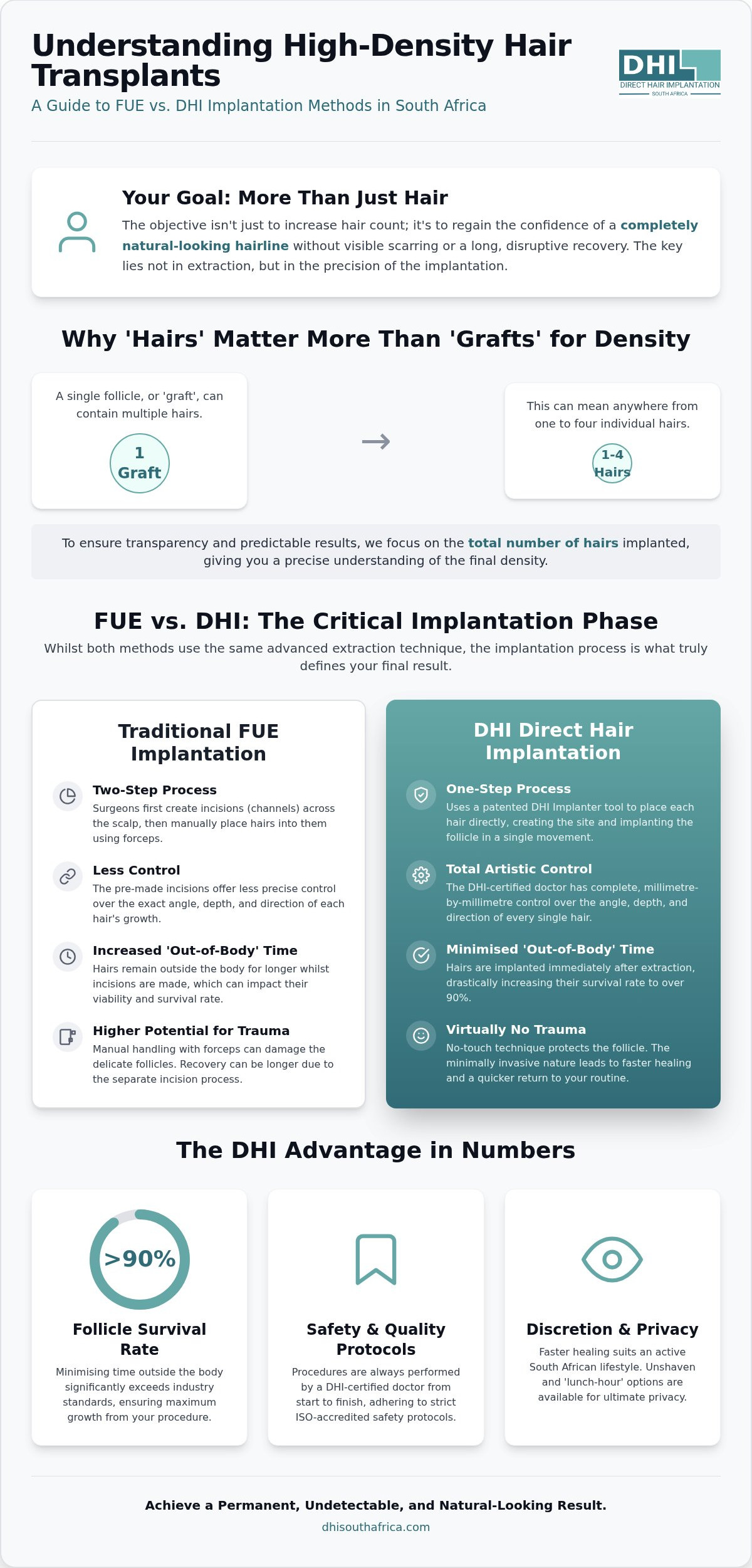
One of the most confusing aspects of hair restoration is the technical jargon used by different clinics. Many speak in terms of "grafts," but this can be misleading because a single graft can contain anywhere from one to four individual hairs. To provide absolute transparency and set accurate expectations for a high density hair transplant South Africa, we prefer to talk about the total number of hairs. If we plan for the placement of 4,000 hairs, you know exactly the level of fullness you can expect to see in the mirror.
During our diagnostic stage, we use specialised tools to identify follicles in the anagen phase, which is the active growth stage of the hair cycle. By selecting these healthy, robust follicles, we ensure a much higher survival rate once they are implanted. This meticulous attention to detail is what allows us to create a hairline that isn't just thick, but looks entirely natural as it grows in over the following months.
FUE vs DHI: Decoding the Technical Differences
When you're researching the best path to restoration, the technical jargon can feel like a barrier. To understand how to achieve a high density hair transplant South Africa, it helps to view the procedure in two distinct phases: extraction and implantation. Whilst many clinics use these terms interchangeably, the way your hairs are handled during these stages determines the final thickness and natural look of your hairline.
Follicular Unit Extraction (FUE) revolutionised the industry by changing how we 'take' hairs from the donor area. Instead of removing a strip of skin, individual follicles are collected one by one. For a deeper look at the mechanics, you can explore this scientific overview of FUE which details the extraction process. However, the real "DHI Difference" lies in what happens next. Traditional FUE is often an extraction-only description; the implantation phase is where the technology has truly evolved.
The FUE Process: Two-Step Implantation
In a standard FUE procedure, the doctor or technician first creates tiny "slits" or holes in the recipient area of the scalp. Once these incisions are made, the harvested follicles are placed into the holes using forceps. This two-step approach involves significant manual handling of the delicate hairs. Because the follicles are exposed to the air for longer and handled with metal tools, they can suffer from trauma. This is a primary reason why industry average survival rates often sit between 50% and 60%, leaving many patients disappointed with the final density.
The DHI Technique: Single-Step Precision
The patented DHI technique is the next logical step in hair restoration technology. We use a specialised tool called the DHI Implanter, which eliminates the need for pre-made incisions or slits. This single-step process allows the doctor to load the hair into the tool and implant it directly into the scalp. It's a much gentler approach that minimises "out-of-body" time for your hairs. By reducing handling, we consistently achieve survival rates of over 90%.
This tool gives the medical expert total control over the angle, depth, and direction of every single hair. It's this level of precision that creates the seamless, high-density results our patients expect. If you'd like to see the real-world impact of this precision, you can browse through our patient results gallery to see the transformations firsthand.
Choosing a high density hair transplant South Africa means looking beyond just how the hair is taken. It's about ensuring the implantation method protects every follicle to give you the fullest, most natural result possible. By following strict DHI protocols, we ensure that your restoration is built to last a lifetime.
Why the Implantation Method Dictates Your Results
When we talk about achieving a high density hair transplant South Africa, we're really talking about a race against time. Each hair follicle is a delicate living organ, and once it's removed from your donor area, the clock begins to tick. The 'out-of-body' time is the period between extraction and implantation; the longer a hair stays outside your scalp, the lower its chances of thriving. Our protocols focus on minimising this window to ensure every follicle remains robust and healthy.
Precision is just as vital as speed. If a hair is handled roughly or placed into a pre-cut slit that doesn't fit its size perfectly, the trauma can prevent it from taking root. This is why simply 'planting more' is a flawed strategy. True density isn't about the number of hairs moved, but the number of hairs that survive and grow. You can see the impact of this survival-first approach in these natural hair transplant results.
Total Control Over Aesthetic Design
The artistry of a transplant lies in how the new hairs blend with your existing ones. Because the DHI Implanter doesn't require pre-made incisions, the doctor has total control over the angle, depth, and direction of every hair. This allows us to mimic your natural growth patterns with incredible accuracy. We pay particular attention to 'temple angle closure,' which is essential for creating a youthful, sophisticated profile that doesn't look 'worked on.'
This level of detail is why our results are often described as undetectable, even by professional hairdressers. We don't just fill in gaps; we reconstruct a hairline that flows seamlessly with your facial features. By controlling the exact exit angle of each hair, we ensure the final look has the natural movement and flow of your original hair.
The Science of Follicle Survival
At the heart of our success is the protection of the hair bulb, the rounded bottom part of the hair fragment that contains living cells. Traditional methods often involve handling this delicate area with forceps, which can cause microscopic damage. DHI protocols eliminate this risk by loading the hair into the implanter tool without touching the bulb. We also use specialised storage solutions enriched with growth factors to keep the follicles nourished whilst they are outside the body.
This scientific approach significantly reduces the trauma levels to your scalp compared to traditional FUE methods. Because there's less inflammation and better follicle health, the high density hair transplant South Africa patients receive at our clinic results in a survival rate of over 90%. It's this commitment to biological safety that transforms a standard procedure into a world-class restoration.
Recovery and Privacy: The Practical Advantages
One of the most significant anxieties we hear from our patients is the fear of being "found out" by colleagues or friends. For the modern professional across South Africa, time is a luxury that can't be wasted on lengthy hospital stays or visible healing. Choosing a high density hair transplant South Africa shouldn't mean pressing pause on your career or social life. Because DHI doesn't involve scalpels or stitches, the "Lunch-Hour" concept becomes a reality for many of our clients.
Most of our patients find they can return to their daily routine almost immediately without the need for heavy bandages or obvious surgical marks. The precision of the DHI Implanter ensures that the entry points are tiny, needle-sized marks that heal rapidly in our temperate climate. This allows you to maintain your active lifestyle whilst your new hairs begin their journey toward full growth.
Returning to Your Routine
Your recovery timeline is remarkably straightforward and designed for minimal disruption. Within the first 48 hours, the newly placed hairs begin to anchor firmly into their new positions. By day three, any minor redness usually fades, and by the end of the first week, the tiny micro-points of entry are virtually invisible to the untrained eye. We recommend avoiding heavy gym sessions or contact sports for at least 14 days to protect the follicles; however, for most office-based work, you're ready to go the very next day.
Unshaven Restoration: The Discreet Choice
The ultimate privacy comes from our ability to perform unshaven hair transplants. Traditional FUE often requires a full head shave, which is a "dead giveaway" that you've had a procedure. Our specialised technique allows us to work amongst your existing hair length, harvesting and placing hairs without altering your current hairstyle. This is why DHI is the preferred choice for South African executives and public figures who need to maintain their professional image whilst their density improves naturally over the coming months.
This approach ensures that your transformation remains your secret. As the hairs grow in over the next six to twelve months, the change is so gradual and natural that people will simply notice you look refreshed and more youthful. They won't be able to point to a specific procedure; they'll just see the results of a high density hair transplant South Africa that was performed with total discretion.
Protecting your investment in those first 48 hours is vital for long-term success. We provide a clear, simple aftercare kit and detailed instructions to ensure your follicles stay hydrated and secure during the initial healing phase. It's this combination of medical excellence and practical convenience that makes our restoration process so effective for the busy individual.
Selecting a clinic for your restoration is a decision that carries significant emotional and physical weight. You aren't just choosing a procedure; you're choosing a medical partner to guide you through a life-changing transformation. At DHI South Africa, we provide a "safe pair of hands" by combining world-class innovation with the warm, attentive care you'd expect from a trusted advisor. Our DHI Total Care System ensures that your safety and aesthetic results are governed by the highest global standards.
Every single procedure we perform is doctor-led from start to finish. This is a critical distinction, as it ensures that the placement of every single hair is handled by a certified medical expert rather than a technician. To achieve a high density hair transplant South Africa, we often adopt a 360-degree approach, integrating supportive therapies like GFC Treatment or PRP Hair Loss Treatment to prime your scalp for the best possible growth environment.
Global Excellence, Nationally Delivered
We are part of an expansive global network with more than 75 clinics across 45 countries. This reach allows us to bring international standardisation and the latest research directly to our patients here at home. Every practitioner undergoes rigorous instruction at the DHI Training Academy and adheres to ISO-certified and UK CQC accredited protocols. When you choose a hair transplant in South Africa through our clinic, you're benefiting from decades of refined medical artistry and scientific rigour.
Your Personalised Hair Restoration Plan
We don't believe in a one-size-fits-all approach to hair loss. Your restoration begins with a comprehensive clinical consultation that includes digital trichoscopy, which is a detailed, high-magnification analysis of your scalp and hair follicles. This allows us to assess the health of your donor area and measure your hair density with absolute precision. By understanding your unique hair cycle and the genetic resistance of your follicles, we can create a sustainable, long-term plan that looks natural for decades to come.
Achieving a high density hair transplant South Africa requires this level of diagnostic depth before a single hair is moved. We'll walk you through every step of the process, answering your questions with candour and transparency. If you're ready to explore what's possible for your hairline, we invite you to take that first step toward a more confident future.
Reclaiming Your Confidence with Precision Restoration
Achieving a high density hair transplant South Africa is about more than just the number of hairs moved. It's about the meticulous science of follicle survival and the artistry of natural placement. We've seen how our patented DHI Implanter technology protects your investment, ensuring a survival rate that far exceeds industry averages. This commitment to clinical excellence is why we're proud of our 99 per cent customer satisfaction rate amongst our patients.
Your restoration should be a seamless transition that fits into your professional life without compromise. With our doctor-certified procedures, you gain the peace of mind that comes from being in the hands of a global leader. You don't have to settle for outdated methods; you deserve a solution that is as sophisticated as it is effective.
Take the first step toward a fuller, more confident future today. Our team is ready to guide you through a personalised analysis of your scalp health and help you rediscover the best version of yourself.
Frequently Asked Questions
Is a minimally invasive hair transplant painful during the procedure?
Most patients report that the procedure is virtually painless thanks to the application of a local anaesthetic to the scalp. You remain awake and comfortable throughout the session, often choosing to listen to music or watch a film whilst our doctors work. Any post-procedure sensation is typically compared to mild sunburn and usually subsides within a day or two.
How long does it take for the transplanted hairs to grow fully?
You will typically see new hair growth starting between three and four months after your procedure. Whilst the initial change is subtle, significant results become visible between six and twelve months as the follicles mature. It's important to remember that the final, most robust result for a high density hair transplant South Africa can take up to 18 months to fully manifest.
Can I have a DHI hair transplant without shaving my head?
You can certainly opt for an unshaven DHI hair transplant if you wish to maintain your current hairstyle and total privacy. This specialised technique allows our doctors to work amongst your existing hair length without the need for a full head shave. It's an ideal choice for high-profile professionals who need to return to their routine without any obvious signs of a procedure.
What is the cost of a hair transplant in South Africa for 2026?
The investment for a hair restoration procedure in South Africa depends on the specific number of hairs required and the complexity of your individual hair loss pattern. Factors such as the clinic's medical accreditation and the expertise of the doctor-led team also influence the final value. We recommend a professional clinical consultation to receive a personalised report and a fixed quote tailored to your unique goals.
Is the result of a DHI hair transplant permanent?
The results of a DHI hair transplant are intended to be permanent because the follicles are harvested from a genetically resistant area of the scalp. These hairs are taken from the back and sides, which are naturally immune to the hormones that cause male pattern baldness. Once successfully transplanted, these follicles continue to grow for a lifetime, behaving just like your original hair.
How many hairs can be transplanted in a single DHI session?
A single DHI session can involve the placement of several thousand hairs, depending on your specific goals and the health of your donor area. Our medical experts focus on a safe harvest to ensure your donor site remains thick and healthy for the future. Every session is carefully mapped to provide the highest possible density whilst protecting your long-term hair bank.
What is the difference between a graft and a hair?
A graft is a small unit of tissue that can contain between one and four individual hairs. We prefer to discuss the total number of hairs rather than grafts because it provides a much more accurate and transparent expectation of final density. This clarity ensures you understand exactly how much fullness we can achieve for your high density hair transplant South Africa.
What happens if I have very limited donor hair available?
If your donor hair is limited, we perform a thorough digital trichoscopy to determine the most effective path forward. Our doctors will assess whether a smaller, strategic restoration is viable or if supportive medical treatments are more appropriate for your situation. In some cases, we may suggest Scalp Micropigmentation (SMP) to create the illusion of greater thickness alongside your natural hair.


Comments