%20(1).jpg)
%20(1).jpg)
Are Hair Transplants Worth It? A South African Guide to Value and Results (2026)
- Dhesan Moodley

- 3 days ago
- 12 min read
What if the most significant cost of your hair loss isn't the price of a procedure, but the daily loss of confidence you feel every time you look in the mirror? It's exhausting to cycle through "miracle" shampoos that fail to deliver, leaving you feeling more frustrated with every wash. When you ask are hair transplants worth it South Africa provides a unique context where clinical excellence meets long-term value, helping you move past the fear of unnatural-looking "plugs" toward a permanent solution.
The answer is a definitive yes, provided the procedure prioritises follicle survival and artistic placement over sheer speed. True value in hair restoration is found at the intersection of high hair survival rates and the clinical precision that makes a procedure undetectable. We'll guide you through the 2026 landscape of hair restoration, explaining how a hair survival rate of over 90% ensures your results are built to last. You'll learn what to expect from the process and how the right medical approach turns a permanent solution into a lifetime of restored self-assurance.
Table of Contents
Measuring the Real Value of a Hair Transplant in South Africa
When you evaluate if the investment is sound, you're looking for more than a simple quote. In the South African context, "worth" is a calculation of three distinct factors: the initial financial outlay, the profound psychological shift in self-image, and the permanence of the medical results. A successful procedure isn't merely about adding volume. It's about restoring a natural aesthetic that integrates perfectly with your existing hair. This is why the benchmark for a successful investment is always an undetectable result that stands the test of time.
To truly understand the value of this journey, we must look at the total impact on your quality of life:
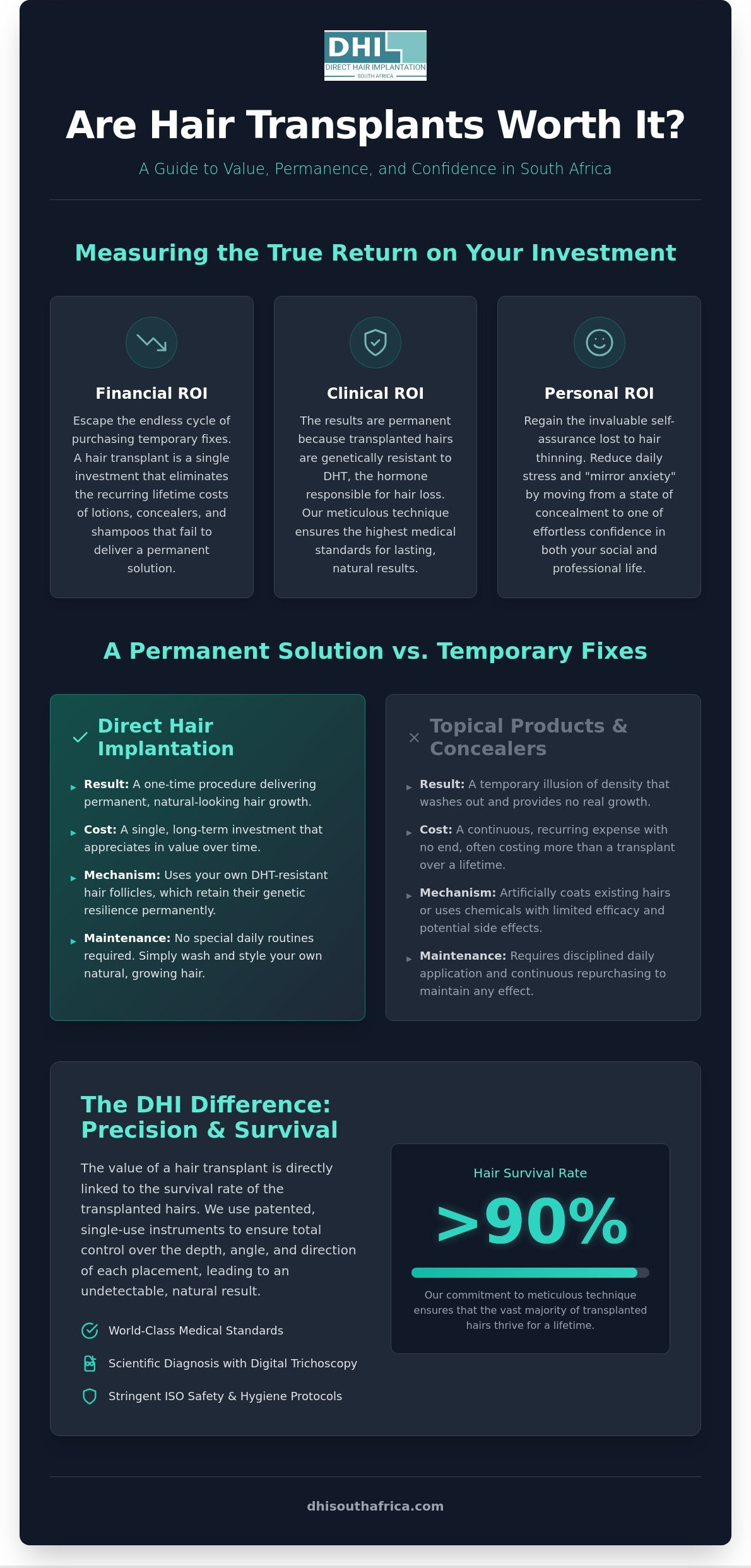
Financial ROI: Lower lifetime costs compared to decades of temporary products.
Clinical ROI: High hair survival rates and permanent DHT resistance.
Personal ROI: Restored self-assurance and reduced daily grooming stress.
Beyond the Mirror: The Psychological ROI
Thinning hair often dictates how you move through the world. It might mean avoiding certain lighting, skipping social events, or feeling a subtle dip in professional presence. This emotional weight is real and often influences social behaviour and confidence. Reclaiming your hairline provides a tangible return on investment by removing that daily "mirror anxiety." When you no longer have to spend twenty minutes every morning strategically styling your hair to hide patches, the mental clarity gained is invaluable. It's a restoration of your baseline confidence. This shift affects how you present yourself in boardrooms and social gatherings alike. It's about moving from a state of concealment to one of comfort.
Permanence vs Temporary Fixes
Many people spend years on a treadmill of topical lotions, concealers, and "miracle" shampoos. Whilst these might offer a temporary illusion of density, they represent a recurring cost that never leads to a final solution. Modern hair transplantation techniques offer a different path. By moving hairs from the donor area, we utilise follicles that are genetically resistant to DHT (dihydrotestosterone). This is the hormone primarily responsible for male pattern baldness. These transplanted hairs retain their genetic resistance even in their new location, meaning the results are permanent.
Unlike temporary fixes that require daily application and monthly purchases, a surgical restoration is a one-time physical change. When you ask are hair transplants worth it South Africa patients find that the lifetime cost of high-maintenance "fixes" often exceeds the price of a single, world-class procedure. At DHI South Africa, we prioritise a hair survival rate of over 90 per cent. This ensures that every hair we place contributes to a lifetime of density. Investing in a hair transplant is not just about the hair you see today; it's about the security of knowing your results will last for decades to come.
Why South Africa is a Global Destination for Hair Restoration
South Africa has quietly emerged as a premier hub for medical excellence, particularly in the specialised field of hair restoration. When asking are hair transplants worth it South Africa offers a compelling argument that combines global clinical standards with a level of personalised care that is often lost in larger medical tourism factories. The South African private healthcare sector is renowned for its rigorous medical training and adherence to strict safety protocols. This ensures that patients receive treatment that is not only aesthetically superior but medically sound. By choosing a local specialist, you're opting for a "safe pair of hands" that understands both the science and the artistry of hair growth.
World-Class Medical Standards at Competitive Rates
Clinics here operate under stringent ISO standards, prioritising patient safety and hygiene above all else. Whilst hair restoration is considered the standard surgical treatment for androgenic alopecia, the success of the procedure relies heavily on the meticulous attention to detail of the specialist. South African practitioners are celebrated for this artistry, often utilising advanced tools like the patented DHI Implanter. This device allows for total control over the angle, depth, and direction of every hair placed, ensuring a seamless blend with your existing hair. For international patients, the favourable exchange rate makes this premium experience highly accessible, yet for locals, the real value lies in receiving world-class care without the need for international travel or the risks associated with "black-market" clinics.
The Importance of Local Expertise and Aftercare
A hair transplant is not a "one and done" event; it is a 12-month physiological journey. The first few months involve shedding and dormant phases, whilst the full density only becomes apparent around the one-year mark. Having your medical team nearby during this period is a vital advantage. Regular follow-up consultations allow your specialist to monitor the anagen phase (the active growth stage) of the transplanted hairs and address any concerns in real-time. This continuity of care is often what separates a good result from a life-changing one. You can see the impact of this dedicated approach by exploring the DHI South Africa results, which showcase natural hairlines achieved through local expertise.
Receiving treatment in your home country also means you have immediate access to your doctor should you have questions during the recovery phase. This proximity builds a relationship of trust and accountability that international clinics simply cannot replicate. If you're beginning to wonder how these standards apply to your specific situation, you might find it helpful to speak with a specialist about your restoration goals.
Comparing Techniques: Why Method Impacts Your Investment
Not all hair restoration procedures provide the same return on investment. When exploring are hair transplants worth it South Africa, you must look beyond the initial price tag to the specific methodology used. A procedure's worth is fundamentally linked to the final aesthetic. If the result looks unnatural or the density is sparse, the investment has failed to meet its primary goal. The method of implantation is what dictates the final look, turning a clinical procedure into a work of art that blends seamlessly with your natural growth. Choosing the right technique is the difference between a lifetime of confidence and the regret of a visible medical intervention.
The High Cost of Low Survival Rates
The industry average for hair survival often hovers around 50 to 60 per cent. This means that for every 2,000 hairs extracted, nearly half might not survive the journey to their new location. From a value perspective, this is a significant loss of both your financial investment and your limited donor hair. Every hair lost during a procedure is a wasted resource that cannot be replaced. At DHI South Africa, we prioritise a hair survival rate of over 90 per cent. This high success rate ensures that the majority of the hairs we place actually grow, providing the natural density you expect from a world-class restoration. When more hairs survive, you get better coverage with fewer procedures, which is the ultimate measure of value.
DHI vs Traditional FUE: A Value Comparison
Traditional FUE (Follicular Unit Extraction) involves a two-step process where reception holes are created in the scalp before the follicles are inserted. This can lead to less control over the final aesthetic and more trauma to the skin. In contrast, the patented DHI technique uses a specialised tool called the DHI Implanter. This allows our certified doctors to have total control over the angle, depth, and direction of each hair as it is placed. Because we don't need to make pre-made incisions, there are no stitches and no visible scarring. This lack of trauma increases the worth of the procedure by ensuring a faster recovery and a result that is entirely undetectable.
The precision of the DHI Implanter means that we can match the natural growth pattern of your existing hair with scientific accuracy. This level of detail is what prevents the "pluggy" look associated with older methods. For a deeper look at these differences, you can read our guide on FUE vs DHI Hair Transplant to see how the science of implantation has evolved. Ultimately, a restoration is only worth the investment if it looks natural under any light and lasts a lifetime.
How to Evaluate Your Personal Return on Investment
Determining your personal ROI requires a shift from general research to individual diagnostics. Whilst industry statistics are helpful, the real value of a procedure depends entirely on your unique scalp health and hair density. This is why a professional diagnosis through digital trichoscopy, which is a high-magnification scalp and hair analysis, is the essential first step. It provides the data needed to predict your results with clinical accuracy before you commit any funds.
When you ask are hair transplants worth it South Africa specialists will tell you that value is found in the longevity of the result. Be cautious of clinics that offer "miracle" results at suspiciously low prices. These often come at the expense of safety or the use of non-certified technicians. A failed procedure doesn't just waste money; it depletes your limited supply of donor hairs, making future restoration much more difficult.
Assessing Your Candidate Suitability
A successful restoration is only possible if you have enough healthy donor hairs to cover the thinning areas effectively. During your consultation, we assess the quality of these hairs and their current growth cycle. Specifically, we look for a healthy percentage of hairs in the anagen phase, which is the active stage where the hair follicle is producing new growth. If your hair loss is still very aggressive, we might suggest stabilising it first to ensure the transplant provides a permanent aesthetic improvement.
Calculating the Long-Term Financial Equation
It's helpful to view the cost of a transplant against the cumulative expense of lifetime maintenance. Whilst supportive treatments like GFC (Growth Factor Concentrate) or PRP (Platelet-Rich Plasma) are excellent for maintaining existing hair, they cannot regrow hair in completely bald areas. A one-time surgical investment often proves more economical over a decade than the endless purchase of concealers and topical treatments.
Doing it right the first time with a certified specialist avoids the hidden costs of corrective surgery. Botched procedures from low-cost clinics frequently require expensive secondary operations to fix unnatural hairlines or poor density. By prioritising clinical excellence and a proven survival rate, you ensure that your investment delivers a permanent boost to your self-assurance. True value is measured in the years of confidence that follow a single, meticulous procedure.
Why DHI South Africa Represents the Pinnacle of Restoration Value
Choosing a clinic is the final piece of the puzzle when determining are hair transplants worth it South Africa. At DHI South Africa, we don't just offer a medical procedure; we provide access to a global legacy of restoration excellence that spans over 50 years. This heritage ensures that every patient benefits from half a century of refined research and clinical innovation. By combining this world-class expertise with a deeply personal, South African approach to care, we ensure that your investment leads to a result that is as safe as it is aesthetically pleasing. This is the "safe pair of hands" you need when making a life-changing physical transformation.
Patented Technology for Superior Hair Survival
The core of our value proposition lies in the patented DHI Implanter. This specialised tool allows for the simultaneous placement of hairs without the need for pre-made incisions, which significantly reduces trauma to the scalp. By protecting the delicate follicles during the implantation process, we achieve a survival rate that exceeds 90 per cent. This isn't just a statistic; it's a guarantee of density and longevity. Every DHI procedure is performed exclusively by certified doctors who have graduated from our global academy. Unlike many clinics that rely on technicians for the heavy lifting, we believe that the artistry of your hairline requires the steady, experienced hands of a medical specialist.
Our single-use, patented instruments ensure the highest levels of safety and hygiene, following strict ISO standards. This medical-grade precision protects your health whilst ensuring that every hair is placed at the perfect angle and depth. The training our doctors undergo is rigorous and continuous, ensuring they remain at the forefront of global hair restoration science. This commitment to education and research is why we can offer results that are both permanent and undetectable.
A Lifetime of Confidence and Natural Results
The ultimate return on your investment is a result that ages gracefully with you. Our doctors focus on the precise angle and direction of every hair to mirror your natural growth pattern, ensuring that the transition between transplanted and existing hair is completely invisible. This meticulous attention to detail eliminates the "pluggy" appearance of older methods, replacing it with soft, natural density. We invite you to explore our patient reviews to see how this clinical precision has transformed the lives of people right here in South Africa.
Your journey toward a permanent solution starts with a clear, data-driven understanding of your options. We're here to provide the clinical authority and compassionate guidance you need to make an informed decision. If you're ready to move beyond the frustration of hair loss and reclaim your self-assurance, the next step is a simple one. Book a consultation today for a personalised assessment and a detailed scalp analysis. Together, we'll create a restoration plan that ensures your investment lasts a lifetime.
Securing Your Future Hairline Today
When you weigh up the evidence, the question of whether are hair transplants worth it South Africa is best answered by the longevity and natural look of the final results. True value isn't found in a bargain price, but in the clinical precision that ensures your hair looks as natural in ten years as it does on day one. By choosing a method that prioritises a hair survival rate exceeding 90 per cent, you're investing in a permanent change that eliminates the daily anxiety of hair loss.
South Africa's private medical sector provides the perfect environment for this transformation, combining global standards with accessible, expert aftercare. With over 50 years of global expertise and procedures performed exclusively by certified doctors, we offer the "safe pair of hands" needed to restore your self-assurance. You don't have to settle for temporary fixes or the recurring frustration of thinning hair.
Reclaiming your confidence is a journey that begins with a single, informed step. We're here to guide you through every stage of your restoration with the care and expertise you deserve.
Frequently Asked Questions
Is a hair transplant really permanent?
Yes, the results are permanent because the transplanted hairs are taken from the back and sides of the head, areas where follicles are genetically resistant to dihydrotestosterone (DHT). This hormone is the primary cause of male pattern baldness. Once these follicles are moved to thinning areas, they retain their genetic resistance and continue to grow naturally for the rest of your life.
How much does a hair transplant cost in South Africa?
The total investment depends on the number of hairs required to achieve your desired density and the specific complexity of your hair loss pattern. When considering if are hair transplants worth it South Africa patients should weigh the one-time cost against the cumulative expense of temporary concealers and lotions. A professional consultation is the only way to receive an accurate quote tailored to your restoration needs.
Is the procedure painful or does it require a long recovery?
The procedure is minimally invasive and performed under local anaesthetic, so you'll feel very little discomfort during the process. Most patients return to their professional routines within two to three days. Because our technique avoids the use of scalpels or stitches, the healing process is much faster and more comfortable than traditional surgical methods.
Can I get a hair transplant if my hair is only just starting to thin?
Yes, but it's vital to begin with a scientific diagnosis like digital trichoscopy to understand the progression of your hair loss. Early intervention can often lead to more natural-looking results by reinforcing thinning areas before they become completely bald. Your doctor might also recommend supportive treatments to stabilise your existing hair whilst planning the restoration.
What is the success rate of hairs surviving the transplant?
Our specialised technique ensures a hair survival rate exceeding 90 per cent, which is significantly higher than the industry average of 50 to 60 per cent. This success is due to our patented tools that minimise the time follicles spend outside the body and protect them from trauma during placement. Higher survival translates directly into better density and a more successful investment.
How do I know if I am a good candidate for DHI?
A good candidate typically has a stable supply of healthy donor hairs and realistic expectations for their restoration. During a consultation, a certified doctor will assess the density of your donor area and the current phase of your hair loss. This medical evaluation ensures that the procedure will provide a lasting aesthetic improvement that meets your goals.
Will people be able to tell that I’ve had a hair transplant?
No, the results are designed to be entirely undetectable because we have total control over the angle, depth, and direction of every hair placed. By meticulously matching your natural growth pattern, we create a hairline that blends seamlessly with your existing hair. There are no visible scars or "pluggy" patches, ensuring a result that looks authentic even upon close inspection.
Can women also benefit from hair transplants in South Africa?
Yes, many women experience significant thinning along the part line or temples and find that hair restoration is a permanent way to regain density. The procedure is adapted to the specific patterns of female hair loss, providing a natural boost to volume and self-assurance. It's a common and highly successful solution for South African women seeking a long-term fix for thinning hair.


Comments