%20(1).jpg)
%20(1).jpg)
Hair Transplant Risks in South Africa: A Patient’s Guide to Safety and Success

Choosing a hair restoration procedure shouldn't feel like a gamble with your appearance or your health. You’ve likely spent hours scrolling through forums, perhaps feeling a knot of anxiety whilst looking at photos of visible scarring or hearing stories of procedures gone wrong. It's completely natural to worry about surgical pain or the dread of an unnatural hairline that doesn't age with you. Understanding the genuine hair transplant risks in South Africa is the first step toward regaining your confidence without compromising your safety.
We agree that your peace of mind is just as important as the final aesthetic result. This guide explores the scientific reality of potential complications and explains how advanced clinical protocols, such as the use of patented titanium-coated instruments, ensure a safe and natural-looking restoration. You’ll discover a clear roadmap for a risk-free recovery and learn why a doctor-led approach, focusing on the precise placement of individual hairs, is essential for a successful outcome. We’ll provide the medical clarity needed to choose a clinic that treats your scalp with the artistry and precision it deserves.
Table of Contents
Understanding Hair Transplant Risks in South Africa
Deciding to restore your hair is a significant milestone, but it's often accompanied by a quiet sense of apprehension. You might find yourself wondering if the procedure will be painful, if the results will look "pluggy", or if the hairs will even survive the move. When we discuss hair transplant risks in South Africa, we aren't just talking about clinical hygiene or the healing process. True risk is a triad: medical safety, the survival rate of the hairs, and the final aesthetic outcome. It is a combination of how you feel during the procedure and how you'll feel looking in the mirror twelve months later.
Whilst modern Hair transplantation procedures are exceptionally safe, the primary "risk" usually lies in the choice of technique and the experience of the person holding the tools. South Africa maintains world-class medical standards, but clinical specialisation varies significantly from one facility to the next. A general plastic surgeon may offer hair restoration as one of many services, whereas a dedicated clinic treats it as a refined medical art. Understanding this distinction is the key to moving from a place of worry to a place of confidence.
The Emotional Weight of Hair Loss and Restoration
Thinning hair often feels like a slow loss of identity. It's frustrating to see a different version of yourself in the mirror every morning, and the hope for a permanent solution is often tinged with the fear of making a mistake. We believe that a consultation should be a space where anxiety is replaced by scientific clarity. An elite clinic won't hide behind jargon; instead, they'll offer total transparency regarding what can be achieved. This honesty is the hallmark of a "safe pair of hands" and ensures you aren't chasing a "miracle" that doesn't exist.
Primary Concerns: Pain, Scarring, and Permanence
One of the most common questions we hear is: "Will it hurt?" It's a valid concern that deserves a compassionate answer. With modern local anaesthesia and refined extraction tools, most patients describe the sensation as a slight pressure rather than actual pain. You can usually relax, listen to music, or even chat with the team during the process. Because the change is permanent, the planning phase must be meticulous to ensure the new hairline ages naturally with your face.
The longevity of the result is grounded in biology. The follicles moved from the back and sides of your head possess a unique genetic resistance to Dihydrotestosterone (DHT), which is the hormone responsible for thinning in other areas. This ensures that the newly placed hairs continue to grow for a lifetime. When you choose a specialist who understands this science, the risk of a "failed" transplant is virtually eliminated.
Surgical Risks: Comparing Traditional Methods vs DHI
When you begin exploring hair transplant risks in South Africa, you'll quickly realise that not all surgical methods are created equal. Traditional techniques, whilst effective in their time, carry inherent risks that modern science has worked hard to overcome. For instance, Follicular Unit Transplantation (FUT) involves surgically removing a strip of skin from the back of your scalp. This often results in a permanent, visible linear scar and a significantly longer, more painful recovery period. It's a heavy price to pay for restoration.
Even Follicular Unit Extraction (FUE), which is often marketed as "scarless", has its own set of challenges. One major risk is over-harvesting. This occurs when too many hairs are removed from the donor area, leaving the back of your head looking patchy or unnaturally thin. There's also the danger of follicle trauma. If the extraction isn't performed with extreme precision, the delicate roots can be damaged before they even have a chance to grow. You deserve a procedure that protects your donor hair as much as your new hairline.
The Problem with Traditional Slit-and-Place Methods
In many standard procedures, the surgeon must first create "slits" or tiny holes in your scalp using a scalpel or needle. This process causes unnecessary trauma and bleeding. It can also increase the risk of inflammation. This two-step process means extracted hairs sit outside the body for hours, increasing the chance of transection, which is the accidental cutting of the hair bulb. A clinical review of surgical complications in hair restoration highlights how these invasive steps can lead to suboptimal healing and skin issues. Traditional FUE often relies on forceps to handle the individual hairs. This mechanical pressure can crush the fragile tissue. It often leads to a higher rate of hair failure.
Direct Hair Implantation: Minimising Scalp Trauma
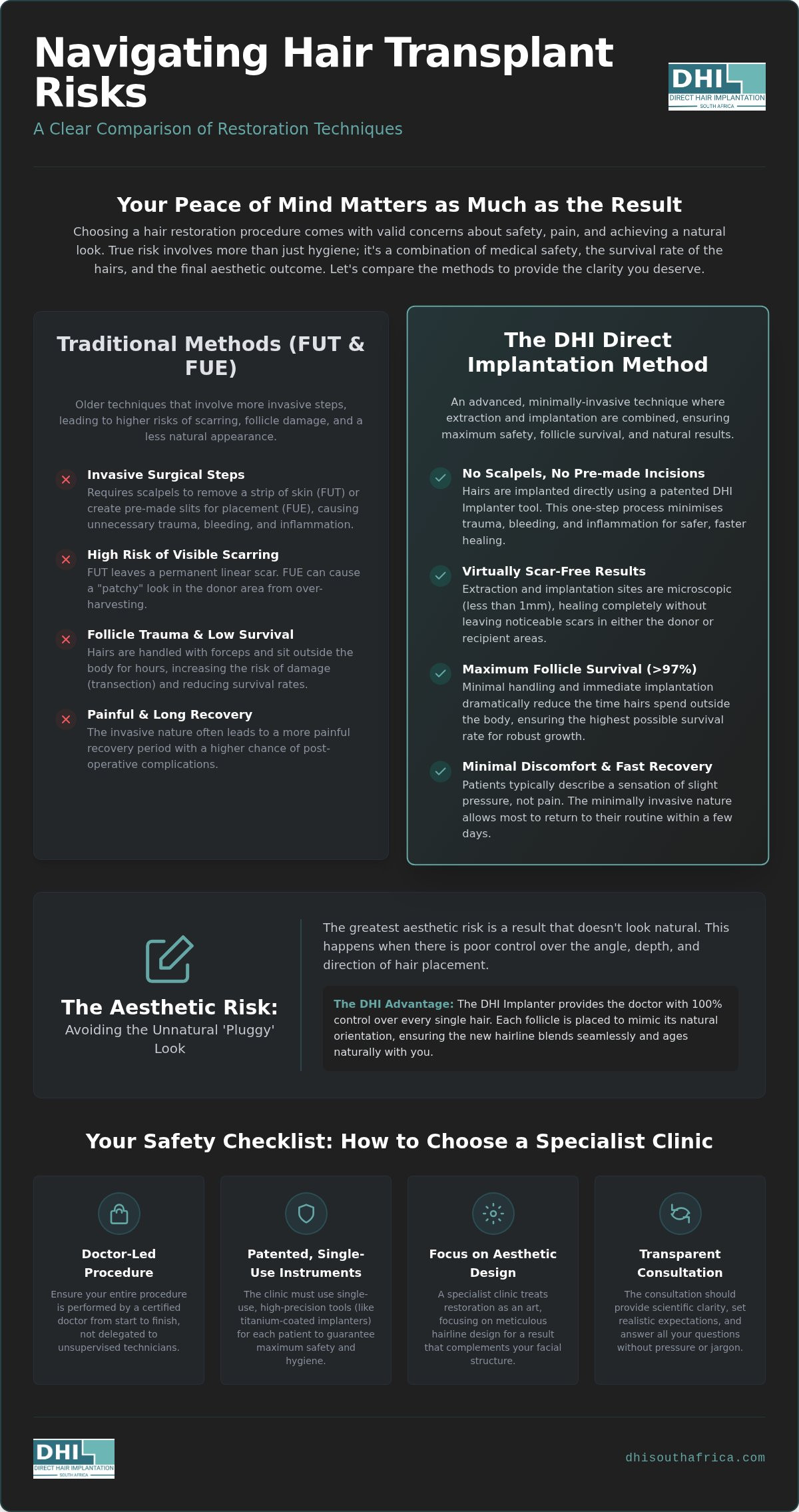
We’ve refined the process to eliminate these specific risks through the Direct Hair Implantation (DHI) technique. The "Direct" in our name refers to the fact that hairs are implanted immediately after extraction. This reduces the time they spend away from their blood supply. We use single-use, patented titanium-coated punches that are incredibly fine. They ensure maximum hygiene and minimal tissue damage. This meticulous approach is why we achieve hair transplant success rates of over 90%, which is significantly higher than the industry average. By using a specialised DHI Implanter, our doctors have total control over the depth, direction, and angle of every hair. We protect your existing hair whilst building new density.
If you're concerned about the physical impact of surgery, it might be helpful to explore our range of minimally invasive treatments to see how we prioritise your comfort and safety.
The Aesthetic Risk: Avoiding the 'Pluggy' or Unnatural Look
Imagine investing your time and hope into a procedure, only to find that whilst the hairs have grown, the result looks unmistakably artificial. This is what we call "aesthetic risk". It’s perhaps the most distressing of all hair transplant risks in South Africa because it affects your self-image every time you look in a mirror. A successful surgery isn't just one where the hairs survive; it’s one where nobody can tell you had a procedure at all. When placement is handled poorly, you end up with the "doll-hair" or "pluggy" effect, where hairs appear in unnatural clusters rather than a seamless flow.
The technical reality is that even if a clinic successfully places 4,000 hairs, the procedure is a clinical failure if those hairs are pointing in the wrong direction. Natural hair doesn't grow in straight lines or uniform rows. It has a specific rhythm and character. If a doctor doesn't respect the natural geometry of your scalp, the result will always look "done". This is why the artistry of the design is just as critical as the medical safety of the extraction.
The Science of Hair Direction and Angle
Natural hairs grow at very specific angles that change across different zones of the scalp. In the crown, they might swirl in a whorl pattern, whilst at the temples, they lie much flatter against the skin. We use the DHI Implanter tool specifically because it gives the doctor total control over the depth, direction, and angle of every single hair. Without this level of precision, you risk "pitting", where the hair looks like it’s sunk into a small crater, or "cobblestoning", where the skin around the hair appears bumpy and uneven. These are permanent textural changes that are very difficult to correct later.
Designing a Hairline That Lasts a Lifetime
A common mistake in less specialised clinics is designing an aggressive, "teenage" hairline for a patient in their 40s or 50s. Whilst it might look good for a few years, it won't age naturally with your face. A truly undetectable hair transplant South Africa depends on creating a soft, transitional zone. We achieve this by using only single-hair follicles at the very front of the hairline, gradually increasing density as we move back. This mimics the way nature builds a hairline. It requires a certified doctor with a deep understanding of facial proportions to ensure your results look as good in twenty years as they do today. Your restoration should be a lifetime investment, not a temporary fix that eventually looks out of place.
Post-Procedure Safety: Infection, Healing, and Aftercare
Once you leave the clinic, the responsibility for your results shifts into a shared partnership between you and your medical team. This is often the time when questions about hair transplant risks in South Africa feel most pressing. You might worry about every itch or wonder if a stray hair on your pillow means the procedure has failed. Rest assured that the healing process is a well-documented biological journey, and we provide you with every tool needed to navigate it safely.
A primary concern for many is the risk of post-surgical infection. We virtually eliminate this danger by using sterile, single-use, patented instruments for every single placement. Our doctors also adhere to 18 mandatory safety checks during the procedure to ensure your scalp remains healthy and protected. Knowing the standard hair transplant recovery time allows you to manage your schedule without the stress of the unknown.
You should also prepare for a phenomenon called 'shock loss'. This is the temporary shedding of newly placed hairs that typically occurs two to four weeks after restoration. It's a natural biological response to the follicle being moved; the hair shaft falls out, but the root stays healthy and dormant. Soon, it will enter the anagen phase, which is the active growth period where your new, permanent hair begins to emerge.
The First 48 Hours: Protecting Your Investment
The first two days are the most critical for ensuring the hairs take root successfully. You must resist any urge to touch, scratch, or wash the treated area, as the follicles are still settling into their new positions. We recommend sleeping with your head elevated at a 45-degree angle during this time. This simple adjustment uses gravity to reduce minor swelling and prevents you from accidentally rubbing your scalp against the pillow. We’ll provide a specialised saline spray to keep the follicles hydrated and calm whilst they heal.
Long-Term Monitoring and Growth
Patience is your greatest ally as you move from the shedding phase into the growth phase at around three to four months. We use structured photographic documentation to track your progress objectively, ensuring every zone is developing as expected. It's not just about the first few weeks; a formal 12-month follow-up is essential to verify that the final density meets our world-class standards. This long-term monitoring ensures that your restoration remains a "safe pair of hands" success story.
Minimising Your Risk: Choosing a Specialist Clinic
The most effective way to mitigate hair transplant risks in South Africa is to move beyond the search for the lowest price and focus instead on clinical accountability. Many clinics operate on a high-volume model where technicians, rather than qualified medical professionals, perform the delicate work of extraction and implantation. This creates a significant gap in safety and aesthetic consistency. When you choose a medical hair restoration South Africa specialist, you aren't just paying for a procedure; you're investing in a rigorous standard of care that protects your donor area and your future appearance.
To ensure you're in a "safe pair of hands", we recommend using this essential vetting checklist during your research:
Will a certified doctor perform the entire procedure from start to finish?
Does the clinic adhere to international ISO and UK CQC-accredited safety protocols?
Are the instruments single-use and patented to prevent cross-contamination?
Can the clinic provide unedited, high-resolution results of their own patients?
Is there a clear, structured plan for long-term monitoring and aftercare?
The Value of Specialised Certification
There's a profound difference between a general plastic surgeon and a doctor who has dedicated their career to hair restoration. Every procedure at our clinic is performed by a doctor who has graduated from the Global Training Academy. This ensures they've mastered the precise artistry required to place thousands of hairs at the correct depth and angle. This specialised training is what allows us to maintain a consistent survival rate of over 90%. We don't believe in "miracle" claims; we rely on transparent, data-driven results that speak for themselves.
Your Next Steps: The Digital Scalp Analysis
We believe that surgery should never be the first conversation. Our "Total Care System" is a 360-degree approach to hair health that begins with a deep understanding of your unique biology. Before we ever discuss the placement of hairs, we perform a digital scalp analysis. This diagnostic report uses digital trichoscopy, a high-magnification examination of the scalp and follicles, to identify the underlying cause of your hair loss. This ensures we aren't just treating the symptoms, but providing a sustainable solution that works for your specific profile.
Choosing the right clinic is about replacing anxiety with the calm confidence that comes from expert guidance. If you're ready to explore your options with total transparency, we invite you to take the first step toward a safe and natural restoration.
Secure Your Future with Expert Restoration
Managing the landscape of hair restoration doesn't have to be a source of stress. By choosing a technique that prioritises scalp health and follicle survival, you effectively manage the common hair transplant risks south africa. You've learned that success depends on more than just hygiene; it requires the artistic eye of a certified doctor and the precision of world-class safety protocols. With a hair survival rate exceeding 90%, the path to a natural, permanent hairline is grounded in proven medical science rather than guesswork.
You deserve a solution that respects your individuality and provides long-term peace of mind. Our team is here to guide you through every step, from the initial diagnostic report to the final growth phase. It's time to replace hesitation with a clear, clinical roadmap toward the version of yourself you've been missing.
We look forward to helping you restore your hair and your self-assurance with the warm, expert care you deserve.
Frequently Asked Questions
Is a hair transplant in South Africa painful?
Most patients find the restoration process remarkably comfortable. We use local anaesthesia to numb the scalp, so you'll only feel a slight pressure as the doctor works. You can relax, listen to music, or even nap during the session. Once the anaesthetic wears off, any mild tenderness is easily managed with standard over-the-counter medication.
What are the most common side effects after the procedure?
You can expect some minor redness and slight swelling around the treated area for a few days. Some patients experience 'shock loss', which is the temporary shedding of transplanted hairs before the new growth cycle begins. These effects are a standard biological response and typically resolve within the first week as your scalp heals naturally.
How do I know if I am a good candidate for a hair transplant?
A good candidate is someone with a stable hair loss pattern and enough healthy donor hair at the back or sides of the head. During a digital scalp analysis, we use high-magnification tools to check your follicle density. This helps us determine if a transplant is the right path or if medical treatments are better suited to your needs.
Can a hair transplant fail, and what causes it?
Poor follicle survival is often a result of the hair transplant risks south africa associated with clinics that use technicians rather than certified doctors. Failure usually happens if the hairs are damaged during extraction or kept away from a blood supply for too long. We mitigate this by ensuring only highly trained doctors handle the delicate follicles throughout the day.
Will I have visible scars after my hair restoration?
You won't have to worry about a permanent linear scar with the DHI technique. Unlike traditional methods that remove a strip of skin, we use tiny, titanium-coated tools to extract individual hairs. This leaves only microscopic dots that heal quickly and become invisible. Even if you prefer to wear your hair very short, there's no tell-tale surgical mark left behind.
How soon can I return to work following the treatment?
Most of our patients return to their normal office routine within two to three days. Whilst you might have some slight redness, it's often barely noticeable to others. If your job involves intense physical activity or heavy lifting, we recommend waiting at least a week to ensure the newly placed follicles are fully protected during the initial healing phase.
Are the results of a DHI hair transplant permanent?
The results are designed to last a lifetime. We move hairs from the 'safe' donor zone at the back of your head, which are genetically resistant to the hormones that cause thinning. Once these follicles take root in their new location, they continue to grow just as they did before. This biological permanence makes the procedure a valuable long-term investment in your self-assurance.
What is the risk of infection during a hair transplant?
The risk of infection is virtually non-existent when you choose a clinic that follows strict medical standards. We virtually eliminate the clinical hair transplant risks south africa by adhering to a strict protocol of 18 mandatory safety checks. We use single-use, patented instruments and maintain a sterile environment that meets international ISO and UK CQC-accredited benchmarks.

Comments