

Hair Restoration ROI: Calculate the Long-Term Cost

Hair restoration ROI is calculated as net financial value minus the investment cost, divided by the investment cost, then multiplied by 100 to express the result as a percentage. When calculating the ROI of hair restoration, include the full cost of treatment and compare it with measurable financial value over the period you’re assessing.
It’s understandable to want a clear figure before making a decision. Calculating the ROI of hair restoration can help you compare options, but it won’t capture every personal benefit, such as feeling more comfortable with your appearance.
This article explains how to annualise the calculation, account for easily overlooked costs and compare surgical and non-surgical approaches. It also shows how ongoing hair loss and future maintenance can affect the long-term picture, helping you assess the figures more clearly.
Table of Contents
Hair restoration return-on-investment framework
Hair restoration ROI compares the value you receive with the full cost of treatment. A useful approach separates financial return from personal satisfaction, then considers each over a clearly defined period.
Meaning of return on investment
Return on investment (ROI) shows how an investment’s net value compares with its cost, expressed as a percentage. For hair restoration, it can help organise financial comparisons, but confidence and satisfaction are personal outcomes, not financial returns. Keep these measures separate when considering a transplant.
Results timeline and longevity
Transplanted follicles develop through their growth cycle, so visible changes take time. Results can be long-lasting, although hair loss may continue in untreated areas and could lead to further procedures. Assess the treated area and possible future hair changes separately when estimating long-term value.
Coverage, risks and success factors
Medical aid coverage in South Africa depends on the scheme’s benefits and treatment eligibility under its rules, so don’t assume a contribution when estimating out-of-pocket expenses. Potential surgical complications include infection, bleeding, scarring, poor growth or an uneven appearance. Modern clinical settings report survival rates of 85% to 97% for transplanted follicles. Success and the number of hairs needed depend on hair loss, donor supply, the area treated and desired density. A commonly cited lifetime donor estimate is approximately 6,000 harvestable follicular units, each containing 1 to 6 hairs.
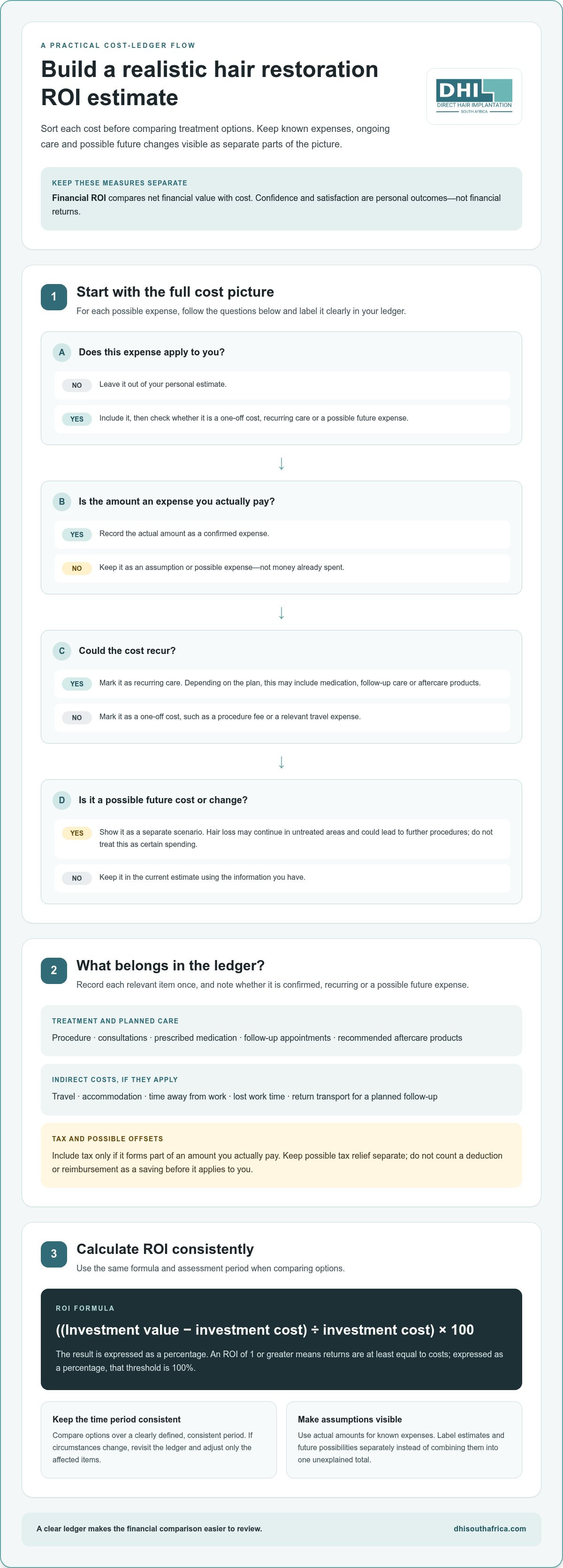
The basic formula is (investment value minus investment cost) ÷ investment cost × 100. For example, a marketing campaign costing R5,000 and generating R25,000 in return has an ROI of 400%. This illustrates the arithmetic, not a forecast for hair restoration. An ROI of 1 or greater means returns are at least equal to costs; expressed as a percentage, that threshold is 100%.
South African property offers a separate benchmark, not a direct substitute for a medical decision. JSE-listed real estate, measured using performance such as the South African Property Index, delivered an average annual return of approximately 5% to 8% over the past decade. Use this context carefully: hair restoration’s personal value can’t be reduced to an investment-market rate.
For a longer-term illustration, the framework uses a 40-year-old with a life expectancy of 90 years, creating a 50-year assessment horizon. That horizon can help spread the initial investment across time, but it doesn’t establish the procedure’s lifespan or predict future spending. A sound approach to calculating the ROI of hair restoration keeps the time period, financial inputs and personal satisfaction measure clear and separate.
Accounting for overhead, taxes, and unexpected changes
A realistic estimate includes more than the procedure fee. Separate treatment costs from indirect expenses, recurring care and possible future changes. For example, a hair transplant may involve travel, accommodation, time away from work and aftercare items. Record each expense once, distinguishing one-off costs from recurring ones.
Start with a personal cost ledger. List the procedure, consultations, prescribed medication, follow-up appointments and recommended aftercare products separately. Include travel and lost work time only if they apply to you. This helps avoid overlooking real expenses, such as return transport for a planned follow-up.
Handle taxes carefully in the same ledger. Include tax only if it forms part of an amount you actually pay, and keep any possible tax relief separate from your expected return. Don’t count a deduction or reimbursement as a saving before it applies to you. This prevents assumptions from being treated as money available to offset the procedure.
Depending on the treatment plan, ongoing costs may include medication, follow-up care and aftercare products. Hair loss may continue in untreated areas, potentially leading to further procedures. List these possibilities as separate scenarios rather than certain expenses. This gives you a clearer comparison between a one-off procedure and care that requires ongoing attention.
Unexpected changes can affect both your budget and priorities. A change in work, travel or household responsibilities may make time away from work more costly than expected. Hair loss may also progress outside the treated area, changing the appearance you hoped to maintain. Revisit your ledger when circumstances change, adjusting only the affected items.
Make your assumptions visible. Label each entry as a confirmed expense, a recurring expense or a possible future expense. For example, list a planned follow-up as expected and a further procedure as a scenario. Don’t combine them into one total without showing the difference. This makes it easier to compare options fairly and identify the assumptions with the greatest impact.
For South African readers, the practical goal is a complete rand-based record, not a misleadingly precise forecast. Use actual amounts for known expenses and note what could change, such as travel distance or the frequency of ongoing care. Reviewing hair loss treatment options can help you identify which types of care belong in your comparison.
Annualised ROI formula
Annualised ROI converts a total return over several years into an equivalent yearly rate. This makes a five-year estimate easier to compare with an option assessed over a different period. It describes the pace of financial return, not a forecast of appearance, confidence or personal satisfaction.
For a compounded annual rate, use: annualised ROI = [(1 + total ROI as a decimal)1 ÷ number of years − 1] × 100. First, convert the total ROI percentage into a decimal, then enter the investment period in years. The result is a percentage per year, assuming returns compound evenly.
For example, a total ROI of 50% over five years becomes 0.50 in the formula. The calculation is [(1.50)1 ÷ 5 − 1] × 100, which gives approximately 8.45% annualised. This is a mathematical illustration, not a hair-restoration price or expected patient outcome.
Simply dividing 50% by five would produce 10% per year, but that is a straight-line average. It doesn’t account for compounding. Use the compounded formula when comparing growth rates across unequal periods, and label the result clearly so readers don’t mistake it for a guaranteed yearly return.
Hair restoration differs from a conventional financial asset: changes in appearance and confidence don’t generate a directly measurable cash return. Keep financial ROI separate from personal outcomes. For a fair comparison, use the same time horizon and cost categories for each option.
Organise the inputs before calculating:
Total investment: combine the initial procedure with relevant follow-up and ongoing expenses.
Financial value: include only benefits that can be expressed in money, not subjective satisfaction.
Period: count the years from the initial outlay to the point being assessed.
Method: use the compounded formula for annualised ROI, or label a straight-line division as an average.
For example, if your comparison covers three years, use the same three-year window for both options. Include an option’s initial cost and later expenses in its total. Otherwise, you’re comparing different periods or incomplete inputs, which can make the annual rate misleading.
Follicles and visible outcomes aren’t annual cash flows. If expenses or measurable benefits occur at different times, a single annualised percentage compresses that timing into one figure. Keep the original dates and amounts alongside the percentage. This helps you understand what the annual rate represents and which assumptions shape it.
Comparing the long-term cost of surgery with non-surgical alternatives
Compare surgery and non-surgical care across the same time horizon, using the full treatment plan rather than its starting expense. In South Africa, the average cost of hair transplant surgery depends on the individual case, including the area treated, the amount of work required and follow-up needs.
Surgery and non-surgical costs
Surgical and non-surgical approaches have different cost patterns, so compare their expected expenses over the same period. Surgery may involve a larger initial outlay, while non-surgical care may involve repeated treatments or ongoing products. The balance depends on the treatment plan and how long you assess it.
Build a separate estimate for each option. For surgery, list the procedure, consultations, aftercare and any possible future procedures as distinct items. Hair loss can continue in untreated areas, potentially leading to further treatment. For non-surgical care, record each planned treatment and product over the same period.
In South Africa, the price depends on the case and is given after a quote request; factors include the treatment plan, extent of hair loss and follow-up needs. Don’t treat a single procedure fee as the full long-term cost. Include recurring expenses where they apply, and distinguish them from possible future expenses.
Financial value versus doing nothing
To assess value against doing nothing, compare the financial outcomes of treatment with those of no treatment. A procedure’s visible result isn’t automatically a monetary return. Count only financial benefits you can reasonably identify, and consider personal satisfaction separately.
Use a consistent period, such as the same five-year window for both choices. List treatment expenses in one column and financial effects you can link to the decision in another. For the “do nothing” comparison, include any hair-related expenses you would still incur rather than assuming that no treatment means no spending.
For example, compare a surgical plan with ongoing non-surgical care and with no active restoration. Apply the same assumptions about travel, time away from work and future hair loss to each scenario. If you can’t assign a defensible financial value to an outcome, leave it out of the ROI calculation and assess it separately.
A sound comparison doesn’t force every benefit into rand. Record appearance, confidence and treatment preferences as non-financial considerations, then use financial figures to assess affordability. This may show whether an option reduces recurring expenses without implying that it will suit everyone.
Finally, test how your conclusion changes when an assumption shifts. For instance, compare the totals with and without a possible future procedure. If that changes which option appears less costly, make the assumption visible rather than hiding it in an overall figure.
ROI considerations for different patient profiles
Hair restoration ROI depends on each patient’s hair-loss pattern, priorities and treatment horizon. A consultation can connect these factors to realistic goals, rather than treating one calculation as right for everyone.
For someone noticing early thinning, the key question is whether the hairline or density has stabilised enough for a lasting plan. Future hair loss can change the appearance around transplanted areas, so an estimate should account for possible additional treatment. Many surgeons avoid operating on patients younger than 25 because future hair loss is difficult to predict. That makes timing an important part of assessing value.
A patient with a clearly established pattern may compare a defined surgical plan with ongoing non-surgical care. For example, someone focused on restoring a receding hairline can list the proposed treatment, follow-up and possible future procedures, then compare these with recurring treatment costs over the same period. The useful outcome isn’t simply the lowest total, but a comparison that reflects the person’s goals and likely maintenance needs.
More extensive hair loss calls for careful consideration of the donor area and the coverage planned. Using available donor hair in one area may leave different priorities for later. A patient can separate current goals, such as framing the face, from future goals, such as adding coverage elsewhere. This helps explain why two people with similar thinning may have different plans and long-term cost profiles.
For someone who prefers non-surgical care, recurring expenses and treatment frequency shape the assessment. List each planned treatment and product, then total them over a consistent period. Compare that amount with a surgical scenario that includes aftercare and possible future procedures. This like-for-like view shows whether a lower starting expense remains lower over time.
Budget and lifestyle matter too. If you’re travelling for treatment, list transport, accommodation and time away from work as individual expenses. If you have limited flexibility, weigh those practical costs alongside the treatment plan. Keep appearance and confidence as personal outcomes, rather than assigning them an invented rand value.
Use a consultation to clarify the factors that affect the comparison: hairline, thinning pattern, donor area, desired coverage and likely follow-up. Then record each option’s costs and assumptions separately. This gives you a patient-specific view instead of relying on an average that may not reflect your circumstances.
DHI South Africa: Direct Hair Implantation (DHI)
DHI South Africa can help you relate this cost framework to a treatment plan suited to your hair-loss pattern and goals. Direct Hair Implantation (DHI) is a surgical option, while GFC Treatment, Regenera Activa and PRP Hair Loss Treatment are non-surgical approaches to discuss.
Consider these options when comparing an initial procedure with ongoing treatments, or when you want a clearer view of the factors shaping your personal estimate. A focused assessment can connect your priorities and hair loss with a suitable approach, without treating a financial calculation as a promise of results.
To discuss your hair restoration options, book a consultation with DHI South Africa.
Make your next step a considered one
The most useful decision reflects both your financial limits and what you hope to change. Use your figures to clarify the trade-offs, then consider how each option fits your priorities for appearance, ongoing care and time. Calculating the ROI of hair restoration can organise the financial side, but it can’t assign a monetary value to feeling more at ease with your appearance.
Bring your questions and treatment priorities to a consultation. A personalised discussion can connect your expectations with an appropriate approach, helping you decide with greater clarity rather than relying on a single percentage.
Take the next step at a pace that feels right for you.
Frequently Asked Questions
How do you calculate ROI?
Subtract the investment cost from its value, divide the result by the investment cost, then multiply by 100 to express ROI as a percentage. For example, if an investment costs R1,000 and its financial value is R1,500, the net value is R500 and ROI is 50%. Use consistent figures and include relevant expenses, or the percentage may give an incomplete comparison.
What Is Return on Investment?
Return on investment is a way to assess the financial gain or loss associated with an expense. It expresses the result relative to the amount invested, helping you compare decisions using a common measure. For a personal treatment decision, it’s useful to remember that an ROI calculation captures only values that can be expressed financially. It doesn’t measure confidence, satisfaction or changes in how you feel about your appearance.
What is ROI?
ROI stands for return on investment, a measure that relates financial value to an investment’s cost. A positive figure indicates that value exceeds cost under the inputs used; a negative figure indicates the opposite. For example, a calculation based only on procedure costs may differ from one that includes follow-up and other expenses, so state clearly what your figures cover.
What is an average or good ROI?
There’s no single average or good ROI that applies to every decision, because the answer depends on the investment, timeframe and costs included. In this framework, an ROI of 1 or greater is positive: the return is at least equal to the cost. Expressed as a percentage, that threshold is 100%. For hair restoration, treat this as a financial comparison, not a measure of personal satisfaction.
What is the difference between ROI and annualised ROI?
Total ROI describes the return across the full period assessed, while annualised ROI expresses it as an equivalent yearly rate. The same total gain can look different when achieved over a shorter period rather than a longer one. Annualising makes time periods easier to compare, but compresses the timing of expenses and benefits into one rate. Keep the original period and assumptions alongside it.
How do you calculate the ROI of hair restoration?
List the financial value you can reasonably attribute to treatment, subtract the full cost, divide by that cost and multiply by 100. Include relevant follow-up, aftercare and possible future treatment in the expense total. Keep appearance-related satisfaction separate from financial value. If comparing options, use the same assessment period and include comparable cost categories for each, so the calculation reflects the decision rather than a partial estimate.
How do hair transplant costs and outcomes compare with medication, PRP, and hair systems?
Compare each option over the same timeframe, including the treatment plan, repeat sessions or purchases, follow-up and associated care. A transplant is surgical; medication, PRP and hair systems involve different treatment or maintenance plans. Their outcomes aren’t directly interchangeable, so consider the intended change alongside the financial total. Use the plan and expenses relevant to you, rather than assuming one option has the lowest lifetime cost.



Comments