

Choosing a Hair Transplant Surgeon: 2026 Patient Guide

What if the strongest sign of a trustworthy hair transplant isn’t a bold promise, but a process you can understand and verify? Choosing a hair transplant surgeon can feel daunting when it’s unclear who will perform the procedure, which claims are backed by clinical practice, or how treatment may affect your comfort and routine.
A careful decision starts with the doctor’s credentials, relevant experience and active registration with the Health Professions Council of South Africa (HPCSA). Find out who will perform each stage and ask direct questions about your treatment plan, comfort and time away from normal activities. This guide will help you assess those details and distinguish useful clinical information from marketing language.
At DHI South Africa, procedures are performed exclusively by trained, certified doctors. DHI uses a patented DHI Implanter Tool under local anaesthesia. The procedure is practically painless, unshaven and hassle-free, with minimal downtime. This guide also covers questions to take into your consultation, including how to discuss comfort, shaving and your individual needs.
Table of Contents
Choosing a hair transplant surgeon starts with your concerns and the right questions
Check the surgeon’s credentials, role and clinical standards
Compare a surgeon’s technique, patient evidence and comfort approach
Use this consultation checklist to judge whether the approach fits you
Why DHI South Africa’s doctor-led approach supports an informed choice
Choosing a hair transplant surgeon starts with your concerns and the right questions
Hair loss can affect how you feel about your appearance, so deciding what to do may feel personal as well as practical. A considered choice depends on understanding who is responsible for your care, how the proposed plan relates to your concerns and whether the explanations help you make an informed decision. Choosing a hair transplant surgeon isn’t about finding the boldest promise. It’s about knowing what you’re being offered and why.
Use a consultation to explore your priorities, not to diagnose yourself or predict an outcome. If your main concern is a changing hairline, for example, explain what you’ve noticed and ask how the doctor’s assessment informs the recommendation. You should be able to discuss alternatives, uncertainties and what the plan is intended to address, without being pushed to decide on the spot.
A general overview can help you understand the language used in consultations. This Hair transplantation techniques and overview introduces common methods and background, but it can’t determine which approach is right for your individual circumstances.
To hear a doctor discuss how to assess a hair-transplant process, watch this video:
What should a hair transplant surgeon be able to explain?
A useful consultation connects your concerns to the doctor’s assessment and proposed approach. Ask who makes the clinical decisions, who is responsible for each stage and how the plan reflects your priorities. The doctor should explain the method in everyday language, including what it involves and what it can’t promise. If an answer feels too general, ask how it applies to your situation.
Separate verifiable information from marketing language
Look for details you can understand and assess, such as clearly named credentials, a defined process and patient examples with enough context to interpret them. Promotional language alone can’t show how a plan was formed. Treat absolute guarantees or claims of identical outcomes as a reason to ask for a clearer explanation of the evidence and its limits.
A credible consultation makes the responsible clinician, proposed method and safeguards understandable, while leaving room for your questions. Explore the clinic’s hair transplant approach to familiarise yourself with the service, then discuss how the doctor’s assessment relates to your concerns.
Check the surgeon’s credentials, role and clinical standards
Credentials help you understand who is responsible for your care and what standards a clinic states it follows. They’re useful evidence to consider, but they don’t replace a discussion of your health, hair loss and suitability for treatment. When choosing a hair transplant surgeon in South Africa, distinguish the doctor’s qualifications and role from a clinic’s accreditations, and understand what each can tell you.
Who performs the procedure at DHI South Africa?
At DHI South Africa, procedures are performed exclusively by certified doctors trained at specialised global hair restoration academies. Knowing which doctor is responsible helps you understand who assesses your case and carries out the procedure. In your consultation, ask how the doctor’s training and role relate to your individual assessment and proposed plan.
DHI is performed under local anaesthesia and is practically painless. The approach is unshaven and hassle-free, with minimal downtime. All procedures follow strict medical safety protocols. Your doctor can explain what these details mean for the proposed procedure and answer questions about your circumstances.
For additional background on the procedure and its methods, the Understanding hair transplant surgery from ISHRS resource offers an overview. Use general information as context for your consultation, not as a substitute for an assessment by the doctor responsible for your care.
How to read clinic accreditations accurately
DHI South Africa’s stated standards are UK Care Quality Commission (CQC) Registration; ISO 9001:2015 Certification; TÜV Austria; ACHS; and Total Care System™. These named standards give you specific information to consider when reviewing the clinic’s documented safety protocols. They are not a personal prediction of results or a replacement for understanding your treatment plan.
Keep the question practical when reviewing a standard: what does the clinic say it covers, and how does that help you understand its clinical processes? Avoid assuming that a title proves more than it states. Consider the named standards alongside the doctor’s credentials, responsibilities and explanation of your care.
During your consultation, ask who will be responsible for the procedure, how the doctor’s training informs the proposed approach and how the clinic’s stated standards relate to your treatment. Clear answers should help you understand the process without turning credentials into a promise of a particular outcome.
To see how the doctor-led process and procedure are presented together, explore DHI South Africa’s hair transplant approach before your consultation.
Compare a surgeon’s technique, patient evidence and comfort approach
A useful comparison looks beyond the name of a technique. Consider whether the doctor can explain the proposed method, who is responsible for your care, what evidence is available and how your comfort questions will be addressed. The aim isn’t to predict an outcome from a procedure label, but to understand the reasoning behind the recommendation and decide whether it makes sense for you.
Use this framework to guide the discussion. It focuses on what you can learn in a consultation, rather than making unsupported comparisons between methods or promising particular results.
What should you look for in patient results?
Look for examples that relate to the area you want to address and note whether the images offer enough context to interpret them. Consider whether the cases appear relevant to your hair characteristics and concerns, but don’t treat any photograph as a forecast of your outcome. The clinic’s hair transplant patient results can provide examples to discuss during an assessment.
Patient accounts offer a different perspective from photographs. Read them as individual experiences, not evidence that your treatment or result will be identical. If a case raises questions, note them and ask the doctor how your circumstances compare.
How to assess the patient experience
Comfort is personal, so raise practical concerns directly, whether you’re anxious about the procedure or wondering how it may fit around work and daily responsibilities. DHI is performed under local anaesthesia and is practically painless. Ask what to expect before, during and after treatment, and what guidance applies to your situation.
As you compare options, focus on whether the explanation is specific to your assessment, whether you understand the clinician’s responsibilities and whether the evidence is presented with appropriate context. This gives you a more grounded basis for choosing a hair transplant surgeon than a technique name or image alone.
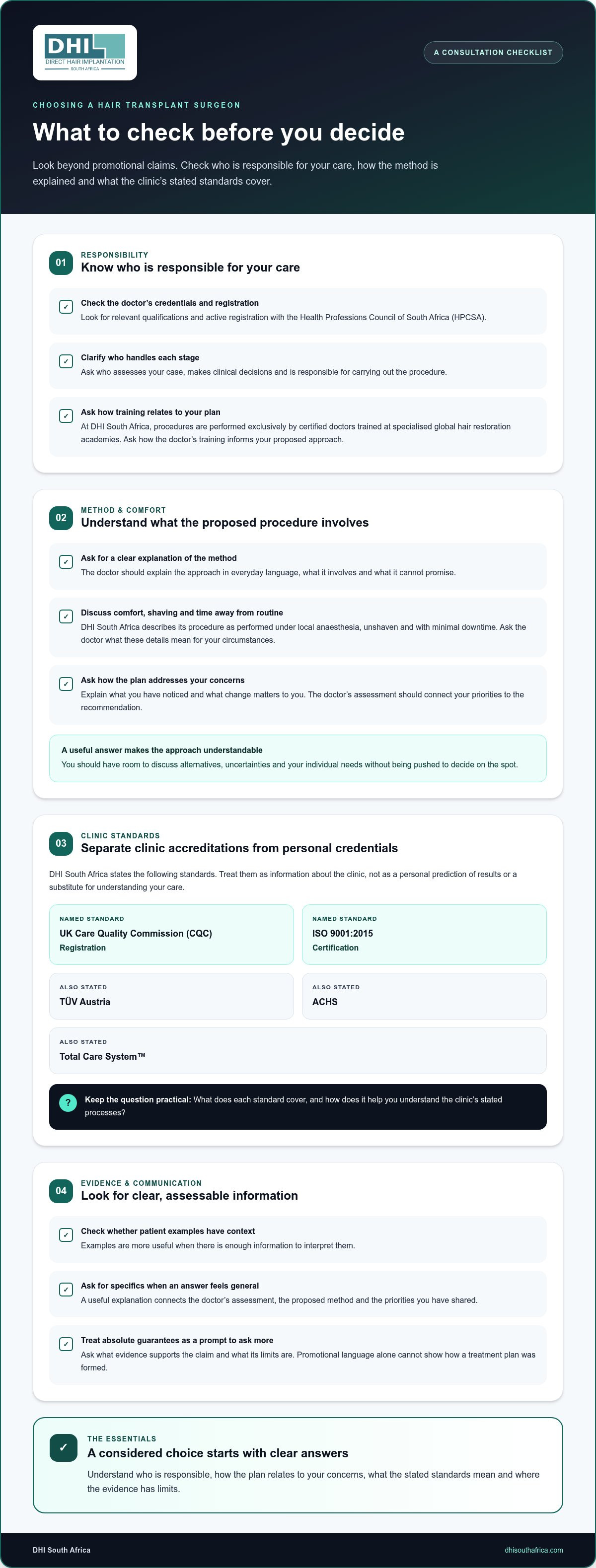
Use this consultation checklist to judge whether the approach fits you
A consultation is a chance to understand the recommendation and decide whether it addresses what matters to you. Take these questions with you, make notes and ask for plain-language explanations. Choosing a hair transplant surgeon is a personal decision, so you should leave with enough information to reflect on the discussion, not feel obliged to decide immediately.
Questions to ask about your assessment and treatment plan
Have I explained my main concern clearly? Describe the change you hope to address, then ask the doctor to summarise your priority. This helps you check that the conversation is centred on your goals.
What did you learn from my assessment? Ask which details influenced the doctor’s view of your situation and how they shape the recommendation. If the explanation is unclear, ask for an example related to your concern.
Why are you recommending this approach for me? Ask the doctor to explain the reasoning, including what the proposed treatment is intended to address and what it may not address.
What other options should I understand? Ask whether there are alternatives to consider and how the doctor distinguishes between them for your circumstances. This can help you understand the choices without assuming one approach suits everyone.
What should I plan for around treatment? Raise practical concerns about comfort, preparation and time away from your usual routine. Ask what guidance applies to your case and what to do if you have questions after the appointment.
Questions to ask about evidence and follow-up
Can I see examples relevant to my concerns? Ask what context is available for patient photographs, such as the area addressed and the stage shown. Consider examples as illustrations, not predictions of your result.
How can I understand the clinic’s stated standards? Ask which standards relate to the processes being discussed and what they mean in practical terms. This helps you consider the information without treating a credential as a personal outcome guarantee.
What follow-up information will I receive? Ask what guidance is provided after treatment, how questions are handled and what signs or concerns should prompt you to seek advice. Clear expectations can help you plan with greater confidence.
If you want broader context before your discussion, the clinic’s hair restoration treatment information can help you familiarise yourself with the options. Use your consultation to explore how the doctor’s assessment relates to your priorities.
Why DHI South Africa’s doctor-led approach supports an informed choice
A confident decision comes from understanding who is responsible for your care, how the proposed method works and what the clinic’s stated standards mean. At DHI South Africa, procedures are performed exclusively by trained, certified doctors, and the DHI technique uses a patented DHI Implanter Tool. These details give you concrete points to discuss with the doctor, while your personal assessment remains central to deciding whether treatment is suitable.
What DHI South Africa makes transparent
DHI South Africa’s stated standards are UK Care Quality Commission (CQC) Registration; ISO 9001:2015 Certification; TÜV Austria; ACHS; and Total Care System™. The clinic also reports a 99%+ customer-satisfaction rating as reported by IMRB. These details are useful to weigh as part of your evaluation, not guarantees of an individual result or a replacement for a medical consultation.
Transparency gives you the opportunity to ask specific questions. Who is the certified doctor responsible for your procedure? How does the doctor’s assessment shape the proposed plan? What does the DHI technique involve in your case? Clear answers help you understand the process and consider whether it aligns with your concerns, rather than relying on broad claims or reputation alone.
South Africa’s Trusted Name in Hair Transplants & Restoration. The tagline expresses the clinic’s position, while your decision should rest on information relevant to you: the doctor’s role, the treatment explanation, stated standards and an assessment of your suitability.
Your next step: book a personal consultation
A consultation gives you the opportunity to discuss what you’ve noticed, what change you hope for and the doctor’s view of whether DHI may suit your circumstances. Bring your questions and take time to consider the answers. You can also explore the hair transplant service and DHI approach to familiarise yourself with the method before speaking with the doctor.
Choosing a hair transplant surgeon isn’t about finding the most confident promise. It’s about leaving with a clear understanding of the doctor’s responsibilities, the proposed technique, comfort information and the reasons behind the assessment. If an explanation feels unclear, ask for it in plain language. You should have space to consider your options without pressure.
When you’re ready, book a consultation through the website to discuss your concerns and receive an individual assessment. It’s a considered next step, not a commitment to proceed.
Take your next step with clarity
Choosing a hair transplant surgeon is a personal decision, and you don’t need to make it before you feel ready. Use your consultation to talk openly about what you’d like to change, understand the doctor’s assessment and consider whether the proposed approach feels right for you.
Bring your questions, ask for clear explanations and give yourself time to think. A considered next step is one that leaves you better informed, whether you decide to proceed now or take more time.
Start with a conversation. You can move forward at a pace that feels comfortable and informed.
Frequently Asked Questions
How can I check whether a hair transplant surgeon is qualified?
Check the doctor’s registration using the Health Professions Council of South Africa (HPCSA) public register, and ask for their registration number so you can search accurately. Also ask about specific hair-restoration training and experience, since a general medical qualification alone doesn’t explain someone’s preparation for this procedure. When choosing a hair transplant surgeon, consider these details alongside how clearly the doctor explains your assessment and proposed care.
Who performs a DHI hair transplant at DHI South Africa?
DHI procedures at DHI South Africa are performed exclusively by trained, certified doctors who have completed training at the DHI International Hair Restoration Training Academy. The doctor’s involvement matters because they are responsible for the medical assessment and procedure. In your consultation, ask how the doctor’s training relates to the DHI method and how they will apply their assessment to your concerns.
What should I bring to a hair transplant consultation?
Bring a short list of your questions and the changes you hope to discuss, such as a receding hairline or thinning in a particular area. It may help to note when you first noticed the change and whether it has altered over time. You can also bring relevant medical information you already have and photographs showing how your hair looked previously, if available. These details can help focus the conversation.
Can women have a consultation about hair transplantation?
Yes. Women can have a consultation to discuss hair loss and whether hair transplantation may be suitable for them. Hair thinning can have different patterns and personal considerations, so an individual medical assessment is important rather than assuming a procedure is appropriate based on photographs or general information. Explain what you’ve noticed and what you hope to address, then discuss the doctor’s assessment.
How do I assess before-and-after hair transplant photographs?
Look for images that show a similar area of concern and comparable hair characteristics, and check whether the photographs are clearly labelled as before and after. Consistent lighting, camera angle and hairstyle make it easier to judge what the images show. Ask about the context of a case if it’s available. Photographs can help you understand examples, but they can’t predict how your result will look.
Is a hair transplant consultation the same as agreeing to treatment?
No. A consultation is an opportunity to discuss your concerns, hear the doctor’s assessment and understand any proposed approach. It isn’t the same as deciding to proceed. Take time to consider what you’ve heard, write down anything you still need clarified and make a decision when you feel informed. You can use the appointment to learn, even if you’re not ready to choose a treatment.
What happens if I am not considered suitable for a hair transplant?
If the doctor considers a transplant unsuitable for you, ask them to explain the reasons in language you understand and which aspects of your assessment informed that view. You can also ask what the assessment means for your options and whether any further discussion is appropriate. A recommendation against surgery is part of an individual medical decision, not a judgement about your concerns or the importance of addressing them.



Comments