%20(1).jpg)
%20(1).jpg)
Bad Hair Transplant Examples: Understanding Clinical Failures and the Path to Restoration

Imagine the frustration of waiting months for your new hair to grow, only to realise the results look "pluggy" or completely out of place. It's a distressing experience that often leaves patients feeling trapped between a hairline they dislike and the fear of further surgery. When you search for bad hair transplant examples, you'll see common issues like poor density, unnatural angles, or visible scarring that stems from outdated techniques or a lack of clinical precision.
You deserve to feel confident in your appearance, and it's important to know that a failed procedure isn't the end of your journey. We'll help you identify the specific signs of a clinical failure and explain the technical reasons behind these aesthetic setbacks. We'll explore how the placement of hairs must be managed with absolute control to ensure a natural finish. By the end of this article, you'll understand how advanced medical protocols can repair an unnatural look and restore the seamless, permanent results you originally sought.
Table of Contents
Understanding Bad Hair Transplant Examples and Why They Happen
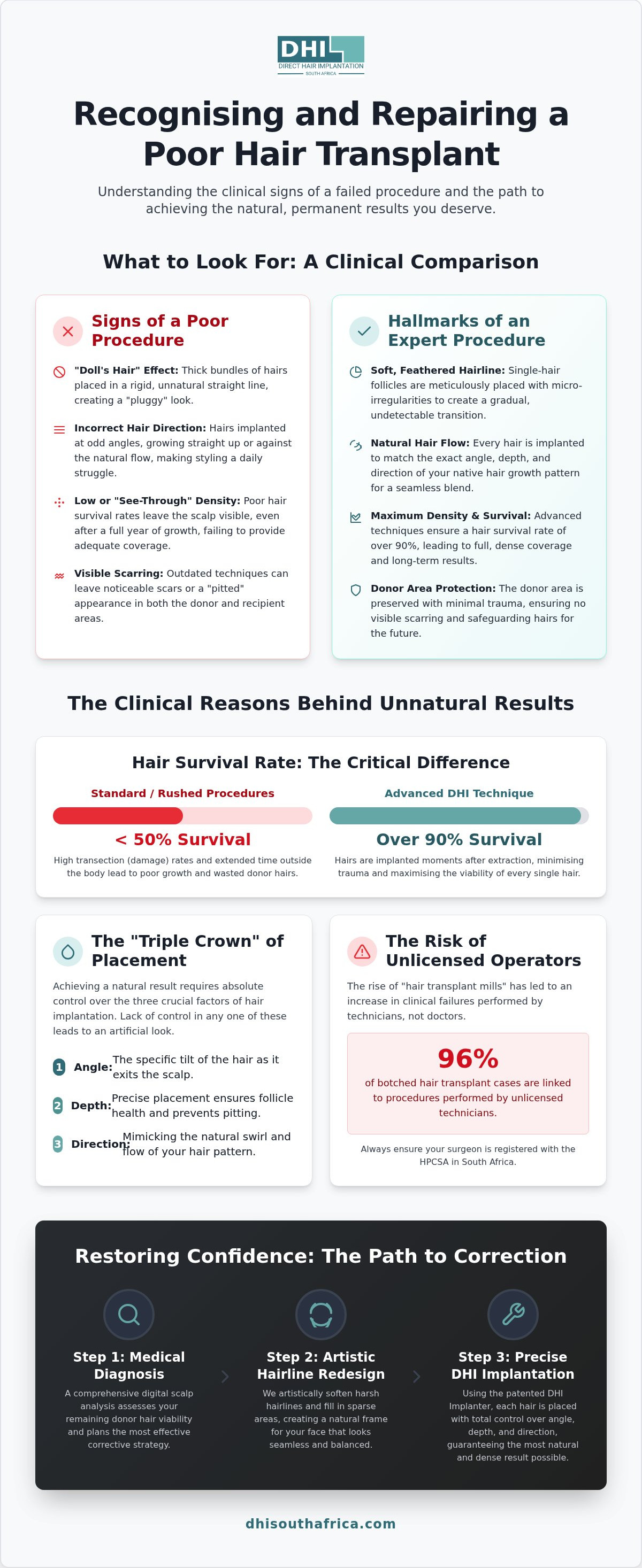
A bad hair transplant is more than just a medical procedure that didn't go as planned. It's any result that lacks natural harmony or causes you clinical distress. When looking at bad hair transplant examples, we often see "doll's hair" hairlines, where thick bundles of hairs are placed in a straight, unnatural line. You might also notice visible scarring or "pluggy" patches that look completely out of place. It's completely normal to feel anxious if your results don't look right, but most of these failures are preventable when the right technique is used.
Successful restoration is a delicate art form backed by rigorous medical science. Understanding Hair Transplantation requires more than just moving hairs from one spot to another. It involves careful planning of the hairline and a deep knowledge of facial proportions. Every hair must be placed with an eye for detail to ensure it blends seamlessly with your existing hair. When this balance is missed, the result looks artificial and clinical.
The Emotional Impact of a Disappointing Result
Investing your time and hard-earned money into a procedure only to feel more self-conscious is incredibly frustrating. Many of our patients mention a specific type of social anxiety that comes from having an obvious, unnatural hairline. They feel as though everyone is looking at their scalp rather than their face. You aren't alone in this experience. According to the ISHRS, around 5 to 6 percent of patients seek another doctor to correct an initial procedure. We see many patients who visit our hair transplant clinic after a negative experience elsewhere, looking for a way to restore their confidence.
Why 'Cheap' Often Costs More in the Long Run
The rise of "hair transplant mills" has led to an increase in clinical failures. In these settings, technicians often perform the entire surgery while the doctor is nowhere to be found. Rushed protocols and poor hygiene can lead to low hair survival rates, which means you lose the very hairs you were trying to save. In fact, data shows that 96 percent of botched cases are linked to unlicensed operators. This is why it's vital to ensure your surgeon is registered with the HPCSA in South Africa.
The most serious risk of a cut-price procedure is donor hair depletion. Your donor area has a finite number of hairs. If a clinic over-harvests or damages these follicles, they're gone forever. This makes future corrective work much more difficult because you have fewer resources to work with. Choosing a clinic based solely on price often leads to hidden costs that are far more expensive to fix later. We focus on protecting your donor area to ensure long-term, sustainable results.
Common Signs of Poor Hair Restoration Results
Identifying a clinical failure requires a keen eye for detail and an understanding of natural hair biology. Common bad hair transplant examples often include the "doll's hair" effect, where thick bundles of hairs are placed in a rigid, straight line. This happens when a surgeon lacks the artistry to select single-hair follicles for the hairline. Instead of a soft, feathered transition, you're left with a "pluggy" appearance that looks artificial under bright light.
Beyond the hairline, incorrect hair direction is a major indicator of a poor result. Hairs should mimic the natural flow and exit angle of your original growth. When they are implanted at odd angles or grow straight upwards, styling becomes a daily struggle. This lack of precision is a key factor in many hair transplant procedure complications, leading to results that look messy or chaotic regardless of how much product you use.
Low density is another painful reality for many patients. You might wait a full year for the final result only to find your scalp still looks "see-through" in the light. This often stems from poor survival rates, where the hairs are damaged during extraction or implantation and fail to grow. If you are concerned about your current progress, you might find it helpful to compare your results against our successful hair restoration outcomes to see the difference clinical expertise makes.
The Unnatural Hairline Design
A tell-tale sign of an amateur transplant is a perfectly straight hairline. Nature never draws a straight line on a human scalp. Real hairlines are defined by "micro-irregularities" and soft, fine hairs at the very edge that create a gradual transition. Even if a clinic promises the placement of 4,000 hairs, the result will look sparse and "fake" if the design doesn't follow these natural biological rules. Artisanal placement is what separates a medical procedure from a life-changing restoration.
Donor Area Depletion and Scarring
We must also look at the back and sides of the head to judge a procedure's success. Aggressive extraction can leave the donor area looking "moth-eaten," with small white dots or patches of permanent hair loss where too many hairs were removed too close together. Traditional FUT strip surgery often leaves a long, visible linear scar that limits how short you can wear your hair in the future. Protecting the donor area is just as vital as the recipient area because these hairs are a finite resource that cannot be replaced once they are gone.
The Clinical Causes Behind Unnatural Hairlines and Scarring
When we examine bad hair transplant examples, the failure is rarely down to simple bad luck. It's usually a fundamental breakdown in clinical precision. We focus on what we call the "Triple Crown" of hair placement: Angle, Depth, and Direction (ADD). If a clinician fails to master these three variables, the result is often a hairline that looks forced and artificial.
The lack of doctor-led surgery in many "hair mills" means these technical details are often overlooked. When a technician, rather than a certified medical expert, handles the placement, the subtle nuances of your natural growth pattern are lost. This leads to the clinical distress and aesthetic dissatisfaction we see in so many corrective cases every year.
The Problem with Pre-Cut Slits
Most standard FUE procedures rely on creating pre-cut "slits" or holes in the scalp before the hairs are inserted. This two-step process significantly limits the surgeon's control over the final angle of the hair. Once a hole is made, the follicle will naturally follow the path of least resistance, which might not be the direction needed for a natural look.
Incorrect depth during this process can lead to visible skin irregularities. You might notice "pitting", where the hair appears sunken into the scalp, or "cobblestones", where the skin looks bumpy and uneven. These are common unnatural hairline and scarring complications that stem directly from this outdated methodology of creating the site before implantation.
Low Survival Rates and Transection
Transection is a major cause of thin, disappointing results. This occurs when the hair bulb is accidentally cut or damaged during the extraction phase. If the bulb is compromised, the hair simply won't grow, regardless of how well it is implanted later. Rough handling by inexperienced staff is the primary driver of this clinical failure.
Whilst the industry average survival rate often sits between 50% and 60%, advanced clinical protocols aim for over 90%. We achieve this by minimising the time hairs spend outside the body and using specialised storage solutions. Integrating treatments like GFC (Growth Factor Concentrate) helps nourish the follicles during this critical transition, ensuring they remain viable for a lifetime of growth once they are returned to the scalp.
Restoring Confidence: How to Correct a Failed Procedure
Realising that your hair restoration hasn't met expectations is a difficult emotional hurdle. Whether you're dealing with an unnatural hairline or visible scarring, the first step toward a solution is a comprehensive medical diagnosis. This clinical clarity is essential before we can plan any corrective implantation. We use this assessment to determine the health of your scalp and the availability of your remaining donor hairs.
Whilst we frequently encounter bad hair transplant examples in our clinical practice, we approach each one with the goal of restoring your self-assurance. Corrective work requires a higher level of precision than a first-time procedure. We use specialised tools to "fill in" sparse areas or soften a harsh, pluggy hairline. This meticulous approach ensures that the new hairs blend seamlessly with your existing growth pattern.
The Role of Scalp Micropigmentation
Scalp Micropigmentation (SMP) is an advanced medical-grade treatment that creates the illusion of density amongst thinning hairs. It involves the careful application of specialised pigments to mimic the appearance of natural hair follicles. This technique is remarkably effective at camouflaging FUE "white dots" or the linear scars often left by traditional strip surgery. You can find more information about Scalp Micropigmentation for non-surgical refinement on our treatments page.
For patients with significant donor depletion, SMP offers a way to achieve a fuller look without the need for further surgery. It provides a clean, shaded appearance that reduces the contrast between your skin and hair. This is often the final touch needed to hide the evidence of a previously failed procedure. Studying bad hair transplant examples allows us to identify exactly where this visual camouflage is most needed.
Revitalising the Scalp with GFC and PRP
Correcting a failed transplant isn't just about moving hairs; it's about healing the scalp. We use Growth Factor Concentrate (GFC) therapy to revitalise the skin and reduce inflammation from previous surgeries. This process involves using your own growth factors to nourish the scalp and improve the survival rate of newly implanted hairs. It's a scientifically backed way to ensure your scalp is in the best possible condition for restoration.
GFC therapy is particularly helpful for patients who have experienced poor results due to low survival rates. By boosting the health of your existing hairs and supporting new growth, we can achieve much better density. To understand the science behind these protocols, you can read our guide on GFC Hair Treatment.
The DHI Difference: Engineering Permanence and Natural Density
Direct Hair Implantation (DHI) isn't just another procedure; it's a patented medical protocol designed to eliminate the clinical variables that lead to failure. Whilst many clinics offer standard FUE, these often result in the bad hair transplant examples we've examined, where a lack of precision leads to an artificial appearance. Our approach centres on the patented DHI Implanter tool, which gives our surgeons absolute control over the angle, depth, and direction of every hair. This ensures that each placement follows your unique growth pattern for a result that is both dense and undetectable.
Success in hair restoration is measured by the survival of the follicles. Whilst the industry average often lingers at a lower threshold, our technique boasts a survival rate of over 90%. We achieve this by ensuring that only certified medical experts perform the entire procedure from start to finish. This doctor-led approach, combined with our "Total Care System" and 18 mandatory safety checks, provides a level of ISO-accredited security that is rare in the industry. You aren't just getting a treatment; you're receiving a world-class medical intervention.
Why Precision Matters for a Natural Hairline
A natural hairline is built on subtlety rather than brute force. The DHI method allows us to place fine, single hairs at the very front of the hairline to create a soft, feathered edge that mimics nature. We utilise a "no-touch" technique that protects the delicate hair follicles from trauma during the transition. This meticulous attention to detail is what creates the seamless transitions seen in our Direct Hair Implantation Results. By avoiding the need for pre-cut slits, we keep the scalp intact and promote faster healing.
Your Journey to Restoration
True restoration doesn't end when you leave the clinic. Success requires long-term monitoring, which is why we track your progress for up to 18 months post-procedure. This ensures that the hairs are transitioning through the anagen phase, which is the active growth stage, exactly as they should. We believe that transparency and education are the foundations of a successful clinical relationship. We're here to guide you through every step, providing the clarity you need to move past a disappointing experience and toward a permanent solution.
Your Path to a Natural Restoration
Moving past a disappointing procedure requires a shift from standard methods to specialised clinical protocols. We've explored how technical failures like "doll's hair" hairlines can be corrected by focusing on the subtle precision of angle and depth. Whilst bad hair transplant examples can be deeply distressing, they don't have to define your final appearance or your self-confidence.
Our procedures are performed exclusively by certified medical doctors, ensuring a level of clinical artistry that technicians cannot replicate. This commitment to expertise is why we maintain a 99% customer satisfaction rate and a hair survival rate of over 90%, far exceeding the 50-60% industry average. You deserve a result that looks and feels entirely natural, backed by the safety of a world-class institution.
We're here to help you turn a previous setback into a successful restoration journey. Let's work together to restore the seamless, permanent look you've always wanted.
Frequently Asked Questions
Can a very old, 'pluggy' hair transplant from the 90s still be fixed?
Yes, we can definitely correct older, "pluggy" results by carefully extracting the large bundles and redistributing them as single hairs. This process softens the harsh appearance of outdated 1990s techniques. Our certified medical experts use the DHI Implanter to place these hairs at natural angles. It effectively camouflages the previous clinical failure and creates a feathered, modern hairline that blends seamlessly with your existing hair.
How many hairs are usually needed to fix a failed hairline?
The number of hairs required varies based on the severity of the original design and the density of your remaining donor area. In many bad hair transplant examples, we use between 1,500 and 4,000 hairs to soften a rigid line or fill in sparse patches. A detailed medical diagnosis is the only way to determine the exact count. We prioritise quality over quantity to ensure a survival rate of over 90%.
Is corrective hair surgery more painful than the first procedure?
Corrective surgery is generally no more uncomfortable than your initial procedure. We use local anaesthetic and minimally invasive tools that don't require scalpels or stitches. Because the DHI technique is so precise, there's typically less trauma to the tissue than traditional FUE or FUT methods. Most patients describe the sensation as a light pressure and find the recovery period much shorter than they originally expected.
What happens if I don't have enough donor hair left for a second transplant?
If your donor area is depleted, we explore alternative solutions like Scalp Micropigmentation (SMP) or body hair restoration. SMP provides a non-surgical way to create the illusion of density amongst thinning areas. We can also use GFC therapy to revitalise your remaining follicles and improve the health of your existing hair. Our goal is to find a sustainable, natural-looking result even when traditional donor resources are limited.
How long do I need to wait after a bad transplant before I can have a repair?
You should typically wait at least 12 months before seeking a corrective procedure. This timeframe allows the scalp to heal fully and ensures all hairs from the first surgery have completed their growth cycle. Rushing into a repair too early can damage the scalp tissue and compromise the survival of new implants. A professional consultation will help determine if your skin is ready for a successful second intervention.
Will my scalp have even more scarring after a corrective procedure?
Our patented implantation technique is designed to be scar-free, so a corrective procedure won't add visible trauma to your scalp. Whilst your first surgery might have left marks, we focus on refined placement that doesn't require new incisions. We can also use Scalp Micropigmentation to camouflage existing "white dots" or linear scars. This dual approach ensures your donor and recipient areas look healthy and natural once more.
Is Scalp Micropigmentation a permanent solution for hiding scars?
Scalp Micropigmentation is a long-lasting solution, though it isn't strictly permanent in the same way a tattoo is. The specialised pigments are designed to fade slightly over time to maintain a natural look as your skin ages. Most patients require a small touch-up every three to five years to keep the colour crisp. It remains one of the most effective ways to hide the evidence of bad hair transplant examples without further surgery.
How does GFC therapy help if my transplanted hairs are falling out?
GFC therapy uses your own growth factors to nourish the scalp and strengthen weakened follicles. If your transplanted hairs are thinning or failing to thrive, this concentrated treatment boosts circulation and revitalises the hair bulb. It reduces inflammation from previous surgeries and creates a healthier environment for growth. We often combine this with corrective implantation to ensure the highest possible survival rate for your new hairs.


Comments