%20(1).jpg)
%20(1).jpg)
Beard Restoration Surgery: The Definitive Guide to a Fuller, Natural Profile

Have you ever wondered why some beard transplants look indistinguishable from nature whilst others appear stiff and artificial? It isn't just about the sheer number of hairs used; it's about the meticulous medical artistry behind beard restoration surgery. You might feel frustrated by patchy growth that refuses to fill in, or perhaps you're tired of trying to style facial hair that lacks a clear, masculine line. These anxieties about visible scarring or an unnatural look are completely valid and shared by many men seeking a permanent change.
We believe you deserve a profile that reflects your inner confidence without any compromise on safety or aesthetics. This guide explores how the patented DHI technique transforms the restoration process by ensuring absolute control over the angle, depth, and direction of every single hair. We'll show you how advanced medical protocols can deliver a dense, well-defined beard line that grows naturally and remains for life. From understanding the science of hair survival to the reality of a scar-free recovery, you're about to discover the definitive path to a fuller, more authentic version of yourself.
Table of Contents
Understanding Beard Restoration Surgery: More Than Just Facial Hair
Beard restoration surgery is a sophisticated medical procedure that redistributes your own healthy follicles to areas of the face where growth is thin or non-existent. It isn't a mere cosmetic fix. It's a permanent clinical solution that relies on the same foundational principles as modern hair transplantation techniques to ensure longevity. By using your own hairs, we eliminate the risk of rejection and ensure the new growth matches your natural texture and colour perfectly.
To better understand how this process works in a clinical setting, watch this helpful video:
This procedure is grounded in medical artistry. A specialist must consider the unique contours of your face to design a beard line that looks authentic. According to 2025 industry data, men make up 84.7% of all surgical hair restoration patients, highlighting a significant shift in how men approach self-care and aesthetic refinement. For many, beard restoration surgery is the key to finally achieving a profile that feels right.
Why Genetics Often Dictate Your Beard Profile
Your ability to grow facial hair is largely determined by your DNA and how your follicles respond to dihydrotestosterone (DHT). Whilst DHT is often associated with scalp hair loss, it's actually the hormone responsible for triggering facial hair growth during puberty. If your follicles have a low sensitivity to these androgens, you might experience patchy growth or a total absence of hair in certain zones. If you're concerned about the underlying causes of your hair loss or thin growth, understanding these biological triggers is the first step. Physical trauma, such as acne scarring or previous surgeries, can also damage follicles and create permanent gaps that no amount of grooming products can fix.
The Emotional Shift: Restoring Masculine Confidence
In many cultures, including here in South Africa, a well-groomed beard is often viewed as a symbol of pride and maturity. We understand the frustration of waiting years for a beard that never quite arrives. This persistent gap between how you feel and how you look can subtly erode self-assurance over time. Choosing a permanent surgical solution allows you to move past the patchy phase and embrace a dense, well-defined profile. It's about more than just hair; it's about the restoration of confidence that comes when your external appearance finally aligns with your internal sense of self. Beard restoration surgery provides a definitive end to the cycle of insecurity.
The DHI Technique: Why Implantation Method Dictates Your Result
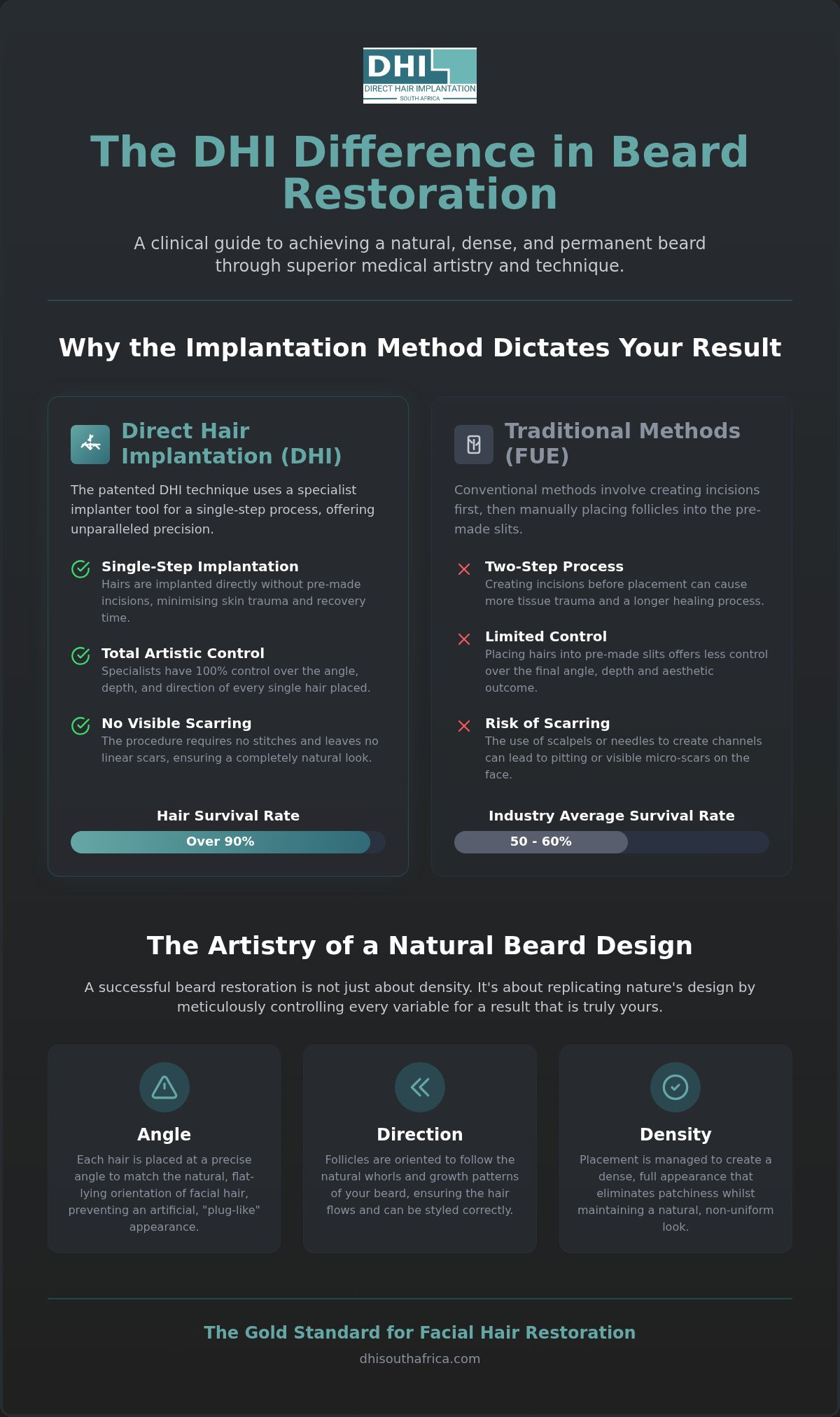
The success of beard restoration surgery depends entirely on how the follicles are handled and placed. Many clinics rely on traditional methods where incisions are made first, followed by the manual placement of follicles. At DHI South Africa, we utilise a patented Direct Hair Implantation technique that eliminates these extra steps. Our method allows for a single-step implantation process, which means each hair is placed directly into the treatment area without the need for pre-made "holes" or slits.
This precision is particularly vital for facial skin, which is thinner and more delicate than the scalp. The DHI Implanter provides our specialists with 100% control over the angle, depth, and direction of each hair. Whilst the industry average for hair survival sits between 50% and 60%, our protocols consistently achieve survival rates of over 90%. This ensures that your investment results in the dense, natural density you expect.
Direct Hair Implantation vs. Traditional FUE
In a standard FUE procedure, a surgeon creates recipient sites before placing the follicles. This two-step approach can lead to unnecessary trauma and potential scarring on the face. Clinical studies on Beard and Moustache Reconstruction highlight that minimising tissue trauma is essential for aesthetic success. By skipping the incision phase, DHI ensures a smoother healing process and a virtually scar-free result.
Because we use your own biological material, a process known as autologous micro-grafting, there is no risk of rejection. You can explore our full range of treatments to see how this technical precision applies to facial restoration. This approach prioritises your comfort and the long-term health of your skin.
The Science of Follicle Survival
Follicle survival is a race against time. Once a hair is removed from the donor area, its viability begins to decrease. Our "Total Care System" ensures that hairs spend the absolute minimum time outside the body. This protects the vital progenitor cells, which are the specialized cells responsible for hair regeneration, and the growth factors that stimulate new growth. We focus on these biological markers to ensure every hair has the best chance to thrive.
Maximum viability: Hairs are kept in a specialised solution to maintain health during the transition.
Single-use instruments: We use high-precision, disposable tools to ensure absolute safety and hygiene.
Certified expertise: Only DHI-certified medical specialists perform the procedure to maintain world-class standards.
The patented DHI Implanter ensures high survival rates by placing hairs with surgical precision, requiring no stitches and leaving no visible traces of the procedure.
Designing the Perfect Beard: The Art of Angle and Density
Designing a beard is fundamentally different from restoring scalp hair. Facial hair grows at a significantly sharper angle, often lying almost flat against the skin. Achieving this requires a level of precision that traditional methods often struggle to provide. During beard restoration surgery, our specialists act as both medical experts and architects, carefully planning a profile that complements your unique jawline and facial structure.
This level of customisation is only possible because our DHI-certified specialists have total control over the placement process. We don't just fill in gaps; we recreate the natural flow of your facial hair to ensure the result is indistinguishable from the hair you were born with. It's a meticulous process that prioritises the subtle nuances of your face.
Controlling the Three Dimensions of Hair Placement
To achieve a result that looks authentic, we focus on three critical pillars during the implantation phase. These dimensions dictate how the hair sits, grows, and feels to the touch. Our specialists follow strict protocols to ensure every hair is positioned with intent.
Angle: Facial hairs must be placed at a very acute angle. If they are inserted too vertically, the beard will look "spiky" or unnatural.
Depth: Every follicle must reach the correct dermal layer to tap into the blood supply. This ensures the hair receives the nutrients it needs to grow strong and healthy.
Direction: We carefully mimic the natural "swirls" and changes in direction that occur across the cheeks, chin, and neck.
By mastering these three dimensions, we ensure that your new beard behaves exactly like natural facial hair. This allows you to groom, trim, and style it with ease as it grows in.
Calculating Your Requirements: How Many Hairs Do You Need?
Every man's vision for his beard is different. Some seek a subtle "low strap" to define their jaw, whilst others aim for a dense, full look. Because we discuss requirements in terms of "hairs" rather than "grafts," you get a much clearer picture of the final density. A typical beard restoration surgery might involve the placement of anywhere from 1,500 to 4,000 hairs, depending on the current coverage and your desired outcome.
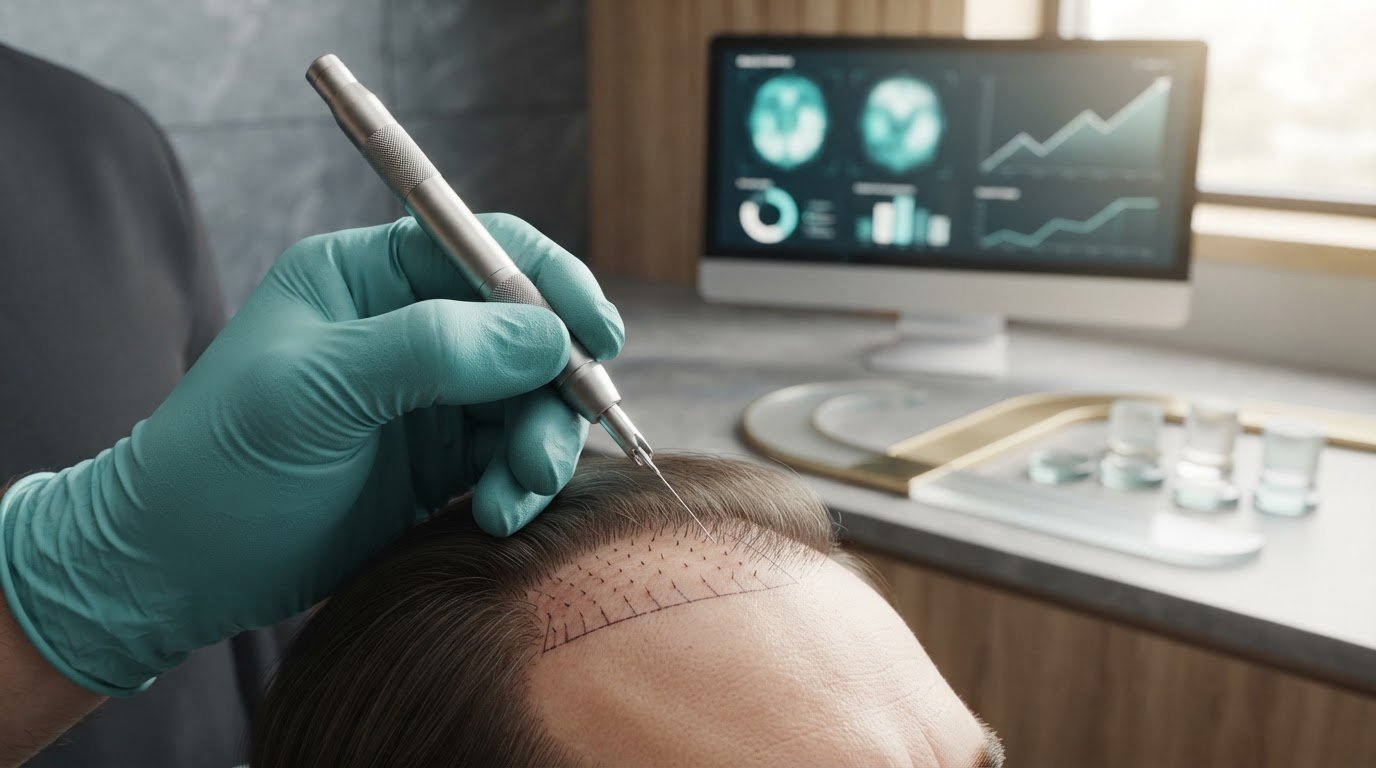
To make this calculation precise, we use digital trichoscopy. This is a high-tech skin and hair analysis that uses specialised cameras to measure your hair density and follicle health. This data-driven approach allows us to plan your procedure with absolute certainty, ensuring we harvest only what is necessary whilst achieving maximum impact. You can see the tangible results of this meticulous planning by viewing our patient transformations.
The Recovery Journey: From Procedure to Permanent Growth
One of the biggest misconceptions about beard restoration surgery is that it requires weeks of hiding away whilst you heal. In reality, the advanced DHI technique is minimally invasive. Because we don't use scalpels or stitches, the trauma to your skin is kept to an absolute minimum. Many of our patients describe the experience as a "lunch-hour" procedure, as they're often able to return to their professional routines almost immediately after leaving the clinic.
It's important to understand the biological cycle your new facial hair will follow. About two to three weeks after your procedure, you'll notice the implanted hairs beginning to fall out. You shouldn't feel alarmed by this. This shedding is a healthy sign that the follicles are transitioning into the anagen phase, which is the active growth stage where new, permanent hair begins to form from the root. Whilst every beard restoration surgery follows a unique path, the timeline for results is remarkably consistent.
The First 48 Hours: Simple Care and Quick Healing
Healing is remarkably swift because the DHI method avoids the large incisions used in traditional FUE. You won't leave the clinic with bandages. Instead, we provide you with a specialised saline spray to keep the newly placed hairs hydrated and clean during the first two days. You'll need to follow a gentle washing routine to protect the follicles as they settle into their new environment.
You might experience some minor tenderness or redness in the treatment area, but this usually subsides within 24 to 48 hours. We prioritise your comfort throughout this window, ensuring you have clear instructions on how to sleep and wash without disturbing the hairs. Most men find that any visible traces of the procedure have vanished within a few days, leaving no scars behind.
The Growth Timeline: What to Expect at 3, 6, and 12 Months
Patience is a vital part of the restoration process. At the 3-month mark, the resting phase ends, and you'll start to see the first fine hairs breaking through the skin. These early hairs will gradually thicken and darken as they mature. By 6 months, significant density becomes visible to the naked eye, and you can begin to see the shape of your new beard line truly taking hold.
The final, permanent result of your restoration is typically achieved at 12 months. By this stage, the hairs have reached their full thickness and the growth direction is fully established. Because these follicles are harvested from areas resistant to genetic thinning, your new beard is designed to remain for life. You'll be able to trim, shave, and style your facial hair with the absolute confidence that it will continue to grow back naturally.
Why DHI South Africa is the Gold Standard for Facial Restoration
Choosing the right clinic for beard restoration surgery is a decision that impacts your appearance and self-assurance for a lifetime. At DHI South Africa, we provide a level of security and clinical excellence that few can match. We're part of a prestigious global network with over 75 clinics worldwide, bringing the world's most advanced restoration protocols directly to you. This global presence isn't just about scale; it's about a shared commitment to the highest medical standards across every continent.
Our protocols are ISO-accredited and align with UK CQC standards, ensuring that every procedure is conducted with surgical precision and absolute hygiene. Unlike many clinics where technicians might handle the delicate work of implantation, we guarantee that only DHI-certified medical specialists perform your procedure. This ensures that the artistry and technical rigour required for a natural facial profile are never compromised, providing you with a safe pair of hands throughout your transformation.
A Global Legacy of Hair Restoration Excellence
The DHI Global Medical Group has a 50-year history of pioneering innovation in the field of hair recovery. We don't just follow industry standards; we set them through our own dedicated training academy. Every specialist undergoes rigorous training to master the nuances of the DHI technique, ensuring a consistent, world-class experience for every patient. You can learn more about our commitment to clinical depth in our detailed exploration of Direct Hair Implantation: The Science of Natural Hair Restoration in 2026.
Your Consultation: Personalised Planning for Permanent Results
The journey toward a fuller, more masculine beard begins with a comprehensive, professional consultation. We don't believe in one-size-fits-all solutions. Instead, we use digital hair analysis to create an accurate, data-driven treatment plan tailored to your specific needs. This diagnostic phase allows us to assess follicle health and donor density with scientific accuracy, ensuring your beard restoration surgery delivers the exact profile you've envisioned.
During this session, we'll discuss your aesthetic goals and provide a transparent overview of what to expect. It's a chance to have your questions answered by a specialist who understands the emotional and physical aspects of hair restoration. We invite you to take that first step toward a more confident version of yourself by speaking with our expert team.
Reclaim Your Profile with Scientific Precision
Achieving a full, natural beard is no longer a matter of waiting on genetics or hoping for a change. Through advanced beard restoration surgery, you can transform patchy growth into a well-defined masterpiece that perfectly complements your unique facial structure. Our patented DHI technique ensures that every hair is placed with absolute control over its angle and direction, resulting in a seamless finish without the need for stitches or the risk of visible scarring.
With over 50 years of global medical expertise behind us, our specialists consistently achieve hair survival rates exceeding 90%. This ensures that your results are both dense and permanent, backed by world-class safety protocols and meticulous clinical artistry. You're not just choosing a medical procedure; you're choosing a definitive restoration of your self-assurance and masculine profile.
We're here to guide you through every step of this life-changing transformation with the care and precision you deserve. Your journey toward a fuller, more authentic version of yourself starts with a single conversation.
Frequently Asked Questions
Is beard restoration surgery painful?
The procedure is minimally invasive and performed under local anaesthetic to ensure you remain comfortable throughout. Because the DHI technique requires no scalpels or stitches, there is none of the post-operative pain typically associated with older methods. Most patients find the experience relaxing and can even watch a film or listen to music whilst our certified specialists work. Any minor tenderness usually subsides within 48 hours.
How many hairs will I need for a full beard?
The number of hairs required is entirely unique to your facial structure and aesthetic goals. A subtle refinement might require 1,500 hairs, whilst a full "lumberjack" profile could involve the placement of up to 4,000 hairs. We use digital trichoscopy during your consultation to measure your donor density and calculate the exact requirement. This scientific approach ensures we achieve your desired density whilst maintaining a natural look.
Will the results of my beard transplant look natural?
Yes, the results are designed to be indistinguishable from your natural facial hair. Our patented DHI Implanter gives the specialist 100% control over the angle, depth, and direction of every hair placed. This level of precision is vital for beard restoration surgery, as facial hair grows at a much sharper angle than scalp hair. By mimicking your natural growth patterns, we ensure a seamless and authentic profile.
Can I shave my transplanted beard?
You can treat your new beard exactly like the rest of your facial hair once the follicles are fully established. After the initial 12-month growth cycle, you're free to shave, trim, or style it as you please. Because these are your own healthy hairs, they will continue to grow back naturally after every shave. This allows you to maintain whatever look fits your personal style throughout your life.
Where do the hairs for the beard restoration come from?
We use your own biological material, a process known as autologous micro-grafting, to eliminate the risk of rejection. The hairs are typically harvested from the back or sides of your scalp, where the follicles are genetically resistant to thinning. These hairs are chosen because they are hardy and capable of thriving in their new location. This ensures that your beard restoration surgery provides a permanent and natural-looking result.
How much does a beard transplant cost in South Africa?
The investment for a restoration procedure varies based on the complexity of the design and the total number of hairs required. Because every face is different, we don't provide a one-size-fits-all price. Instead, we offer a professional consultation where a specialist can assess your needs and provide a tailored treatment plan. This ensures you receive a clear, transparent breakdown of the costs specific to your unique restoration journey.
Are the results of a beard restoration permanent?
The results are permanent because we transplant follicles that are genetically programmed to grow for a lifetime. Once these hairs have successfully transitioned through the resting phase and begun their active growth, they will behave just like your original facial hair. Our survival rates exceed 90%, which is significantly higher than the industry average. This longevity makes the procedure a definitive solution to lifelong insecurities about patchy or thin growth.
What is the recovery time after a DHI beard procedure?
There is virtually no downtime associated with our specialised protocols. Many patients describe it as a "lunch-hour" procedure because they can return to their daily routines almost immediately. Whilst you might notice some minor redness or small crusts in the treatment area for the first 48 hours, these clear up very quickly. We provide a comprehensive after-care plan to ensure your skin heals smoothly and your new hairs thrive.


Comments