

Cost of 1000 grafts in South Africa or Istanbul: Which to choose

The lower headline price may not mean the lower overall cost. The cost of 1000 grafts in South Africa depends on factors such as the extent of hair loss, donor-hair quality and the procedure planned, so there isn’t one fixed price for everyone. To compare domestic treatment with international options fairly, look at the full cost and what the quoted fee covers, not just the surgery figure.
It’s understandable to focus on the price when you’re weighing a procedure at home against travelling abroad. But surgery-only fees and all-inclusive packages can cover different things, which makes a like-for-like comparison important. The headline figure alone may not show the full financial commitment.
This article explains how to assess treatment options, what can affect a procedure fee and how to distinguish surgery costs from wider travel and accommodation expenses. It also explains why graft count is only one part of planning, helping you compare the costs and care involved more clearly.
Table of Contents
Hair Transplant in South Africa - or Istanbul?
Compare South African and Istanbul options by the planned hair placement and the full quote. Graft counts remain useful when a clinic prices surgery by graft, but they don’t show how many hairs a plan places. For facial procedures, the treatment area and design also shape the comparison.
South African Clinic Transplant Prices
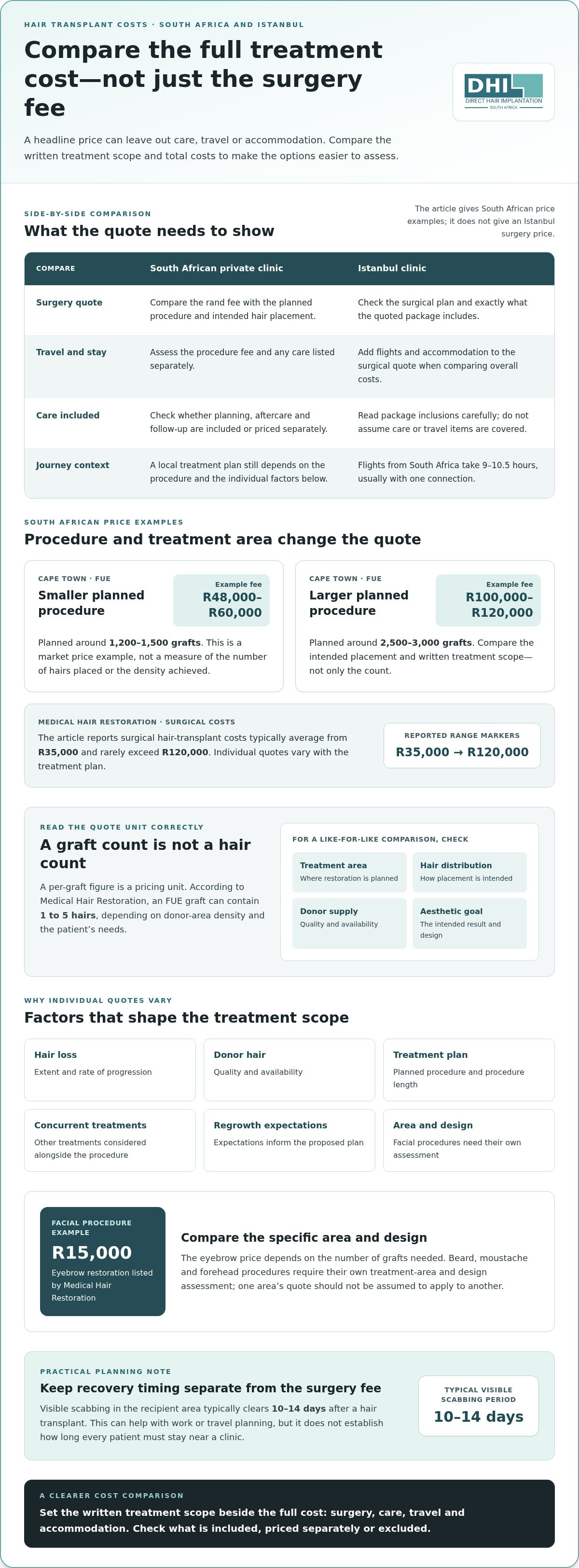
South African private-clinic quotes vary by procedure and treatment area. In Cape Town, an FUE procedure planned around 1,200 to 1,500 grafts costs R48,000 to R60,000; a 2,500 to 3,000-graft procedure costs R100,000 to R120,000. These are market price examples, not a measure of how many hairs will be placed or the density achieved.
For facial work, Medical Hair Restoration lists eyebrow restoration at R15,000, depending on the number of grafts needed. Beard, moustache and forehead procedures require their own treatment-area and design assessment. Compare the intended placement and coverage, rather than assuming one area’s quote applies to another.
Overall Surgical Costs and Quote Factors
Medical Hair Restoration says surgical hair-transplant costs typically average from R35,000 and rarely exceed R120,000. An individual quote reflects the planned procedure, the extent and rate of hair loss, donor-hair quality and availability, concurrent treatments, regrowth expectations and procedure length. These factors shape the treatment scope and the distribution of hairs.
South Africa and Istanbul also differ in the practical costs around treatment. Flights from South Africa to Istanbul take 9-10.5 hours, usually with one connection. Compare travel and accommodation alongside the surgical quote, and assess what care each estimate includes.
Hair Transplant Price per Graft
A per-graft figure is a pricing unit, not a count of hairs. According to Medical Hair Restoration, an FUE graft can contain 1 to 5 hairs, depending on donor-area density and the patient’s needs. Therefore, two quotes using the same graft count may represent different numbers of hairs and different placement plans.
Compare the treatment area, planned hair distribution and donor supply, as well as the fee. Ask how the proposed plan addresses your aesthetic goal. This puts a graft-based price in context without treating graft count as a direct measure of coverage.
Choose by comparing the written treatment scope, intended hair placement and total travel costs; details of hair transplantation in South Africa are available online.
Services and care included in the procedure fee
A hair transplant fee may cover surgery alone or a broader set of services. Compare the written inclusions, not just the total: planning, the procedure, aftercare and follow-up may be listed separately. This distinction matters when comparing treatment in South Africa with a package abroad, which may also include travel-related items.
Use a simple comparison list for each estimate. Record whether it covers the procedure, care around it, or travel and accommodation. Then note which items are included, priced separately or excluded. This makes different quotes easier to assess without assuming a particular service is included as standard.
Planning: Note whether the proposed recipient area, donor-hair quality and availability inform the treatment plan.
Procedure: Check that the estimate describes the planned surgical work and the procedure length.
Care: Separate any stated aftercare or follow-up from the surgery-only fee.
Travel: For Istanbul, add flights and accommodation when comparing the overall cost with local treatment.
Procedure duration is one factor that can affect transplant costs. Hair-loss severity and progression, concurrent treatments, donor-hair quality and availability, and regrowth expectations can also shape an individual plan. For example, someone with more extensive hair loss may need a different treatment scope from someone seeking restoration in a defined area.
Length of stay is a separate planning question from the surgical fee. A local patient and someone travelling for treatment have different arrangements to consider. The schedule depends on the procedure plan and any travel itinerary. Don’t treat accommodation as part of the surgical price unless the quote explicitly includes it.
Aftercare timing can also affect practical planning. Visible scabbing in the recipient area typically clears 10-14 days after a hair transplant. That period helps you consider how the recovery phase fits around work or travel, but it does not establish how long every patient must stay near a clinic.
For a useful comparison, group every line into surgery, care and travel. Check whether the plan accounts for hair-loss severity, donor supply, concurrent treatments, expected regrowth and procedure length. These factors explain why two people asking about the same graft count may receive different plans, and why a package total must be read alongside its inclusions.
To explore how different approaches may fit a hair-restoration plan, review hair restoration treatment options.
Comparing surgery-only prices with all-inclusive costs
A surgery-only figure and an all-inclusive total answer different budget questions. South African surgical hair-transplant costs typically average from R35,000 and rarely exceed R120,000. A Cape Town FUE estimate for 1,200 to 1,500 grafts is R48,000 to R60,000, while 2,500 to 3,000 grafts is R100,000 to R120,000.
Treat advertised figures as market context, not as a like-for-like comparison. A surgical price may cover the medical procedure, while a package total may also include travel-related items. The label alone doesn’t establish what’s covered. Read the itemised quote to distinguish the surgical fee from costs related to the trip.
Build a comparison in South African rand by recording each amount in its own category. Keep the surgery fee separate from flights, accommodation, local transport and other travel expenses. This prevents a lower headline figure appearing cheaper simply because it excludes costs shown together in another quote.
Surgical fee: Note the procedure and planned graft range shown in the quote.
Travel: Record the flight and accommodation costs for an Istanbul trip.
Care: List any medical services or follow-up items included in the written estimate.
Total: Add the separate amounts in Rand before comparing the final budgets.
For example, compare a Cape Town FUE estimate for 1,200 to 1,500 grafts with an Istanbul offer by placing each surgery fee beside its travel costs. Then compare the combined totals and the listed care. Doctors’ roles and the described medical plan matter too: a price comparison can’t show whether two offers describe the same procedure or treatment scope.
Check whether each estimate identifies the planned work, graft count and what the surgical fee covers. A package may group costs together, while a procedure-only estimate may list them separately. Neither format shows the full financial commitment until you compare the same categories on both sides.
Choose by comparing the complete Rand total alongside the written medical scope, rather than selecting the lowest headline amount. For a patient weighing local treatment against Istanbul, that step makes the difference between comparing a procedure price and comparing the cost of the whole journey.
Clinic contact and quote enquiries
A consultation is essential for an accurate hair-transplant cost. A request based only on “1,000 grafts” gives limited context for clinical planning. The specialist also needs to understand the area affected by hair loss, the desired aesthetic change and donor-hair availability. Those details help shape a personalised restoration plan and a more meaningful quote.
Before an enquiry, write down what you want to address. For example, note whether you’re concerned about a receding hairline, thinning crown or more widespread loss. Describe how long you’ve noticed the change and whether it seems to be progressing. These details give a consultation a clear starting point without assuming one technique suits everyone.
Prepare a concise list of questions. Ask what the proposed procedure covers, how the plan relates to the donor area, and which costs sit outside the surgical fee. If you’re comparing South Africa with Istanbul, request the surgery amount separately from travel-related expenses. That lets you compare like with like, rather than relying on different package labels.
State the area you want assessed, such as the hairline or crown.
Share the graft estimate you’re considering, while treating it as a starting point.
Ask how the clinical plan accounts for donor-hair quality and availability.
Request a clear breakdown of surgery, care and any travel costs.
Keep each written estimate so you can compare scope and totals.
A quote should connect the proposed technique to the clinical assessment, not simply repeat a requested graft number. Hairline restoration may need a different design from crown work. The assessment also considers hair-loss severity, donor supply, regrowth expectations, concurrent treatments and procedure length. Each factor can change the planned work and its cost.
Use the consultation to clarify the terms in your estimate. For example, ask whether “procedure fee” means surgery alone or includes specific care. Note any follow-up arrangements stated in writing, and keep them separate from flights or accommodation. A clear breakdown helps you understand what the total represents before comparing options.
Bring your questions to the consultation, then review the proposed plan and cost categories afterwards. If the estimate changes from the initial enquiry, compare the reasons with the assessment details. A revised graft plan, different treatment area or finding about the donor area may explain the change. This keeps your decision grounded in your clinical needs, not just a headline number.
Number grafts
A graft count is a unit used in transplant estimates, but it doesn’t describe the number of hairs on its own. According to Medical Hair Restoration, an FUE graft can contain 1 to 5 hairs, depending on donor-area density and the patient’s needs. So two plans with the same graft count may place different numbers of hairs. Ask how the estimate relates to the hairs planned for your recipient area.
Planning starts with the area to be treated and the appearance you’re aiming for. For a hairline, hair placement and direction shape the outline. For a crown, the thinning pattern guides how coverage is distributed. The number of hairs is only one part of the plan. Existing hair and available donor supply also affect where and how placement can be planned.
According to Medical Hair Restoration, most FUE patients start at 1,000 grafts or above. That is a market reference for the procedure unit, not a recommendation that every patient needs the same amount. For example, a patient focused on a defined area may have a different plan from someone with hair loss across a wider part of the scalp.
Donor-area density also influences what can be planned. According to Medical Hair Restoration, a 3,000-graft transplant is estimated to cover 60 to 75 square centimetres. This is an area estimate, not a measure of the final hair density. The way hairs are distributed across that area depends on the treatment design and the patient’s existing hair.
Clarify the unit: Find out whether an estimate counts grafts, hairs or both.
Discuss placement: Ask how hairs will be distributed across the treatment area.
Consider donor supply: Donor density affects the composition and availability of grafts.
Relate the count to the goal: Compare the planned hair placement with the area you want treated.
For a meaningful comparison, look beyond the graft total. Consider the planned distribution of hairs, the area being addressed and the available donor supply. These details show why a quoted graft count is a planning unit, not a complete description of the intended aesthetic result.
DHI South Africa: Direct Hair Implantation (DHI)
DHI South Africa offers Direct Hair Implantation (DHI) for people considering surgical hair restoration. A consultation gives you the opportunity to discuss your hair-loss pattern, goals and suitable approach. The focus is your individual plan, not graft count alone.
Hair loss doesn’t always call for a transplant. Depending on your needs, options also include GFC Treatment, Regenera Activa and PRP Hair Loss Treatment. These are distinct treatments, so your consultation can focus on the support you’re seeking and whether a surgical or non-surgical approach is relevant.
Use the discussion to talk through your priorities and understand the next steps for assessment. Contact DHI South Africa to discuss your hair-restoration needs.
Make your next step a considered one
Choosing where to have hair restoration is not simply a matter of selecting a destination. Use your next conversation to move from estimates to a decision that reflects your priorities: the treatment approach, the clinical plan and how you want care organised around everyday life. This makes the cost of 1000 grafts in South Africa a useful starting point, rather than the only measure guiding you.
Bring forward the questions that matter most. Ask for an assessment of your hair-loss pattern, a recommended approach and a written explanation of the proposed plan and quote. Consider your priorities, including staying close to home or arranging travel, and ask for a clear explanation of the clinical approach. A focused discussion turns those priorities into a practical next step.
Take the time you need to make a decision that feels right for you. A clear plan gives you a considered foundation for moving forward.
Frequently Asked Questions
How long do I need to take off work?
Plan time away around your work duties and the clinic’s aftercare instructions. A desk-based role may be easier to manage than work involving strenuous activity, close public contact or protective headwear. Before booking, discuss your usual schedule and any important work commitments during recovery. This helps you make practical arrangements without treating a general recovery timeline as a fixed period of leave.
What is included in the price?
Your quote should state which parts of treatment and care it covers. Check the procedure, any stated aftercare or follow-up, and costs listed separately. A travel package and a surgery-only fee, for example, cover different budget categories. Keep them distinct and compare quotes based on the same services, not the package name or headline total.
Which Technique is Used?
DHI South Africa performs Direct Hair Implantation (DHI), using FUE to extract follicles before implantation. Certified doctors perform the procedure under local anaesthesia, and it is described as practically painless. Ask the clinic what the procedure involves and whether shaving is required in your case. Ask how the technique relates to your treatment goals and planned hair placement.
What is the average cost of 1,000 hair transplant grafts in South Africa?
There isn’t one average price that applies specifically to 1,000 grafts. Medical Hair Restoration says surgical hair-transplant costs typically average from R35,000 and rarely exceed R120,000, but this is an overall procedure range, not a 1,000-graft tariff. Your estimate depends on the technique, planned work, donor-hair quality and treatment area. Compare the written scope alongside the Rand amount.
What is the typical price range for 1,000 hair grafts in Johannesburg, Cape Town, and Durban?
Price comparisons between Johannesburg, Cape Town and Durban need the same treatment scope and pricing unit. The available Cape Town market examples cover procedures planned for larger graft ranges, rather than a specific 1,000-graft quote. For any city, compare the planned hair placement, procedure and fee inclusions. That makes the Rand estimates more useful than comparing location names or headline prices alone.
Do South African hair transplant clinics charge per graft or use fixed package pricing?
Both pricing approaches appear in the market. A per-graft or per-follicle quote uses a unit to calculate the surgical fee, while fixed pricing gives a procedure or package total. The unit doesn’t tell you how many hairs will be placed, as grafts can contain different numbers of hairs. Check the pricing basis before comparing totals.
How do FUE and FUT hair transplant costs compare in South Africa for 1,000 grafts?
The pricing unit can differ by technique: FUE is usually priced by individual follicle, while FUT is usually priced per graft. That makes a direct comparison of 1,000 units misleading unless both estimates describe the same scope and clarify their units. Compare the planned hair placement, surgical work and any separately listed care. This explains the fee structure without treating the two units as equivalent.
What is included in a 1,000-graft hair transplant price in South Africa?
A 1,000-graft estimate should identify the procedure and explain which services the quoted amount covers. Look for any stated planning, aftercare or follow-up, and distinguish these from travel or accommodation costs. The estimate should also make clear whether it uses grafts or individual follicles as its pricing unit. That detail helps you understand what the Rand total represents before comparing it with another quote.



Comments