

DHI Hair Transplant Results: Growth Stages and Long-Term Growth

The long-term results of a DHI procedure usually reach final maturity 12-18 months after treatment. Early shedding can be part of the growth cycle, with new hair commonly beginning to appear around month three. The change is gradual, so the first few weeks don’t show what the finished result will look like.
Waiting through the quieter stages can feel unsettling, especially when you’re looking for signs that transplanted hair is taking. Understanding the timeline helps you know what may happen next and why progress can look uneven before fuller growth develops.
This article explains the stages from the initial healing period to longer-term growth, and what graft survival means for lasting results. It also looks at how DHI compares with FUE and how careful placement, hair direction and a thoughtfully designed hairline contribute to a natural-looking outcome.
Table of Contents
Natural-looking hair placement and direction
The number of hairs planned for DHI depends on the area being restored, your existing hair pattern and donor supply. Temple recession calls for a different plan from broader crown coverage. Planning focuses on the hair needed for the intended appearance, rather than treating one count as suitable for every stage of hair loss.
A natural result depends on how each hair follows the surrounding growth pattern. At the frontal edge, placement can create a softer transition; behind it, direction and spacing should blend with existing hair. A hairline designed without considering the temples, for example, may look disconnected from the side.
Density is also an aesthetic consideration. The plan should account for hair thickness, the size of the recipient area and the direction in which your hair naturally lies. A narrow frontal area and a broad crown have different coverage needs, even when both are included in the same restoration plan.
The visible timeline can help you interpret changes without treating the early appearance as the final result. In the first days, short stubble, redness and small crusts may be present. Transplanted shafts can then shed, making the scalp look less covered before new growth appears.
New hairs can emerge unevenly and vary in texture. Fine strands, for instance, may look different from established hair until they gain length. Comparing the front, temples and crown separately gives you a more useful view than judging the entire scalp from a single photograph.
Hair thickness affects how much scalp is concealed. Coarser hair may provide more visual coverage than finer hair at a similar length, while styling can also change the appearance of density. Your plan should therefore consider your hair’s characteristics, not just the number of hairs placed.
A balanced design also considers the relationship between the recipient area and surrounding native hair. If the frontal edge is planned in isolation, changes in nearby hair can affect how well the result blends. Reviewing the hairline from the front and both sides helps assess how it fits the overall pattern.
Photographs can help you understand how placement looks across different cases, provided you consider the area treated and the stage shown. The hair transplant results gallery provides examples to view alongside your own goals and hair characteristics.
There is no single graft count for each stage of hair loss. The plan depends on the area being restored, your existing hair pattern and donor supply. Temple recession and broader crown coverage have different needs, so the intended appearance and your hair’s characteristics guide the number planned.
What are the dhi hair transplant growth stages month by month?
When assessing DHI, look for a clear medical assessment, treatment plan and aftercare process. Ask who performs the procedure, how donor suitability is evaluated and how progress will be monitored. At DHI South Africa, procedures are performed exclusively by trained, certified doctors.
Transplanted follicles from the permanent donor area retain genetic resistance to pattern thinning. This can support lasting growth, but it does not make every hair on your scalp resistant. Transplanted hair may remain while native hair around it gradually changes, affecting how evenly the overall result appears.
Shedding after a transplant can involve the hair shaft rather than the follicle beneath the skin. The visible strand may fall out as the follicle adjusts to transplantation, so seeing shed hairs does not, by itself, show whether the follicle has survived. Distinguishing shaft shedding from follicle loss can make early changes easier to interpret.
Shock loss describes temporary shedding that can affect transplanted or nearby native hair after surgery. These are different observations: one concerns the implanted area, while the other can involve existing hair nearby. If a patch looks thinner, its location and whether it contains transplanted or native hair are useful details for clinical follow-up.
Minoxidil and finasteride act on native hair rather than shortening the growth cycle of transplanted hair. Finasteride lowers scalp levels of dihydrotestosterone, a hormone that can shrink follicles in pattern hair loss. Whether either medicine suits your care plan depends on your circumstances, its intended role and a clinician’s assessment.
Non-surgical hair-loss treatments offer an alternative to transplantation, although they work differently. PRP and GFC treatments, for example, do not implant follicles into an area. This distinction matters if your priority is adding hair to a specific region rather than taking a non-surgical approach to hair loss.
Month-by-month records can help distinguish changes in transplanted hair from progression in native hair. Keep follow-up images organised by date and scalp area, such as the frontal region, temples and crown. This gives your clinician a clearer basis for discussing changes than relying on memory or a single photograph.
A clinic’s explanation of follicle permanence, shedding, native-hair changes and treatment alternatives should connect those factors to your own pattern of loss. The hair transplant approach is easier to assess when the proposed plan also explains how progress will be reviewed.
DHI graft survival and long-term growth
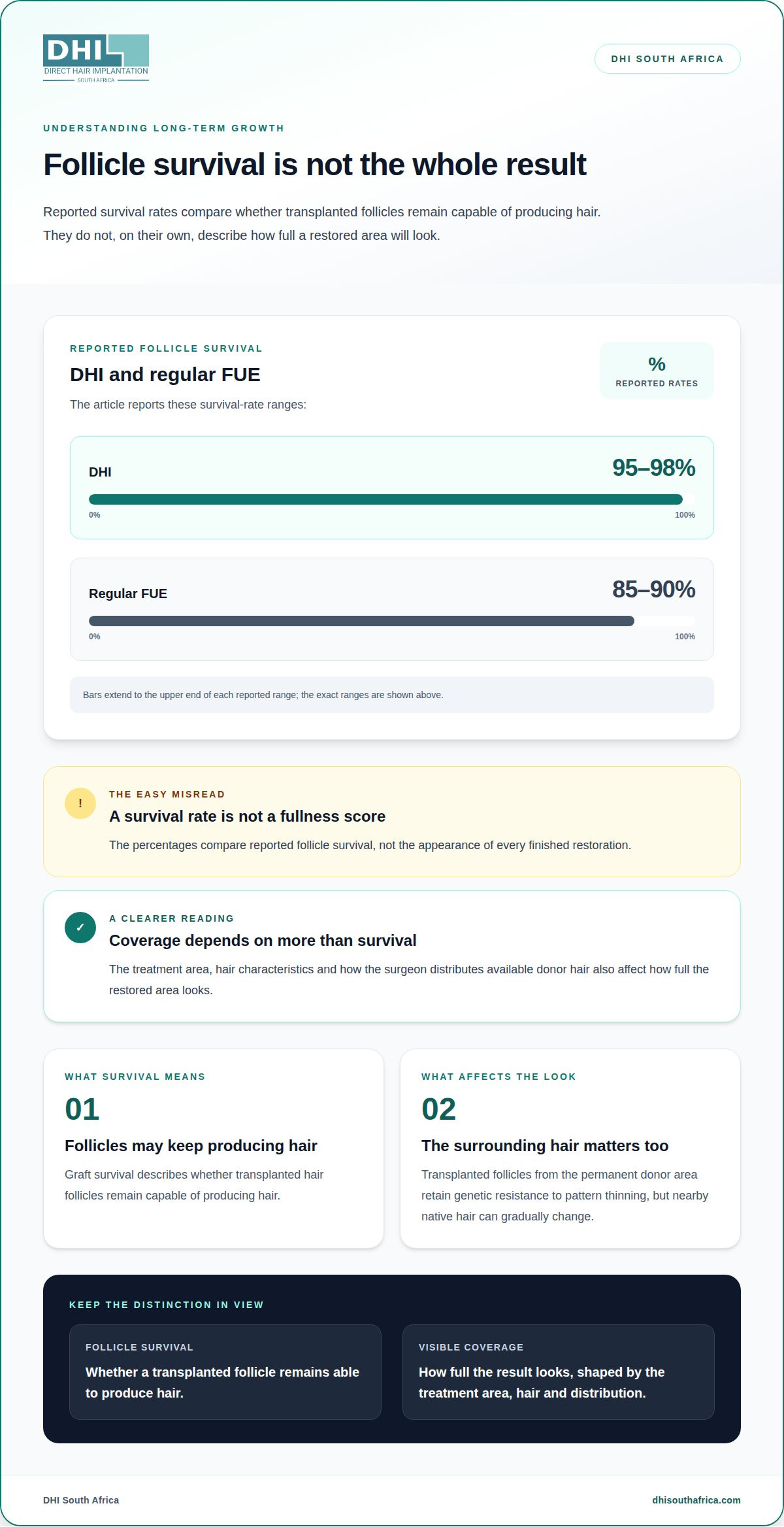
Graft survival describes whether transplanted hair follicles remain capable of producing hair. It contributes to the outcome, but does not, by itself, describe how full the restored area will look.
Reported survival rates are 95-98% for DHI and 85-90% for regular FUE. These figures compare reported follicle survival, not the appearance of every finished restoration. Coverage also reflects the treatment area, hair characteristics and how the surgeon distributes available donor hair.
Progress during months three to six
Growth progress is the change from newly emerging hairs to strands that provide more visible coverage. Hair can emerge at different rates and lengths, so an area may look uneven during this phase. The useful measure is whether the treated region is developing in context, rather than whether every follicle appears equally active.
Crown and hairline growth
The crown and hairline can create different visual impressions, even when both contain surviving follicles. Hair direction, styling and the shape of the area affect how much scalp shows through. Apparent coverage at the front does not automatically predict how dense the crown will look.
Survival and density are related, but they are not interchangeable. Survival describes follicles that continue producing hair; density describes how much hair appears across an area. An area can show continued growth yet look less covered than expected if the recipient area is broad or the hair is fine.
Follicle characteristics also influence the visible result. Hair thickness, colour contrast against the scalp and natural curl can change how much coverage the same arrangement provides. These features are considered when planning restoration, rather than treating every surviving follicle as visually identical.
Implantation is one part of survival. The condition of donor follicles, their handling between extraction and placement, and the recipient site all matter. A careful plan also considers how many follicles the donor area can provide without compromising its appearance.
Aftercare supports the treated area while it heals. Follow the clinic’s instructions for washing, scalp contact and activity instead of improvising based on general advice. Rubbing or picking at crusts, for instance, can disturb healing skin, so handle the area gently and follow the directions provided for your procedure.
Long-term assessment should consider the treated area alongside surrounding native hair. A doctor can interpret photographs and clinical observations together, distinguishing changes in coverage from changes in styling or hair length. This broader view makes graft survival more meaningful as one part of your overall outcome.
Natural-looking implantation and hairline design
A natural appearance depends on more than the number of follicles implanted. DHI is a patented, minimally invasive technique that uses a DHI Implanter Tool to control the angle, depth and direction of placement. These decisions help transplanted hair follow the surrounding growth pattern rather than form an obvious line.
The DHI technique uses a Choi Implanter Pen to place follicles into the recipient area. The pen is designed to make incisions measuring 0.6mm to 0.9mm in diameter, and to insert grafts at an angle of 40 degrees. These are features of the instrument, not a promise that every hairline or scalp requires identical placement.
Hairline planning begins with the face and existing hair pattern. A straight, sharply defined edge can look less natural than a design that follows your features and allows for irregularity. The doctor also considers how hair grows behind the hairline, so the transition into denser areas looks coherent.
Direction matters at the temples, frontal edge and mid-scalp. Hairs at the temples, for example, generally grow at a different angle from those near the centre of the forehead. Matching these patterns helps hair sit naturally when worn short, brushed forwards or parted to one side.
Density needs similar care. DHI implantation can achieve 60-80 follicular units per square centimetre, while natural hair density is 80-100 follicles per square centimetre. These measures use different terms, so they shouldn’t be treated as an exact comparison. The design balances coverage with the available donor hair.
A higher concentration of implants is not automatically best for every area. At the frontal hairline, spacing and direction influence how the edge frames the face; across the crown, the natural swirl changes the direction required. The planned pattern should account for both areas rather than apply one uniform layout.
Planning also considers how the appearance may change as hair loss progresses. A hairline designed too low or too dense can become harder to blend if native hair behind it continues thinning. The treatment plan therefore weighs present coverage against the surrounding pattern and donor supply.
During DHI, a certified doctor uses the patented Implanter Tool for precise follicle placement. The aesthetic result still depends on the design decisions behind each insertion. Reviewing the hairline from the front and both sides, then mapping direction across the recipient area, helps create a consistent plan. Careful placement makes the technique serve your features, not dictate them.
What does DHI hair transplant before and after results look like over time?
Before treatment, photographs record the hairline, temples, mid-scalp and crown as separate areas. After a DHI transplant, the first visible changes are not the final outcome: swelling, redness, short stubble and small crusts can affect the scalp’s appearance during the first 10 days. Comparing photographs from matching angles helps distinguish healing from later growth.
During the first six weeks, transplanted hair shafts usually shed. This can make a post-treatment photograph look less full than expected, even while follicles remain beneath the skin. The early shedding stage is not a useful time to judge final density or coverage.
New growth commonly begins around month three, then develops unevenly. At month six, most people see about 60% of new hair growth by six to nine months after a transplant, according to MedlinePlus. Short hairs can provide less visual coverage than longer strands, so a photograph at this stage may show progress without reflecting the eventual result.
By month nine, transplanted hair is mostly visible and established. The front and mid-scalp can appear further along than the crown, where density assessment may be delayed until 18 months after the procedure. A before-and-after comparison should therefore note which scalp area is shown and how much time has passed.
At the 12-month mark, most DHI patients are reported to have achieved 90-95% of their final results. The NHS notes that a hair transplant’s full result can take a year or more to appear. For the long-term results of a DHI procedure, the 12-month photograph is a useful milestone, but crown development can continue beyond it.
Comparisons between techniques need the same care. DHI results at six months are described as comparable to FUE results at 10-12 months. This is a comparison of reported timelines, not proof that every patient will develop at the same pace or achieve identical coverage. Differences in area treated, hair characteristics and growth pattern affect how photographs look.
At the two-year mark, reported patient satisfaction after DHI treatment is 90-95%. Satisfaction and visible density measure different things: one reflects patients’ assessments, while photographs show hair coverage under particular lighting and styling. Reviewing both time points can provide a fuller picture than relying on a single image.
For a fair visual comparison, use photographs taken from the same angles, with similar lighting and hair length. Compare the hairline, mid-scalp and crown separately, and record the interval since treatment. A six-month image and a 12-month image show different stages, not competing versions of the same result.
DHI South Africa
DHI South Africa helps you consider hair restoration options in relation to your hair loss and goals. If you’re weighing the long-term results of a DHI procedure, you can discuss Direct Hair Implantation (DHI) alongside non-surgical options such as GFC Treatment, Regenera Activa and PRP Hair Loss Treatment. DHI is performed under local anaesthesia, is practically painless and does not require full shaving.
Get in touch to discuss your hair-loss pattern, what contributes to a natural-looking result and how growth may develop over time. The right approach depends on factors such as the areas affected and the condition of your existing hair. A consultation with a certified doctor can help clarify which treatment options suit your situation.
Make your next step an informed one
Understanding the long-term results of a DHI procedure is one part of deciding whether hair restoration fits your priorities. Consider what you want to change, how you feel about gradual progress and what questions would help you make an informed decision. A clear discussion can turn general expectations into a more personal understanding of your options.
Your hair-loss pattern, donor area and existing hair all shape treatment planning. Your individual outcome depends on these factors, so discuss how they apply to you before choosing a path. There is no need to rush: a considered decision starts with feeling comfortable with the information in front of you.
If you’d like to talk through your hair restoration options, you can contact DHI South Africa.
Take the next step at your own pace, with a clearer understanding of what matters to you.
Frequently Asked Questions
How Long Does It Take for Hair to Grow After DHI?
New hair commonly starts emerging around three months after DHI, although visible progress varies across the scalp. MedlinePlus reports that most people see about 60% of new hair growth by six to nine months after a hair transplant. If you’re tracking your progress, compare photographs taken from similar angles and under similar lighting, rather than relying on day-to-day changes.
Is DHI good for hairline restoration?
DHI can be used for hairline restoration, where placement direction and the transition from the forehead to denser hair matter. The design should take account of your facial proportions, existing growth pattern and the hair behind the proposed line. A hairline planned without considering future thinning in nearby native hair, for example, may become harder to blend as that hair changes.
What are the long-term results of DHI hair transplantation after 1, 5, and 10 years?
At one year, results are approaching maturity, while crown development may continue for longer. At five and ten years, the appearance reflects both transplanted hair and any changes in surrounding native hair. Donor-area follicles retain genetic resistance to pattern thinning, but this does not prevent untreated hair elsewhere from thinning. Long-term photographs are most useful when compared with the original images.
How many transplanted DHI grafts survive long term, and what affects graft survival?
Reported DHI graft survival is 95-98%, compared with 85-90% for regular FUE. Survival figures don’t tell you how dense the finished area will look: coverage also depends on the recipient area, donor supply, hair characteristics and placement plan. For example, the same number of surviving follicular units can create different visual coverage across a small hairline area and a broader crown.
Does transplanted DHI hair continue growing permanently, and can hair loss progress around it?
Transplanted follicles from the permanent donor area retain genetic resistance to pattern thinning and can continue producing hair. However, this resistance applies to the transplanted follicles, not all the hair on your scalp. Native hair around the treated area can continue to thin, changing the contrast between transplanted and untreated areas. A long-term plan should consider both the recipient area and surrounding hair.
What are the long-term risks and complications of DHI hair transplantation?
Possible early changes include scalp redness, small crusts and temporary swelling. Serious infections occur in less than 1% of hair implantation surgeries. These figures describe reported complications, not a prediction for an individual. Follow the aftercare instructions provided for your procedure, and tell the treating team about symptoms that concern you. The condition of your scalp and the healing process are relevant to follow-up care.
How does DHI compare with FUE and FUT for long-term results?
DHI and FUE differ in how follicles are implanted, and reported survival rates are 95-98% for DHI and 85-90% for regular FUE. FUT uses strip harvesting, so its extraction approach differs from those methods. Long-term appearance also depends on donor hair, placement and continuing changes in native hair. A comparison should consider the planned coverage and growth pattern, not technique names alone.
What is the DHI recovery timeline, and when are final results visible?
The first days involve visible healing, with short stubble, redness or small crusts possible during the 0-10-day immediate stage. Gentle washing can typically begin 48 to 72 hours after the procedure. New growth commonly appears around month three, while final maturation may take 12-18 months. These milestones help set expectations, but the crown can take longer to assess than the frontal area.


Comments