

GFC vs PRP for Hair Loss: Compare Results and Recovery

GFC may offer a stronger growth-factor concentration, but it isn’t automatically the better choice for every type of hair loss. If you’re weighing up which is better, GFC or PRP, the answer depends on factors such as remaining follicles, comfort and the results you’re hoping to achieve.
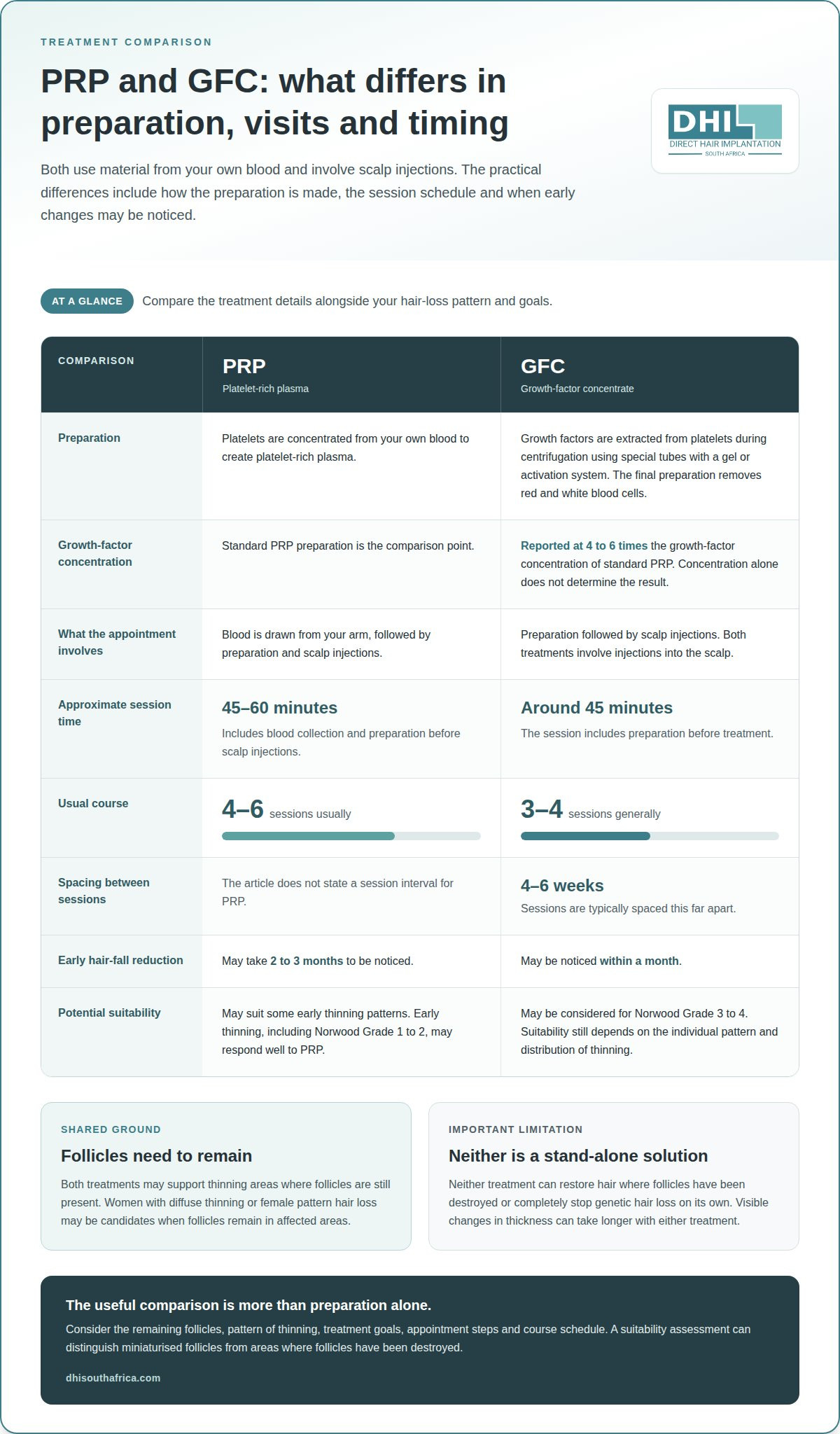
It’s understandable to want a clear timeline before choosing a treatment. Hair fall reduction after GFC may be noticed within a month, while PRP may take 2 to 3 months; visible changes in thickness can take longer with either treatment.
This comparison explains how the treatments differ in preparation, growth-factor concentration and recovery, as well as their potential benefits and limitations. You’ll also learn what to expect from regrowth timelines, and why neither treatment can restore hair in areas where follicles have been destroyed or completely stop genetic hair loss on its own.
Table of Contents
PRP vs GFC Treatment: Which is Better for Hair Regrowth?
Neither treatment is automatically better for every person experiencing hair loss. The useful comparison is whether it suits your hair-loss pattern, remaining follicles and restoration goals.
Both treatments are intended to support thinning areas where follicles remain. Neither can restore hair where follicles have been destroyed or completely stop genetic hair loss on its own.
How PRP and GFC treatments work
Both treatments use material from your own blood, injected into selected scalp areas. PRP uses platelet-rich plasma, while GFC concentrates growth factors from platelets. This difference in preparation is one consideration, not a standalone measure of suitability. The treatment plan also depends on the areas being addressed and the condition of the follicles.
Hair-loss suitability and candidate selection
Women with diffuse thinning or female pattern hair loss may be candidates when follicles remain in affected areas. Early thinning, including Norwood Grade 1 to 2, may respond well to PRP; GFC may be considered for Norwood Grade 3 to 4. These stages help describe patterns, but the treatment choice still depends on the individual distribution of thinning.
A suitability assessment should distinguish between miniaturised follicles and areas where follicles have been destroyed. For example, someone with thinning across the scalp has different needs from someone with a completely bald area. Direct Hair Implantation may be relevant when the goal is to address areas without viable follicles.
Expected hair-growth timing
Assess progress against a specific goal, such as reduced shedding, stronger existing hair or improved coverage, rather than relying on one early visual change. Consistent photographs of the same scalp areas at follow-up visits can make comparisons clearer and help account for differences in styling.
Visible progress depends on the follicles being treated and the pattern of hair loss. Reduced shedding and fuller coverage are different outcomes. Defining your goal helps clarify what treatment is intended to support, without assuming that either preparation will produce the same response for everyone.
Choose by matching the treatment to your follicle pattern and desired outcome, not by preparation alone.
Is PRP or GFC treatment painful?
Neither treatment is needle-free: both involve injections into the scalp. PRP also requires blood to be drawn from your arm, adding another needle step. That makes the procedures different in what you experience, even though both include scalp injections. The number of injections and the treatment area also shape the appointment. Your clinician can explain the planned steps before treatment begins.
Appointment length is similar. A PRP hair-treatment session takes around 45-60 minutes; a GFC session takes around 45 minutes. The PRP appointment includes blood collection and preparation before the scalp injections. GFC also requires preparation before treatment. Allowing for the full appointment, rather than injections alone, gives you a more practical sense of the time involved.
The courses differ in session numbers. PRP usually involves 4-6 sessions, while GFC generally involves 3-4. GFC sessions are typically spaced 4-6 weeks apart. This means GFC may involve fewer visits, but each treatment plan still needs to account for the number of sessions and the intervals between them.
PRP: usually 4-6 sessions, each taking around 45-60 minutes.
GFC: generally 3-4 sessions, typically spaced 4-6 weeks apart, with sessions around 45 minutes.
The practical difference in the treatment experience is the blood draw, which is part of PRP as well as the scalp injections. Both treatments involve injections, so discuss the planned area and steps with your doctor beforehand. This helps set clear expectations without assuming one option will feel the same for everyone.
Scheduling also affects how the course fits into work and other commitments. PRP’s longer appointment window and greater session count may require more time overall. GFC has a shorter stated session duration and generally fewer sessions, with a defined interval between visits. These details help you compare practical demands, not just the treatment names.
Before treatment, your doctor can outline the appointment sequence, session spacing and what each visit involves. This gives you a clear picture of the time commitment and injection steps. The useful comparison is not simply which treatment sounds less uncomfortable, but which schedule and procedure suit you.
Differences in effectiveness and growth-factor concentration
A comparative study reported higher mean hair counts with GFC than PRP. These results offer a comparison, not a guarantee for every patient.
Growth-factor concentration and processing
PRP concentrates platelets from your own blood, creating platelet-rich plasma for scalp treatment. GFC uses special tubes with a gel or activation system to extract growth factors from platelets during centrifugation. Its final preparation removes red and white blood cells. GFC is reported to contain 4 to 6 times the growth factor concentration of standard PRP preparations, although concentration alone doesn’t determine the result.
The difference lies in preparation, not source: both use the patient’s platelets. Growth factors are signalling proteins that can support follicle activity. GFC is prepared to concentrate growth factors in a solution without platelets or blood cells. The response still depends on the follicles present and the pattern of hair loss.
Clinical research on effectiveness
The comparison included 30 participants per group, aged 18 to 50 years, with mild to moderate androgenetic alopecia. Mean hair counts were 138 in the PRP group and 160 in the GFC group at three months. At six months, they were 156 and 180; at 12 months, 162 and 185, respectively.
Thickness followed a similar pattern. Hair thickness was also measured in the study, with results favouring GFC. At six months, the figures were 0.054 µm and 0.068 µm. At 12 months, they reached 0.055 µm and 0.070 µm. These results favour GFC within this study, but its participant group was limited.
In regression analysis, GFC was a significant positive predictor of hair-density improvement (β=0.45, p=0.02). This supports a potential advantage in the studied group, rather than proving the same response for all patients. The study focused on adults with mild to moderate hair loss, so its results may not apply equally to different causes or stages.
These findings suggest potential benefits of GFC for density and thickness, but follicle health and hair-loss pattern remain central to treatment choice.
Potential benefits and limitations
GFC and PRP may support thinning hair, but neither suits every cause or stage of hair loss. Consider their potential benefits alongside the limits of injection-based treatment.
GFC benefits and side effects
GFC delivers a concentrated preparation of growth factors derived from your platelets. In one comparison, none of the GFC participants reported dissatisfaction after treatment. That finding describes the study, not how every patient will respond. Growth-factor concentration alone cannot predict an individual result.
GFC has clear limitations: it cannot restore hair where follicles have been destroyed or completely stop genetic hair loss on its own. Since treatment involves scalp injections, discuss your health history, the treatment plan and aftercare with your doctor. These details matter more than calling one therapy advanced or risk-free.
PRP benefits and limitations
PRP uses your own blood to prepare platelet-rich plasma for injection into thinning areas. Its benefit is that the treatment uses your own platelet material, while its limits include the same dependence on existing follicles. It won’t regrow hair where follicles have been destroyed, and it cannot fully prevent ongoing genetic hair loss by itself.
In the comparison, 13.3% of PRP participants reported dissatisfaction, compared with none in the GFC group. Satisfaction is one measure, not a complete account of side effects or individual experience. The available comparison doesn’t provide a detailed symptom breakdown, so it cannot support a specific side-effect list or prove that PRP is less comfortable.
For both options, scalp injections are central to treatment. Discuss the treatment area, your medical history and how progress will be monitored with your doctor. Neither a “rich plasma” label nor a concentrated preparation establishes suitability on its own. The cause of thinning, the follicles that remain and your treatment goals all inform the decision.
GFC: concentrated growth factors, with favourable satisfaction in the comparison, but no effect on destroyed follicles.
PRP: platelet-rich plasma prepared from your own blood, with limits for advanced follicle loss.
Neither treatment replaces hair restoration when follicles are absent. The practical choice depends on whether viable follicles remain and which outcome matters most to you. Comparisons of preparation or study results can inform that choice, but cannot guarantee an individual result or establish that one treatment has fewer side effects.
Expected results and timelines
Progress is easier to interpret when you track specific outcomes rather than rely on a general impression. Reduced shedding, stronger existing hair and fuller coverage are distinct changes.
GFC results and timelines
Before GFC treatment, decide which area and outcome matter to you. For example, you might monitor whether a widening part looks less noticeable rather than expect a completely different hairline. Consistent photographs and notes about shedding give your doctor more useful context than memory alone.
Record the same scalp areas under similar lighting and with similar styling. This makes comparisons more meaningful at follow-up. A medical assessment can also distinguish changes in hair appearance from changes in coverage, keeping expectations tied to the treatment goal.
PRP results and timelines
With PRP, use the same approach: identify the concern you want to track, such as shedding or visible scalp through thinning hair. The fact that PRP uses your own blood does not change how progress should be assessed. Compare like with like, rather than judging a result from photographs taken under different conditions.
Keep your treatment course and observations together. A record of injection areas, shedding patterns and perceived density can make follow-up discussions more specific. It also helps distinguish a short-term styling change from a sustained difference in the treated area.
How long do GFC and PRP results last? Neither treatment completely stops genetic hair loss, so visible benefits may change as hair loss progresses. They are not permanent cures. Focus on whether improvement in the treated area remains useful over time, alongside the ongoing pattern of thinning.
For either option, assess progress against your original goal. Someone focused on reduced shedding may judge change differently from someone seeking better coverage at the crown. Your doctor can use treatment records and consistent photographs to discuss progress without treating every variation in appearance as a treatment effect.
If a hair transplant is also part of your treatment plan, its purpose differs from an injection treatment intended to support existing follicles. Discussing both can clarify which areas each approach is intended to address. This distinction helps you assess progress by the right measure, rather than expecting one treatment to address every aspect of hair loss.
DHI South Africa
Choosing between GFC and PRP is one part of planning hair restoration. DHI South Africa offers both treatments, alongside Regenera Activa and Direct Hair Implantation (DHI), so your next step can reflect your hair-loss pattern rather than a single comparison.
GFC Treatment and PRP Hair Loss Treatment are options for thinning areas where follicles remain. The choice depends on your pattern of thinning, treatment goals and whether you want to support existing hair. Neither treatment restores hair where follicles have been destroyed or completely stops genetic hair loss on its own.
For some people, the main question is whether a non-surgical treatment suits their needs. For others, more extensive loss may prompt a discussion about Direct Hair Implantation. These approaches address different situations: GFC and PRP focus on supporting existing follicles, while DHI is a hair transplant option. They are not interchangeable procedures.
GFC Treatment: a growth-factor-based option for thinning hair where follicles remain.
PRP Hair Loss Treatment: a platelet-based option using the patient’s own blood.
Regenera Activa: another hair-regeneration treatment available within the clinic’s treatment range.
Direct Hair Implantation: a hair transplant option to discuss when the concern involves areas with more extensive loss.
A useful next step is to discuss the pattern and stage of your hair loss, your goals and the treatments you’re considering. That conversation can help clarify whether GFC, PRP, Regenera Activa or DHI is relevant to the concern you want to address. You can also explore the clinic’s hair-loss treatment options to understand the range available.
You do not need to choose based on growth-factor concentration alone. The follicles present, affected areas and whether you are considering a transplant all matter. A considered discussion can help you understand the differences and identify a suitable direction for hair restoration.
If you’d like to discuss your options, contact DHI South Africa at your own pace.
Frequently Asked Questions
Comparing PRP and GFC: What’s the Difference?
The main difference is how platelet material is prepared before scalp treatment. PRP produces platelet-rich plasma, while GFC extracts growth factors into a separate solution. Compare the preparation, treatment schedule, your comfort with a blood draw and the condition of your scalp. The preparation method alone cannot show which treatment suits your hair-loss pattern.
Which Is Better for Hair Loss: PRP or GFC?
Neither option is universally better; suitability depends on your hair-loss pattern, treatment aims and remaining follicles. Someone seeking support for thinning areas may need a different approach from someone with extensive areas where follicles are absent. Both treatments are intended to support existing follicles, not replace them. Weigh the evidence and practical considerations rather than treating a higher growth-factor concentration as a guaranteed outcome.
Can PRP or GFC Be Combined with Other Treatments?
A treatment plan may combine PRP or GFC with other measures, such as minoxidil, peptide-based solutions, DHT blockers when required, nutritional supplements, or lifestyle and stress management. These options address different parts of a hair-loss plan, so the combination depends on the cause and pattern of thinning. PRP and GFC may also be used before or after hair transplant procedures as part of broader treatment planning.
Conclusion: Which Should You Choose?
Choose by matching treatment to your main concern, not by focusing on one headline difference. If you have thinning hair and follicles remain, compare preparation, appointment schedule and the outcomes you want to track. If your concern is an area without functioning follicles, injection-based treatment will not replace a hair transplant. The most useful decision is based on your hair-loss pattern and a clear treatment goal.
How Many Sessions Are Needed for PRP and GFC?
A typical course involves 4-6 PRP sessions or 3-4 GFC sessions, though the treatment plan and response shape the schedule. GFC sessions are commonly spaced 4-6 weeks apart. Think about the full course when planning appointments, rather than judging the commitment by a single visit. Your progress is assessed over time, because changes in shedding and visible density may appear at different stages.
What Are the Considerations for Choosing Between PRP and GFC Treatments?
Consider your hair-loss pattern, whether follicles remain, your preference about blood collection, appointment frequency and the changes you want to monitor. Also distinguish reduced shedding from increased density: they are different outcomes and may appear at different times. If thinning is diffuse, the affected areas and distribution matter. If your main concern is a completely bald patch, consider whether a treatment supporting existing follicles matches that goal.
What Is the Difference Between GFC and PRP Treatment?
PRP is platelet-rich plasma prepared from your blood, whereas GFC is a solution containing growth factors extracted from platelets. The distinction lies in the preparation and the material injected into the scalp. Both use platelet-derived components, but the preparations differ. This technical distinction helps explain why treatment schedules may vary; it does not establish which treatment will deliver the outcome you want.
How Effective Are GFC and PRP for Hair Loss?
Both treatments may help reduce shedding or improve hair density when follicles remain, but neither can regrow hair where follicles have been destroyed or completely stop genetic hair loss alone. Comparative findings suggest GFC may perform better on measured hair-count and thickness outcomes in the studied group. Those results do not establish the same response for every cause or stage of hair loss, so consider the evidence alongside your individual pattern and goals.


Comments