%20(1).jpg)
%20(1).jpg)
Hair Loss Consultation: What to Expect During Your Clinical Assessment

What if your first step toward hair restoration wasn't a sales pitch, but a sophisticated medical diagnosis designed to uncover the scientific "why" behind your thinning? It's natural to feel a sense of trepidation when booking a hair loss consultation. You've likely spent hours wading through conflicting online advice or worrying that the solution might be more daunting than the problem itself. We understand that anxiety, and we're here to replace it with clinical certainty.
When you book a hair loss consultation what to expect is a comprehensive clinical assessment that prioritises your long-term health over a quick fix. This article will walk you through the exact medical steps we take, from digital trichoscopy, which is a high-definition scalp analysis, to the delivery of your personalised Total Medical Hair Restoration report. You'll discover how we use data-driven insights to create a predictable path forward, ensuring you feel confident and fully informed before any treatment begins. We'll preview the diagnostic tools, the specialist expertise involved, and the precise methodology used to map out the placement of your hairs for a seamless, natural result.
Table of Contents
Understanding the Purpose of a Clinical Hair Loss Consultation
Seeking professional help for thinning hair is rarely a snap decision. For most, it's the result of months, or even years, of silent worry whilst watching a hairline recede or a crown become more visible. This emotional weight is significant; hair is deeply tied to our sense of identity and self-assurance. When you begin researching a hair loss consultation what to expect, the most vital shift to make is moving from a state of passive observation to one of scientific control. A clinical consultation isn't a sales pitch; it's a medical grade assessment of your scalp health and hair cycle.
While many commercial clinics offer a brief "hair check," a world-class assessment provides a Total Medical Hair Restoration report. This is a comprehensive diagnostic document that moves beyond guesswork. By Understanding Hair Loss through a clinical lens, we can identify the specific triggers behind your thinning, whether they're genetic, hormonal, or environmental. This level of detail ensures that any treatment path we choose is grounded in data rather than generalisations.
Moving Beyond the Mirror: Why Professional Insight Matters
The naked eye is a poor tool for diagnosing the early stages of hair depletion. By the time you notice your hair looks "thin," you might have already lost a significant percentage of hair density in that area. Our specialists look for signs of miniaturisation, a process where hair follicles gradually shrink and produce finer, shorter hairs until they eventually stop growing altogether. We also evaluate the anagen phase, which is the active growth stage of your hair cycle. If this phase is cut short, your hair cannot reach its full length or thickness. Identifying these microscopic changes early is the difference between simple prevention and complex restoration.
The Goal: A Personalised Roadmap for Your Hair
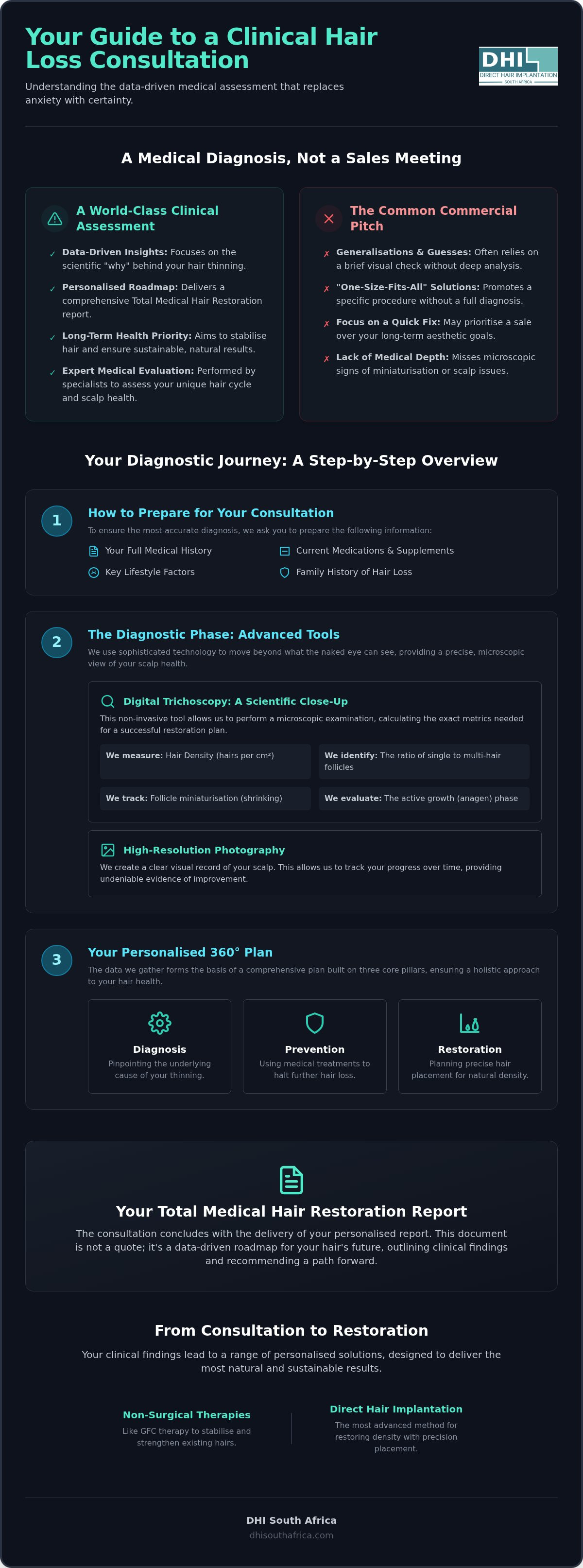
Every scalp has a unique "signature" of hair density and follicle health. We don't believe in one-size-fits-all protocols because your hair loss pattern is as individual as your fingerprint. During your clinical assessment, we focus on calculating the exact number of hairs per square centimetre to determine your restoration potential. This forms the basis of a 360-degree approach that covers three pillars:
Diagnosis: Pinpointing the underlying cause of thinning through medical expertise.
Prevention: Using medical grade treatments to stabilise existing hairs and halt further loss.
Restoration: Planning the precise placement of hairs to restore natural density and flow.
Our priority is your long-term aesthetic result. We focus on the health of your donor area as much as the thinning zones to ensure that any restoration is sustainable for decades, not just months. You can explore our range of treatments to see how these diagnostic insights translate into clinical action.
The Diagnostic Phase: Advanced Tools and Techniques
Precision is the hallmark of a world-class clinical assessment. When considering a hair loss consultation what to expect, you should look for a process that moves beyond a simple visual check. We utilise advanced diagnostic tools to strip away the guesswork, providing a microscopic view of your scalp health. This data-driven approach aligns with the standard dermatologist's diagnostic process; however, we take it a step further by mapping your future restoration potential in high definition.
To ensure every step of your progress is recorded, we use high-resolution photographic documentation. These images allow us to compare your scalp health over time, providing a clear visual record of how your hair density improves. This level of transparency ensures that your personalised medical report is backed by undeniable visual evidence, giving you a clear understanding of your starting point before any treatment begins.
Digital Trichoscopy: A Scientific Close-Up
Digital trichoscopy is the gold standard for modern scalp analysis. It involves using a specialised, non-invasive digital lens to perform a microscopic examination of your hair follicles and scalp tissue. This tool allows us to calculate the exact number of hairs per square centimetre, identifying the ratio of single-hair follicles to multi-hair follicles. For instance, if we are planning the placement of 4,000 hairs, this data tells us exactly where that density is needed most. It also helps us track miniaturisation, which is the process of hairs becoming progressively thinner and weaker over time, allowing us to intervene before the loss becomes permanent.
Assessing the Donor Area: The Foundation of Restoration
The success of any restoration depends entirely on the donor area, typically located at the back and sides of the head. These follicles are genetically resistant to the hormones that cause pattern baldness, making them ideal for relocation. During your assessment, we carefully evaluate the "safe" donor zone to ensure it has sufficient density. We don't just look at how many hairs we can move. We ensure the donor area remains natural-looking and full after extraction, maintaining the integrity of your existing hair. This meticulous planning is why we consistently achieve such exceptional aesthetic results for our patients.
Medical Diagnosis vs. Commercial Sales Pitches
A clinical environment feels distinctly different from a retail space. When you consider a hair loss consultation what to expect, the most critical differentiator is the presence of medical accountability. Commercial clinics often rely on sales consultants who use high-pressure tactics to push a single solution. In contrast, a medical assessment is a collaborative investigation into your biology. We don't just look at the thinning areas; we examine your entire medical history, including lifestyle factors and current medications, to ensure we aren't treating a symptom whilst ignoring the cause.
This thorough approach often includes diagnostic tests for hair loss, such as blood panels or scalp biopsies, if the initial examination suggests an underlying systemic issue. By prioritising a diagnosis over a transaction, we ensure that your treatment plan is bespoke. It's the difference between buying a "one-size-fits-all" remedy and receiving a precision medical protocol designed for your specific physiology.
The Role of the Certified Specialist
At DHI South Africa, every diagnosis is performed by a certified doctor, not a technician or a salesperson. This distinction is vital for your safety and the success of your results. Our doctors follow strict ISO and UK CQC-accredited protocols, ensuring that every clinical decision meets global medical standards. This isn't just about technical expertise; it's about a compassionate, peer-to-peer conversation. You'll have the space to voice your anxieties and receive honest, medical grade answers from a professional who understands the complexities of hair biology.
Transparency in Outcomes and Planning
We replace "miracle" marketing claims with transparent, data-driven facts. Part of our commitment to you is setting realistic expectations for hair density and coverage. We talk in terms of the placement of hairs, such as the strategic distribution of 4,000 hairs to create a natural hairline, rather than vague promises of "fullness." The method of implantation matters far more than just the raw count of hairs. By focusing on the angle, depth, and direction of each hair, we ensure the final result is seamless and permanent. This level of planning ensures you leave the consultation with a clear roadmap, not just a quote.
How to Prepare for Your Consultation
Preparing for your clinical assessment is about more than just showing up. It's a vital opportunity to provide the data our doctors need to build your Total Medical Hair Restoration report. When researching a hair loss consultation what to expect, remember that the quality of the diagnosis depends on the depth of information you share. By arriving prepared, you turn a standard appointment into a high-level medical strategy session. This collaborative approach ensures that every recommendation is grounded in your specific health profile rather than a generic template. Think carefully about your primary goals, such as whether you prioritise the restoration of your hairline, the crown, or overall density, as this helps our specialists align clinical possibilities with your personal expectations.
We recommend organising your thoughts into a clear checklist to ensure no detail is missed during the conversation. Having this information ready allows the doctor to focus on the microscopic analysis of your scalp and the calculation of your hair density. It also helps us understand the impact of your current routine on your scalp health. Consider preparing the following factors:
Medications: List any current prescriptions, supplements, or vitamins you take daily.
Hair Care: Bring the names of your favourite shampoos or topical treatments.
History: Note any previous surgical or non-surgical restoration attempts you've made.
Gathering Your Medical History
Your family history is a vital piece of the puzzle. Knowing if your father or grandfathers experienced alopecia helps us predict the genetic trajectory of your own hair loss. We also need to discuss your lifestyle, as high stress levels or nutritional gaps can push hairs into the telogen (resting) phase prematurely. This context ensures we focus on what will work for your unique physiology and long-term health.
Questions to Ask Your Specialist
You should leave your consultation feeling empowered and fully informed. We encourage you to ask about the survival rate of hairs during the procedure; our ISO-accredited protocols consistently achieve survival rates over 90%. Inquire about the difference between DHI and traditional FUE surgery to understand the precision involved in every placement. Finally, ask about the long-term maintenance plan for your existing hair to ensure your results remain seamless for decades.
From Consultation to Restoration: The Next Steps
Once the clinical analysis is complete, you'll sit down with your doctor to review the Total Medical Hair Restoration report. This document acts as your medical blueprint, translating the high-definition data from your digital trichoscopy into a clear, actionable strategy. It's at this stage that the value of a professional hair loss consultation what to expect becomes truly apparent; you move from the anxiety of uncertainty to a structured, scientific plan. Whether your path involves clinical treatments or surgical restoration, every decision is made with the calm composure and precision of a medical expert.
Personalised Treatment Pathways
For many patients, the most effective course of action is a non-surgical approach designed to stabilise loss and revitalise existing hairs. GFC therapy is a primary example of this, as it uses a highly concentrated preparation of your own growth factors to stimulate dormant follicles and improve hair diameter. For those in the earlier stages of thinning, Regenera Activa offers a sophisticated solution through autologous micro-grafting. This technique uses your body's own regenerative cells to trigger the repair of thinning areas. You can explore these innovative options in more detail in our clinical guide to Advanced Hair Loss Solutions.
The DHI Implantation Advantage
If your report indicates that permanent restoration is the most effective choice, we utilise the patented Direct Hair Implantation technique. Unlike traditional methods that require pre-made incisions or slits, our doctors use the DHI Implanter to control the angle, depth, and direction of every hair placed. This single-step process is significantly gentler on the scalp tissue and ensures hair survival rates over 90%. By avoiding the trauma of traditional FUE, we achieve a density and flow that is virtually indistinguishable from your original hair. We invite you to view our gallery of natural hair transplant results to see the artistry and precision this method allows.
Restoration is a journey that extends far beyond the procedure day itself. We include an 18-month post-procedure monitoring phase as a standard part of our care, ensuring that your results develop exactly as planned. We schedule regular check-ups to track the growth of your hairs and provide guidance on maintaining your overall scalp health. This long-term commitment is a core part of our philosophy, providing you with ongoing clinical support as your confidence is fully restored through a life-changing transformation.
Restoring Your Confidence Through Clinical Certainty
A clinical assessment is the definitive bridge between the anxiety of thinning hair and the clarity of a scientific solution. By prioritising a medical diagnosis over a commercial sales pitch, you gain access to a personalised roadmap that treats the root cause of your hair loss. Our certified medical specialists use patented DHI technology and advanced tools like digital trichoscopy to ensure every placement of hairs is precise, artistic, and permanent.
With a 99% customer satisfaction rate, we focus on delivering aesthetic results that are as safe as they are seamless. Understanding your hair loss consultation what to expect allows you to approach this journey with absolute trust in our world-class protocols. You aren't just choosing a procedure; you're choosing a partner dedicated to your long-term restoration and self-assurance.
We look forward to helping you reclaim your natural density and the confidence that comes with it.
Frequently Asked Questions
Is a hair loss consultation painful or invasive?
No, the assessment is completely non-invasive and pain-free. We use digital trichoscopy, which involves viewing the scalp at high magnification, to assess your follicles without any discomfort. This microscopic look allows our doctors to evaluate follicle health and miniaturisation whilst you relax. It's a diagnostic session designed to provide clarity, not a physical procedure that requires recovery or local anaesthetic. You'll find the process as comfortable as a standard check-up with your GP.
How long does a typical clinical hair assessment take?
A comprehensive clinical assessment usually takes between 45 and 60 minutes. This gives our specialists enough time to perform a thorough scalp analysis, review your medical history, and discuss your personal goals. We don't believe in rushed appointments; we ensure you leave with a clear understanding of your Total Medical Hair Restoration report and a transparent roadmap for your future care. It's a methodical process that respects the gravity of your decision and provides total clarity.
Will I be pressured to book a surgery on the same day?
You'll never experience high-pressure sales tactics at our clinics. Our focus is on medical accountability and providing a data-driven diagnosis rather than a commercial pitch. We want you to feel confident in your decision, so we encourage you to take your time reviewing the clinical findings. When considering a hair loss consultation what to expect, you should anticipate a professional medical environment that prioritises your education and safety over a simple transaction or an immediate booking.
Can a consultation help if I have already lost a significant amount of hair?
Yes, a consultation is still vital even if your thinning is advanced. We can evaluate the health of your donor area to see if restoration is possible or explore alternatives like scalp micropigmentation (SMP) and high-quality hair systems. Our doctors look at your scalp's potential as a whole, ensuring we provide realistic expectations for the placement of hairs based on your available donor density and aesthetic goals. It's never too late to gain scientific clarity.
Do I need to stop using hair products before my appointment?
It's actually helpful to maintain your normal hair care routine before your appointment. Seeing how you currently style your hair and which products you use gives our specialists insight into your daily habits and scalp health. You should bring a list of your favourite shampoos or topical treatments so the doctor can review their ingredients and determine if they're supporting or hindering your natural hair cycle. This helps us build a more accurate and personalised medical profile.
Will the specialist examine my scalp under a microscope?
Yes, we use a specialised digital lens to perform a microscopic examination of your scalp. This process, known as digital trichoscopy, is the gold standard for modern hair loss diagnosis. It allows us to see exactly what's happening at the follicle level, such as the ratio of single-hair follicles to multi-hair follicles. This level of detail is essential for creating a predictable, scientific plan for your restoration that ensures the highest possible survival rate for your hairs.
What happens if my hair loss is caused by something other than genetics?
If your hair loss isn't hereditary, our medical specialists will help identify the true cause. We look for indicators of nutritional gaps, hormonal imbalances, or high stress levels that might be disrupting your anagen phase, which is the active growth stage of your hair cycle. Because our consultations are performed by certified doctors, we can recommend specific diagnostic tests or refer you for further medical investigation to ensure we treat the underlying issue rather than just the symptoms.
Is there a difference between a consultation for men and for women?
Whilst the clinical tools remain the same, the assessment of hair loss patterns differs between men and women. Men often experience thinning at the temples or crown, whilst women typically see a diffuse thinning across the entire scalp. When planning a hair loss consultation what to expect, both genders receive a bespoke medical report that accounts for these biological differences. This ensures the placement of hairs follows a natural, gender-appropriate aesthetic that restores your self-assurance seamlessly.


Comments