%20(1).jpg)
%20(1).jpg)
Hair Restoration Safety Protocols: A Clinical Guide to Safe Results
- Dhesan Moodley

- 1 hour ago
- 12 min read
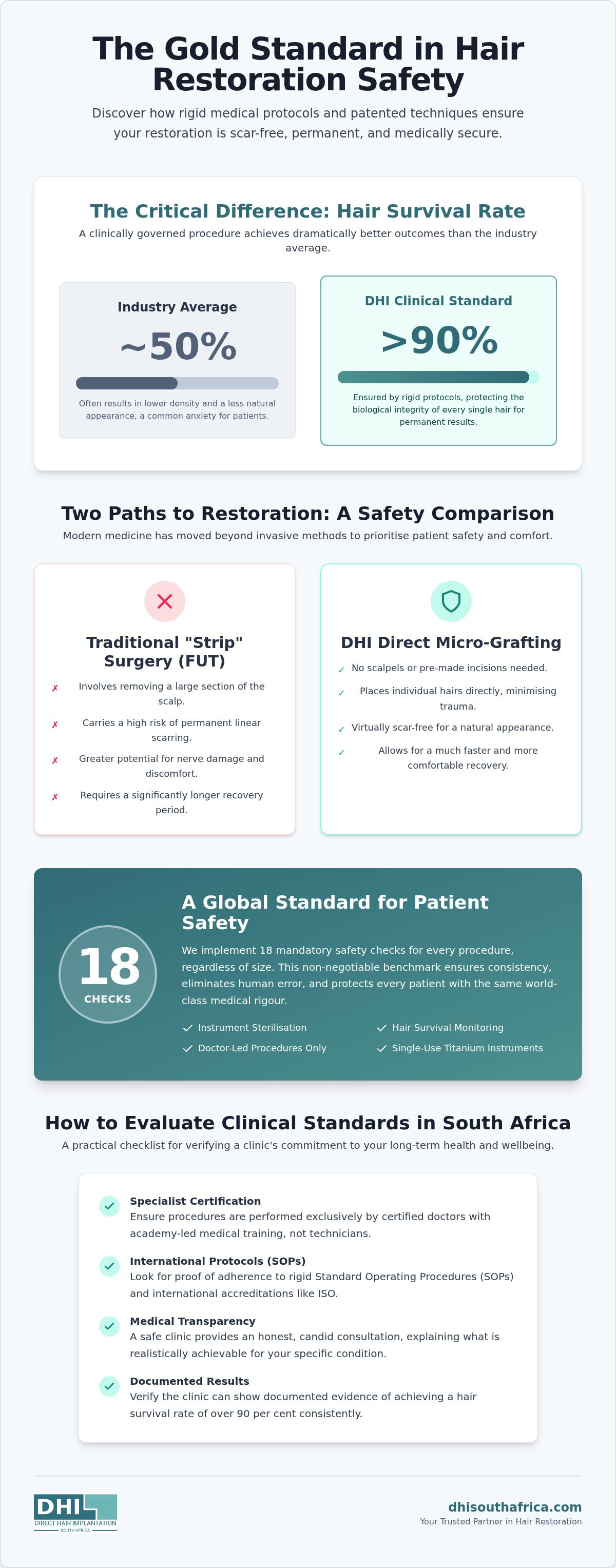
Did you know that whilst the industry average for hair survival often hovers around 50 per cent, a clinically governed procedure can achieve a survival rate of over 90 per cent? This stark difference isn't down to luck; it's the result of rigid hair restoration safety protocols designed to protect both your health and your aesthetic outcome. It's completely natural to feel anxious about surgical complications or the fear of an unnatural 'doll-hair' look, especially with so much conflicting information online. You deserve to feel certain that you're in a 'safe pair of hands' rather than risking your wellbeing at a cut-price clinic.
We understand that the decision to restore your hair is deeply personal and should never be overshadowed by safety concerns. This clinical guide will show you exactly how rigorous medical standards and patented techniques ensure your restoration is scar-free, permanent, and medically secure. You'll discover the 18 mandatory safety checks we employ to prevent infection and the specific single-use, titanium-coated instruments that minimise tissue trauma. By the end of this article, you'll have the clarity and confidence needed to choose a certified specialist who prioritises your long-term health as much as the successful placement of your new hairs.
Table of Contents
What are Hair Restoration Safety Protocols in 2026?
When you decide to address your hair loss, you aren't just looking for a cosmetic change; you're looking for a medical solution that respects your health. In 2026, hair restoration safety protocols have evolved into a sophisticated set of Standard Operating Procedures (SOPs) designed to eliminate human error at every stage. These protocols, often referred to as a Total Care System, ensure that every step, from the initial digital trichoscopy (a high-definition scalp analysis) to the final placement of hairs, follows a predictable, medically secure path.
Safety is no longer just about a sterile room or wearing gloves. It's about protecting the biological integrity of every hair whilst minimising physical trauma to the scalp. We know the anxiety that comes with hair loss. It feels like losing a part of your identity. The last thing you need is the added stress of surgical complications or an unnatural result. You deserve a 'safe pair of hands' that prioritises your long-term wellbeing over quick, cut-price results. This patient-centric approach ensures that the medical journey is as comfortable as the aesthetic result is impressive.
The Shift from Traditional Surgery to Micro-Grafting
For years, the industry standard was "strip" surgery, or FUT. This method involves removing a large section of the scalp, which often carries significant risks like permanent linear scarring and potential nerve damage. Modern medicine has moved toward micro-grafting as a far safer, minimally invasive alternative that avoids these aggressive techniques entirely.
At the heart of this shift is autologous micro-grafting. This simply means we use your own follicles, which ensures a rejection-free result because the body recognises the tissue as its own. By focusing on individual hairs rather than large strips of skin, we can achieve natural-looking density without the trauma associated with traditional surgery. This method allows for a much faster recovery time, meaning you can return to your daily routine with total peace of mind.
Why Empathy and Candour are Safety Requirements
A truly safe clinic doesn't just focus on the procedure; it starts with an honest conversation. We've seen the "miracle" marketing that promises impossible results, and we know how frustrating that can be. In our view, transparency is a clinical requirement. You need to know exactly what is possible for your scalp before you commit to a procedure.
Building trust means being candid about what's achievable for your specific hair type and donor area. Even if a procedure is marketed as a "lunch-hour" treatment, it must still adhere to rigid medical rigour. A safe protocol means we never compromise on safety checks just to save time. It's why we ensure only certified doctors perform the procedures, maintaining a level of expertise that high-pressure sales clinics simply cannot match. This ensures you feel fully informed and supported throughout your entire transformation.
The 18 Mandatory Clinic Safety Checks: A Global Standard
When you step into a clinic, you shouldn't have to wonder if the equipment is sterile or if the staff are following the latest medical guidelines. Consistency is the hallmark of a world-class institution. That's why we implement 18 mandatory safety checks for every single procedure we perform. It doesn't matter if we're placing 500 hairs or 5,000; the clinical rigour remains identical. These hair restoration safety protocols act as a non-negotiable benchmark, ensuring that every patient receives the same level of care and precision that has made us a global leader in the field.
These checks aren't just about ticking boxes. They cover the entire spectrum of your care, from the initial sterilisation of the procedure room to the minute-by-minute monitoring of hair survival during the implantation phase. By following these rigid steps, we can consistently achieve a hair survival rate of over 90 per cent, which is significantly higher than the industry average of 50 to 60 per cent. It's this level of detail that provides the peace of mind you need when making such a life-changing decision.
Accreditation and SOPs: ISO and CQC Standards
ISO accreditation is much more than a certificate on the wall. For you, it means that every aspect of your treatment is governed by internationally recognised quality management systems. This ensures that our results aren't just good by chance; they're good by design. Similarly, we adhere to the standards set by the UK Care Quality Commission (CQC). These regulations protect patients by ensuring that clinical environments are strictly monitored for safety and hygiene. We view our Standard Operating Procedures (SOPs) as the blueprint for clinical excellence, providing a clear and repeatable path to success for every doctor trained in our academy.
Single-Use Instruments: Eliminating Cross-Contamination
One of the most critical safety protocols involves the tools we use. We exclusively employ single-use, titanium-coated punches for the extraction of hairs. In many budget clinics, multi-use equipment is still common, which significantly increases the risk of cross-contamination and post-procedure inflammation. By using a fresh, patented tool for every patient, we eliminate these risks entirely. The titanium coating also ensures the sharpest possible edge, which minimises tissue trauma and promotes faster healing. This meticulous attention to detail is what defines a premium medical institution. If you'd like to see the outcome of these high standards, you can browse our patient results to see the difference clinical precision makes.
Minimising Trauma: Comparing Implantation Techniques for Safety
Safety is often discussed in terms of hygiene, but for a clinical expert, the most critical safety factor is the physical interaction between the tool and your tissue. Traditional methods like FUT (strip surgery) and standard FUE often involve significant scalp trauma. FUT requires a large incision and stitches, whilst standard FUE usually involves a two-step implantation process where 'slits' or 'pre-made holes' are cut into the scalp before the follicles are inserted with forceps. These older methods increase the risk of bleeding, inflammation, and permanent scarring.
In contrast, the patented Direct Hair Implantation technique uses a specialised tool called the DHI Implanter. This device allows the doctor to place hairs directly into the scalp without the need for pre-cut incisions. By combining the creation of the site and the placement of the hair into one gentle motion, we significantly reduce the risk of infection and tissue damage. This refined approach to hair restoration safety protocols ensures that your scalp heals rapidly, often with no visible signs that a procedure even took place.
The Science of Hair Survival
The survival of your hairs is perhaps the most honest safety metric available in our industry. When a hair follicle is removed from the body, it begins a race against time. The longer it stays in an external environment, the higher the risk of desiccation (drying out) and cellular death. Our protocols are designed to minimise this 'out-of-body' time, ensuring that every follicle is handled with extreme care.
By using single-step implantation, we avoid the trauma of 'crushing' the follicle with forceps, which is a common cause of poor results in budget clinics. This meticulous handling is why we can confidently achieve a hair survival rate of over 90 per cent. When you are planning the placement of 4,000 hairs, this difference in survival isn't just a statistic; it's the difference between a thin, patchy result and a dense, natural-looking head of hair. You can explore our specific hair restoration treatments to see how this science is applied.
Reducing Scalp Trauma and Inflammation
Precision is the ultimate safeguard against an unnatural appearance. The DHI Implanter gives the doctor total control over the depth, angle, and direction of every hair placed. This level of accuracy prevents 'pitting' (small indentations in the skin) and ensures that the new hairs blend seamlessly with your existing native hairs. Because we avoid making scalp incisions, the biological trauma is kept to an absolute minimum.
Less trauma naturally leads to less inflammation and a significantly faster recovery. Most of our patients find they can return to their normal routine almost immediately, without the need for stitches or heavy bandages. This 'no-downtime' nature of modern techniques addresses the very real fear of a long, painful recovery. It's a safer, more compassionate way to restore your confidence whilst ensuring the integrity of your scalp remains intact.
How to Evaluate Clinical Standards in South Africa
Choosing a clinic in South Africa requires more than just looking at a price tag or a glossy brochure. You need to verify that the institution adheres to global hair restoration safety protocols to avoid the risks associated with "black-market" clinics. These cut-price facilities often rely on technicians rather than qualified doctors, which significantly increases the chance of poor hair survival and infection. During your initial consultation, you should feel empowered to ask direct questions about clinical rigour. Use this checklist to ensure you're in a 'safe pair of hands':
Is a certified doctor performing the entire procedure, from extraction to implantation?
Can the clinic provide photographic documentation of long-term results?
Do they use single-use, patented instruments for every patient?
Is there a written, structured aftercare plan that includes regular follow-ups?
The DHI Specialist Certification
It's a common misconception that any general surgeon or doctor is qualified to perform hair restoration. True expertise comes from specialised training that focuses on the artistry and medical precision of hair placement. A certified DHI Specialist must undergo rigorous training at our global Academy, completing at least 20 supervised procedures before they are allowed to operate independently. This clinical benchmark ensures that every doctor maintains the highest standards of precision. Ongoing quality reviews further guarantee that the placement of hairs remains consistent with our world-class standards, protecting the donor area and the recipient site.
Aftercare: Protecting Your Investment
Safety doesn't end when you leave the procedure room. The first 48 hours are critical for the survival of your new hairs, as they begin to anchor into the scalp. A structured monitoring plan, which should last up to 18 months, is essential for tracking your progress and ensuring long-term success. We utilise digital trichoscopy, which is a high-definition digital scalp analysis, to monitor hair density and scalp health throughout your recovery. This data-driven approach allows us to provide personalised guidance, ensuring your results are as permanent as they are natural-looking. It turns a one-off procedure into a comprehensive medical journey.
The DHI Difference: Patented Safety for Permanent Results
The patented Direct Hair Implantation (DHI) technique represents the pinnacle of medical evolution in this field. It isn't merely about moving hairs from one area to another; it's about a holistic approach to patient wellbeing. By adhering to the most stringent hair restoration safety protocols in the industry, we've transformed a once-invasive surgery into a refined, minimally invasive procedure. This dedication to precision is why we consistently achieve a hair survival rate of over 90 per cent, providing you with the permanent, natural-looking density you deserve.
We know that hair loss can feel like a loss of control. It's a source of daily frustration that impacts how you see yourself in the mirror and how you move through the world. Our goal is to be that 'safe pair of hands' that helps you navigate this journey with total peace of mind. By combining the cold precision of medical science with a compassionate, patient-centric approach, we ensure that your transformation is as comfortable as it is life-changing. Reclaiming your self-assurance shouldn't be a gamble; it should be a predictable, secure medical outcome.
A Global Network of Excellence
Choosing a provider with a global footprint offers a level of security that local, independent clinics often cannot match. With over 75 clinics in 45 countries, the DHI Medical Group has spent more than 50 years refining the Total Care System. This globally vetted system ensures that whether you are in Europe or South Africa, the safety standards remain identical. This legacy of medical history means you aren't just a patient; you're the beneficiary of decades of research and clinical excellence that prioritises your health above all else. It's this global oversight that maintains our position as a pioneer in the industry.
Your Next Steps: The Digital Scalp Analysis
The path to reclaiming your confidence begins with a simple, low-friction conversation. We invite you to experience a digital scalp analysis, which is the cornerstone of our diagnostic process. During this session, we use high-definition digital trichoscopy to assess your hair density, skin health, and donor area capacity. This isn't a high-pressure sales meeting; it's a professional medical consultation designed to provide you with a clear, safe, and realistic treatment plan tailored to your unique needs. We believe that education is the first step toward a successful restoration.
We're here to listen to your concerns and provide the expert guidance you need to make an informed decision. Reclaiming your confidence is a significant step, and we'd be honoured to walk that path with you. When you're ready to see what's possible for your hair, we're here to help you start your journey toward a permanent, natural result. You can explore our patient reviews to see how this commitment to safety has changed the lives of others.
Reclaiming Your Confidence with Clinical Precision
Restoring your hair is a journey that deserves the highest medical rigour. By choosing a clinic that prioritises hair restoration safety protocols, you're ensuring that your results are both permanent and natural-looking. We've explored how our 18 mandatory safety checks and ISO-accredited standards provide a 'safe pair of hands' for your transformation. With a documented hair survival rate of over 90 per cent, you can move forward knowing that every hair is handled with the utmost care and precision.
This isn't just about aesthetics; it's about the restoration of your self-assurance through proven science. You don't have to settle for the risks of 'black-market' clinics or outdated surgical methods that leave permanent scars. Our patented DHI technique offers a scar-free, minimally invasive solution that respects the biological integrity of your scalp whilst delivering exceptional density. It's a world-class approach that puts your safety and comfort at the centre of the entire process.
Take the first step toward a permanent solution by understanding the unique needs of your scalp. We look forward to welcoming you and helping you discover the life-changing impact of world-class medical care delivered with compassion.
Frequently Asked Questions
Is hair restoration surgery safe for everyone?
Suitability for hair restoration depends on a personalised medical assessment by a certified specialist. Whilst the procedure is safe for most people with early-stage to moderate hair loss, we must first evaluate your donor area and scalp health. We use autologous micro-grafting, which means we use your own follicles to eliminate the risk of rejection. This ensures a natural result that is medically secure for your body.
What are the 18 mandatory clinic safety checks?
These are non-negotiable Standard Operating Procedures (SOPs) that govern every procedure. They cover everything from the sterilisation of the clinical environment and single-use instruments to hair survival monitoring and risk management. These checks ensure that our hair restoration safety protocols meet UK CQC and ISO standards, providing a consistent level of care for every patient across the country.
Will I have scars after a DHI hair transplant?
No, you won't have visible scars after the patented DHI technique. We use a specialised DHI Implanter and single-use, titanium-coated punches that don't require scalp incisions or stitches. This minimally invasive approach ensures that both the donor and recipient areas heal perfectly. It's a significant safety advantage over traditional FUT strip surgery, which often leaves a permanent linear scar that can be difficult to hide.
How long is the recovery time after the procedure?
Most patients experience little to no downtime and can return to their normal routine almost immediately. Since there are no stitches or aggressive incisions, the scalp heals remarkably quickly. Many people describe it as a 'lunch-hour' procedure because of its efficiency and speed. We provide a structured aftercare plan to monitor your progress and ensure the safety of your new hairs during the critical first 48 hours.
What is the survival rate of transplanted hairs?
We achieve a hair survival rate of over 90 per cent, which is significantly higher than the industry average of 50 to 60 per cent. This high success rate is a direct result of our rigid hair restoration safety protocols and the use of the patented DHI Implanter. By minimising the time hairs spend outside the body and avoiding tissue trauma, we ensure the biological integrity of every follicle.
Can I go back to work the day after the procedure?
Yes, most of our patients return to work the very next day. The procedure is minimally invasive and doesn't require heavy bandages or significant recovery time. You might have slight redness for a few days, but it's typically discreet enough that it doesn't interfere with your professional schedule. We'll give you specific guidance on how to care for your scalp during the initial healing phase to keep you comfortable.
Why is a doctor-led procedure safer than one led by technicians?
A certified doctor has the medical training to handle complications and ensure the highest level of clinical precision. Many 'black-market' clinics use technicians to save costs, which significantly increases the risk of infection and poor results. Our doctors are academy-trained specialists who have performed at least 20 supervised procedures. This expertise ensures that the depth, angle, and direction of every hair are managed with scientific accuracy and total safety.
How do I know if a clinic in South Africa follows ISO standards?
You should ask the clinic directly for proof of their ISO and UK CQC accreditations during your consultation. A reputable clinic will be transparent about their Standard Operating Procedures and the 18 mandatory safety checks they follow. At DHI South Africa, these certifications are part of our Total Care System, ensuring that our national standards match the high benchmarks of our global network across 45 countries.


Comments