%20(1).jpg)
%20(1).jpg)
Hair Transplant Recovery Time: A Comprehensive Month-by-Month Guide
- Dhesan Moodley

- 1 day ago
- 12 min read
What if the most daunting part of your hair restoration journey wasn't the procedure itself, but the quiet weeks that follow? It's completely natural to feel a flicker of anxiety about your hair transplant recovery time, especially when you're balancing a busy career with the desire for a discreet transformation. You likely worry about visible signs of the procedure or how many days you'll truly need to step away from your professional life. We understand that the fear of "shock loss," which is the temporary shedding of transplanted hairs, can feel unsettling even when you know it's a standard part of the biological process.
Most patients find they can return to work within five to seven days, as the scalp heals remarkably quickly with modern, minimally invasive techniques. While the initial redness typically fades within two weeks, the journey to your final result is a steady, predictable marathon rather than a sprint. You'll likely see the first signs of new growth around the three to four-month mark, with the permanent, dense results of your new hairs fully maturing between 12 and 18 months.
This guide provides a clear, month-by-month roadmap to help you navigate every stage of healing with the composure of a well-informed patient. We'll demystify the anagen phase, which is the active growth period of your hair follicles, and offer practical advice to ensure your recovery is as seamless as the procedure itself. From the first 24 hours to the final reveal, you'll discover how to manage your results with expert precision.
Table of Contents
The First Week: Navigating the Critical 7-Day Healing Window
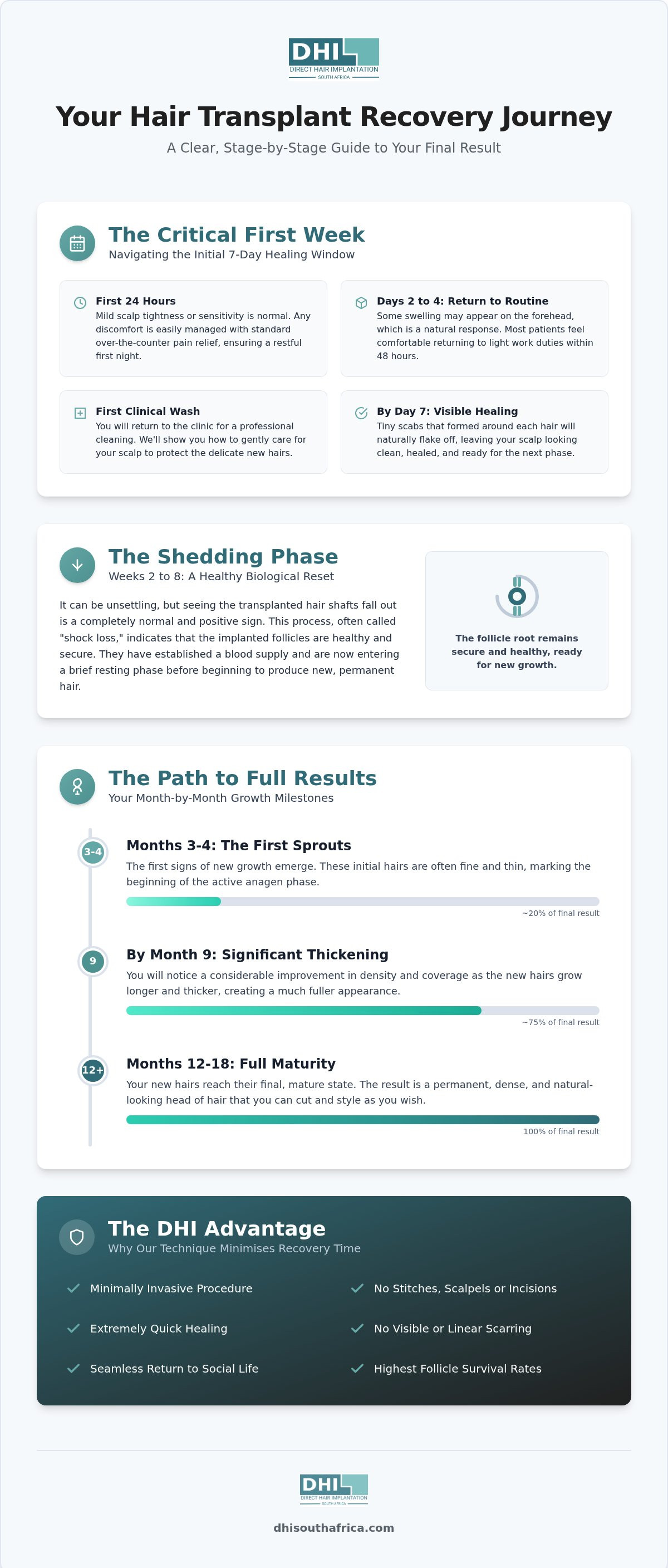
The first 24 hours following your procedure are often the most delicate phase of your hair transplant recovery time. As the local anaesthetic begins to wear off, you might experience a mild tightness or sensitivity across your scalp. This is perfectly normal and expected. Unlike traditional hair transplantation techniques that might involve invasive incisions, the Direct Hair Implantation method is designed to be as gentle as possible. Most of our patients find that any initial discomfort is easily managed with standard over-the-counter pain relief, allowing for a restful first night.
To help you visualise this initial phase and the journey ahead, watch this helpful video outlining the immediate recovery timeline:
Between days two and four, it's common to notice some swelling around the forehead or occasionally the eyes. This isn't a sign of infection; it's simply your body's natural response to the fluid used during the procedure. Because the DHI technique is so minimally invasive, many of our patients feel comfortable returning to light work duties within just 48 hours. If your role doesn't require heavy physical exertion, you'll likely find that you can resume your professional routine quite quickly without drawing unwanted attention from colleagues.
Managing Initial Swelling and Discomfort
To keep swelling to a minimum, we recommend sleeping with your head elevated at a 45-degree angle for the first few nights. This helps gravity assist with fluid drainage and prevents pressure on the treatment area. It's vital that you don't touch or scratch the newly implanted hairs during the first three days, as the follicles are still anchoring into their new positions. If you feel a slight itch as the micro-incisions close, a simple saline spray can provide immediate, soothing relief without risking the health of the hairs.
The First Clinical Wash and Scab Management
Whilst the total hair transplant recovery time spans several months, the first clinical wash is a major milestone. We invite you back to the clinic so our specialists can clean the scalp with professional precision, ensuring the delicate hairs remain undisturbed. During this session, we'll teach you how to gently pat the area dry rather than rubbing it. Over the next few days, you'll notice tiny scabs forming around the base of the transplanted hairs. These small crusts are a natural protective barrier that signifies healthy skin regeneration is occurring beneath the surface. By day seven, these scabs will begin to flake off naturally, leaving the scalp looking clean and well-healed.
The Shedding Phase: Understanding Why Your New Hairs Fall Out
If there's one phase that tests the patience of even the most composed person, it's the shedding period. Around two to eight weeks into your hair transplant recovery time, you'll likely notice the very hairs we meticulously placed beginning to fall out. This can feel like a step backwards, but it's actually a vital biological reset. We often hear the term "shock loss" used to describe this, but that's a bit of a misnomer. It suggests something has gone wrong, when in reality, your scalp is simply clearing the way for new, permanent growth.
The follicles remain healthy and secure. They established a vital blood supply in the first few days following your procedure. What you see on your pillow or in the shower is just the temporary hair shaft. It's a sign that the follicle is entering a resting phase. It will soon begin its lifelong production of new hair. Think of your follicles as seeds that have just been planted in a new garden. They need a moment to settle into the soil before they can sprout. During this part of the hair transplant recovery time, your body is prioritising internal healing over external growth.
The Biology of the Hair Cycle
To understand this, we look at the transition from the anagen, or growth, phase to the telogen, which is the resting phase. When a hair is moved, the physical relocation signals the follicle to hit the reset button. The old shaft is shed so that a stronger, more resilient hair can take its place. Our DHI technique ensures a survival rate of over 90 percent. This is because we handle the follicles with such precision, protecting them during this delicate transition. While you wait, using the recommended DHI Hair Loss Products can help maintain a healthy scalp environment.
Managing the "Ugly Duckling" Anxiety
We call this the "ugly duckling" phase because your scalp might look much as it did before the procedure, perhaps with some lingering redness. It's an emotional dip we see often. You've invested time and hope, and suddenly the results seem to vanish. Please remember that this is the precursor to your final transformation. This temporary state is just a brief stop on the way to achieving truly Natural Hair Transplant Results. If you're feeling uncertain, it often helps to look at our patient gallery to see how others navigated this exact same milestone. If you're noticing shedding and want to ensure your scalp is on the right track, you might find a digital scalp analysis provides the reassurance you need.
The Growth Timeline: Milestones from Month 3 to One Year
Entering the third month marks a significant psychological shift in your hair transplant recovery time. This is when the "waiting game" of the shedding phase finally pays off. You'll begin to notice tiny, fine hairs breaking through the scalp surface. These initial hairs are often thin and light in colour, resembling "peach fuzz," but they represent the successful activation of the transplanted follicles.
By month five or six, you'll see the most dramatic progress in your hair transplant recovery time. This is when fine strands transition into mature terminal hairs, which are the thicker, pigmented strands providing lasting coverage. Between months five and nine, you'll likely notice a substantial increase in density. Your new hairline will start to take a definitive shape, and you'll probably feel a renewed sense of confidence as the coverage becomes more visible.
Whilst many expect the journey to end at the one-year mark, the maturation process actually continues up to 18 months. During this final stretch, the texture of the hairs softens and begins to blend perfectly with your existing hair. We include an 18-month monitoring period as part of your recovery journey to ensure the colour deepens correctly and any initial wiriness disappears. This results in a completely natural look that is virtually indistinguishable from your original hair.
Month 4 to 6: The Turning Point
As your new hairs transition from fine fuzz to mature terminal hairs, styling might require a bit of creativity. We suggest the following tips to manage this intermediate stage:
Keep the sides and back shorter to create a more balanced look whilst the top fills in.
Use water-based styling products that don't weigh down the new, delicate strands.
Avoid harsh chemical dyes until your 6-month review to protect the healing scalp.
It's helpful to remember that even if we've performed a placement of 4,000 hairs, they will not all sprout on the same day because each follicle follows its own unique biological clock.
Reaching Peak Density at 12 Months
The 12-month milestone is what we call the "Full Reveal." This is the point where we evaluate the final aesthetic result and the overall naturalness of your new hairline. Because our patented DHI implanter allows us to control the exact angle, depth, and direction of every hair, the result at this stage should look seamless. We'll invite you for a final 12-month clinical review to document your results and ensure you're completely satisfied with your transformation.
Professional Aftercare: Protecting Your Investment for Life
Achieving a world-class result is only half the battle. The weeks following your procedure require a disciplined approach to aftercare to ensure those new hairs thrive. We provide a range of specialised DHI Hair Loss Products designed to maintain an optimal scalp environment. These medical-grade formulations support the skin's natural barrier whilst the follicles settle, ensuring the transition is as smooth as possible.
During the first 14 days of your hair transplant recovery time, you must strictly avoid strenuous exercise and direct sun exposure. Increased blood pressure from heavy lifting or intense cardio can cause unnecessary stress on the newly implanted follicles. Similarly, harsh UV rays can damage the delicate healing tissue. We recommend wearing a loose-fitting surgical cap or a very structured hat if you must be outdoors, provided it doesn't touch the treatment area.
Integrating GFC and PRP Therapy
We often recommend GFC Treatment, or Growth Factor Concentrate, to accelerate the revitalisation of your follicles. By using your body's own autologous growth factors, which are concentrated proteins that stimulate healing, we can improve hair survival rates to over 90 percent. These regenerative treatments are ideally timed at specific intervals during your recovery to boost the anagen phase, which is the active growth period of the hair. You can learn more about these protocols in our guide to Advanced Hair Loss Solutions.
Daily Habits for Permanent Results
Your daily routine plays a vital role in the longevity of your results. Nutrition is key. We suggest a diet rich in proteins and specific nutraceuticals to provide the building blocks your hair needs for shaft thickening. It's reassuring to know that the hairs we transplant are taken from the "safe zone" at the back of the head. These follicles are genetically resistant to the hormones that cause pattern baldness, meaning they're built to last a lifetime. For the first six months, stick to gentle grooming. Avoid high-heat styling or aggressive brushing that could pull on the maturing hairs.
Finally, we don't simply say goodbye once the procedure is over. We maintain a comprehensive 18-month photographic documentation series. This allows us to track your progress with scientific accuracy and provide clinical reassurance at every milestone of your hair transplant recovery time. This steady, unhurried monitoring ensures that your transformation remains on the right path.
The DHI Advantage: Why Our Technique Minimises Recovery Time
The methodology chosen for your procedure is the single most significant factor in determining your hair transplant recovery time. At DHI South Africa, we utilise a patented single-step implantation process that fundamentally changes the healing experience. Unlike older methods that require a doctor to create recipient holes before placing follicles, our technique uses the specialised DHI Implanter to place each hair directly into the scalp. This precision significantly reduces tissue trauma, allowing the skin to begin its regenerative process almost immediately.
This approach is often referred to as a "lunch-hour" transplant because of its remarkable efficiency and minimally invasive nature. You won't have to worry about stitches or the linear scars associated with traditional strip surgery. For the busy professional, this means a much faster return to social and work activities without the anxiety of visible signs of a procedure. When every one of your 4,000 hairs is placed with such meticulous care, the body responds with a swifter, more comfortable healing journey.
Comparing DHI with Traditional FUE Recovery
In traditional FUE procedures, the scalp undergoes two separate stages of trauma: first when the incisions are made, and again when the follicles are inserted. This double-handling of the tissue often leads to increased swelling and a longer period of redness. Our DHI Implanter allows for much faster skin closure because the tool creates the space and places the hair simultaneously. This lack of pre-made slits is why DHI is considered a premier choice for Medical Hair Restoration. You'll find that the donor and recipient areas heal with no visible scarring, preserving the natural aesthetic of your scalp.
Certified Expertise and Safety Protocols
Your peace of mind is built into our clinical standards. We follow 18 mandatory clinic safety checks to ensure your recovery is as predictable and complication-free as possible. Every specialist performing the procedure is trained at the DHI Global Academy, ensuring they master the exact depth, angle, and direction required for a 90 percent hair survival rate. We don't believe in "miracle" shortcuts; instead, we rely on rigorous medical science and a compassionate, patient-centric approach. If you're ready to see how our technique can fit into your life, we invite you to begin with a professional assessment.
Your Path to a Permanent Transformation
Understanding your hair transplant recovery time doesn't have to be a source of worry when you're in a safe pair of hands. The transition from initial healing to the final reveal requires both clinical precision and a little patience. By choosing a technique that avoids stitches, you ensure a faster return to your daily life whilst securing a hair survival rate of over 90%. This methodical approach ensures that every hair contributes to a dense, natural result.
Our 99% customer satisfaction rate reflects our commitment to results that look entirely natural. From the first wash to the 12-month reveal, we remain your dedicated partners in this restoration. You've already taken a great step by educating yourself on these milestones; now let us map out your specific clinical needs with a personalised touch. We're here to answer your questions with the candour and expertise you deserve.
We look forward to welcoming you to our clinic and helping you rediscover the quiet confidence of a healthy hairline. Guided by over 50 years of global medical expertise, your transformation is closer than you think.
Frequently Asked Questions
How long does a hair transplant take to heal fully?
Your scalp will typically heal from the micro-incisions within seven to ten days, but full biological maturation takes longer. Whilst the surface appears clear quite quickly, the follicles continue to anchor and mature for several months. We monitor our patients for up to 18 months to ensure the hair texture and colour reach their peak. This comprehensive timeline ensures that the underlying tissue has completely regenerated and the new hairs are fully established.
When can I wash my hair normally after a DHI procedure?
You can begin a modified, gentle washing routine 48 hours after your procedure, ideally starting with a clinical wash at our clinic. During the first week, you must avoid direct shower pressure and rubbing the recipient area. By day ten, once the protective scabs have naturally flaked off, you can usually return to your normal hair-washing behaviour. We provide specialised medical-grade products to support your scalp health during this sensitive transition.
Is it normal for my transplanted hairs to fall out after two weeks?
Yes, it's entirely normal for the transplanted hair shafts to shed between week two and week eight. This process, often called the shedding phase, is a healthy biological reset that allows the follicle to enter a new growth cycle. The follicle itself remains securely anchored beneath the skin. Once this temporary phase concludes, you'll begin to see permanent new hairs emerging from the three-month mark onwards.
When can I return to work after my hair restoration?
Most patients feel comfortable returning to a desk-based professional role within 48 hours of their procedure. Because the DHI technique involves no stitches or linear scarring, there are fewer visible signs of surgery compared to older methods. If your job involves heavy physical exertion or a dusty environment, we recommend waiting five to seven days. This ensures your hair transplant recovery time isn't interrupted by unnecessary physical strain or risk of infection.
Can I wear a hat or helmet during the recovery period?
You can wear a loose-fitting, clean hat three days after your procedure, provided it doesn't touch or compress the newly implanted hairs. It's vital to avoid any friction on the recipient area during the first 72 hours. If you need to wear a tight-fitting helmet for cycling or motorcycling, you should wait at least 14 days. This allows the follicles to become firmly established and the scalp sensitivity to subside completely.
How soon will I see the final results of my hair transplant?
You'll see the definitive shape and density of your new hairline at the 12-month mark, often called the "Full Reveal." However, the final aesthetic result continues to improve for up to 18 months as the hair texture softens and the colour matures. This steady progression is part of a natural growth cycle. We document your journey with a photographic series to track these subtle improvements until the transformation is complete.
Are there any long-term restrictions after the recovery time is over?
There are no long-term restrictions once your recovery is complete. The transplanted hairs are taken from the genetically resistant "safe zone," meaning they'll continue to grow for a lifetime. You can cut, style, and treat your hair exactly as you did before the procedure. We simply recommend maintaining a healthy scalp environment with quality hair care products to support the longevity of both your new and existing hairs.
Does the DHI technique require more downtime than other methods?
Actually, the DHI technique typically requires less downtime than traditional methods like strip surgery. Because we use a patented implanter for single-step placement, we avoid the need for pre-made incisions or stitches. This reduces tissue trauma and leads to faster skin closure. Many clients describe it as a "lunch-hour" procedure because they can resume their social and professional lives much sooner than with more invasive hair transplant recovery time requirements.


Comments