%20(1).jpg)
%20(1).jpg)
FUE vs DHI Hair Transplant: Choosing the Superior Path for Restoration in 2026
- Dhesan Moodley

- 2 days ago
- 12 min read
The most significant factor in a successful hair restoration isn't actually how the hairs are removed, but the clinical precision with which they are placed back into your scalp. If you've been researching crown hair loss treatment south africa, you've likely felt the weight of conflicting advice and the genuine anxiety of choosing a procedure that might leave you with visible scarring or disappointing results. It's perfectly natural to feel hesitant when your appearance and professional confidence are on the line, especially when survival rates in the industry can vary so wildly.
In this article, you'll discover why the clinical shift from standard FUE to Direct Hair Implantation (DHI) represents the superior path for restoration in 2026. We'll explain how the use of a patented implanter tool provides total control over the angle, depth, and direction of every hair, ensuring a survival rate of over 90%. You'll learn the vital difference between "graft" counts and the meticulous placement of individual hairs to mimic your natural growth patterns. We'll also explore how this medical-grade approach offers a permanent, high-density solution that allows you to return to your professional life without the tell-tale signs of traditional surgery.
Table of Contents
Understanding the Evolution: What is the Difference Between FUE and DHI?
The Technical Breakdown: How Extraction and Implantation Methods Differ
Comparing Clinical Outcomes: Survival Rates and Aesthetic Precision
Personal Suitability: Which Technique Aligns With Your Hair Loss Pattern?
The DHI Advantage in South Africa: Why Technique Trumps Quantity
Understanding the Evolution: What is the Difference Between FUE and DHI?
Selecting the right path for effective hair restoration, particularly for crown hair loss, often starts with a single question: what is the difference between these acronyms? Follicular Unit Extraction, or FUE, was the first major breakthrough in modern restoration. It replaced the invasive "strip" surgery with a method that harvests individual follicles one by one. However, as medical science progressed, the industry realised that extraction was only half the battle. Direct Hair Implantation (DHI) was developed as a more refined, doctor-led evolution. It focuses on the delicate nature of the implantation phase, where the final aesthetic result is truly determined.
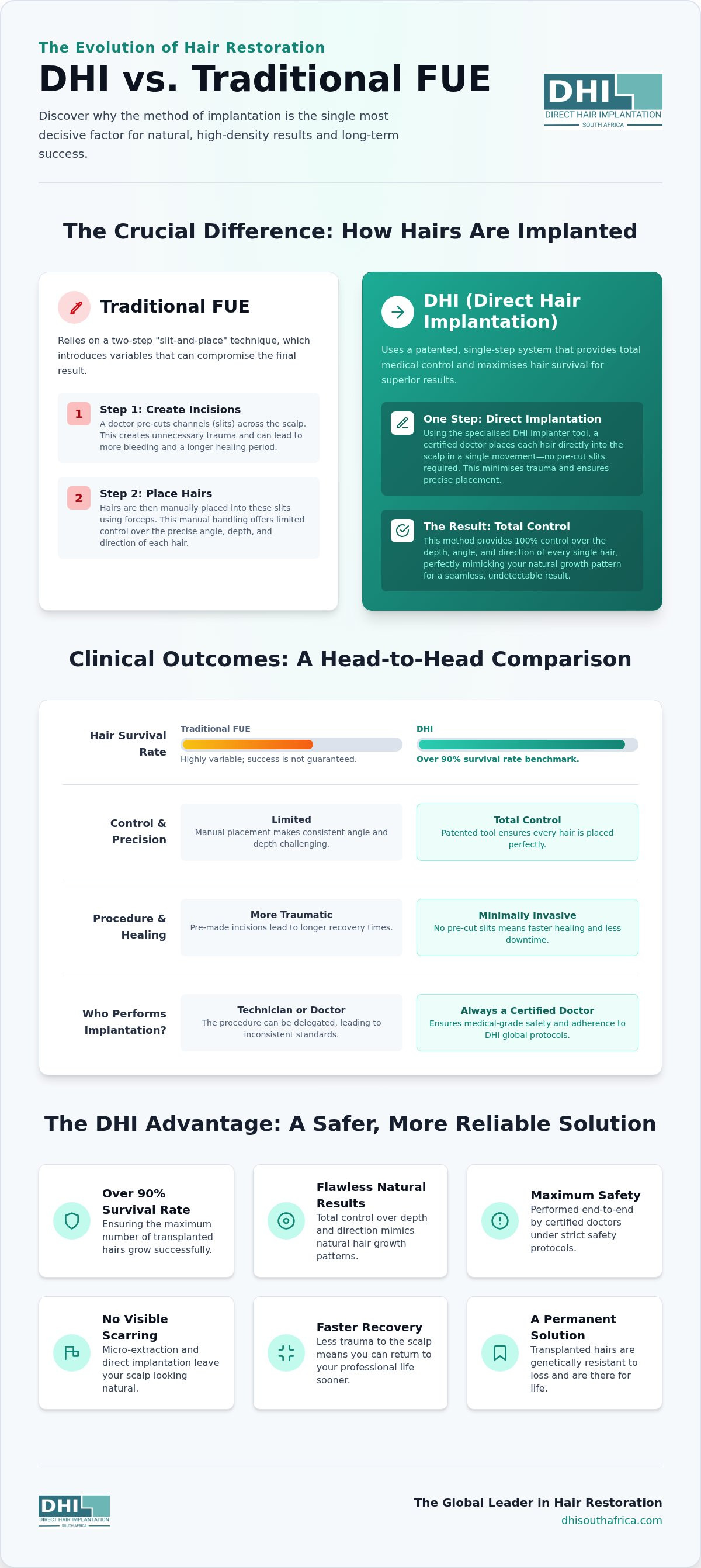
The primary distinction lies in how the hairs are returned to your scalp. Whilst FUE is a two-step implantation process that requires a doctor to manually create "slits" before placement, DHI uses a specialised tool to perform both actions simultaneously. This isn't just a technicality. For patients in South Africa looking for a permanent solution, this shift in methodology represents a significant jump in both safety and the natural appearance of the final result.
The Traditional FUE Method Explained
The traditional FUE approach relies on a two-step implantation technique. A doctor first creates "channels," which are essentially tiny incisions or slits in the recipient area of the scalp. After these slits are prepared, the harvested hairs are tucked into place using forceps. This manual handling can be problematic. It's challenging to ensure every hair is placed at the perfect angle or the exact depth required for long-term health. Because the scalp is effectively wounded twice, once for the slit and once for the placement, the recovery time can be longer and the final density may appear patchy in the crown area, where hair naturally grows in a complex swirl.
How DHI Elevates the Restoration Process
DHI simplifies and secures the process by using a single-step implantation system. There's no need for pre-cut channels. Instead, a certified doctor uses the patented DHI Implanter tool to place the hair directly into the scalp. This allows for 100% control over the direction and depth, which is vital for mimicking the natural growth of your hair. By reducing the time the hairs spend outside the body and eliminating unnecessary trauma to the scalp, we achieve a survival rate of over 90%. This level of precision is why many seeking a crown hair loss treatment south africa choose DHI. It's a method built on decades of research by the DHI Global Medical Group, founded in 1970 to set a higher standard for patient care and aesthetic results.
The Technical Breakdown: How Extraction and Implantation Methods Differ
Both DHI and traditional FUE share a common technical foundation: they both utilise the Follicular Unit Extraction method to harvest donor hairs. However, the similarity often ends there. At DHI South Africa, our extraction protocol is defined by a commitment to follicle integrity. We use motorised, low-transection titanium-coated punches that are single-use for every patient. This medical-grade precision is vital for those pursuing a crown hair loss treatment south africa, as the crown requires a high volume of healthy hairs to achieve convincing, natural density.
Follicle Extraction: The First Step to Success
Success in hair restoration is measured by how many hairs actually take root and grow. A major hurdle in this process is "transection," which is the accidental damage or severing of a follicle during its removal from the donor area. If a hair is transected, its biological structure is compromised and it cannot survive the transplant. Our patented extraction tools are specifically engineered to minimise this trauma, ensuring we harvest only the healthiest follicles. This micro-extraction approach is entirely scar-free, avoiding the unsightly linear scars associated with older strip methods. It leaves your donor area looking natural, even if you prefer to keep your hair short.
The Implantation Phase: Slit-and-Place vs. Direct Implantation
The most significant technical divergence occurs during implantation. Traditional FUE often relies on a "slit-and-place" technique, where a doctor first cuts tiny channels into the scalp. This two-step process can lead to more significant bleeding and a prolonged healing phase. DHI eliminates this trauma by using a patented implanter tool that places hairs directly into the recipient site without pre-cut slits. This "Direct" method significantly reduces the "out-of-body time," which is the critical window hairs spend outside the scalp's blood supply. You can explore our gallery of results to see how this reduced handling leads to thicker, more natural growth.
Control is the hallmark of a world-class procedure. Because we don't use pre-cut channels, our certified doctors have 100% control over the depth, angle, and direction of every hair placed. In the crown area, where hair grows in a complex, circular "whorl" pattern, this level of artistry is the only way to ensure the results don't look artificial. Every step, from the first extraction to the final placement, is performed by a medical expert, not a technician, ensuring your safety and the longevity of your new hair.
Comparing Clinical Outcomes: Survival Rates and Aesthetic Precision
When you're investing in your appearance, the most critical metric isn't how many hairs are moved, but how many actually grow. For anyone considering a crown hair loss treatment south africa, the survival rate of those hairs is the difference between a life-changing result and a disappointing outcome. Many patients feel a deep sense of anxiety about whether their transplant will look thin or patchy. This is why we focus so heavily on the biological health of the follicle. While the industry average for follicle survival often fluctuates between 50% and 60%, the DHI protocol sets a global standard of over 90% survival.
The Science of the >90% Survival Rate
Survival rate is a clinical term for the percentage of hairs that successfully take root and resume their natural growth cycle after being transplanted. Our DHI Total Care System ensures this high success rate by protecting the delicate bulb of the hair follicle, which acts as the biological engine of hair growth. By drastically reducing the time hairs spend outside the scalp and using specialised medical storage solutions, we maintain the vitality of every hair. This meticulous handling means you achieve maximum density without wasting your precious donor supply, ensuring your results look thick and healthy for a lifetime.
Aesthetic Artistry: Designing a Natural Crown
Restoring the crown requires more than just technical skill; it requires an eye for artistry and a steady hand. Hair in the crown area doesn't grow in a simple straight line. Instead, it follows a complex, circular whorl pattern that is unique to every individual. DHI’s patented implanter tool gives our certified doctors the ability to control the exact exit angle and depth of each hair to perfectly mimic this natural pattern. This precision is also what prevents the "cobblestone" effect, a common complication in traditional FUE where the scalp skin appears uneven, bumpy, or pitted after healing.
You can view the visual evidence of this density and precision in our DHI results gallery. For those who want to understand the deeper medical standards we follow, our clinical guide on medical hair restoration in South Africa offers a comprehensive look at how we achieve these permanent, natural results. This level of care ensures that your new hair isn't just permanent, it's indistinguishable from the hair you were born with.
Personal Suitability: Which Technique Aligns With Your Hair Loss Pattern?
Choosing between restoration methods can feel overwhelming, especially when you're balancing the desire for results with the demands of a busy professional life. A common misconception we often clear up during consultations is that DHI is only suitable for minor thinning or small patches. In reality, the precision of DHI makes it an exceptional crown hair loss treatment south africa for a wide variety of hair loss stages. Whether you're just starting to notice a widening part or you've been managing significant thinning for years, the focus remains on the quality and survival of the hairs being moved.
When DHI is the Clear Choice
DHI is frequently the preferred path for patients who prioritise high-density results in delicate areas like the hairline, beard, or the crown whorl. One of its most significant advantages for the modern professional is the possibility of an unshaven hair transplant. This allows you to restore your hair without the need for a full head shave, making the recovery phase incredibly discreet. This technique is particularly effective for those who want to maintain their current hairstyle whilst the new hairs settle and begin their growth cycle. It's an ideal solution for those who can't afford significant downtime or who wish to keep their procedure private from colleagues and clients.
Evaluating the FUE Option
Whilst DHI is the evolution of the process, traditional FUE extraction remains a powerful tool, particularly for patients in advanced Norwood stages (a scale used to classify the extent of male pattern baldness) who require a very high number of hairs for coverage. In some complex cases, our doctors may even recommend a "hybrid" approach. This involves using the efficiency of FUE extraction to harvest a large volume of donor hairs, followed by the clinical precision of DHI implantation to ensure they look natural and survive well. This versatility ensures that we never take a one-size-fits-all approach to your care. Instead, we adapt the science to your individual anatomy, ensuring that your donor area remains healthy and your results look seamless.
Every scalp is unique, and the best path forward depends on your specific hair density, donor health, and aesthetic goals. We understand the emotional weight of this decision. It isn't just about hair; it's about reclaiming the confidence that hair loss often takes away. A professional consultation is the only way to determine which crown hair loss treatment south africa will deliver the permanent, natural results you deserve.
The DHI Advantage in South Africa: Why Technique Trumps Quantity
The success of a hair restoration procedure often rests on who is holding the tools. In many clinics across the globe, the critical steps of extraction and implantation are delegated to technicians. At DHI South Africa, we maintain a different standard. Every single procedure is performed from start to finish by certified doctors who have undergone rigorous training in our patented protocols. This medical-grade oversight is a fundamental part of why we are a leading choice for crown hair loss treatment south africa, ensuring that your safety and the aesthetic quality of your results are never compromised.
Our approach is designed to be as non-invasive as possible, often referred to as a "lunch-hour transplant" because of its streamlined nature. We don't use scalpels, and we don't require stitches. This means there are no linear scars to hide and your recovery time is significantly reduced. To ensure the highest level of patient safety, our clinics follow 18 mandatory safety checks that govern every aspect of the process, from follicle handling to environmental sterilisation. When you consider the DHI hair transplant cost in South Africa, it is helpful to view it as a lifetime investment in your self-assurance rather than a one-off expense.
Beyond the Surgery: The DHI Total Care System
We believe that hair restoration should be a comprehensive journey rather than a single event. Our DHI Total Care System provides a 360-degree approach that includes diagnostic, preventive, and restorative solutions tailored to your unique pattern of thinning. Along with the transplant itself, many patients benefit from PRP hair loss treatment, which uses your own platelets to stimulate and nourish the newly placed hairs. Our commitment to your results continues long after you leave the clinic, with structured photographic documentation and 18 months of post-procedure monitoring to ensure your new hair thrives as expected.
Choosing Local Excellence Over Medical Tourism
It is tempting to look at "cheap" offshore options, but medical tourism often comes with hidden risks that can lead to depleted donor areas and poor survival rates. Choosing a local specialist for your crown hair loss treatment south africa gives you the peace of mind that comes with accessible aftercare and face-to-face follow-up appointments. You won't be just another number in a high-volume "hair mill" where speed is prioritised over precision. Instead, you receive personalised care from a team that is deeply rooted in global medical standards whilst remaining right here in your own community. We invite you to take the first step toward a permanent solution by booking a consultation for a detailed digital scalp analysis.
Reclaiming Your Confidence Through Clinical Excellence
Choosing the right path for hair restoration is a decision that impacts your self-assurance for decades to come. By opting for a method that prioritises follicle health and artistic placement, you ensure a result that's both permanent and natural. Whether you require a discreet unshaven procedure or a high-density crown hair loss treatment south africa, the clinical shift toward Direct Hair Implantation offers a level of precision that traditional methods simply can't match. Precision is our standard.
You aren't just choosing a procedure; you're joining a global community of over 250,000 satisfied patients who've trusted our DHI Academy certified doctors. With a 99% customer satisfaction rate (IMRB accredited), we provide a safe pair of hands to guide you through your transformation. It's time to stop worrying about thinning. Look forward to a fuller, more youthful profile.
Your journey toward restoration is a deeply personal one, and we're here to ensure it's handled with the care and medical expertise you deserve.
Frequently Asked Questions
Is DHI more painful than FUE hair transplantation?
DHI is designed to be a minimally invasive experience, typically involving less discomfort than traditional FUE. Because we don't use scalpels or stitches, the physical trauma to the scalp is significantly reduced. Precision is our priority. We use local anaesthesia to ensure you remain comfortable throughout the procedure. Most patients describe the sensation as light pressure rather than pain, and you can even relax whilst our doctors work.
Can I get a DHI hair transplant without shaving my head?
Yes, one of the primary reasons patients choose this crown hair loss treatment south africa is the unshaven option. Our specialised tools allow us to extract and place hairs without needing to shave the recipient area. This is ideal for professionals. It allows you to maintain your current style whilst the newly implanted hairs begin their natural growth cycle without any obvious signs of a procedure.
How long does the recovery take for DHI vs FUE?
Recovery from a DHI procedure is remarkably swift, often allowing patients to return to their professional routine within 24 to 48 hours. Unlike traditional FUE, which requires the healing of pre-cut channels, DHI’s single-step implantation causes minimal scalp trauma. You might notice tiny crusts, but these typically flake away within a week. The donor area heals almost invisibly. This happens usually within three to five days after the session.
Why is the survival rate higher with DHI than traditional FUE?
The survival rate is higher because we significantly reduce out-of-body time and physical handling. In traditional FUE, hairs are often handled with forceps and placed into pre-cut slits, which can damage the delicate follicle bulb. Our patented implanter protects the hair during placement. This ensures a survival rate of over 90%. This clinical precision ensures that every hair has the best possible chance to take root and grow permanently for a lifetime.
Does DHI leave any visible scarring in the donor area?
DHI does not leave any linear or visible scarring in the donor area. We use motorised, low-transection punches with a diameter of 1mm or less to harvest individual hairs. These micro-points heal so effectively that they are virtually undetectable to the naked eye. This remains true even if you wear your hair short. It's a significant advantage over older strip methods that left permanent, horizontal scars across the back of the head.
How many hairs can be transplanted in a single DHI session?
A single session can involve the placement of several thousand hairs, depending on your donor health and aesthetic goals. Rather than focusing on graft counts, which can be misleading, we plan procedures based on the total number of individual hairs required for natural density. Every scalp is different. During your digital scalp analysis, our doctors will provide a precise plan tailored to the specific requirements of your crown or hairline restoration.
Is DHI suitable for women with diffuse thinning hair?
DHI is an excellent solution for women experiencing diffuse thinning or female pattern hair loss. Since the procedure doesn't require shaving the head, it's a discreet way to restore density amongst existing hair. It's a safe choice. The precision of the implanter tool allows our doctors to navigate around healthy follicles without damaging them, making it a sophisticated option for women seeking a permanent crown hair loss treatment south africa.
How much does a DHI hair transplant cost in South Africa?
The cost of a hair restoration procedure in South Africa is determined by the complexity of the case and the total number of hairs required. We view this as a lifetime investment in your confidence. Because each treatment is bespoke, we recommend a professional consultation to receive an accurate quote. This ensures you receive a medical-grade plan that respects both your aesthetic goals and your long-term donor health without any guesswork.


Comments