%20(1).jpg)
%20(1).jpg)
PRP vs GFC for Hair Loss: The Clinical Evolution of Hair Restoration
- Dhesan Moodley

- 11 minutes ago
- 12 min read
The standard Platelet-Rich Plasma (PRP) treatment you have likely heard of is no longer the final word in non-surgical hair restoration. You have probably spent hours scrolling through forums, feeling overwhelmed by an "alphabet soup" of medical acronyms whilst your hair continues to thin. It is deeply frustrating to feel like you are guessing with your own self-confidence, especially when you want results that are both visible and lasting.
When weighing up prp vs gfc for hair loss, the choice often comes down to how directly we can stimulate your follicles. Whilst PRP uses your own platelets to release growth factors after injection, Growth Factor Concentrate (GFC) is a more advanced evolution that isolates these restorative proteins beforehand. This clinical refinement ensures a higher, more consistent concentration of the biological "fuel" your scalp needs to thrive, often leading to better density with fewer sessions.
In this article, we will demystify the scientific differences between these two regenerative therapies. You will discover why GFC is increasingly favoured for its precision and comfort, helping you determine which path will best revitalise your thinning hairs and restore your peace of mind.
Table of Contents
Understanding the Science of Regenerative Hair Therapy
Losing your hair is rarely just about the reflection in the mirror. It's about the quiet anxiety that sets in when you notice more hairs in the shower drain or the way you've started adjusting your hat in every shop window. At DHI South Africa, we understand that this isn't just an aesthetic concern; it's a challenge to your self-assurance. Regenerative medicine offers a sophisticated way to reclaim that confidence by using your body's own cells to repair and restore dormant follicles. This scientific foundation is the starting point for anyone weighing up prp vs gfc for hair loss.
The primary culprit we're fighting is a process called miniaturisation. Over time, hair follicles shrink, producing hairs that are progressively thinner, shorter, and more brittle. Eventually, these follicles stop producing visible hairs altogether. Regenerative therapies intervene by delivering growth factors, which act as "chemical messengers." These messengers signal the follicle to stop shrinking and return to a state of healthy production. By improving the biological environment of the scalp, we can often reverse the early stages of thinning before the follicle closes permanently.
The Role of Autologous Treatments
We believe the safest and most effective tools for restoration are already inside you. Autologous treatments use your own biological material, such as Platelet-Rich Plasma (PRP), to stimulate healing. Because the serum comes from your own blood, the risk of allergic reactions or rejection is virtually non-existent. It's a precise, clinical intervention that remains entirely natural, working in harmony with your body’s unique chemistry. This "self-healing" approach ensures that the treatment is as biocompatible as possible, providing a foundation of safety that synthetic alternatives simply cannot match.
The Anagen Phase: Keeping Hairs Growing
Every hair on your head follows a specific cycle: growth, transition, and rest. The anagen phase is the active growth stage, and in a healthy scalp, it can last for several years. When miniaturisation takes hold, this phase is cut short, leading to the visible thinning that causes so much distress. Our goal with regenerative therapy is to prolong the anagen phase, keeping your hairs in the growth stage for as long as possible. This forms a key part of our 360-degree solution, ensuring we don't just mask the problem but actively improve follicle health. Understanding how these growth factors interact with the growth cycle is essential when choosing between prp vs gfc for hair loss.
Platelet-Rich Plasma (PRP): The Traditional Foundation
For over a decade, Platelet-Rich Plasma (PRP) has served as the bedrock of regenerative hair restoration. It was the first treatment to prove that we could harness the body's own healing mechanisms to fight thinning. The process is straightforward. A small amount of your blood is drawn, spun in a centrifuge to separate the platelets, and then injected back into the scalp. Once there, these platelets release growth factors that signal dormant follicles to wake up.
While it has helped thousands, the common frustration many patients share is the inconsistency of the results. You might have friends who swear by it, whilst others see very little change. This variability is one of the main reasons patients research prp vs gfc for hair loss. The effectiveness of standard PRP depends heavily on the quality of your own blood on the day of the procedure, which can be affected by everything from hydration to sleep.
How PRP Stimulates Follicles
When platelets are injected into the scalp, they undergo a process called activation. This triggers the release of proteins that improve blood flow and provide essential nutrients to the hair bulb. A scientific review of PRP for hair regrowth highlights how these proteins help maintain the follicles in the growth phase. Typically, a standard course involves four to six sessions to see a meaningful difference in hair density. It's a reliable way to improve overall scalp health, but it does have its clinical ceiling.
The Limitations of Standard PRP
Standard PRP is not a pure concentration of growth factors. It often contains red blood cells and white blood cells, which can sometimes lead to unnecessary inflammation or pain during the injection process. Because the platelets only release their growth factors after they are injected, the concentration reaching your follicles isn't always stable or predictable. This clinical gap is why many specialists now look toward more refined methods. If you're curious about how these results compare to your current hair density, you can view our patient results to see the real-world impact of these therapies.
This inconsistency in platelet concentration and the presence of inflammatory cells paved the way for the next stage of hair restoration evolution. By moving beyond the simple "platelet-rich" model, we've found ways to deliver the growth factors directly. This shift has led to the development of GFC, which addresses many of the limitations found in traditional PRP.
Growth Factor Concentrate (GFC): The Next Generation of Restoration
Growth Factor Concentrate (GFC) represents the next clinical chapter in our mission to restore your hair's natural density. Whilst traditional methods paved the way, GFC refines the process by delivering a highly purified, concentrated version of the proteins your scalp needs to thrive. At DHI South Africa, we begin this procedure by drawing 15-18ml of your own blood. This is then processed using advanced centrifugation techniques to ensure we extract only the most potent growth factors, leaving behind the cells that aren't necessary for hair regrowth.
The most significant scientific advantage of GFC is its cell-free nature. By removing red and white blood cells from the final serum, we significantly reduce the risk of post-procedure swelling and inflammation. When considering prp vs gfc for hair loss, this purity is a clinical game-changer. You aren't just getting a platelet-rich solution; you're receiving the direct, active ingredients that signal your follicles to produce thicker, healthier hairs. This refined approach allows for a more predictable outcome, as we no longer rely on the body to activate the platelets after they've been injected.
Why GFC is Considered More Potent
In traditional therapies, platelets must be activated within the scalp before they release their growth factors. GFC skips this step entirely. We deliver the growth factors in their active state, allowing for a more immediate and potent interaction with the hair bulb. When weighing up prp vs gfc for hair loss, the direct delivery of these active proteins is what sets this generation of therapy apart. This system achieves much higher concentration levels in a single session, making it particularly effective at revitalising dormant follicles that have begun the miniaturisation process.
The Patient Experience: Less Pain, More Gain
Because the serum is highly refined and free of inflammatory cells, most patients find GFC to be a significantly more comfortable procedure than older alternatives. It's a true "lunch-hour" treatment with zero downtime, allowing you to return to your daily routine in South Africa immediately. Whilst individual responses always vary, most of our patients begin to see visible improvements in density and hair quality after just 3-4 sessions. This efficiency makes it an ideal choice for those seeking a sophisticated, science-led solution that fits into a busy lifestyle without the need for surgical recovery.
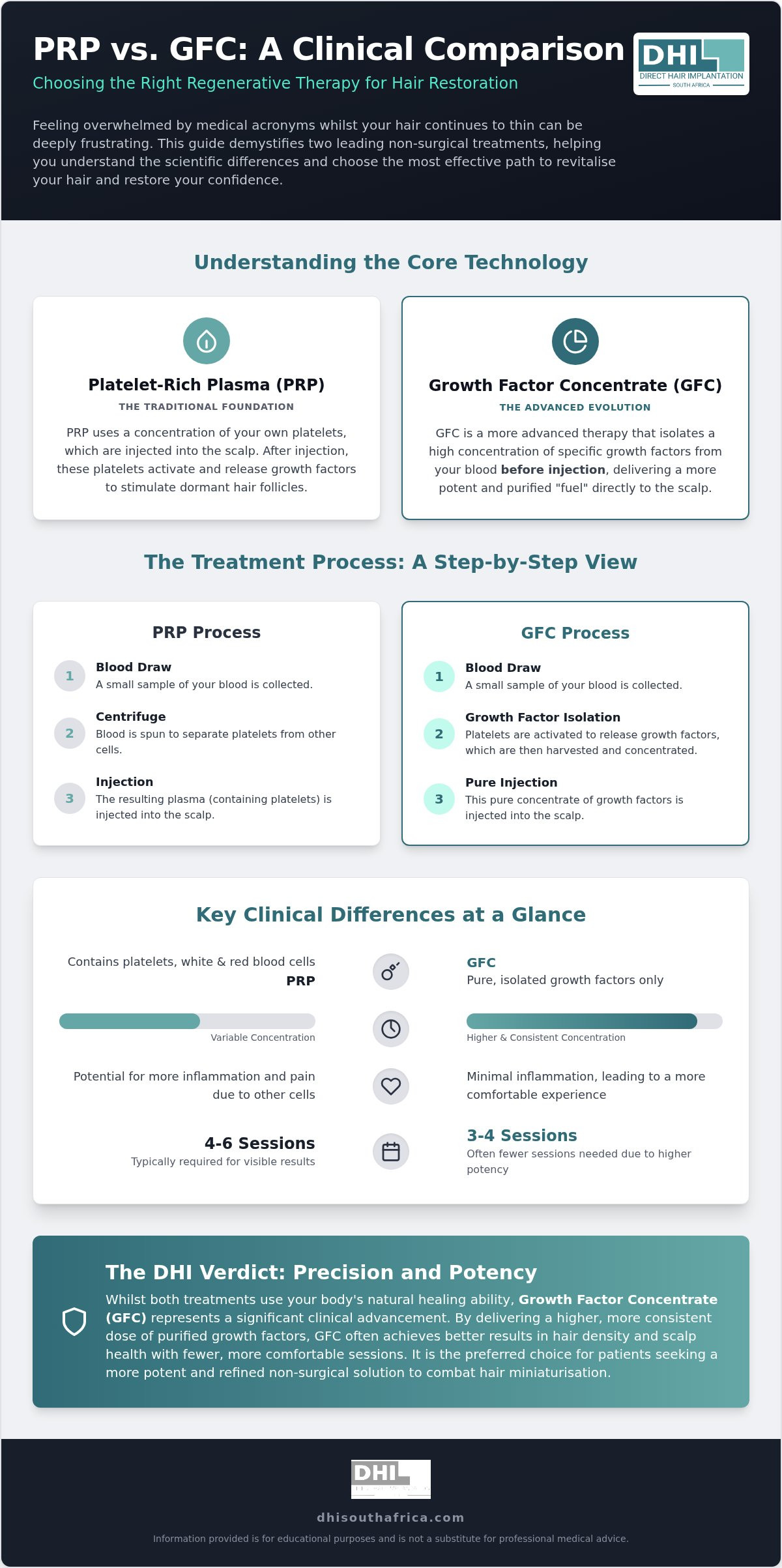
PRP vs GFC: A Direct Comparison for Your Hair Restoration Journey
Choosing the right clinical path requires a clear understanding of how each therapy aligns with your personal goals. When we look at prp vs gfc for hair loss, the decision often rests on the intensity of the results you desire and the current stage of your thinning. Whilst both treatments utilise your own biological material, GFC provides a more streamlined, potent delivery of growth factors. For a detailed breakdown of how these fit into a broader plan, you can explore the DHI treatments page.
The timeline for results is a primary concern for most patients. Standard PRP typically requires a commitment of four to six sessions to achieve a meaningful change in density. In contrast, GFC is often more efficient. Because the growth factors are already concentrated and activated, many patients see a visible improvement in their hairs after just three to four sessions. This makes GFC a more time-effective option for those with busy schedules who want to see progress sooner.
Potency and Consistency Benchmarks
Clinical data suggests a clear distinction in performance between these two generations of therapy. Research indicates that GFC can lead to an approximate 50% increase in hair density, whereas standard PRP typically averages around 35%. This difference is largely due to the "purity" of the concentrate. By removing inflammatory cells and focusing solely on growth factors, GFC offers a more predictable outcome. You aren't just hoping your body activates the platelets; we are delivering the active proteins directly to the follicle bulb.
Suitability: Who Should Choose Which?
GFC is generally the preferred choice for patients experiencing moderate thinning who want a more intensive, faster-acting intervention. It acts as a powerful stimulant to revitalise follicles that have begun to miniaturise. PRP remains a valuable tool, particularly as a maintenance therapy for those in the very early stages of hair loss or for younger patients looking to preserve their current density. The best way to decide is through digital trichoscopy, a high-magnification scalp analysis that allows us to measure your hair thickness and follicle health with scientific precision. This data-driven approach ensures your treatment plan is tailored to your unique biological needs.
Beyond the Serum: The DHI South Africa Approach to Total Care
At DHI South Africa, we don't believe in isolated treatments. Hair restoration is a comprehensive medical journey that requires more than just a single injection. This is why we developed the DHI Total Care System, the gold standard for restoration in South Africa. When you are deciding between prp vs gfc for hair loss, you are actually choosing the foundation for your future results. We often use GFC as a sophisticated tool to prime the scalp, ensuring the skin is healthy and the blood supply is optimised before any permanent restoration begins.
If your hair loss has progressed beyond the point where regenerative therapy can work alone, you might be considering our Direct Hair Implantation technique. In these cases, GFC acts as the perfect clinical partner. By preparing the scalp with a high concentration of growth factors, we create a nutrient-rich environment that supports the successful placement of thousands of hairs. This integrated approach ensures that every step of your treatment plan works in harmony to achieve a natural, dense result.
Improving Hair Survival Rates
The success of any restoration procedure depends on how well the relocated hairs thrive in their new position. Our protocols achieve hair survival rates of over 90%, a benchmark of world-class excellence. GFC plays a vital role in this by significantly reducing post-procedure inflammation and accelerating the healing process. Whilst traditional methods might leave the scalp tender for longer, the cell-free nature of GFC ensures a smoother recovery. This synergy between autologous micro-grafting and growth factor therapy is what allows us to deliver results that are both seamless and permanent.
Your First Step: The Professional Consultation
We know that the "alphabet soup" of medical treatments can feel overwhelming. You shouldn't have to guess which procedure is right for your scalp. Your journey begins with a diagnostic session where we use digital trichoscopy to assess your specific hair loss type. This isn't a high-pressure sales pitch; it's a medical assessment. We adhere to 18 mandatory clinic safety checks to ensure your peace of mind and safety at every stage. For a deeper look at how we manage complex cases, you can read our guide on Advanced Hair Loss Solutions.
Choosing between prp vs gfc for hair loss is a significant decision, but you don't have to make it alone. Our specialists are here to guide you through the science, validating your frustrations whilst providing a clear, data-driven path to restoration. Whether you need to revitalise thinning hairs or are preparing for a full restoration, we provide the expert care you deserve.
Your Path to Restored Confidence and Density
Regenerative medicine has moved beyond simple platelet therapy. By choosing Growth Factor Concentrate, you are opting for a purified, active solution that works directly on your follicles to reverse miniaturisation. Whether you are maintaining early density or preparing for a permanent implantation, the decision between prp vs gfc for hair loss should be rooted in scientific data and professional guidance. You deserve a treatment plan that is as unique as your own biology.
DHI South Africa has been a global leader in hair restoration since 1970, ensuring every procedure is performed by certified DHI specialists. Our IMRB-accredited 99% customer satisfaction rate reflects our commitment to both clinical excellence and your personal comfort. We combine world-class medical standards with a compassionate, patient-centric approach to help you reclaim your self-assurance.
You don't have to navigate thinning alone. Take the first step toward revitalising your thinning hairs with a team that combines the precision of a scientist with the attentive care of a trusted advisor. We look forward to helping you achieve the density and results you deserve.
Frequently Asked Questions
Is GFC hair treatment better than PRP for thinning hairs?
GFC is an advanced evolution of traditional therapy that delivers a more potent result for thinning hairs. Whilst PRP requires the body to activate platelets after injection, GFC provides these growth factors in a direct, concentrated form. This clinical refinement often leads to a 50% increase in hair density compared to the 35% typically seen with standard PRP. It is a more predictable option for those seeking significant revitalisation.
How many sessions of GFC are needed to see results?
Most of our patients begin to see a visible improvement in hair quality and density after just 3-4 sessions. This is a more efficient timeline than traditional PRP, which usually requires 4-6 sessions to achieve similar outcomes. Each session is spaced appropriately to allow the follicles to respond to the concentrated growth factors. Your specific timeline will be determined during a digital trichoscopy analysis to ensure we meet your aesthetic goals.
Is the GFC procedure painful compared to traditional PRP?
You will likely find the GFC procedure more comfortable than standard treatments. Because GFC is a highly purified, cell-free concentrate, it eliminates the red and white blood cells that often cause inflammation and pain during or after the procedure. It is a true "lunch-hour" treatment with zero downtime. Most patients report only mild tenderness at the injection site, which resolves quickly, allowing you to return to your daily activities immediately.
Can I combine GFC with a Direct Hair Implantation procedure?
GFC is an excellent companion to our Direct Hair Implantation (DHI) technique. We often recommend GFC to prime the scalp before the procedure or to boost the health of the area post-treatment. This combination helps maintain our world-class survival rates of over 90% for transplanted hairs. By delivering active growth factors directly to the scalp, we ensure the newly placed follicles have the best possible biological environment to thrive and grow.
What is the cost difference between PRP and GFC in South Africa?
When comparing prp vs gfc for hair loss in terms of investment, GFC is generally more expensive per session. This reflects the advanced centrifugation technology and the more complex laboratory process required to isolate pure growth factors. Because GFC often requires fewer sessions to achieve visible results, many patients find it more economical in the long term. It offers a higher cost-to-value ratio by delivering a more potent, consistent clinical outcome.
Are there any side effects to Growth Factor Concentrate therapy?
Side effects are exceptionally rare because the treatment is autologous, meaning it uses your own blood. There is no risk of allergic reactions or rejection. You might experience slight redness or minor swelling at the injection site, but the "cell-free" nature of GFC significantly reduces these risks compared to older methods. Our specialists follow 18 mandatory safety checks to ensure every procedure is performed to the highest global medical standards for your safety.
How long do the results of GFC hair treatment last?
The results of GFC therapy typically last for 12 to 18 months before a maintenance session is recommended. Because hair loss is often a progressive condition, ongoing care is essential to preserve the density you have gained. Your results will depend on factors like the stage of your thinning and your overall scalp health. We use digital trichoscopy to monitor your progress and determine exactly when a "top-up" session is needed to keep your hairs healthy.
Can GFC help with traction alopecia or female pattern thinning?
GFC is an effective solution for both traction alopecia and female pattern thinning. It works by revitalising follicles that have been stressed or miniaturised, encouraging them to return to the active anagen growth phase. For women, it offers a non-surgical way to improve density without the downtime of more invasive procedures. Whether you are dealing with thinning at the temples or general loss of volume, GFC provides the concentrated biological fuel your scalp needs.


Comments