%20(1).jpg)
%20(1).jpg)
Managing Hair Loss Due to GLP-1: Causes and Treatments
- Dhesan Moodley

- 1 day ago
- 12 min read
What if the price of your transformative weight loss didn't have to include the hair you see gathering in your shower drain? It's deeply distressing to watch your hair thin just as you're finally achieving the body you've worked so hard for. You've likely embraced the life-changing benefits of modern medications, yet the sudden, heavy hair loss due to GLP use feels like a frustrating trade-off for your success. We understand that this anxiety is real; you shouldn't have to choose between your health goals and your self-confidence.
The good news is that this shedding is typically a temporary metabolic response rather than permanent balding. You'll discover exactly why rapid weight loss triggers a resting phase in your follicles called telogen effluvium, which is the biological cause of the thinning. We'll also explain how clinical regenerative therapies, such as Growth Factor Concentrate (GFC) and Regenera Activa, can revitalise your scalp and speed up the regrowth process. This guide provides a clear, medical path to restoring your hair density whilst maintaining your weight loss results.
Table of Contents
What is GLP-1 Hair Loss and Why Does it Occur?
Seeing more hair in the brush than usual can feel like a high price to pay for your weight loss journey. It's vital to understand that hair loss due to GLP isn't a sign that your medication is toxic or that you're "poisoning" your system. Instead, it's a natural, albeit frustrating, physiological response to the rapid metabolic changes your body is undergoing. This type of thinning is typically a non-scarring, temporary condition. While it feels alarming, it doesn't mean your follicles are dead; they're simply taking a break while your body adjusts to its new, healthier weight. You've achieved a massive health win, and this scalp transition is just a hurdle we can help you clear. If you're feeling overwhelmed, exploring our resources on hair loss can provide the clarity you need to move forward confidently.
The Link Between Semaglutide and Your Scalp
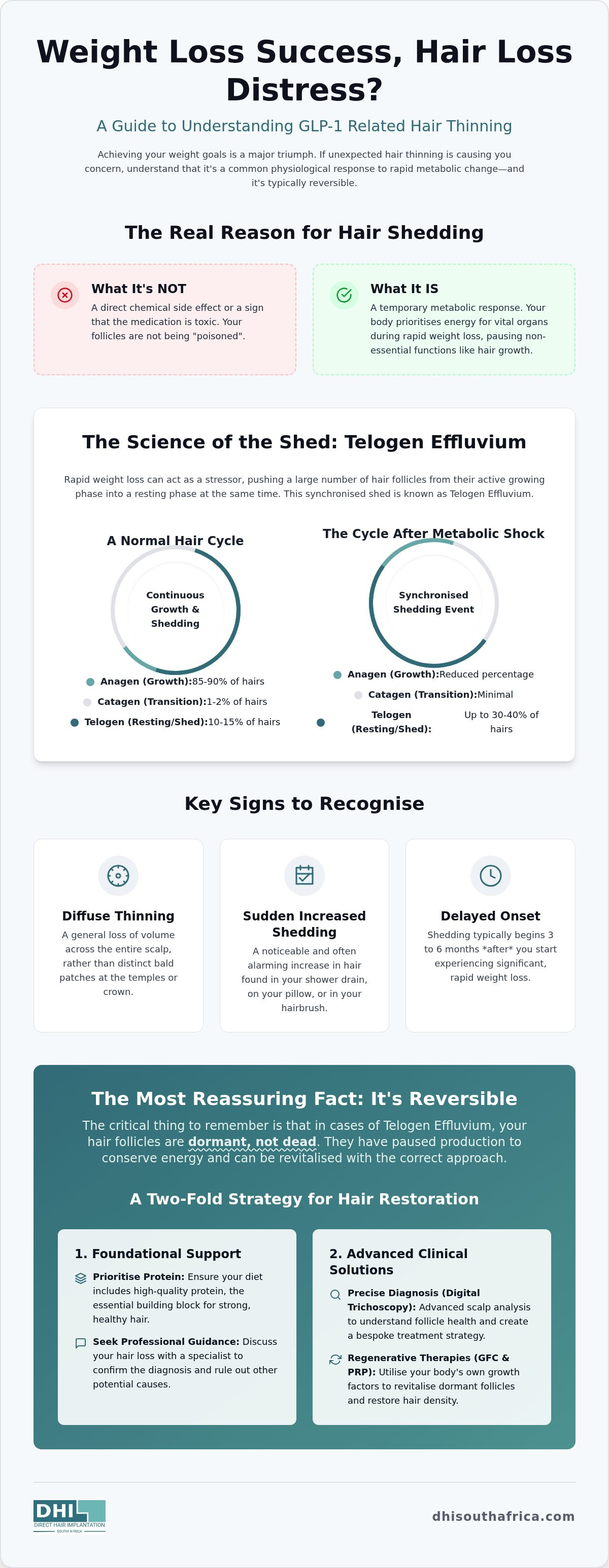
Medications like semaglutide and tirzepatide work beautifully by altering how your body handles calorie intake and nutrient absorption. However, when weight drops quickly, your body enters a state of "resource prioritisation." It's a survival instinct; your system directs vitamins and minerals to vital organs like your heart and brain first. Unfortunately, your hair follicles are at the bottom of that priority list. GLP-1 receptor agonists are metabolic modulators that can indirectly pause hair growth by shifting your body's energy focus away from non-essential aesthetic functions. This often leads to a condition known as Telogen Effluvium, where hairs are pushed into a resting phase prematurely. This shift isn't a permanent failure of the follicle, but rather a temporary pause in production whilst your metabolism stabilises.
Recognising the Signs of Medication-Induced Shedding
The most common sign of this shift is the "clumps in the shower" phenomenon. You might notice a sudden, heavy increase in shedding when you wash or brush your hair, which can be quite startling. Unlike genetic balding, which often starts at the temples or the crown, hair loss due to GLP usually presents as diffuse shedding across the entire scalp. You'll likely feel a general loss of volume and density rather than seeing specific bald patches. Timing is another major clue for diagnosis. This shedding typically begins three to six months after you start seeing significant weight loss. It's the body's delayed reaction to the initial metabolic shock, meaning the hair falling out today is often reacting to the progress you made several months ago. Understanding this timeline helps reduce the panic, as it confirms the shedding is a trailing indicator of your body's transformation.
The Science of Telogen Effluvium: How the Hair Cycle Pauses
To understand why you're experiencing hair loss due to GLP, we need to look at the three distinct phases of your hair's life cycle. At any given time, the majority of your hairs are in the Anagen phase, which is the active growth period that can last for several years. This is followed by the brief Catagen phase, a transitional stage, and finally the Telogen phase. In the Telogen phase, the hair rests for a few months before eventually shedding to make room for a new strand. It's a perfectly natural rhythm that usually goes unnoticed because only a small percentage of hairs shed at once.
Think of your body's metabolism like a busy coffee shop facing a sudden power surge. When you experience rapid weight loss, your system faces a significant energy deficit. To keep the most critical "appliances" running, such as your heart, lungs, and brain, the body "unplugs" non-essential services. Your hair follicles are often the first to be disconnected. This metabolic shock forces a large number of hairs out of the Anagen phase and into the Telogen phase simultaneously. The result is a noticeable, diffuse shedding that occurs a few months after the initial "unplugging" event.
Why Rapid Weight Loss Triggers the 'Rest' Phase
A sharp caloric deficit acts as a profound physical stressor on your endocrine system. During the Anagen phase, your follicles require a constant, high-energy supply of nutrients to produce new hairs at a steady rate. When you lose weight quickly, your body perceives this as a period of scarcity. It classifies hair production as an expendable luxury. By cutting the growth phase short, your body conserves vital resources for more critical biological functions, effectively putting your hair's development on an indefinite hiatus whilst your weight stabilises.
Is it Permanent? Understanding Follicle Health
The most reassuring fact is that the follicle itself remains alive and healthy beneath the surface. Unlike androgenetic alopecia, which involves the permanent miniaturisation and eventual death of the follicle, Telogen Effluvium is a temporary system reset. The "machinery" required to grow new hairs is still perfectly intact; it's simply waiting for the signal that resources are plentiful again. However, choosing a "wait and see" approach can lead to many months of thinning and diminished self-confidence. You don't have to wait in silence for your hair to return. Exploring our range of advanced treatments can help bridge the gap between shedding and regrowth, ensuring your hair density soon matches your new, healthier physique.
Diagnosing Your Hair Loss: Is it the GLP-1 or Something Else?
It's easy to blame the injection pen for every change in your body, yet hair thinning is often a multi-faceted issue. While hair loss due to GLP is a strong candidate, we must ensure other underlying factors aren't compounding the problem. A professional medical hair restoration consultation provides the clarity you need to move from anxiety to action. By taking a clinical approach, we can determine if your shedding is a temporary metabolic reaction or if it's masking a different condition entirely.
The Role of Digital Trichoscopy in Diagnosis
Digital Trichoscopy is essentially high-resolution mapping of your scalp and hairs. Using a specialised lens, we examine your scalp at up to 200x magnification to see exactly what's happening at the follicular level. This tool allows us to identify the specific markers of Telogen Effluvium by calculating the percentage of hairs currently in the resting phase. It's a vital step because it prevents misdiagnosis. You won't waste time or resources on unnecessary treatments for genetic balding if the issue is actually a temporary metabolic shift.
Ruling Out Nutritional Deficiencies
Rapid weight loss often triggers a significant reduction in appetite, which can inadvertently lead to "malnutrition amongst plenty." Your body is losing weight, but your follicles might be starving for the essential building blocks of growth. We look closely at the "Big Three" for hair health:
Ferritin (Iron): This is essential for oxygenating the cells that repair and grow your hairs.
Vitamin D: This nutrient is vital for creating new hair follicles and maintaining growth cycles.
Zinc: Zinc plays a key role in hair tissue growth and the proper functioning of oil glands around the follicles.
Blood tests help us rule out thyroid issues or iron deficiency, both of which are common when your calorie intake drops sharply. For a 360-degree view of your scalp health, we recommend a Total Medical Hair Restoration report. This medical-grade diagnostic ensures we address every variable, from your internal biochemistry to your external hair density.
We also encourage you to track your protein intake alongside your medication. Hair is primarily made of keratin, a protein that requires a steady supply of amino acids to maintain its structure. If your medication has suppressed your appetite to the point where you're missing your daily protein targets, your hair will naturally suffer. Combining dietary adjustments with clinical insights ensures that hair loss due to GLP doesn't overshadow your weight loss success.
How to Stop the Shed: Actionable Steps for Regrowth
Stopping the initial shedding requires a two-pronged approach: stabilising your internal biology and stimulating the scalp externally. While hair loss due to GLP is a significant concern, you can take immediate steps to signal your body that it's safe to resume normal growth cycles. By prioritising the right nutrients and seeking medical guidance, you can protect your hair density whilst continuing your weight loss journey. It's about giving your follicles the "green light" to start producing again.
Step 1: Increase high-quality protein to ensure your follicles have the amino acids needed for keratin production.
Step 2: Consult your prescribing doctor about micro-adjusting your GLP-1 dosage if the shedding becomes extreme.
Step 3: Introduce clinical growth factor therapies to "wake up" follicles stuck in the resting phase.
Step 4: Optimise your scalp environment using medical-grade topical solutions designed for metabolic shedding.
Step 5: Practice patience. It takes time for the hair cycle to re-organise itself after a metabolic shift.
Nutritional Strategies for the GLP-1 User
Your hair is essentially a protein filament, so its health depends heavily on your daily intake. We recommend aiming for 0.8g to 1.2g of protein per kilogram of body weight to provide the necessary building blocks for new hairs. This is particularly important because GLP-1 medications significantly reduce appetite, making it easy to fall into a protein deficit without realising it. Biotin and specific amino acids are also vital components in the keratin production process, acting as the fuel for your follicle's engine. Avoid the temptation of "crash dieting" on top of your medication; extreme caloric restriction only deepens the physiological stress that triggers hair loss due to GLP.
Medical Interventions to Accelerate Recovery
When metabolic shock occurs, over-the-counter shampoos are often insufficient because they don't penetrate deep enough to affect the hair cycle. We focus on "Follicle Revitalisation" through clinical means, using autologous treatments that leverage your body's own healing potential. These medical-grade interventions provide a concentrated boost of growth factors directly to the scalp, encouraging hairs to transition back into the Anagen (growth) phase more quickly than they would on their own. For a deeper dive into these non-surgical options, explore our Advanced Hair Loss Solutions guide.
DHI South Africa’s Regenerative Solutions for GLP Hair Loss
Whilst home-based strategies like protein optimisation provide a necessary foundation, clinical intervention is often required to overcome the biological momentum of metabolic shedding. At DHI South Africa, we provide a sophisticated range of autologous treatments that use your own biological material to revitalise the scalp. These procedures are not mere aesthetic fixes; they are medically grounded protocols designed to reset the hair cycle. By choosing a clinical path, you move beyond the "wait and see" approach and take active steps to protect your appearance. Our DHI Total Care System ensures that every treatment is performed by certified specialists under strict safety standards, giving you the peace of mind you deserve during this transition.
When addressing hair loss due to GLP, the objective is to shorten the resting phase and provide follicles with a concentrated boost of energy. We understand that seeing your hair thin whilst your body improves is a confusing experience. Our team is dedicated to providing a "safe pair of hands," combining scientific precision with the compassionate care of a trusted advisor. We focus on transparency and data-driven results, ensuring you feel fully informed at every stage of your restoration journey.
GFC Therapy: The High-Concentration Advantage
Growth Factor Concentrate (GFC) Therapy represents a significant advancement in non-surgical hair restoration. Unlike standard PRP, GFC involves a specialised process that isolates and activates growth factors from your own blood in a highly stable, acellular form. The procedure begins with a small blood draw, which is then processed using advanced centrifugation to extract the specific proteins required for follicular repair. These concentrated growth factors are then precisely injected into the scalp at the level of the hair bulb. This direct delivery signals dormant follicles to re-enter the anagen phase, which is the active growth period. Most patients observe a visible improvement in hair quality and scalp coverage after a series of three to four sessions.
Regenera Activa: A Modern Answer to Thinning
Regenera Activa is a revolutionary, single-session therapy that addresses diffuse thinning by utilising the power of progenitor cells. This therapy uses progenitor cells, which are specialised cells that act as the engine for tissue regeneration, to revitalise the scalp environment. During the procedure, a small tissue sample is taken from the permanent hair zone at the back of the head and processed into a highly potent suspension. When this suspension is reintroduced to areas of thinning, it helps to curb miniaturisation and restores the natural rhythm of your hair's development. It is an ideal solution for those seeking a multitargeted approach to hair loss due to GLP without the need for multiple appointments. If you're interested in this advanced technology, you can contact us for a personalised suitability assessment with our medical experts.
Take Control of Your Hair Restoration Journey
Your weight loss journey is a significant achievement for your health, and you shouldn't feel that your appearance must suffer as a result. We've explored how hair loss due to GLP is typically a temporary metabolic reaction rather than permanent balding. By using advanced diagnostics like Digital Trichoscopy and regenerative therapies such as GFC, you can effectively bridge the gap between shedding and full restoration. You've done the hard work of transforming your health; now it's time to ensure your hair density reflects that success.
At DHI South Africa, we combine global excellence with personalised care to provide a "safe pair of hands" for your scalp. Our protocols follow ISO and UK CQC-accredited safety standards, ensuring you receive world-class medical attention. With an IMRB-accredited 99% customer satisfaction rate and our patented DHI technique offering a hair survival rate of over 90%, we're here to help you regain your confidence. We understand the anxiety this shedding causes, but with the right clinical approach, your hair can thrive once again.
We look forward to helping you achieve the look you deserve whilst you continue your health transformation. You've earned this new chapter, and we're here to make sure you look and feel your absolute best.
Frequently Asked Questions
Does Ozempic cause permanent hair loss?
No, Ozempic does not cause permanent balding. The thinning you're seeing is a condition called telogen effluvium, where hairs enter a resting phase due to metabolic stress. This process doesn't damage the follicles themselves, so your hair remains capable of growing back once your system stabilises. It's a temporary pause in your growth cycle rather than a permanent loss of your hairs.
How long after starting Wegovy will my hair start shedding?
Most patients notice shedding between three and six months after starting their medication or achieving rapid weight loss. This delay occurs because your hairs stay in the telogen, or resting, phase for several months before they finally shed. It's often a trailing indicator of the progress you made months ago. Understanding this timeline helps reduce the anxiety associated with sudden hair loss due to GLP use.
Can I take Biotin to stop GLP-1 hair loss?
Biotin can support the keratin production process, but it isn't a "magic bullet" to stop metabolic shedding. While it provides the building blocks for healthy hairs, it doesn't address the underlying physiological stress that triggers the rest phase. We recommend using biotin as part of a broader clinical strategy that includes protein optimisation and professional regenerative treatments like GFC to achieve the best results.
Will my hair grow back if I stay on Mounjaro?
Your hair can definitely grow back whilst you stay on Mounjaro. Once your weight stabilises and your body adjusts to the metabolic changes, your growth cycles will naturally resume. The key is ensuring your nutritional intake, specifically protein and iron, meets your body's demands. Clinical treatments can also accelerate this transition, helping you regain density whilst you continue your weight loss journey.
Is it better to have PRP or GFC for medication-induced shedding?
GFC, or Growth Factor Concentrate, is generally considered the superior option for medication-induced shedding. While PRP is effective for boosting circulation, GFC provides a higher concentration of growth factors in a more stable, acellular form. This "high-concentration" advantage makes it particularly effective at waking up follicles that have been shocked into a resting phase by rapid metabolic shifts or hair loss due to GLP medications.
How much protein do I need to eat to prevent hair loss on GLP-1s?
You should aim for approximately 0.8g to 1.2g of protein per kilogram of your body weight every day. Since your hairs are primarily composed of a protein called keratin, a deficit can lead to brittle strands and increased shedding. Meeting these targets ensures your body has the necessary resources to maintain hair production even whilst you're in a caloric deficit from your weight loss medication.
Can DHI hair transplants help if my hair doesn't grow back?
If your hair density doesn't return to your satisfaction after your weight stabilises, a DHI hair transplant is a permanent solution. Our patented technique ensures a survival rate of over 90% for the implanted hairs. This procedure is ideal for restoring areas that have become permanently thin, providing a natural and seamless result that lasts a lifetime. It's a sophisticated way to finalise your transformation.
What is the difference between Ozempic hair loss and normal balding?
The primary difference lies in the pattern and the cause. Medication-induced loss is usually "diffuse," meaning it happens all over the scalp simultaneously and is often temporary. Normal balding, or androgenetic alopecia, follows a specific pattern at the temples or crown and involves the permanent miniaturisation of follicles. A digital trichoscopy analysis can accurately distinguish between these two conditions to ensure you receive the correct treatment.


Comments