%20(1).jpg)
%20(1).jpg)
Hairline Lowering Surgery: A Clinical Guide to Restoring Facial Harmony
- Dhesan Moodley

- 2 days ago
- 12 min read
What if the secret to a perfectly balanced face wasn't about changing your features, but simply about where your hair begins? For many people seeking hairline restoration South Africa, a high forehead feels like a barrier to confidence that dictates every hairstyle and social interaction. You've likely spent years trying to camouflage the area; perhaps you're worrying that any surgical solution might leave behind tell-tale scars or an unnatural, "pluggy" appearance. It's a deeply personal frustration, but modern medical artistry now offers pathways to restore your facial harmony without the fear of looking artificial.
In this clinical guide, you'll discover the scientific and aesthetic nuances of hairline lowering whilst we compare traditional surgical excision with the refined precision of Direct Hair Implantation. We'll explore how the meticulous placement of individual hairs can create a seamless, dense result that respects your unique anatomy. By the end of this article, you'll understand how to achieve a permanent, natural-looking profile with minimal downtime, moving from anxiety to a place of informed, quiet confidence.
Table of Contents
Hairline Lowering Surgery: Defining Facial Harmony and Proportions
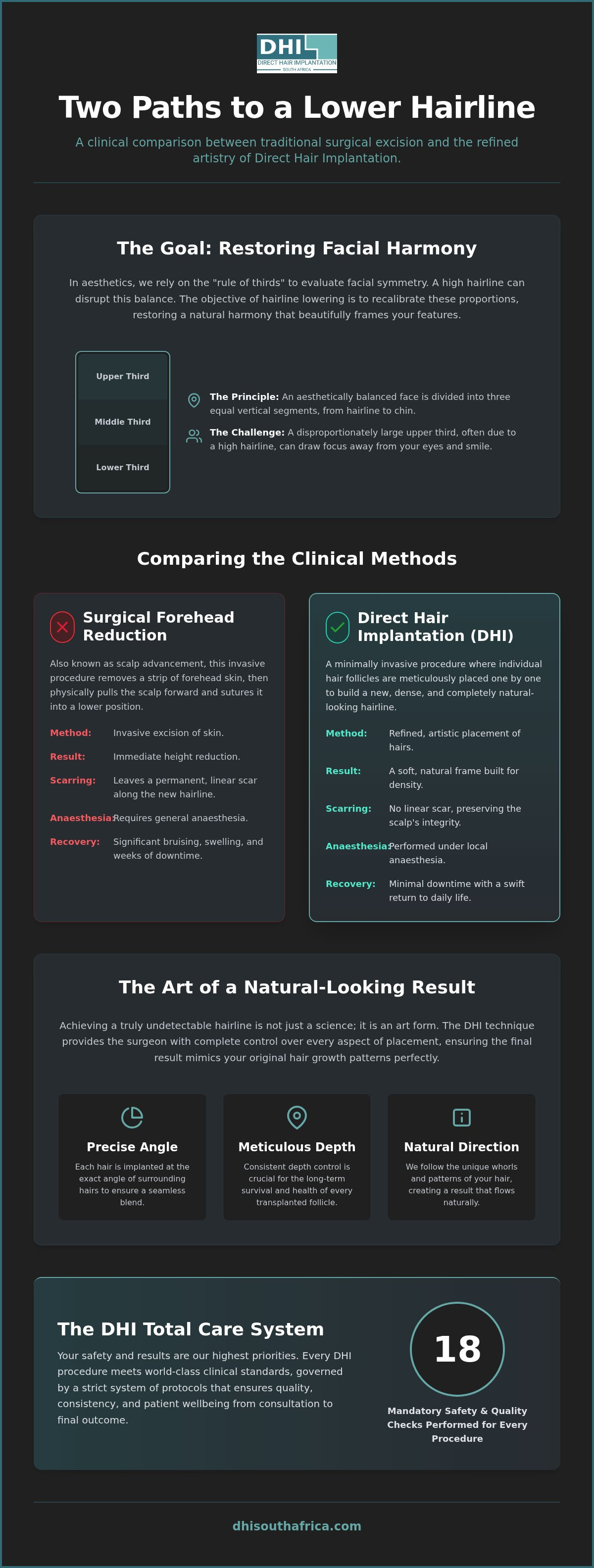
Achieving a balanced profile is as much about geometry as it is about hair density. In aesthetic medicine, we rely on the "rule of thirds" to evaluate facial symmetry. This principle suggests that an attractive face is divided into three equal segments: from the chin to the base of the nose, the nose to the eyebrows, and the eyebrows to the hairline. When the upper third is disproportionately large, it often draws focus away from your eyes and smile. For many individuals across South Africa exploring hairline restoration, this imbalance is a source of persistent self-consciousness that dictates how they style their hair every morning.
Hairline lowering surgery is a specialised clinical procedure designed to move the hairline further down the forehead, effectively recalibrating these proportions. We understand that a high hairline isn't just a physical trait; it often carries a heavy emotional weight. Many patients describe feeling vulnerable in windy weather or when swimming, constantly adjusting their hair to hide a forehead they feel is too prominent. To better understand how we design these proportions for different hair types, watch this helpful video:
The Science of Facial Proportions
Ideally, the distance between your eyebrows and the start of your hair should mirror the other two segments of your face. Genetics often play the largest role here, giving some individuals a naturally high forehead from birth. Others may experience a receding boundary due to traction alopecia, a condition where constant tension on the follicles causes the hairline to migrate backwards. It's exhausting to feel that your appearance doesn't reflect how you feel inside. Clinically, we address this through two primary paths: surgical excision, where skin is removed to pull the scalp forward, or hair transplantation, which builds density hair by hair to create a soft, natural frame.
Why Patients Seek Hairline Refinement
Most patients seek refinement because they want to soften their facial features and achieve a more youthful look. A high genetic hairline or receding temples can make the face appear longer or more aged than it truly is. By lowering the hairline, we create a more compact and balanced aesthetic that highlights your eyes and bone structure. This is particularly relevant for women who feel their forehead is too masculine or prominent. For those navigating these specific challenges, exploring a female hair loss treatment can be the first step toward reclaiming a profile that feels authentic and harmonious. Addressing the hairline isn't just about changing a measurement; it's about restoring the self-assurance that comes with a balanced appearance.
Forehead Reduction vs. Hair Transplantation: Comparing the Two Methods
When you're exploring hairline restoration South Africa, you'll likely encounter two distinct clinical paths. On one hand, you have surgical forehead reduction, which physically alters the skin's surface to reduce the forehead's height. On the other, you have the refined artistry of hair transplantation. Both seek to harmonise your facial proportions, but they offer very different patient experiences and long-term aesthetic outcomes. It's about choosing between a structural change and a density-based restoration.
Surgical Forehead Reduction (Excision)
Surgical reduction, often called a forehead lift or scalp advancement, utilises a pretrichial incision. During this procedure, a surgeon removes a horizontal strip of forehead skin and pulls the hair-bearing scalp forward to be sutured in a lower position. While the reduction in forehead height is immediate, it's vital to consider the trade-offs involved in such an invasive approach. The procedure usually demands general anaesthesia and results in a permanent linear scar where the incision was made. Recovery is typically more robust, with significant bruising and downtime that can last several weeks before the swelling fully subsides.
Hairline Lowering via Hair Transplantation
Hairline lowering via transplantation takes a different, more meticulous approach. Rather than cutting away skin, we carefully move individual hairs from a donor area at the back of your head to the forehead region. This method is exceptionally gentle, performed under local anaesthesia while you relax or listen to music. Because there are no stitches or scalp removal, you won't have to worry about a visible surgical scar. This technique also allows for the filling of receding temples and the creation of a soft, irregular transition zone, a nuanced refinement that traditional surgery often cannot provide. It ensures your new hairline looks entirely natural, even when viewed up close.
Which Method is Right for You?
Deciding which path to take depends on your unique anatomy, such as your scalp laxity and the number of hairs available for relocation. If your scalp is tight, surgical advancement might not be possible, making transplantation the superior choice for achieving your goals. We always recommend a professional consultation to evaluate your specific hair density and skin elasticity. Understanding the long-term benefits of medical hair restoration South Africa is key to choosing a solution that lasts a lifetime. If you're unsure which route best suits your goals, we invite you to explore our patient results gallery to see these life-changing transformations first-hand.
The Art of the Natural Hairline: Why DHI Precision Matters
When we move beyond the structural choice between excision and transplantation, we enter the realm of pure medical artistry. Direct Hair Implantation (DHI) isn't just a sophisticated alternative to traditional surgery; it's a technique that prioritises the subtle details of human growth patterns. For anyone considering hairline restoration South Africa, the goal isn't just a lower hairline, but a result that remains invisible even under the closest scrutiny. This level of realism is achieved by mastering what we call the three pillars of a natural hairline: angle, depth, and direction.
Every hair on your head grows at a specific angle and in a unique direction. If a practitioner ignores these nuances, the result can look "pluggy" or unnatural, like hair forced into a pattern where it doesn't belong. We don't just place hairs; we mirror your natural anatomy. By controlling the depth of every follicle, we ensure the scalp remains healthy and the hair grows with the same vigour as the rest of your mane. This meticulous attention to detail is why our survival rate for hairs is over 90%, significantly higher than the industry average of 50 to 60%.
The Patented DHI Implanter Advantage
The secret to this level of control lies in our patented DHI Implanter. Unlike older methods that require a doctor to first cut "slits" or incisions in the forehead and then place follicles into them, our tool performs the implantation in one single, fluid step. This is a game-changer for your comfort and recovery. Because we don't make prior incisions, there's far less trauma to the scalp tissue, which translates to minimal bleeding and a much faster healing process. The implanter allows the doctor to dictate the exact exit angle of each hair, ensuring it lays flat and follows the natural flow of your existing hair.
Artistic Design and Density
Creating a believable hairline requires more than just density; it requires a "feathered" edge. We use a specialised design technique where the very front of the hairline consists of fine, single hairs placed in an irregular, soft pattern. As we move back, we increase the density to provide the volume you desire. A typical procedure might involve the strategic placement of 2,000 to 4,000 hairs to build a robust yet soft frame for your face. This transition is what separates a clinical success from a truly artistic restoration. To dive deeper into the technicalities, you can read more about Direct Hair Implantation: The Science of Natural Hair Restoration. This approach ensures that your new profile looks as though it has always been there, giving you the freedom to style your hair any way you choose.
Understanding the Patient Journey: Consultation, Procedure, and Recovery
Choosing a partner for your hairline restoration South Africa shouldn't feel like a leap of faith. It's about finding a clinical protocol that treats your safety with the same gravity as your aesthetic results. We operate under the DHI Total Care System, a comprehensive framework that governs every aspect of your experience from the first greeting to the final growth check. This system includes 18 mandatory safety checks that our team performs during every procedure, ensuring that your health and the vitality of your hairs remain our primary focus. We want you to feel like you're in a safe pair of hands, guided by world-class standards at every step.
The Clinical Consultation and Diagnosis
Your journey begins with a thorough diagnostic assessment. We don't just look at where you want your hairline to be; we evaluate whether your hair loss has stabilised to ensure long-term success. During this phase, we utilise a 9-angle photographic series to document your current profile and plan the precise placement of new hairs. This meticulous planning allows us to design a result that complements your facial structure perfectly. You'll only ever be treated by certified medical experts who have undergone rigorous training in our specialised techniques. We don't use technicians for implantation because we believe the artistry of your hairline deserves the steady, experienced hand of a doctor.
Procedure Day and the Healing Phase
On the day of your procedure, you'll find the environment surprisingly relaxed. Many of our patients describe the experience as having a "lunch-hour" feel because it's so minimally invasive. There are no stitches to worry about and no surgical scars to hide, which means you can return to your daily routine almost immediately. While the physical healing happens quickly, the biological process takes a little more time. You may notice some of the newly placed hairs shedding after a few weeks; this is a natural part of the telogen phase, or the resting stage of the hair cycle. It's perfectly normal and makes way for permanent, robust growth to emerge.
We remain your partners long after the procedure is finished. Our post-procedure monitoring continues for up to 18 months to track the progress of your new density and ensure you're delighted with the final outcome. We'll be there to answer every question as your new profile begins to take shape, providing the same level of care during your final check-up as we did on day one. This unhurried, methodical approach is designed to give you absolute clarity and peace of mind throughout your transformation.
Hairline Lowering: Expert Advice and Candidacy
Deciding to move forward with a procedure is a significant step, and it's essential to understand what makes a successful candidate for hairline restoration South Africa. While the desire for a more balanced profile is the starting point, our clinical team looks for specific indicators that ensure your results will be both beautiful and permanent. We don't believe in one-size-fits-all solutions; we focus on the unique biological and aesthetic factors that will make your transformation a success. It's about ensuring the foundation of your scalp is as ready for change as you are.
Evaluating Your Candidacy
The most critical factor in your candidacy is the availability of healthy donor hair. Since we relocate individual hairs from the back or sides of your head to the forehead, we must ensure you have a sufficient supply to achieve the density you desire. We also assess your overall scalp health and the stability of your hair loss. Patients experiencing early-stage androgenetic alopecia, or common genetic thinning, are often ideal candidates because we can restore the hairline before the forehead area becomes too expansive. This procedure is equally effective for both men and women. Whether you're a woman seeking to lower a naturally high forehead or a man looking to refine receding temples, our goal is to create a soft, natural frame that feels entirely yours.
The DHI Commitment to Excellence
Choosing DHI South Africa means placing your trust in a global leader with over 50 years of specialised expertise. We've spent decades refining our techniques to ensure they meet the highest possible medical standards. This dedication is reflected in our 99% customer satisfaction rate and our strict adherence to ISO-accredited protocols. We don't take shortcuts with your safety or your results. Every procedure utilises single-use, titanium-coated instruments to ensure maximum hygiene and the most delicate handling of your hairs. This level of precision is what allows us to guarantee the natural, seamless look that has become our hallmark.
You've seen the science and the artistry behind our approach, and now it's time to see the real-world impact. We're proud of the life-changing transformations we facilitate every day. If you're ready to explore how we can restore your facial harmony and boost your self-assurance, we invite you to view our patient results or book a personalised clinical consultation. Taking the next step with a professional scalp analysis will provide the clarity you need to move forward with confidence.
Reclaiming Your Profile with Clinical Artistry
The journey to a more balanced facial profile is a blend of medical science and artistic vision. By choosing a refined approach to hairline restoration South Africa, you're opting for a method that prioritises your comfort and the longevity of every hair. We've explored how DHI bypasses the need for invasive excision, instead using a patented system that ensures a hair survival rate of over 90% whilst maintaining total control. This precision allows for a seamless, dense hairline without the tell-tale scars of traditional surgery.
Every procedure is performed by our certified medical doctors, drawing on a global network with over 50 years of clinical expertise. You don't have to settle for an unnatural look or lengthy downtime. Instead, you can achieve a permanent restoration that respects your unique features.
Take the first step toward the self-assurance you deserve. We're here to guide you through every stage of your transformation with the care and expertise your hair deserves.
Frequently Asked Questions
Is hairline lowering surgery permanent?
Yes, the results are permanent. The hairs moved during the DHI procedure are genetically resistant to the hormones that cause thinning and loss. This means once they take root in their new position, they continue to grow for a lifetime. It is a stable solution for hairline restoration South Africa, providing an enduring profile that ages naturally with you without the need for repetitive treatments.
How many hairs are typically needed for a hairline lowering procedure?
The total count depends on your unique facial proportions and the desired density. Typically, we place between 2,000 and 4,000 hairs to create a soft, believable border and fill in the temples. During your clinical consultation, we use digital trichoscopy to measure your donor density. This allows us to calculate the exact number required to achieve a balanced result whilst ensuring the donor area remains healthy.
What is the main difference between forehead reduction surgery and a hair transplant?
Forehead reduction is an invasive surgery that removes a strip of skin to physically pull the scalp forward. In contrast, a hair transplant builds a new hairline by adding individual hairs. While surgery offers an immediate change, it often leaves a linear scar. DHI provides a refined alternative that creates a soft, irregular transition zone and fills receding areas that traditional excision surgery simply cannot reach.
Will there be a visible scar along my new hairline?
No, the DHI technique does not leave a visible surgical scar. Because we don't use scalpels, incisions, or stitches, there is no linear mark along your new hairline. We use a patented implanter to place individual hairs into the scalp in a single, precise step. This minimizes tissue trauma and ensures that once the initial healing phase is complete, the only thing visible is your own natural hair growth.
How long is the recovery period before I can return to work?
Most patients return to work within two to three days. The procedure is minimally invasive, so there is no significant downtime or heavy bandaging required. You might notice minor redness or tiny crusts around the placed hairs, but these typically resolve within a week. We provide a specialised post-care kit to ensure your scalp heals quickly, allowing you to resume your daily routine with total peace of mind.
Can men undergo hairline lowering surgery to fix a high forehead?
Absolutely. Men often seek this procedure to correct a naturally high forehead or to refine temples that have receded due to genetics. It is a popular choice for hairline restoration South Africa when the goal is to restore a more youthful, balanced profile. We meticulously design the male hairline to ensure the angle and direction of every hair mimic natural patterns, avoiding an artificial or "pluggy" appearance.
Does the procedure require general anaesthesia?
No, we perform the entire procedure under local anaesthesia. This ensures you remain awake and comfortable throughout the day without the risks or lengthy recovery associated with general anaesthesia. You can relax, listen to music, or chat with our team while our certified doctors place each hair. This approach prioritizes your safety and comfort, making the clinical experience feel calm and unhurried from start to finish.
When will I see the final results of my hairline lowering?
You will see the final, mature results approximately 12 to 18 months after the procedure. While the new shape is visible immediately, the placed hairs enter a resting phase and shed after a few weeks. New, permanent growth begins to emerge around the third month and continues to thicken over the following year. We monitor your progress through regular check-ups to ensure the density and direction meet our standards.


Comments