%20(1).jpg)
%20(1).jpg)
Non-Surgical Hair Regrowth: A Clinical Guide to Restoring Your Confidence in 2026
- Dhesan Moodley

- 2 hours ago
- 11 min read
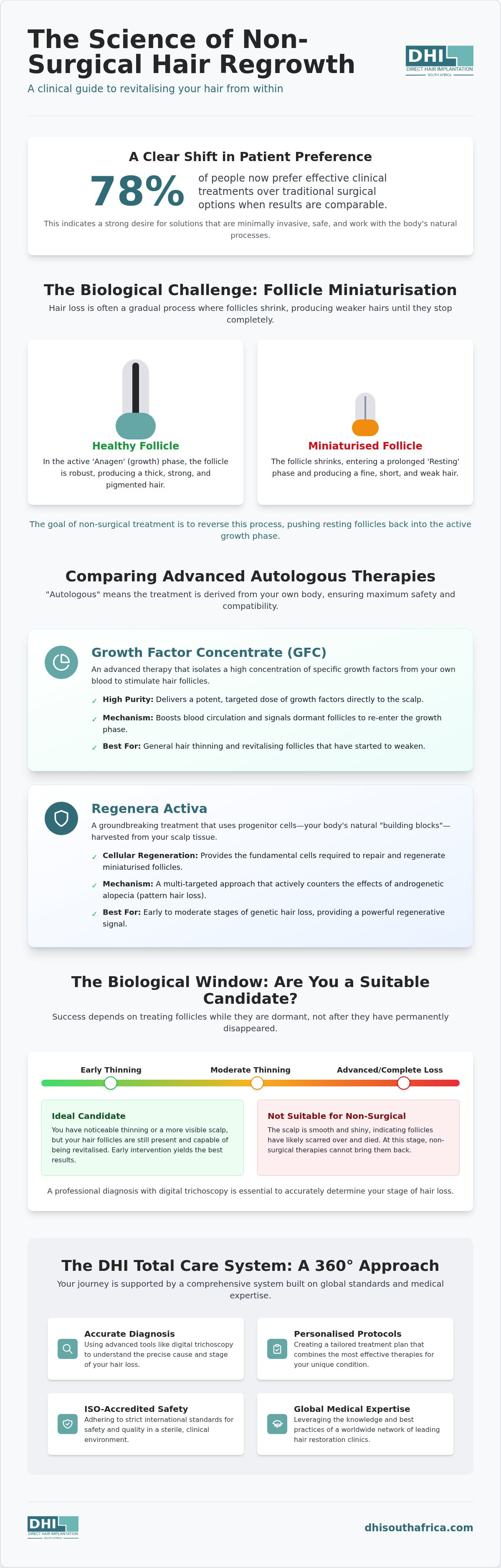
Recent medical data shows that 78% of people now prefer clinical treatments over surgical options when the results are comparable. It’s a clear indication that the era of choosing between a scalpel or a bottle of ineffective lotion is finally over. If you’ve felt the pang of anxiety whilst catching a glimpse of your scalp in the mirror, you know that thinning is more than just an aesthetic concern. It’s a direct challenge to your self-assurance. Finding a reliable path for non surgical hair regrowth shouldn't feel like a gamble, yet the market is often saturated with promises that lack scientific backing.
We agree that your journey to restoration should be as natural and safe as possible. This article promises to reveal the scientific reality of how autologous therapies can revitalise your natural hairs without a single incision or a day of downtime. We’ll explore the mechanics of follicle miniaturisation and how advanced treatments like Growth Factor Concentrate (GFC) and Regenera Activa use your own biological material to halt loss. By the end of this guide, you’ll understand the precise clinical protocols available in 2026 to help you achieve visible thickening and reclaim your confidence through a world-class, medical-grade approach.
Table of Contents
Understanding Non-Surgical Hair Regrowth and Why It Matters
Hair loss isn't just a minor aesthetic change. It's a deeply personal experience that can quietly erode your self-assurance every time you catch your reflection. We understand the frustration of trying every over the counter lotion only to see more thinning in the mirror. When we discuss non surgical hair regrowth, we are moving away from empty promises and focusing on the clinical stimulation of dormant follicles. It's about waking up hairs that have slowed down but are still biologically capable of growth, using a scientific approach to restore what's been lost.
Most instances of Pattern hair loss are driven by a process called miniaturisation. This occurs when individual follicles shrink over time, producing hairs that are progressively finer, shorter, and lighter in colour. Eventually, these follicles may stop producing visible hair entirely. Autologous treatments aim to interrupt this cycle by using your own biological material to revitalise the scalp environment. If you've been searching for answers to hair loss, understanding this biological decline is the first step toward a solution that works with your body, not against it.
To better understand this concept, watch this helpful video:
Regrowth vs. Camouflage: Knowing the Difference
It's easy to get lost in a sea of products that promise a fuller head of hair. Many people turn to hair systems, toupees, or micro-fibres as a first port of call. Whilst these tools provide an immediate visual change, they are merely camouflage. They don't treat the underlying condition. Clinical non surgical hair regrowth is fundamentally different because it targets the root cause of thinning at a cellular level. Instead of hiding the scalp, we focus on permanent biological improvement, strengthening your existing hairs so they can grow thicker and stay in place longer.
The Biological Window of Opportunity
Timing plays a massive role in the success of any hair restoration strategy. There is a critical window where follicles are in a "resting" phase but haven't yet died off completely. Once a follicle has reached the point of permanent death and scarring, non-surgical options can't bring it back. The goal of modern clinical therapy is to push these resting follicles back into the anagen phase, which is the active growth period for hairs where they receive the vital nutrients needed to thrive. Early intervention is your greatest ally, as it allows us to protect and revitalise follicles before they vanish for good.
The Science of Autologous Therapies: Using Your Own Cells
The word "autologous" might sound complex, but its meaning is simple and powerful: it comes from your own body. In the context of non surgical hair regrowth, using your own biological material is the ultimate form of personalised medicine. Because we use your own cells, the risk of donor-site rejection or adverse allergic reactions is entirely eliminated. You aren't introducing foreign chemicals; you're simply redirecting your body's natural healing resources to where they're needed most.
Progenitor cells and stem cells act as the fundamental "building blocks" for hair health. These cells have the unique ability to repair damaged tissue and stimulate the regeneration of follicles that have begun to fail. Growth factors play a supporting role by boosting scalp circulation, ensuring that each hair receives a steady supply of oxygen and nutrients. Achieving this level of precision requires a controlled clinical environment, where advanced centrifugation can isolate these potent elements with medical-grade accuracy. If you're curious about how these biological tools work in practice, you can explore our range of specialised treatments to see the science in action.
How Growth Factors Stimulate Dormant Hairs
Follicles often get stuck in the telogen, or resting, phase. This is when the hair stops growing but hasn't yet fallen out. Growth factors act as a biological wake-up call for these dormant hairs. By improving the "soil" of the scalp, these treatments create a fertile environment where hair shafts can emerge thicker and more resilient. This clinical approach is significantly more effective than standard noninvasive treatments for hair loss found on pharmacy shelves, which often lack the concentration required to trigger deep cellular change.
The Safety and Ethics of Bio-Restoration
Your safety is our absolute priority. Using your own biological material is widely considered the "gold standard" because it's naturally compatible with your system. In our clinics, we follow strict ISO-accredited protocols and use sterile, single-use instruments for every procedure. These Standard Operating Procedures (SOPs) ensure that every step of your non surgical hair regrowth journey is handled with the same level of care you'd expect from a world-class medical institution. It's a methodical, ethical process designed to give you peace of mind whilst restoring your natural hair density.
Comparing Clinical Treatments: PRP, GFC, and Regenera Activa
Choosing the right clinical path for non surgical hair regrowth shouldn't feel like a guessing game. You don't need to clear your diary for weeks or prepare for a long recovery. Most of our advanced clinical sessions are completed in under an hour, fitting seamlessly into a busy professional life. Whether we are waking up dormant follicles or strengthening existing hairs, these treatments offer a "lunch-hour" convenience that allows you to return to your day immediately with absolute discretion.
Whilst each therapy is powerful on its own, we often recommend a 360-degree approach that combines these technologies. This ensures we are tackling hair loss from every biological angle, from improving scalp circulation to providing the cellular building blocks required for density. By tailoring the protocol to your specific needs, we can create a robust environment where your natural hair can thrive again.
GFC Therapy: The Advanced Centrifugation Advantage
Growth Factor Concentrate (GFC) represents a significant evolution of traditional PRP. Whilst standard methods rely on platelets to release growth factors after injection, GFC uses advanced centrifugation to extract these factors at their highest concentration before they ever touch your scalp. This means we can deliver a more potent, precise dose of revitalising proteins directly to miniaturised hairs. It's a key component of our Advanced Hair Loss Solutions, designed for those who want maximum efficacy from a minimal blood draw.
Regenera Activa: Autologous Micro-Grafting
For those facing the early stages of androgenetic alopecia, Regenera Activa offers a multitargeted answer. This process uses autologous micro-grafting to harvest progenitor cells from a small, healthy area of your scalp. These cells are then processed and reintroduced to thinning areas to curb the miniaturisation process. It's an excellent way to improve hair density without traditional surgery. Interestingly, this treatment also plays a vital role in improving the survival of hairs if you decide a transplant is necessary later in life.
PRP Hair Loss Treatment: A Trusted Foundation
Platelet-Rich Plasma (PRP) remains a trusted foundation in the world of non surgical hair regrowth. During a session, we take a small sample of your blood and concentrate the platelets, which are then precisely injected into the scalp to maintain existing hair density. Consistency is the secret to success here. We typically recommend a schedule of 3-4 sessions to see visible results, as this allows the scalp environment to stabilise and the growth cycle to reset. It’s a methodical, safe, and deeply personal way to take control of your hair health.
Determining Your Suitability for Non-Surgical Restoration
Success in hair restoration begins with a clear understanding of your current stage of loss. If you've noticed early-stage thinning or a decrease in overall density, you're likely an ideal candidate for non surgical hair regrowth. These treatments are specifically designed to revitalise existing follicles that are still active. However, if an area has reached advanced baldness where the scalp is smooth and shiny, the follicles may have permanently scarred over, requiring a different clinical approach.
It's vital to manage expectations from the start. Non-surgical therapies aim to thicken and strengthen the hairs you already have; they don't move hairs from one part of the head to another. For women experiencing diffuse thinning across the entire scalp, these autologous treatments are often the preferred choice because they address the systemic health of the follicles without the need for incisions. Whilst many people search for non surgical hair regrowth as a quick fix, the reality is that clinical success depends on the biological health of your remaining follicles.
Relying on a professional diagnosis rather than self-treating with supermarket lotions ensures you don't waste precious time on ineffective solutions. A specialist can identify the specific cause of your thinning, whether it's hormonal, genetic, or environmental, and recommend a targeted path forward. This methodical approach saves you the frustration of trial and error whilst protecting the hairs you still have.
The Role of Digital Trichoscopy in Diagnosis
We believe that every restoration journey should be data-driven. Digital trichoscopy is a high-magnification analysis of the scalp and hairs that allows us to see exactly what's happening beneath the surface. By examining follicle density and hair shaft diameter, we can create a diagnostic report tailored to your unique loss pattern. This level of precision is especially beneficial for women, and you can find more detail in our Female Hair Loss Treatment guide.
When to Consider Transitioning to a Hair Transplant
There may come a point where non-surgical options are no longer enough to achieve your desired density. When follicles have completely ceased production, transitioning to a surgical solution is the most effective path forward. Interestingly, non-surgical treatments like GFC therapy often act as a perfect primer, preparing the scalp environment and improving the health of surrounding hairs for a successful Direct Hair Implantation. This synergy ensures that the transplanted hairs have the best possible foundation to thrive in their new location.
The DHI South Africa Approach: Total Care for Your Hair
At DHI South Africa, we don't just treat hair; we treat the person. Our Total Care System is a 360-degree approach that ensures your journey towards non surgical hair regrowth is supported by global expertise and local care. Being part of a world-class network with 75+ clinics across 45 countries means you benefit from decades of refined medical protocols. Every procedure is performed by certified medical experts who prioritise your safety above all else, following strict ISO and UK CQC-accredited standards.
Transparency is the foundation of the trust we build with you. We use rigorous photographic documentation and long-term monitoring to track your progress with scientific precision. This isn't about vague promises; it's about measurable results that you can see and feel. Our commitment to your hair health extends far beyond the treatment room, ensuring that your results are both natural and enduring through every stage of the restoration process.
A Compassionate Consultation Process
Your first visit to our clinic is designed to be as informative as it is reassuring. We start by listening to your story, validating the emotional weight that hair loss carries, and understanding your personal goals. Our specialists focus on your emotional well-being as much as the clinical analysis, ensuring you feel like a partner in your restoration. We invite you to experience a digital scalp analysis, which provides a high-magnification look at your follicles to begin your restoration journey with absolute clarity.
Why Specialisation Matters in Hair Restoration
There is a profound difference between a general aesthetic clinic and a dedicated medical hair restoration specialist. Our focus is singular, allowing us to master the artistry and science of hair health. By choosing our specialised approach to non surgical hair regrowth, you benefit from patented instruments and strict Standard Operating Procedures (SOPs) that have delivered a 99% customer satisfaction rate. This level of precision ensures that every hair is handled with meticulous care, leading to the seamless results our global reputation is built upon. Reclaiming your confidence is a journey we take together, and we are here to guide you every step of the way.
Take the First Step Toward a Fuller Future
The journey to restoring your hair density doesn't have to involve surgery or guesswork. By choosing clinical non surgical hair regrowth, you're opting for a path that uses your body's own biological building blocks to revitalise dormant follicles. We've explored how autologous therapies like GFC and Regenera Activa offer a safe, natural alternative to temporary camouflage, provided you act whilst your follicles remain in the biological window of opportunity.
At DHI South Africa, we combine our status as global leaders in hair restoration since 1970 with a 99% customer satisfaction rate to ensure you're in the safest possible hands. Our ISO and UK CQC-accredited safety protocols are designed to give you absolute peace of mind whilst you focus on your transformation. Reclaiming your self-assurance is a deeply personal process, and our specialists are ready to guide you through every clinical detail with the empathy and candour you deserve.
Your path to a fuller head of hair is a partnership built on science and trust. We look forward to helping you rediscover the confidence that comes with a restored, natural appearance.
Frequently Asked Questions
Is non-surgical hair regrowth permanent?
Non-surgical hair regrowth is not typically a one-time permanent fix; it is a clinical strategy to manage a progressive condition. Whilst these treatments effectively thicken existing hairs and revitalise dormant follicles, they do not change your genetic predisposition to thinning. To maintain the results achieved through autologous therapies, most patients require periodic maintenance sessions. Think of it as a long-term commitment to your scalp health rather than a singular event.
How long does it take to see results from non-surgical treatments?
You should expect to see visible improvements within three to six months of starting your treatment plan. Hair growth is a slow biological process, as follicles must transition from the telogen (resting) phase back into the anagen (active) phase. Initial changes often include a reduction in shedding, followed by a noticeable thickening of individual hairs. Patience is essential, as the most significant transformations usually appear after a full cycle of growth has occurred.
Can non-surgical treatments help with advanced baldness?
Non-surgical options are generally not effective for areas of advanced baldness where the scalp is smooth and follicles have permanently scarred. These therapies rely on the presence of existing, albeit weakened, follicles to stimulate regrowth. If you've reached a stage where the skin is completely bare, a surgical hair transplant is likely the only clinical solution. We use digital trichoscopy to determine if your follicles are dormant or deceased before recommending a path forward.
Are there any side effects to autologous hair therapies?
Side effects are extremely rare because autologous therapies use your own biological material, eliminating the risk of allergic reactions or rejection. You might experience mild tenderness, redness, or slight swelling at the injection sites for a few hours following the procedure. These minor symptoms typically resolve within 24 hours. Because we operate under strict ISO and UK CQC-accredited safety protocols, the process remains one of the safest medical interventions available for hair restoration.
Can I go back to work immediately after a GFC or PRP session?
Yes, you can return to your professional and social activities immediately after your session. We often describe these as "lunch-hour" treatments because they are quick, discreet, and require no downtime. There are no bandages or visible scars to manage. We simply advise that you avoid strenuous exercise or washing your hair for about 24 hours to allow the scalp to settle and ensure the growth factors can work effectively.
How many sessions of non-surgical treatment will I need?
Most patients require an initial course of three to four sessions, spaced approximately four weeks apart, to achieve optimal non surgical hair regrowth. This loading phase allows the concentration of growth factors to build up and effectively reset the hair cycle. After this initial series, we usually recommend a maintenance session every six to twelve months. Your specific schedule will be tailored to your unique hair loss pattern and biological response to the therapy.
Is non-surgical hair regrowth suitable for women?
Absolutely, women are often the most ideal candidates for these clinical therapies, particularly when experiencing diffuse thinning. Female hair loss frequently involves a general loss of density rather than a receding hairline, making autologous treatments a perfect non-invasive solution. These procedures strengthen miniaturised hairs across the entire scalp without the need for surgery. It is a compassionate, effective way to restore volume and confidence whilst working with your body's natural regenerative capabilities.


Comments