%20(1).jpg)
%20(1).jpg)
Hair Transplant Before and After in South Africa: Your Guide to Natural Results (2026)
- Dhesan Moodley

- 1 day ago
- 12 min read
You've likely spent far too many mornings in front of the mirror, adjusting your hair to hide thinning patches or questioning if that messy concealer powder actually looks natural under office lights. It's a quiet, daily weight that many of our patients carry, especially considering that over 33% of South African men experienced male-pattern baldness in 2025. When you begin looking into a hair transplant before and after South Africa, you're looking for a permanent solution that restores your confidence without the telltale signs of a "fake" hairline or visible scarring.
We understand that the decision to pursue medical restoration is significant, and you deserve a result that mirrors nature's own design. In this guide, we'll explore the science behind our patented Direct Hair Implantation technique, which ensures a hair survival rate of over 90% whilst maintaining total control over the angle and depth of every hair. You'll discover what to expect during the 12-month recovery journey and learn how the precise placement of individual hairs creates the density and flow you've been missing.
Table of Contents
Understanding Hair Transplant Before and After Results in South Africa
Deciding to restore your hair is rarely just about vanity. It's about reclaiming a sense of self that feels like it's been slipping away with every morning shower. When you browse a gallery of a hair transplant before and after South Africa, you aren't just looking for more hair. You're looking for the end of a long, often exhausting cycle of temporary powders and clever styling. We believe a truly successful result is one that passes the "close-up" test, where even your barber can't tell where nature ended and clinical artistry began.
To achieve this level of transparency, it's vital to look beyond simple front-on selfies. A reputable clinic should provide a full 9-angle photographic series. This allows you to scrutinise the density, crown coverage, and seamlessness from every possible perspective. Many South African patients are now choosing Direct Hair Implantation (DHI) specifically because it offers a scar-free profile, meaning you can keep your hair short without worrying about the linear scars associated with older methods.
The Emotional Impact of Hair Restoration
There's a profound link between hair density and personal confidence. We see it in the way a patient's posture changes once their hairline is restored. Topical treatments or hairpieces often feel like a compromise, keeping you in a state of constant anxiety about wind or bright lights. A permanent solution offers a psychological freedom that temporary fixes simply can't match. Our approach prioritises clinical candour because you deserve to know exactly what is possible for your specific scalp. We don't make miracle claims; we rely on the science of redistributing genetically resistant hairs to areas of loss.
What Makes a Transformation Look "Natural"?
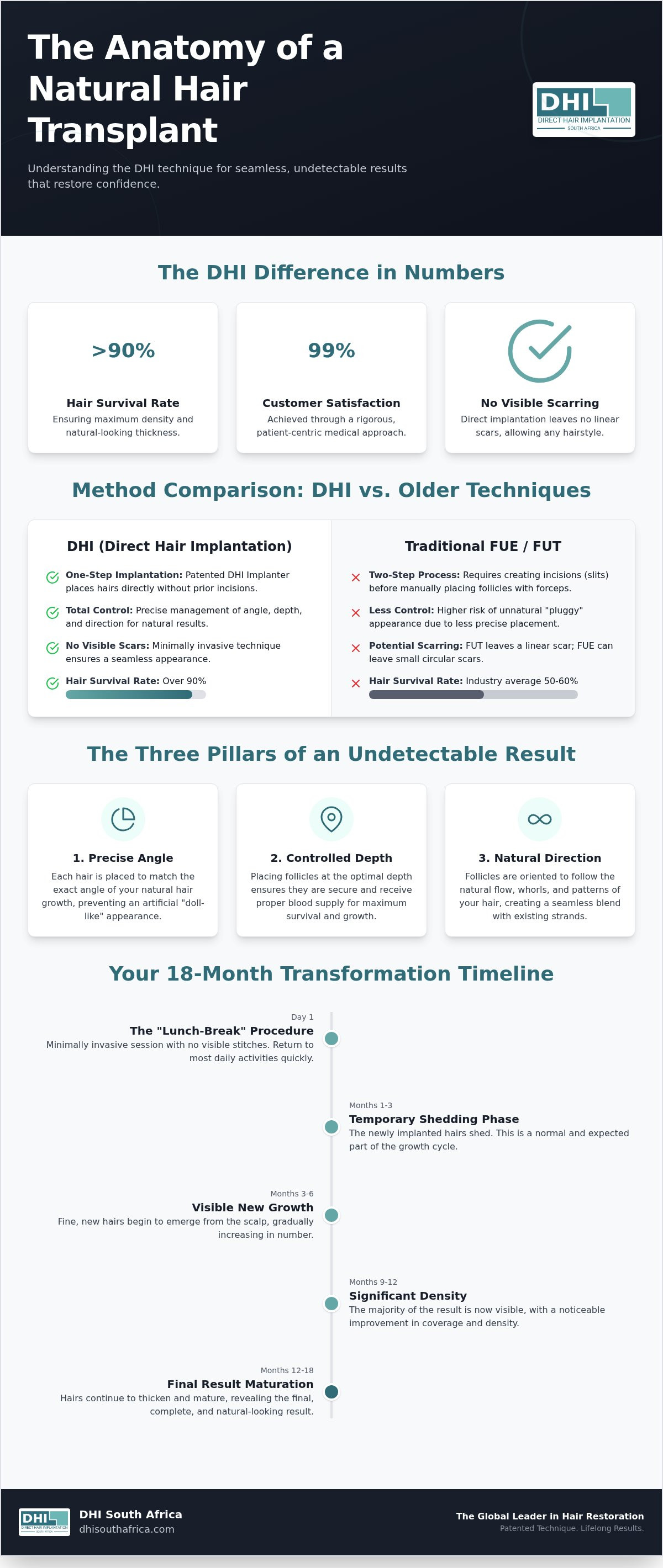
A natural look depends entirely on the precision of the placement. Older modern hair transplantation techniques often resulted in a "pluggy" effect because they lacked control over the growth direction. Today, we focus on the three pillars of a bespoke result: angle, depth, and direction. By using our patented DHI Implanter, we ensure that every one of the thousands of hairs we place matches your original growth pattern. This meticulous attention to detail is why our results look so seamless.
The most critical metric remains the survival rate of the hairs. Whilst the industry average often sits between 50% and 60%, our technique achieves over 90%. This high survival rate ensures the density looks authentic and thick, rather than sparse or patchy. It's the difference between merely "filling a gap" and truly restoring a youthful frame to the face.
The Artistry Behind Natural-Looking Hair Restorations
The visual impact of a hair transplant before and after South Africa is often startling, but the magic happens in the microscopic details. Unlike traditional FUE or FUT methods, which often involve creating "slits" or incisions before placing follicles, our patented Direct Hair Implantation technique uses a specialised tool to place hairs in a single step. This reduces the time the hairs spend outside the body, which is a major reason why we achieve a survival rate of over 90%.
When discussing surgical treatment for androgenic alopecia, precision is the difference between a result that looks "done" and one that looks natural. We use your own autologous hairs, meaning there's zero risk of rejection because the tissue is your own. Because these hairs are taken from the genetically resistant donor area at the back of the scalp, they're biologically programmed to grow for a lifetime, even after they've been moved to a new location.
The DHI Implanter: Precision in Every Placement
The DHI Implanter is the cornerstone of our success. It allows our specialists to have total control over the angle, depth, and direction of every hair placement. By avoiding pre-made incisions, we ensure there is minimal trauma to the scalp and no visible scarring. We use single-use, titanium-coated instruments for every procedure to maintain the highest global standards of hygiene and safety. This level of control prevents the "unruly" or "picket-fence" look that often plagues older techniques, ensuring the new growth blends perfectly with your existing hair.
Designing a Hairline That Ages Gracefully
An artistic eye is just as important as a steady hand. A hairline that looks great at 30 might look out of place at 60, so we take a conservative, future-proof approach to every restoration. We don't just fill in the gaps; we design a frame for your face that accounts for potential future hair loss patterns. This involves carefully mixing single and multiple hair groupings to mimic the soft, staggered transition of a natural hairline. When reviewing a hair transplant before and after South Africa gallery, you'll notice that the most successful results are those that respect this natural ageing process. If you're curious about how this artistry could apply to your own scalp, you might want to speak with one of our specialists for a personalised assessment.
Your Transformation Timeline: What Happens After a Hair Transplant?
Patience is the most important part of your recovery. Whilst the physical procedure is swift, your body needs time to anchor the newly placed hairs. Understanding the full timeline of a hair transplant before and after South Africa helps you navigate each phase with confidence rather than anxiety. We often refer to our method as a "lunch-break" procedure because there are no stitches or painful linear scars to manage. You can typically return to your professional routine within a day or two; however, the true transformation is a 12-to-18-month journey that begins with a period of quiet healing.
The First 14 Days: Healing and Protection
Redness and minor scabbing are expected in the first week. These are signs of your skin's natural inflammatory response as it heals around your hair transplant procedure. Since we don't use scalpels, the donor and recipient areas heal remarkably quickly. You'll need to follow a strict clinical after-care protocol to protect the newly implanted hairs. Our specialists will guide you through several essential steps:
Regular saline misting to keep the recipient area hydrated and promote healing.
Avoiding heavy exercise, swimming, or direct sun exposure for at least 14 days.
Sleeping in an upright position for the first few nights to minimise swelling.
By the end of the second week, you can usually return to your normal hair washing routine. You will watch as the initial scabs naturally flake away, leaving the scalp looking clean and settled. This marks the end of the immediate recovery phase and the beginning of the internal biological work.
Months 3 to 12: The Growth Revolution
Around week three, you might experience the "shedding phase," also known as telogen effluvium. This is a temporary resting state where the transplanted hair shafts fall out. Don't panic; the follicles remain securely rooted and healthy beneath the surface. It is a natural part of the hair cycle before new growth begins.
You'll begin to notice fine, downy growth around the three-to-four-month mark. These "baby hairs" gradually thicken into mature hair shafts as they enter the anagen phase, which is the active growth period of the hair cycle. By month nine, you'll see significant density and coverage. We always wait until the 12-to-18-month mark to assess the final, polished result in our results gallery, as this is when the hair reaches its full aesthetic potential.
How to Evaluate Hair Transplant Galleries and Success Rates
When you're scrolling through a gallery of a hair transplant before and after South Africa, it's easy to get caught up in the dramatic transformations. However, a discerning eye is your best tool. A successful result isn't just about the volume of hair added; it's about the biological survival of every hair placed. Whilst many clinics boast about the number of hairs they can transplant, this metric is meaningless without a high survival rate. At DHI, we maintain a survival rate of over 90%, which is significantly higher than the industry average of 50% to 60%.
Trust should be built on data, not just aesthetics. We're proud of our 99% customer satisfaction rate, which is IMRB accredited. This isn't just a marketing claim; it's a reflection of our commitment to global medical standards, including ISO and UK CQC benchmarks. We ensure that every South African patient receives the same world-class care found in London or Athens. We don't believe in cutting corners when it involves your self-assurance and health.
Analysing Photo Quality and Consistency
A transparent clinic will always provide a 9-angle photographic series rather than just a few flattering front-on shots. Look for consistency in lighting and background across the set. If the "after" photo has significantly better lighting or a different angle, it might be hiding a lack of density. When evaluating a hair transplant before and after South Africa gallery, check for "unshaven" results if privacy is your primary concern. This allows you to see how the restoration looks without the need for a full buzz cut, which is often a requirement for less sophisticated techniques.
The Hidden Value of Safety Protocols
Safety is the foundation of artistry. We employ 18 mandatory clinic safety checks for every procedure, ensuring that your health is never compromised for a cosmetic outcome. Every DHI procedure is performed by a certified medical expert, not a technician. This distinction is vital; a doctor has the clinical training to handle complex scalp anatomy and ensure the longevity of your results. We also often integrate autologous treatments like GFC (Growth Factor Concentrate) to enhance the healing process and stimulate the newly implanted hairs.
Why DHI South Africa Delivers Superior Outcomes
Choosing a clinic based on a hair transplant before and after South Africa gallery is a decision that impacts your confidence for decades to come. Our superior outcomes aren't the result of luck; they're the product of combining over 50 years of global medical research with a dedicated, patient-centric presence in South Africa. We don't view hair restoration as a simple cosmetic transaction. Instead, we follow the DHI Total Care System, a 360-degree methodology that ensures every step, from your initial diagnosis to your post-procedure nutraceuticals, is medically sound and artistically precise.
Our specialists prioritise the placement of hairs to mimic your original growth behaviour. By carefully matching the exact angle and direction of your surrounding hair, we achieve a result that's indistinguishable from nature's own design. This level of detail is only possible through our patented implantation technique, which allows for a survival rate of over 90%. We're committed to providing a permanent solution that respects the unique characteristics of your scalp and hair type.
A Global Leader with Local Expertise
We're proud to be part of the world's strongest hair restoration brand, benefiting from a legacy of innovation that spans the globe. Every specialist at our clinic has been trained at the DHI Global Academy, the only international institution dedicated purely to the science of hair restoration. This rigorous training ensures that the technique used on your scalp meets the highest international medical standards. You don't need to travel abroad for world-class care; you can Explore our South African results gallery to see how this global expertise translates into life-changing local transformations.
Your Personal Restoration Plan
Your journey begins with a Total Medical Hair Restoration report, a comprehensive diagnostic tool that goes beyond the surface to identify the root cause of your hair loss. We don't believe in one-size-fits-all solutions. We often create a synergy between DHI implantation and regenerative therapies like PRP or GFC Treatment to ensure your scalp is in the best possible condition for new growth. This holistic approach is why our patients report such high levels of satisfaction. If you're ready to stop worrying about thinning patches and start your restoration, we invite you to Book your consultation for a bespoke hair restoration plan and take the first step toward a more confident version of yourself.
Reclaiming Your Natural Confidence
Your journey toward a full, natural-looking hairline is about more than just aesthetics; it's about the permanent restoration of your self-assurance. When you review a hair transplant before and after South Africa gallery, remember that clinical precision is what separates a life-changing result from a temporary fix. By utilising our patented DHI Implanter, we ensure a hair survival rate of over 90%, giving you the density and direction required for a seamless finish that lasts a lifetime.
We've guided thousands of patients through this 12-month transformation, maintaining an IMRB-accredited 99% satisfaction rate through meticulous safety protocols and world-class expertise. You don't have to settle for thinning hair or the daily anxiety of temporary concealers any longer. Our team is ready to help you navigate the science of restoration with the calm, measured composure you expect from a premium medical institution.
You deserve a solution that matches the quality and behaviour of your original hair growth. We're here to provide the expert guidance and medical artistry needed to make that a reality, ensuring you feel like yourself again.
Frequently Asked Questions
How long does it take to see the final results of a hair transplant?
You'll see the final results of your restoration between 12 and 18 months after the procedure. Whilst fine new hairs begin to appear around month four, it takes over a year for the hair shafts to mature and the full density to develop. This timeline allows the follicles to settle and move through their natural growth cycles. We monitor your progress throughout this journey to ensure your hair transplant before and after South Africa meets our clinical standards.
Is a hair transplant permanent, or will the hairs fall out eventually?
A hair transplant is considered a permanent solution because the hairs are taken from the genetically resistant donor area at the back of your scalp. These follicles are biologically programmed to continue growing for a lifetime, even after they've been moved to a new location. Whilst you may experience temporary shedding of the hair shafts shortly after the procedure, the underlying follicles remain rooted. This genetic resistance ensures that your results provide lasting coverage.
Will people be able to tell that I have had a hair transplant?
No, your results will be virtually undetectable thanks to the precision of the DHI Implanter. Because we have total control over the angle, depth, and direction of every hair placement, we can perfectly match your original growth pattern. We avoid the "pluggy" look associated with older methods by using a conservative hairline design. Most of our patients find that even their barbers cannot distinguish the transplanted hairs from their natural ones.
What is the survival rate of hairs during a DHI procedure?
We achieve a hair survival rate of over 90% during our procedures, which is significantly higher than the industry average of 50% to 60%. This high success rate is due to our patented technique that reduces the time hairs spend outside the body. By minimising handling and trauma to the follicles, we ensure that almost every hair we move successfully anchors and grows. This efficiency is why we can promise such dense, natural-looking results.
Can I get a hair transplant without shaving my head?
Yes, we offer an "unshaven" procedure option for patients who require maximum privacy during their recovery. This technique allows us to extract and implant hairs without a full buzz cut, making it much easier to return to work without anyone noticing the change. It's particularly popular amongst professionals who want to maintain their current appearance whilst their hair transplant before and after South Africa results develop quietly over the coming months.
How much does a hair transplant cost in South Africa?
The cost of a procedure is determined by the specific number of hairs required to achieve your desired density and the complexity of your restoration plan. Because every scalp is unique, we provide a personalised quote only after a thorough diagnostic analysis. We avoid "per graft" pricing models that can be misleading, focusing instead on the total medical outcome. This ensures you receive a transparent plan tailored to your long-term aesthetic goals and hair health.
What is the difference between hairs and grafts in medical planning?
A graft is a small piece of scalp tissue that can contain anywhere from one to five individual hairs. In our medical planning, we focus on the total number of hairs rather than grafts because it provides a far more accurate measure of the final density you'll see. For example, a placement of 4,000 hairs provides a specific visual result that "2,000 grafts" cannot guarantee. This precision allows us to plan your restoration with absolute clinical certainty.
Is the hair transplant procedure painful?
Most patients report very little discomfort during the procedure, describing the sensation as similar to a relaxed day in a clinic. We use local anaesthesia to numb the scalp entirely before we begin, so you won't feel the extraction or implantation process. Many of our patients spend the session watching a film or catching up on emails. Because we don't use scalpels or stitches, the post-procedure recovery is typically swift and requires only mild over-the-counter relief.


Comments