%20(1).jpg)
%20(1).jpg)
Hair System vs Hair Transplant in South Africa: Which is Right for You?
- Dhesan Moodley

- 4 hours ago
- 12 min read
What if the choice between a hair system and a hair transplant isn't actually about the hair itself, but about the lifestyle you want to lead five years from now? It's common to feel a deep sense of distress when you notice visible thinning, and the decision is often clouded by the fear of a 'fake' result or the anxiety of surgery. When weighing a hair system vs hair transplant south africa, the right choice ultimately depends on whether you seek an immediate, non-surgical fix or a permanent, biological restoration that grows naturally from your own scalp.
We understand that you want to stop worrying about the wind or water and simply feel like yourself again. This clinical comparison will guide you through the maintenance requirements, aesthetic outcomes, and long-term value of both paths. You'll discover how a meticulously planned restoration can provide a natural-looking hairline that evolves with you, ensuring your investment delivers true self-assurance for years to come. By comparing these two distinct approaches, we'll help you decide which solution aligns with your personal goals and your vision for a confident future.
Table of Contents
Evaluating Hair Restoration in South Africa: The Choice Between Immediate Results and Permanent Growth
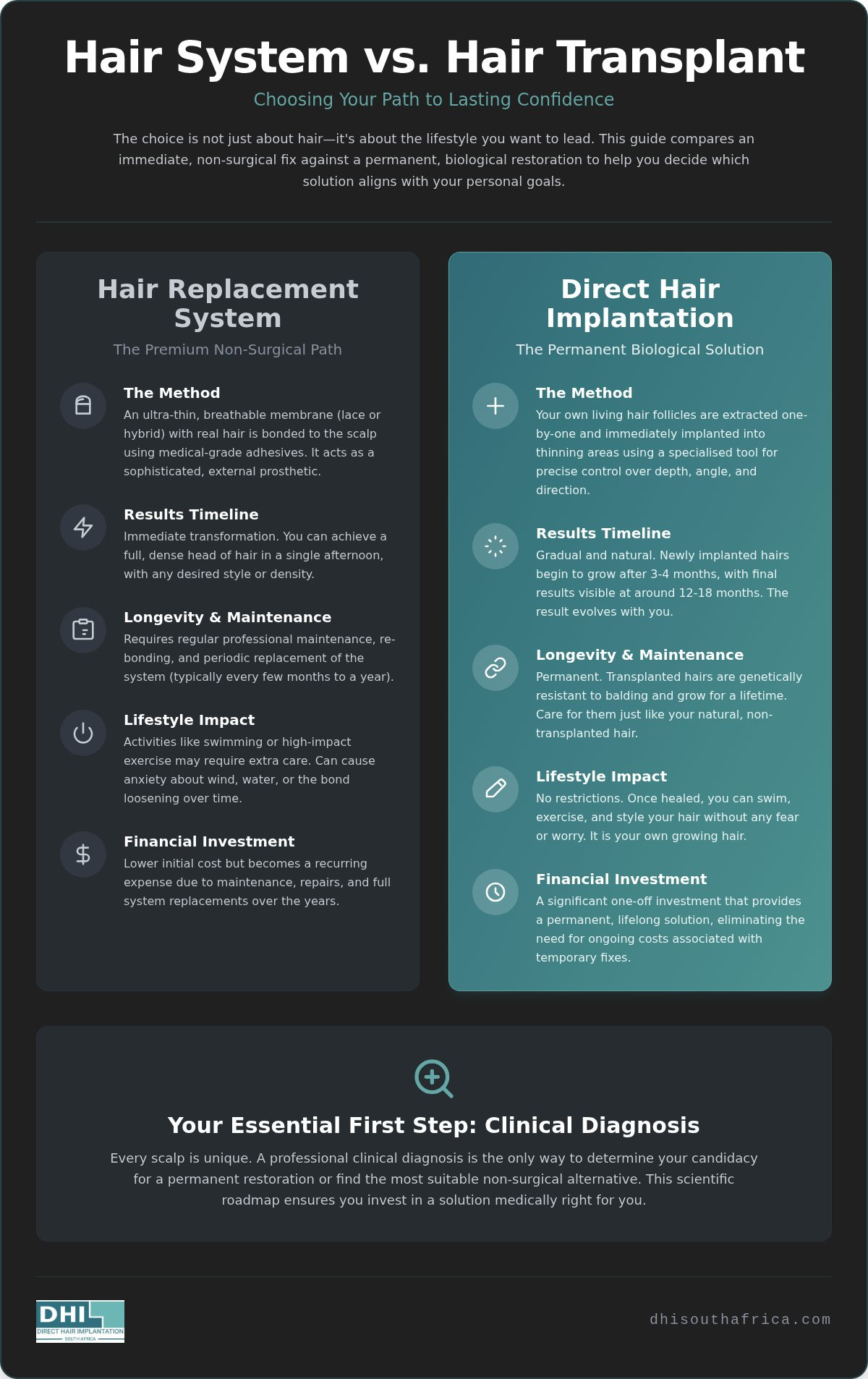
Dealing with visible thinning often brings a heavy emotional burden. It's that moment of hesitation before stepping into the wind or the anxiety felt under bright overhead lights. When you begin researching a hair system vs hair transplant south africa, you're essentially choosing between an immediate aesthetic transformation and a long-term biological solution. A hair system acts as a sophisticated prosthetic, providing an external layer of density. In contrast, a hair transplant involves the strategic redistribution of your own living follicles to areas of loss.
The desire for a quick fix is completely natural. You want to look in the mirror and see the person you remember. However, the path you choose should align with both your lifestyle and your long-term expectations. Whilst one offers a finished look in a single afternoon, the other is an investment in your own anatomy. Understanding the mechanics of each is the only way to find a solution that truly restores your self-assurance.
What is a Modern Hair Replacement System?
Forget the outdated concept of "wigs" that looked unnatural and felt bulky. Modern hair replacement systems use ultra-thin, breathable membranes made of lace or hybrid materials that mimic the appearance of the scalp. These systems are bonded securely using medical-grade adhesives, allowing for a seamless blend with your existing hair. The primary advantage is the speed of the result. You can walk into a clinic with thinning hair and leave a few hours later with a full, dense head of hair without any surgical intervention.
What is a Direct Hair Implantation (DHI) Transplant?
Direct Hair Implantation represents a significant advancement in surgical restoration. Unlike older hair transplantation procedures, the DHI technique involves extracting and then implanting your own hairs using a specialised tool for precise control over depth and angle. This is a purely autologous process. We use your own biological material, which eliminates any risk of rejection. Because these hairs are genetically resistant to the hormones that cause balding, they continue to grow naturally for a lifetime once they've successfully taken root. You can learn more about our specific hair transplant approach to see how this differs from traditional methods.
Choosing the right path isn't a decision you should make based on a brochure. Every scalp is unique. Factors like donor hair density and the underlying cause of hair loss play a vital role in your success. This is why a clinical diagnostic approach, such as a Total Medical Hair Restoration report, is the essential first step in the South African market. It provides a scientific roadmap, ensuring you don't invest in a solution that isn't medically suitable for your specific needs.
Understanding Hair Replacement Systems: The Premium Non-Surgical Path
For many individuals, surgery might not be the desired or even possible route. Perhaps you have limited donor hair, or you're concerned about the risks and side effects of hair transplants. In these instances, a modern hair replacement system offers a sophisticated, non-invasive alternative. These aren't the generic hairpieces of the past; they're bespoke medical-grade prosthetics designed to integrate seamlessly with your life.
When evaluating a hair system vs hair transplant south africa, the non-surgical path stands out for its versatility. We use different base materials to suit your skin type and lifestyle. Lace membranes are incredibly breathable, making them a favourite in the South African climate. Skin systems, made from ultra-thin polyurethane, provide an uncanny mimicry of the scalp's surface. Hybrid membranes combine both, offering durability without sacrificing that natural, undetectable hairline. Each unit is custom-coloured and textured to match your remaining hairs perfectly, ensuring the transition is invisible to the naked eye.
The Benefits of Immediate Density
The most striking advantage of a system is the speed of results. If you're managing conditions like Alopecia Totalis, where surgical restoration isn't an option, a hairpiece is often the most effective way to regain your confidence. You can achieve any density or style overnight. There's no waiting for follicles to enter the anagen phase (the active growth stage) or navigating the recovery period associated with clinical procedures. It's a "walk-in, walk-out" transformation that provides instant aesthetic relief.
The Reality of Maintenance and Upkeep
Whilst the results are immediate, they do require a dedicated maintenance schedule. To keep the system looking its best and to maintain scalp health, you'll need to visit a clinic for rebonding every 4 to 6 weeks. During these sessions, the system is professionally removed, cleaned, and the scalp is treated to prevent any irritation or hygiene issues. Because these systems are made from real human hair, they eventually experience natural wear and tear. You should expect to replace the unit periodically to ensure the colour and texture remain vibrant. If you're curious about which path suits your lifestyle, exploring our range of non-surgical treatments can provide more clarity.
Hair System vs Hair Transplant: A Comparative Framework
Choosing between a hair system vs hair transplant south africa often comes down to your personal definition of value. If you need a full head of hair for an event next week, a system is the only logical choice. However, if you're looking for a solution that simplifies your life for the next decade, a transplant offers a biological permanence that a prosthetic simply can't match. It's a balance of immediate density against the freedom of natural growth.
Your "donor hair" is the most critical factor in this framework. This refers to the healthy follicles at the back and sides of your head that are genetically programmed to grow for life. If your hair loss has progressed to a point where you don't have enough donor hairs to cover the thinning area, a hair system becomes a premium alternative. For those with sufficient donor supply, a transplant allows you to treat the hair as your own; because it is your own.
Biological Growth vs. Synthetic Density
There's a significant psychological shift that happens when you know your hair is real. With the DHI technique, we have total control over the placement of every single one of the hairs. We carefully manage the angle, depth, and direction to ensure the new growth follows your natural pattern perfectly. Whilst modern systems look incredible, they can feel restrictive in the intense South African heat. Humidity and sweat can affect the adhesive bond, which sometimes creates a lingering anxiety that a permanent transplant completely removes.
Long-Term Cost Analysis for South African Patients
When you look at the numbers, the financial comparison is quite revealing. A hair system has a much lower entry price, but you're committing to a lifetime of recurring costs for rebonding and unit replacements. Over a five to ten-year period, these monthly expenses often exceed the one-off investment of surgery. You can explore a detailed breakdown of the hair transplant cost in South Africa to see how the numbers stack up for your budget.
The "break-even" point varies, but most patients find that surgery becomes the more affordable path after roughly three to four years of system maintenance. Beyond the rands and cents, there's the value of time saved from monthly clinic visits. If you're ready to understand the clinical precision behind a permanent fix, our guide to Direct Hair Implantation explains why this technique is the gold standard for natural results.
Lifestyle and Performance: Living with Your Restoration Choice
Imagine waking up on a Saturday morning in Cape Town and deciding to head for a surf or a trail run. When choosing a hair system vs hair transplant south africa, your decision dictates how much mental energy you'll spend on your hair during these moments. A hair system requires you to be mindful of the bond's integrity and the impact of moisture. In contrast, a permanent transplant allows you to shower, sleep, and exercise with the same subconscious ease you had before thinning began.
There's a distinct security in knowing your hair is part of your own anatomy. With Direct Hair Implantation, the results are so integrated that you can treat your restored area exactly like the rest of your head. You don't have to worry about a system shifting during high-contact sports or the adhesive softening in midday heat. Because we use your own biological hairs, they even age naturally with you, turning grey at the same rate as your surrounding hair; a level of seamlessness that a prosthetic unit simply cannot replicate.
The confidence factor extends beyond physical activity into the quiet moments of daily life. There's a profound relief in not having to check the mirror after a gust of wind or worrying about the lighting in a restaurant. Whilst a system offers density, a transplant offers peace of mind. It's the difference between wearing a high-quality garment and having your own skin restored.
Active Lifestyles and High-Intensity Training
High-intensity training presents a unique challenge for non-surgical systems. Excessive sweat and scalp oils can compromise medical-grade adhesives, often requiring more frequent maintenance during the humid summer months. Athletes often find the freedom of a transplant far superior, as there are no restrictions on swimming in chlorinated pools or salt water once the initial healing is complete. If you're looking for increased density but aren't ready for surgery or a system, Scalp Micropigmentation offers a robust, maintenance-free alternative for the active individual.
The 'Secret' of Restoration: Privacy and Discretion
Discretion is often a top priority for our patients. A hair system provides an "overnight" transformation, which, whilst impressive, can be difficult to explain to colleagues who saw you just days before. A DHI transplant offers a more subtle journey. We even provide an "unshaven" session for those who need to return to work without any visible signs of a procedure. The hairs grow in gradually over 12 months, making the restoration appear like a natural, healthy recovery of your original density rather than a sudden change.
The DHI Philosophy: Finding Your Personal Path to Confidence
At DHI South Africa, we recognise that the journey to restoration is deeply personal. Choosing between a hair system vs hair transplant south africa isn't just a financial decision; it's a medical one. Our philosophy is built upon the DHI Total Care System, a comprehensive framework that ensures every patient receives a solution tailored to their specific biological needs. We don't merely offer procedures. We provide a steady, expert hand to guide you toward reclaiming your self-assurance through science and artistry.
Whether your path leads to a permanent surgical restoration or a premium non-surgical system, our priority remains your safety and the naturalness of your result. Every procedure at our clinic is performed by certified medical doctors who have undergone rigorous training within our global network. This medical-first approach distinguishes us from retail-focused outlets, as we prioritise the long-term health of your scalp and the survival of every hair we treat. By combining clinical authority with a compassionate understanding of your frustrations, we help you move past the anxiety of thinning and toward a life-changing transformation.
Why a Clinical Consultation is Non-Negotiable
Before you commit to any restoration path, we must understand the "why" behind your hair loss. This is why we utilise digital trichoscopy during our consultations. This specialised diagnostic tool allows us to perform a high-magnification analysis of your scalp and follicles, identifying the root cause of thinning before any treatment begins. It's an essential step to ensure that if you choose a transplant, your donor hairs are healthy enough for a successful result. We invite you to DHI South Africa to experience this diagnostic precision firsthand and discover which restoration route aligns with your physiology.
The Future of Your Hair: A Permanent Legacy
For those suitable for surgery, our patented Direct Hair Implantation technique offers a level of precision that leads the industry. We focus on a high survival rate, ensuring that over 90% of the hairs we place successfully take root and grow for a lifetime. This isn't just about density; it's about the artistry of designing a hairline that looks seamless from every angle. We manage the depth and direction of each of the hairs to ensure they mimic your original growth pattern perfectly. Whilst a system offers a temporary fix, a DHI restoration creates a permanent legacy. Your journey to a fuller head of hairs starts with a single conversation, and we're here to listen whenever you're ready to take that first step.
Take the Next Step Toward Your Restoration
Choosing the right path for your hair restoration is a significant milestone in reclaiming your self-assurance. Whether you opt for the immediate density of a premium hair system or the permanent biological growth of a transplant, your decision should align with your lifestyle and long-term goals. We've seen how the choice between a hair system vs hair transplant south africa ultimately hinges on your unique scalp health and the availability of healthy donor hairs. At DHI, we've been global leaders in this field since 1970, ensuring that every procedure is performed by certified medical doctors to the highest clinical standards.
With our patented technique, we achieve a hair survival rate of over 90%, providing results that age naturally and last a lifetime. You don't have to navigate these choices alone. A professional diagnostic report will provide the clarity you need to move forward with absolute confidence.
Your journey to a fuller head of hair is a transformation that changes more than just your appearance; it's about feeling like yourself again. We're ready to help you write the next chapter of your restoration story whenever you're ready to begin.
Frequently Asked Questions
Is a hair system better than a hair transplant for total baldness?
A hair system is often the superior choice for total baldness, as surgical restoration requires a sufficient supply of healthy donor hairs. If you've lost all your biological hair, there's no material to redistribute. A system provides an immediate, dense aesthetic result that doesn't depend on your scalp's current condition, making it the most effective solution for those with extensive loss.
Can people tell if I am wearing a hair replacement system?
It is extremely difficult for others to notice a modern hair replacement system when it's professionally fitted. We meticulously match the unit's colour and texture to your remaining hairs. The ultra-thin, breathable membranes allow your scalp to show through, creating a seamless and undetectable transition even at the hairline, ensuring you feel confident in any social setting.
Does a hair transplant last forever?
Transplanted hairs are permanent because they're harvested from areas genetically resistant to thinning. Once we've successfully placed these hairs into the recipient area, they'll continue to grow naturally for the rest of your life. This biological restoration evolves with you, even as your surrounding hair begins to grey, providing a solution that truly lasts a lifetime.
Can I swim and exercise with a hair system?
You certainly can swim and exercise, though it demands a more rigorous maintenance schedule. Perspiration and salt water can affect the medical-grade adhesive, potentially causing the bond to lift earlier than expected. Many active South Africans find that a permanent transplant offers more peace of mind during high-intensity training, as it doesn't require any special lifestyle restrictions.
How much does a hair system cost per month in South Africa?
Monthly costs involve rebonding sessions every four to six weeks and the purchase of specific maintenance products to keep the unit clean. You must also budget for a new hairpiece every few months as the natural hairs on the unit wear down. When comparing a hair system vs hair transplant south africa, these recurring expenses often surpass the initial cost of a permanent procedure over time.
What happens if my hair transplant fails?
True failure is very unlikely with the DHI technique, as our certified doctors achieve a survival rate of over 90%. If you're concerned about your growth, we'll perform a digital trichoscopy to evaluate the health of the scalp and follicles. We always stand by our patients to ensure they achieve the best possible aesthetic outcome through follow-up care and clinical support.
Is the DHI technique painful compared to other transplants?
Most patients find the DHI technique much more comfortable than traditional methods. We use a local anaesthetic to numb the area, and because there's no cutting or stitching involved, the post-procedure discomfort is minimal. It's a precise, minimally invasive approach that prioritises patient comfort and rapid healing, allowing you to return to your daily routine much faster.
How long does it take to see results from a hair transplant?
Patience is key, as your new hairs need time to enter the anagen phase, which is the active growth stage. You'll likely see initial stubble within three to four months, with the density significantly improving by the six-month mark. The final, full result of your restoration journey is usually visible after 12 to 18 months as the hairs thicken naturally.


Comments