%20(1).jpg)
%20(1).jpg)
Scar Free Hair Restoration: Debunking the Myths of Surgical Marks
- Dhesan Moodley

- 3 days ago
- 12 min read
What if you could restore your hairline without ever having to explain a permanent scar to your barber? For many South Africans, the greatest barrier to seeking help isn't the procedure itself, but the anxiety of living with a tell-tale linear mark or a pattern of "micro-dots" across the scalp. It's a genuine concern, particularly if you're researching how to avoid hair transplant scars while maintaining the freedom to wear your hair as short as you like. You've probably encountered conflicting marketing claims about "scarless" surgery, which only adds to the weight of making the right decision.
We understand that you're looking for more than just hair; you're looking for the quiet confidence that comes with a completely natural result. This article will show you how advanced, patented medical technology now allows for restoration without the need for traditional incisions or stitches. You'll learn how this refined approach ensures a hair survival rate of over 90%, providing a dense, seamless finish that stands up to even the closest inspection. We'll break down the science behind single-step implantation and explain why it's the most reliable path to a truly discreet outcome.
Table of Contents
The Aesthetic Anxiety: Why Scarring Haunts Hair Restoration
For many people in South Africa, the decision to undergo a hair transplant isn't just about the hair they gain, but what they might lose in the process. We define scar-free hair restoration as a procedure that leaves no discernible marks on either the donor area at the back of the head or the recipient area where new growth is placed. In the past, the primary goal was simply density at any cost. Today, our patients prioritise "stealth" restoration. They want the freedom to wear their hair short or even shave their heads without a permanent surgical signature. Scar-free hair restoration is the gold standard for aesthetic medicine in 2026 because it prioritises the patient's long-term privacy as much as their new growth.
If you're researching how to avoid hair transplant scars, you've likely seen the results of older, more invasive techniques. The fear of a visible scar often outweighs the excitement of a fuller hairline. It's a valid concern. A truly successful procedure should be invisible to the naked eye. It should allow you to move through the world without the weight of surgical marks or the need to style your hair specifically to hide a donor site. We believe that the best work is the kind that no one ever suspects was done in the first place.
The Emotional Toll of Visible Scars
New growth should bring a sense of liberation and a return to your younger self. However, when that growth is accompanied by a visible scar, it can undermine the very confidence you sought to rebuild. We often hear from patients who worry about "looking like they've had work done" when they're at the gym, swimming, or simply sitting in a barber's chair. This anxiety is common and entirely justified. Modern patient behaviour has shifted dramatically toward seeking discreet results. You shouldn't have to trade a receding hairline for a permanent reminder of a medical procedure. Our approach focuses on validating these anxieties and providing a path to restoration that respects your privacy.
The Legacy of the Strip Method
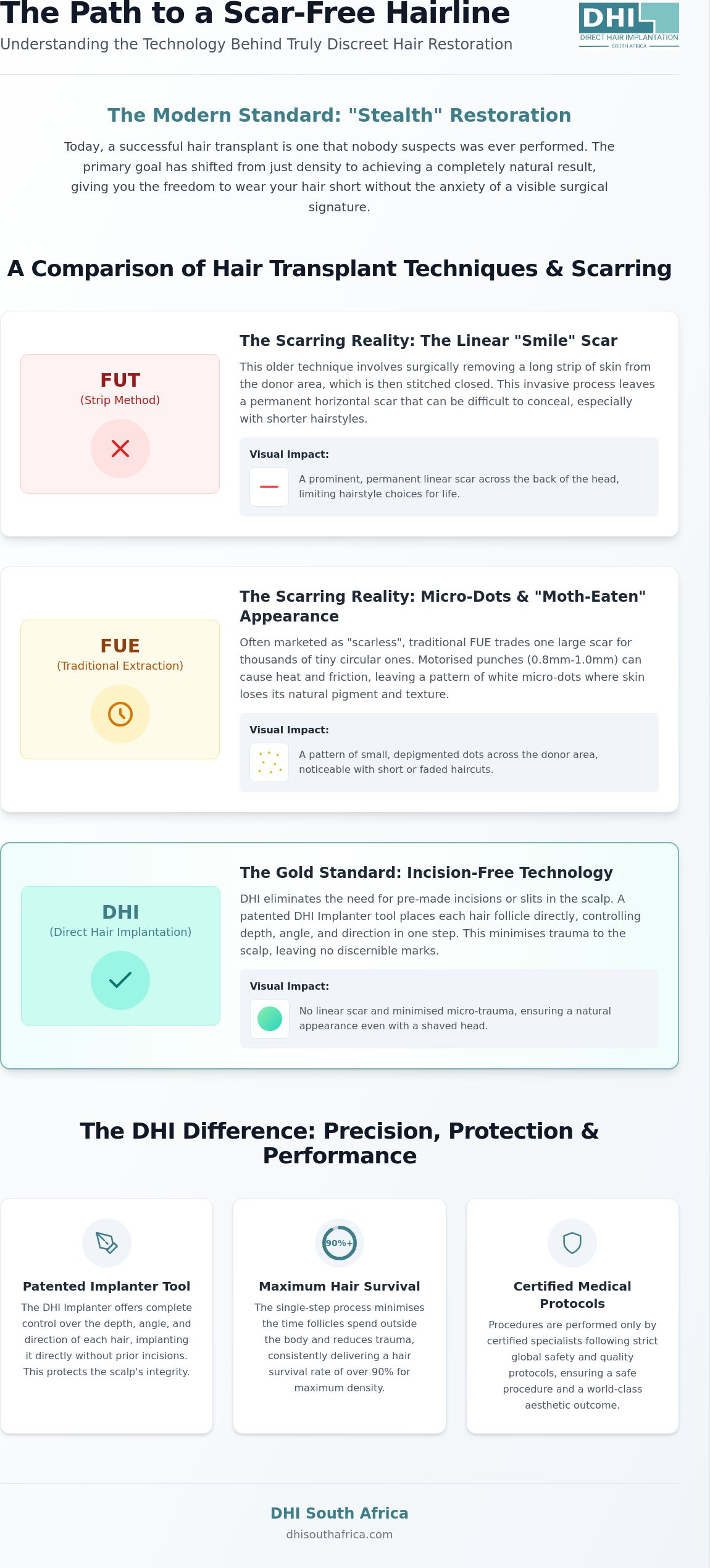
The most common source of surgical anxiety is the legacy of traditional Hair transplantation techniques like Follicular Unit Transplantation (FUT). This older method involves removing a long strip of skin from the donor area, which results in a permanent horizontal scar that can be difficult to conceal. Whilst FUT was once the industry standard, patients across South Africa are moving away from traditional strip surgery in favour of more refined, less invasive methods. Choosing a clinic that specialises in modern, incision-free alternatives is the most effective way to protect your scalp. By avoiding the strip method entirely, you eliminate the risk of the "smile" scar that has haunted the industry for decades.
Debunking the 'Scarless' Marketing: FUE vs. FUT Realities
Let's be candid about the marketing you'll see online. Many clinics use the term "scarless" as a catch-all buzzword, but in a precise medical context, it's often a bit of an overstatement. If you're researching how to avoid hair transplant scars, you need to understand the fundamental difference between "no linear scar" and "no scar at all." Whilst older strip methods are famous for leaving a long horizontal mark, modern techniques like Follicular Unit Extraction (FUE) are often marketed as the perfect solution. However, FUE is not inherently scar-free; it simply trades one large scar for thousands of tiny ones.
Traditional FUE typically relies on motorised punches to harvest follicles. These tools can cause significant micro-trauma through heat and friction, leaving behind a pattern of white "micro-dots." For many South Africans who prefer a shorter haircut or a faded style, these dots can be just as noticeable as a linear scar. Achieving a truly discreet result requires a deeper understanding of how the skin heals and how to minimise the footprint of the extraction itself.
The Reality of FUE Micro-Dots
When a clinic performs a high-volume procedure, they may use extraction punches ranging from 0.8mm to 1.0mm in diameter. Healing from these thousands of tiny circular wounds can lead to what specialists call a "moth-eaten" look in the donor area. This happens because the skin loses its natural texture and pigment in those specific spots. To avoid this, the focus must shift from high-speed motorised extraction to manual, precision-led methods that respect the scalp's anatomy. The smaller the tool and the more controlled the movement, the less chance there is of visible trauma.
Why 'Minimal Scarring' Isn't Good Enough
Aesthetic integrity is about preserving the natural look and feel of your scalp, not just adding density. When thousands of tiny scars form, they create a layer of fibrous tissue that can disrupt the local environment. This scar tissue can actually impact the health of surrounding hairs by restricting blood flow and nutrient delivery to the follicles. While some advanced researchers suggest we can remodel and reduce scars using follicle placement, the most effective strategy for how to avoid hair transplant scars is to prevent the damage during the very first step. If you're concerned about how your scalp will heal, you can speak with one of our specialists to discuss your specific skin type and hair goals.
The DHI Difference: How Incision-Free Technology Changes the Game
While traditional methods focus on managing the damage, we believe the best way to address surgical marks is to prevent them from occurring in the first place. If you're looking for how to avoid hair transplant scars, the most significant advancement lies in the transition from a two-step placement process to a single-step implantation. In standard FUE, a doctor first creates thousands of tiny "slits" or incisions in the recipient area before placing the follicles. This "slit-making" phase is where much of the visible scarring and skin trauma occurs. Direct Hair Implantation (DHI) changes this dynamic entirely by eliminating those pre-made incisions.
The evolution of modern surgical hair restoration techniques has led us to a point where we can treat the scalp with far greater delicacy. By using a specialised tool, we can extract and implant follicles without the need for traditional surgical apertures. This doesn't just reduce the physical footprint of the procedure; it fundamentally alters how the skin heals. Without the trauma of pre-made slits, the recipient area recovers much faster, and the risk of "pitting" or uneven skin texture is virtually eliminated.
The Patented DHI Implanter Tool
At the heart of this technique is the patented DHI Implanter. This precision instrument allows our certified specialists to place each follicle directly into the scalp in one smooth motion. The tool acts as a protective shield for the hair follicle during the transition from donor to recipient, ensuring the delicate bulb isn't crushed or damaged by forceps. We use single-use, titanium-coated needles that are significantly finer than the punches used in robotic or motorised FUE. This level of precision is the key to achieving a dense hairline that shows no evidence of medical intervention.
Artistry in Angle, Depth, and Direction
True restoration requires more than just medical science; it requires the eye of an artist. Because the DHI Implanter gives the specialist total control over the angle, depth, and direction of every placement, we can perfectly mimic the natural growth pattern of your existing hairs. This level of control is impossible with older methods where follicles are simply "dropped" into pre-made holes. We ensure that the new growth blends seamlessly with your original hair, creating a result that is indistinguishable from nature. It's this meticulous attention to detail that allows our patients to enjoy a full, natural-looking head of hair without the tell-tale signs of surgery.
Beyond the Scalp: Protecting Your Aesthetic Integrity and Growth
Aesthetic integrity is about the harmony between the absence of visible marks and the vitality of the new growth. When you understand how to avoid hair transplant scars through incision-free methods, you also unlock a higher biological success rate. It's a common misconception that all restoration techniques offer the same density. In reality, the physical trauma caused by traditional incisions can shock the scalp; this often compromises the delicate environment needed for follicles to take root and thrive. By choosing a method that respects the skin's natural structure, you're ensuring that the foundation for your new hair remains healthy and receptive.
The Science of Hair Survival
The DHI technique achieves a survival rate of over 90%, which is significantly higher than the industry average of 50% to 60%. This success is largely due to minimal handling of the follicles. Because we use the patented implanter tool, we don't need to touch the hair bulbs with forceps during placement, which prevents crushing the delicate tissue. We also prioritise follicles in the anagen phase, which is the active growth cycle where hairs are at their most resilient and genetically stable. By preserving the surrounding progenitor cells, which are the specialised cells responsible for hair regeneration, and natural growth factors, we ensure the transplanted hairs flourish. This biological precision is a core part of the Direct Hair Implantation pillar of care, moving beyond simple aesthetics into the realm of regenerative medicine.
Recovery and the 'Lunch-Hour' Reality
The absence of recipient-site incisions doesn't just prevent scarring; it radically accelerates your recovery time. Most patients find they can return to their daily routines almost immediately, which is why the procedure is often referred to as a "lunch-hour transplant" in international media. Within the first 48 hours, the tiny extraction points begin to close naturally without the need for stitches or heavy bandaging. This minimal downtime is a significant advantage for busy South Africans who cannot afford weeks of visible healing or the logistical challenges of post-operative wound care. Long-term, your investment is protected by the genetic resistance of the transplanted follicles, which are harvested from donor areas unaffected by pattern baldness. Protecting your aesthetic integrity means choosing a path that offers both immediate privacy and permanent results, allowing you to return to the gym or the boardroom with absolute confidence.
Reclaiming Confidence with DHI South Africa
DHI South Africa stands as the definitive choice for those seeking a discreet, high-integrity result. Our leadership in the field isn't just based on the specialised tools we use, but on the strict medical protocols that govern every movement our doctors make. When you choose us, you're opting for a methodology that has been refined over decades to ensure the highest survival rates and the most natural hairlines. If you've been researching how to avoid hair transplant scars, you deserve the peace of mind that comes from a clinic that treats restoration as both a medical science and a fine art.
Understanding how to avoid hair transplant scars is only half the battle; the other half is ensuring that your chosen clinic operates under the highest global safety standards. Our approach prioritises your long-term health as much as your aesthetic outcome. We don't rely on generalisations; we rely on a patented process that has successfully restored the confidence of thousands of patients globally. This commitment to excellence is what makes us the premier destination for hair restoration in South Africa.
Global Standards, National Clinical Care
We are part of a prestigious global network spanning 75+ clinics across 45 countries, bringing world-class expertise directly to South African shores. Every specialist at our facilities is a certified medical doctor who has undergone intensive training at the DHI Global Training Academy. This ensures that the precision of our technique remains consistent across all our locations. To maintain our reputation for safety, we adhere to 18 mandatory clinic safety checks and ISO-accredited protocols. This level of oversight is rare in the industry and provides a "safe pair of hands" for your transformation journey.
Your Journey to Restoration
Your path to a fuller hairline begins with a thorough understanding of your unique hair loss pattern. During a professional consultation, we don't just look at the areas of thinning; we perform a comprehensive assessment to create a personalised diagnostic report. This report serves as your roadmap, detailing exactly how we will achieve your desired density whilst preserving the health of your donor area. We believe in complete transparency and data-driven results, ensuring you feel fully informed and empowered before making any decisions about your care. Your restoration is a personal experience, and we are here to guide you with the calm, measured composure of experts.
Embrace a Future of Natural, Discreet Restoration
Choosing the right path for your hair restoration journey means looking beyond the promise of density to the reality of aesthetic integrity. You now understand that how to avoid hair transplant scars is not a matter of chance; it's the direct result of using patented technology that bypasses the trauma of traditional incisions. By utilising the DHI Implanter, our certified medical specialists ensure a hair survival rate of over 90%, providing a result that is as biologically robust as it is visually seamless. This refined approach offers you the freedom to wear your hair exactly as you choose without the burden of surgical signatures, ensuring your results remain your private business.
You don't have to carry the anxiety of visible surgical marks or the limitations of outdated procedures into your future. We invite you to experience the difference that world-class medical artistry can make in your life. Reclaiming your self-assurance starts with a single, unhurried conversation, and we are here to provide the expert guidance you deserve. Your journey toward a natural, dense hairline is closer than you think.
Frequently Asked Questions
Is a hair transplant truly scar-free?
A truly scar-free hair transplant is the goal of every DHI procedure, as we eliminate the need for traditional incisions or slits in the recipient area. Whilst any medical intervention involves some degree of tissue interaction, our single-step implantation method ensures that no visible marks are left behind. This allows you to maintain your privacy and enjoy a result that looks entirely natural even under close inspection or when your hair is wet.
How does DHI differ from FUE in terms of scarring?
DHI differs from traditional FUE by removing the secondary step of creating recipient-site incisions with a scalpel or motorised punch. In standard FUE, these pre-made slits often lead to visible "pitting" or micro-scarring once they heal. By using the patented DHI Implanter, we bypass this trauma entirely, which is the most effective way of how to avoid hair transplant scars in the hairline and temple areas.
Can I wear my hair very short after a DHI procedure?
Yes, you have complete freedom to wear your hair in a short fade or even shave your head following a DHI restoration. Because we don't use the strip method (FUT), there is no permanent horizontal scar to hide. The extraction points we create are so minute that they heal without leaving the "moth-eaten" appearance often associated with older, larger-diameter motorised extraction tools used in other clinics.
What is the recovery time for a scar-free hair transplant?
Most patients return to their normal work and social routines within 48 hours of their procedure. Since there are no stitches to remove and no large incisions to manage, the healing process is remarkably swift and comfortable. You might experience some minor redness or tiny crusting in the first few days, but these typically resolve within a week, leaving no permanent evidence of the medical intervention.
Will the donor area look thin after the hairs are removed?
Your donor area will maintain a natural, full appearance because our specialists use a strategic and scientific extraction pattern. We only harvest a safe percentage of hairs from the back and sides of the head, ensuring that the remaining density is more than sufficient to cover the scalp. This careful planning prevents the "patchy" or "thinned-out" look that can occur when too many follicles are taken from a single spot.
Are the results of scar-free restoration permanent?
The results of your hair restoration are permanent because we harvest follicles from the "safe zone" at the back of the head. These hairs are genetically resistant to Dihydrotestosterone (DHT), the hormone responsible for pattern baldness. Once these follicles are successfully implanted and enter their new growth cycle, they will continue to produce hair for the rest of your life, just as they would in their original location.
Can DHI be used to repair scars from previous hair transplants?
DHI is an excellent solution for camouflaging old FUT linear scars or visible FUE micro-dots from previous surgeries performed elsewhere. We can carefully place new hairs directly into the scar tissue to break up the visible line and blend it with the surrounding hair. This technique restores the aesthetic integrity of your scalp and allows you to wear shorter styles with renewed confidence and privacy.
How do I know if I am a candidate for scar-free restoration?
Most individuals experiencing thinning or a receding hairline are excellent candidates for this advanced, incision-free technique. During your consultation, we'll use digital trichoscopy to analyse your scalp health and donor hair density in detail. This diagnostic approach helps us determine the best strategy for how to avoid hair transplant scars whilst achieving the specific density and hairline shape you desire for your unique facial structure.


Comments