

When Is It Too Early for a Hair Transplant? Age, Risks and Timing

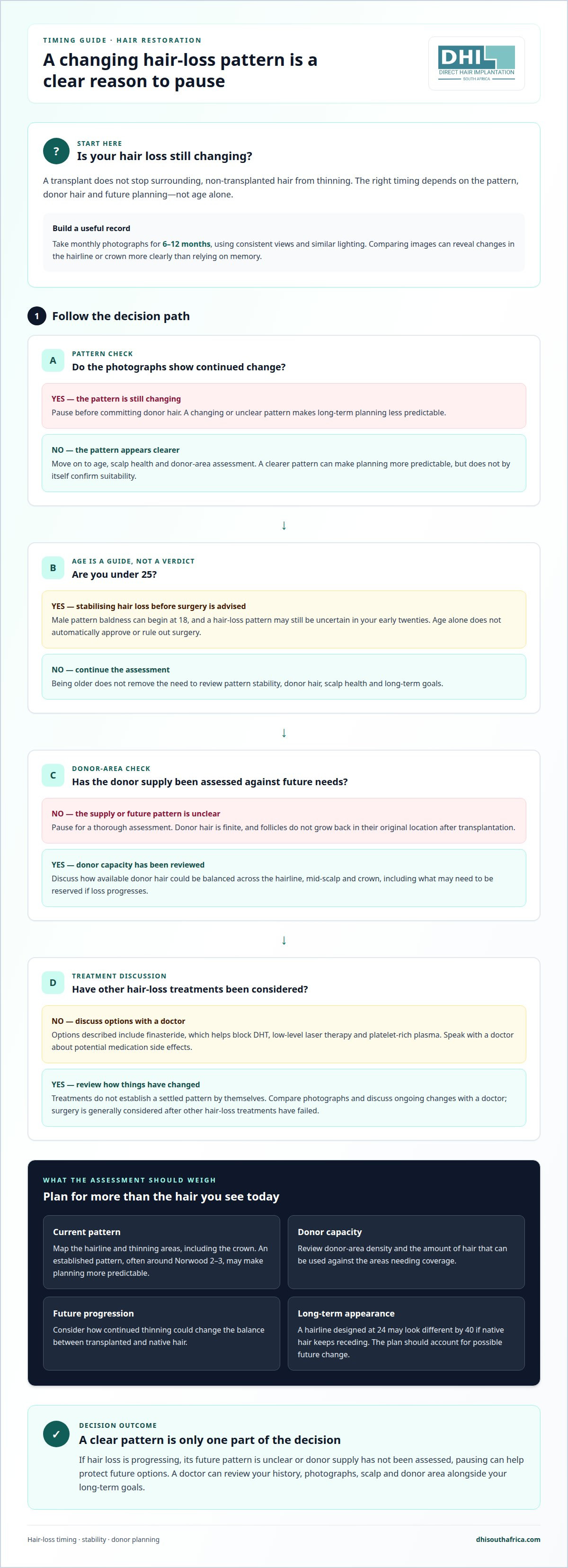
A hair transplant can be too early when your hair loss is still changing, even if thinning has already begun. If you’re under 25, stabilising hair loss before considering surgery is advised; age alone, however, doesn’t determine whether the timing is right. Knowing when it is too early for a hair transplant means looking at the pattern of loss, the strength of your donor hair and how a hairline may look as you age.
It’s understandable to want to act as soon as thinning becomes noticeable. But a transplant doesn’t stop surrounding hair from continuing to thin. That can affect how natural the result looks over time and whether further treatment may be needed.
This article explains how age, hair-loss stability, donor hair and surgical risks shape the decision. You’ll also learn why a considered plan needs to account for future changes, not just how your hair looks today.
Table of Contents
Can You Get A Hair Transplant Too Early?
A transplant may be premature when hair loss is progressing and its future pattern is unclear. The question “When is it too early for a hair transplant?” is best answered by looking beyond age to hair-loss stability, donor hair and long-term planning.
Hair-loss stability and timing
Hair-loss stability means the pattern has become clear enough to plan around, rather than changing rapidly. Male pattern baldness can begin at 18, but people under 25 are advised to consider stabilising their hair loss before surgery. A 21-year-old with a receding hairline may still have an uncertain future pattern. Age is a guide, not an automatic approval or refusal.
Monthly photographs over 6-12 months can show whether the hairline or crown is changing. Compare consistent views in similar lighting, rather than relying on memory. An established pattern, often around Norwood 2-3, may make planning more predictable. A doctor can review this record alongside your history and scalp assessment.
Progressive and unpredictable hair loss
Progressive hair loss means surrounding, non-transplanted hair may continue thinning after surgery. The transplanted area can then look isolated, even if its placement initially suited your hairline. A hairline designed at 24 may look different by 40 if native hair keeps receding. Planning must account for possible future change, not only today’s visible loss.
Uncertainty matters particularly when thinning is recent or uneven. Someone with early pattern hair loss may continue to lose hair over the following two decades. Observing changes for a year or two can help a doctor understand the pace. If you’re asking, “When is it too early for a hair transplant?”, a changing pattern is a strong reason to pause before committing donor hair.
Treatments before surgery
For early hair loss, treatment may help address progression before surgery is considered. Finasteride is described as helping block DHT. Speak with a doctor about potential side effects before starting medication. Low-level laser therapy and platelet-rich plasma treatments are also options that may help slow hair loss.
These approaches don’t establish a settled pattern by themselves, so monitoring still matters. Discuss treatment goals and ongoing changes with a doctor, then compare photographs over 6-12 months. Surgery is generally considered after other hair-loss treatments have failed. This sequence can help avoid operating on areas that may change substantially.
In South Africa, hair-transplant clinics operate under applicable health-professional and healthcare-facility rules. Regulatory compliance and clinical suitability are separate considerations. Neither makes an unclear hair-loss pattern stable.
At a South African consultation, expect discussion of your medical history, affected areas and changes over time. The assessment should also consider your donor area and long-term goals. Bring dated photographs if available; they can help show changes that are difficult to recall. A hair transplant assessment in South Africa can help clarify whether your timing, pattern and expectations align.
Donor hair availability and late-stage hair loss
Donor hair is a finite resource, so a transplant plan needs to account for future thinning as well as current coverage. This is particularly important if hair loss is still progressing or the affected area may expand.
Donor-area strength
Donor-area strength describes how much suitable hair the back of the head can provide for restoration. Transplanted hair is taken from this area, which is less prone to hair loss. Its density and appearance help determine what can be covered, while the size of the thinning area influences how that supply is used.
For example, a plan focused only on a receding hairline may leave less flexibility if thinning later reaches the crown. A thorough assessment considers the donor area alongside the areas needing coverage. This helps avoid treating today’s visible gap as the only future need.
Preserving donor hair
Preserving donor hair means limiting extraction so some supply remains available if further procedures are needed. Donor follicles do not grow back in their original location after transplantation, so each extraction makes lasting use of that resource.
The trade-off is clear in the example of a 22-year-old whose hairline is lowered using 2,500 grafts. That allocation could use a large portion of the person’s donor hair before their eventual pattern becomes clear. A conservative plan can leave more options if hair loss expands.
Progression matters because a transplant doesn’t prevent surrounding hair from thinning. If loss continues around the transplanted area, the contrast may become more noticeable, and further procedures could be considered. A plan should account for both the intended hairline and possible future loss, rather than concentrating all available donor hair in one area.
Limited donor hair can also affect how coverage is prioritised. The front hairline, mid-scalp and crown may all need to be considered against the same finite supply. A doctor can assess the donor area and discuss which areas matter most to your long-term goals. The aim is to balance visible improvement with the possibility of later progression.
Before deciding, consider these planning points:
Assess the donor area’s density and the amount of hair that can be used.
Map the current hairline and thinning areas, including the crown.
Consider how continued loss could change the balance between transplanted and native hair.
Discuss how much donor hair to reserve for possible future procedures.
Later-stage hair loss can make the pattern easier to see, but it doesn’t automatically mean donor supply is sufficient. The donor area still needs assessment, and the plan must match its capacity to the areas needing coverage. Advice should reflect your hairline, donor hair and long-term restoration goals, not simply how much you hope to cover now.
Age and timing for hair transplant surgery
Age helps frame the decision, but the hair-loss pattern, donor area and long-term goals matter too. Hair transplant surgery should account for how native hair may change after treatment.
Suggested age for surgery
There is no strict upper age limit for a hair transplant, while younger people may need more time for their pattern to become clear. Hairlines can still be forming between 18 and 29, and patterns tend to become more predictable by the mid-to-late 20s, and certainly by the 30s.
Some people in their late 20s or early 30s may be suitable candidates. Healthy people may also have surgery into their 60s and beyond. Age is a guide, not a stand-alone measure of suitability: scalp health, medical conditions and lifestyle also shape the decision.
Signs surgery may be premature
Surgery may be premature when the hairline or crown is changing, or when the eventual pattern remains uncertain. A hairline transplant at 22, for example, may be followed by natural recession by 26, leaving transplanted hair separated from native hair.
Crown surgery also needs careful timing because further loss can expose the treated area. Advice in the research cautions against crown transplantation for male patients younger than 25. A design created in your twenties should also be considered against how it may look at 50, not only how it appears today.
Assessing candidate suitability
Doctors assess suitability by considering the hair-loss pattern, donor area, scalp health, medical conditions, lifestyle and long-term goals. These factors help determine whether the planned coverage fits the available donor hair and the likely direction of future loss.
At a consultation, discuss when thinning began, which areas have changed and what you hope surgery will achieve. A certified doctor can assess the donor area alongside the hairline and crown, then consider whether the pattern is predictable enough for surgical planning. The assessment should cover the whole head, not just the area you want treated.
Timing also depends on the area being considered. Crown loss can continue after surgery, and a transplant does not prevent further hair loss. For that reason, advice against crown surgery before 25 reflects uncertainty about future progression, rather than a universal age rule for every procedure.
Personal goals matter as well. Someone seeking a lower hairline may need a different plan from someone prioritising crown coverage. Consider whether the design would still look natural at 40 or 50 if native hair continues to thin. A clinic’s assessment should weigh that future appearance against current concerns.
Before deciding, bring dated photographs showing changes over time and describe any treatments you’ve tried. This gives the doctor useful context alongside the examination. If the pattern keeps changing, observation can provide a clearer basis for timing. If it is established, planning can focus on donor-area strength and long-term coverage.
Risks of transplanting hair too early
Operating before hair loss settles can create problems beyond an unsatisfactory hairline. Existing, miniaturising hairs may be vulnerable to damage or shock loss during transplantation. These hairs contribute to density around the treated area. If they weaken or are lost, the contrast between transplanted and native hair can become more visible.
Timing also affects how well a surgical plan accounts for future progression. A transplant fills selected areas; it doesn’t stop hair loss elsewhere. If thinning continues behind the transplanted hairline, the result may look separated from surrounding hair. Crown surgery presents a similar planning challenge because the affected area can expand while transplanted hair remains in place.
Patients sometimes focus on immediate coverage and overlook how the pattern could change. For example, a design that creates a low, dense hairline may leave less flexibility if recession continues. The question isn’t simply whether the transplanted follicles grow. It’s whether the overall distribution remains balanced as native hair changes.
Another risk is using donor hair before the extent of future loss becomes clearer. Each procedure places follicles in specific positions, while later thinning can create new areas needing attention. This can make density planning more difficult. Consider how the first surgical plan relates to possible future treatment, rather than judging it only by the initial area of concern.
Observation helps clarify timing. Monthly photographs over 6-12 months can show changes in the hairline, crown and overall density. A doctor can compare those images with the current pattern and discuss whether progression remains active. Hair-bulk measurements taken one year apart while taking finasteride may also help predict the eventual balding pattern, according to Dr. William Rassman.
Medication decisions need separate consideration from surgical planning. Finasteride is described as helping block DHT, which shrinks hair follicles. Speak with a doctor before starting it to understand potential side effects. The aim is to assess whether treatment and observation can clarify the picture before surgery is considered, not to assume medication will remove every future risk.
Before proceeding, discuss these points with the doctor:
Which existing hairs are miniaturising and vulnerable to shock loss?
How could continued progression change the appearance around the transplanted area?
How does the proposed density fit the current pattern and future hair loss?
What does the monitoring record show about timing and stability?
When hair loss is still changing, delaying surgery can provide useful evidence for planning. A year or two of medical treatment and observation can help a doctor understand how the pattern is developing. That context helps distinguish a stable surgical candidate from someone whose current density may soon change.
Expectations for transplant results
A hair transplant redistributes follicles; it doesn’t stop thinning in untreated areas. Transplanted follicles retain their genetic composition and remain resistant to DHT’s effects, while surrounding native hair may continue to recede. This distinction matters: the result can look different as untreated hair changes, even if transplanted hair remains.
Think beyond the first result. A hairline planned in your twenties should be considered against how it may look at 30, 40 and 50. A design that appears dense today may look less balanced if surrounding hair thins later. Long-term planning weighs the placement and density of transplanted follicles against the possibility of future loss.
Donor supply also shapes what coverage is achievable. The number of hairs needed depends on the areas being addressed and the available donor hair. One estimate suggests 2,500 grafts may provide close to 6,000 hairs. That example illustrates why graft counts alone don’t describe the visible result: placement, distribution and the size of the area also matter.
Hair doesn’t appear immediately after surgery. The telogen phase, the resting part of the hair cycle, lasts a few months. Early appearance therefore doesn’t show the final result. Allow time for growth and assessment before judging the outcome or considering another session.
A later session may be considered after the first result has been observed for about a year. This allows the initial outcome to be assessed before more donor hair is allocated. If thinning has progressed elsewhere, the next plan can account for those changes rather than simply repeating the original design.
Realistic expectations also depend on health and scalp condition. People over 50 may be candidates when they are healthy and have realistic expectations. For older patients, results can be good when enough donor hair is available and the scalp is healthy. Age alone does not determine whether coverage is feasible.
Before planning restoration, consider what the result should achieve:
Set a hairline that remains appropriate as you age.
Discuss how untreated thinning could affect the overall appearance.
Relate the requested coverage to donor hair availability.
Allow about a year to observe the first result before considering another session.
Minoxidil is not a substitute for surgical planning: medication and transplantation address hair loss differently. Discuss treatment choices with a doctor, including potential effects and how they fit your goals. For a useful discussion, focus on the density you want, future progression and whether enough donor hair may remain for later needs.
DHI South Africa: Direct Hair Implantation (DHI)
DHI South Africa offers Direct Hair Implantation (DHI) for people considering surgical hair restoration. It may be relevant once your hair-loss pattern, donor area and long-term goals have been assessed, rather than simply because thinning has started.
If surgery may be premature, GFC Treatment, Regenera Activa and PRP Hair Loss Treatment are other options to discuss. The right approach depends on what is driving the loss and whether your pattern is still changing. Understanding these factors can help you weigh treatment and timing before making a surgical decision.
For a considered discussion of your hair restoration options, contact DHI South Africa.
Make your next step a considered one
If you’re still asking when it is too early for a hair transplant, make your next step a clear conversation about your priorities, not a rushed commitment. Think about what you want to change, what would feel like a natural result and how you might feel if your hair continues to change. These questions can help you explain your expectations and understand the options.
Raise your concerns openly, including any uncertainty about timing. A thoughtful plan should make space for your questions and help you decide what feels right for your circumstances. You deserve to approach hair restoration with clarity and confidence, at a pace that suits you.
Take the next step when you feel ready. A well-considered decision is a positive place to begin.
Frequently Asked Questions
Can I have a small session now and more later?
Possibly, but splitting treatment into smaller sessions doesn’t remove the need for a long-term plan. Each session uses donor follicles, so even a limited first procedure can affect what remains available later. For example, a small hairline adjustment should be considered alongside potential future crown thinning. Discuss the purpose of each proposed session and how the overall design could adapt if your hair changes.
Does family history predict how much hair I will lose?
Family history can offer clues about a tendency towards pattern hair loss, but it can’t tell you exactly how much hair you will lose or when. Relatives, for example, may have different degrees of thinning despite sharing a family pattern. Treat family history as context, not a forecast. Your own changes over time, including where thinning appears, are more useful for understanding how your hair loss is progressing.
How does your age affect your treatment?
Age affects how long your hair pattern may have been developing and how confidently a lasting design can be planned. A younger person may need to consider how their appearance could change, while an older person’s assessment may focus more on scalp health, donor supply and personal goals. The same treatment choice won’t suit everyone of the same age; the reasons for treatment matter too.
Should I wait until my hair loss stops?
You may not need to wait until every change has stopped, but it helps to understand whether loss is active and how quickly it is changing. Some people manage ongoing hair loss with treatment rather than waiting for it to cease completely. For instance, if photographs show a changing crown but a steadier frontal area, that difference can inform the discussion. A doctor can interpret the pattern alongside your treatment history.
Should You Wait or Act Now?
Base your decision on evidence of change, not a sudden difficult day or a single photograph. Compare dated images, note which areas are changing and write down what you hope treatment will achieve. If recent shedding is your main concern, first discuss its cause and possible treatment options. If your priorities remain clear after reviewing the pattern, you can have a more focused conversation about possible next steps.
The Magic Number: Is There a “Best Age”?
No single age guarantees the best result. The useful question is whether your hair pattern, donor area and expectations make sense together. Someone older may have limited donor supply, while someone younger may have a pattern that is still developing. Treat age as one part of the assessment, not a finish line. A sound plan should make sense for your future appearance as well as your present one.
What causes young people to lose hair?
One cause is inherited pattern hair loss, which can begin after puberty as follicles become sensitive to dihydrotestosterone, or DHT. Other factors can also contribute to shedding, so a young person shouldn’t assume every change has the same cause. Note when the loss began, whether it is gradual or sudden, and which areas are affected. That history helps guide an appropriate medical assessment.
What is the minimum age for a hair transplant in South Africa?
A specific statutory minimum age for hair-transplant surgery in South Africa cannot be given here as a verified rule. Clinically, people under 25 are advised to consider stabilising hair loss before surgery. Age alone doesn’t establish suitability: the pattern, donor area, health and ability to make an informed decision all matter. If you’re under 25, focus the discussion on those factors and whether waiting could improve planning.



Comments