%20(1).jpg)
%20(1).jpg)
15 Vital Questions to Ask a Hair Transplant Surgeon Before Your Procedure

A successful hair transplant isn't measured by how many hairs are moved; it's defined by how many actually grow back and how natural they look. It is completely normal to feel a sense of anxiety about unnatural results or to feel lost in a sea of technical jargon. You're likely looking for the specific questions to ask a hair transplant surgeon to ensure you're in the hands of a world-class specialist rather than a technician. Making the right choice is the difference between a result that looks "pluggy" and a hairline that restores your confidence for a lifetime.
We believe that every patient deserves absolute transparency and clinical precision. You want to feel certain that your procedure will yield a hair survival rate of over 90 percent and a density that looks entirely organic. This article provides the ultimate vetting framework to help you navigate your consultation with total composure. We'll preview the fifteen vital questions that separate average clinics from global leaders, ensuring you have the tools to secure the sophisticated, high-standard care you deserve.
Table of Contents
Why Your Choice of Surgeon Determines Your Lifetime Result
Choosing a surgeon isn't just about finding a practitioner; it's about selecting a partner for a life-altering transformation. Hair loss often erodes self-confidence silently, making the decision to undergo a procedure feel both urgent and overwhelming. Whilst it's easy to get caught up in marketing promises, the clinical reality is that your results depend entirely on the expertise of the hands performing the work. This is why preparing specific questions to ask a hair transplant surgeon is the most critical step in your journey.
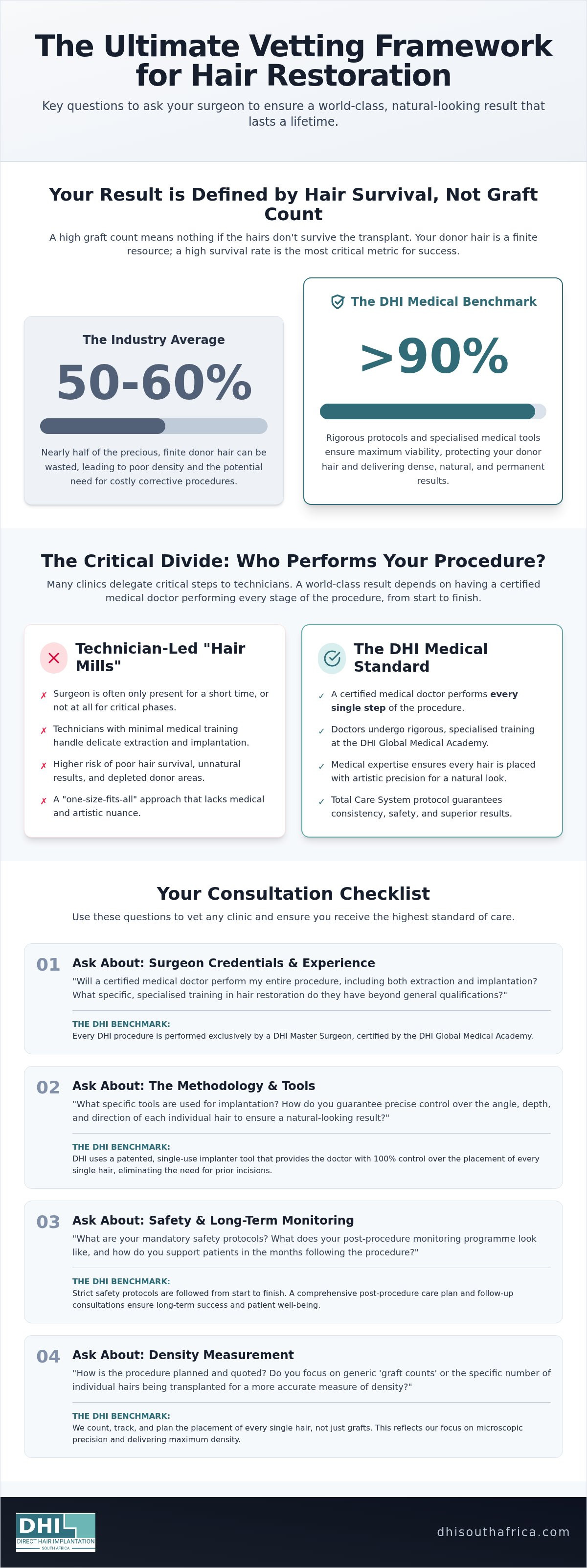
Modern hair transplantation procedures have evolved into a sophisticated blend of medical science and meticulous artistic design. It isn't just about moving hair; it's about ensuring those hairs survive and thrive in their new location. In the broader industry, survival rates often hover between 50 and 60 percent. This means nearly half of the donor hair, which is a finite resource, could be wasted. In contrast, the DHI benchmark exceeds 90 percent, ensuring that your investment translates into visible, permanent density. This difference in outcome is rarely accidental; it's the result of rigorous training and specialised tools.
The Emotional Impact of Hair Restoration
Thinning hair can feel like losing a part of your identity. It's a deeply personal experience that requires a surgeon who offers empathy alongside clinical skill. A professional clinic will never use high-pressure sales tactics. Instead, they provide a transparent, data-driven consultation that respects your concerns. Viewing this as a long-term medical investment in your self-assurance helps shift the focus from a "quick fix" to a sustainable, high-quality result that looks natural for years to come.
Understanding Hair Survival vs. Graft Count
Many clinics focus heavily on "graft counts" to justify their pricing, but this is a misleading metric. What truly matters is the hair survival rate. If you move 2,000 grafts but only 1,000 survive, you've lost precious donor hair that can never be replaced. DHI South Africa prioritises the health of every individual hair through a Total Care System. This protocol ensures that follicles are handled with microscopic precision from extraction to implantation. For those seeking comprehensive medical hair restoration in South Africa, understanding this distinction is vital to avoiding the need for expensive corrective surgery later.
Opting for a "cheap" procedure often leads to hidden costs and significant emotional distress. Poorly executed transplants can result in "pluggy" hairlines or depleted donor areas, requiring complex and costly repairs. A world-class surgeon ensures the angle, depth, and direction of every hair are controlled, creating a result that is indistinguishable from natural growth. When you prepare your list of questions to ask a hair transplant surgeon, focus on their ability to marry technical success with aesthetic longevity. This ensures your restoration is a one-time investment rather than the start of a corrective cycle.
Questions Regarding Surgeon Credentials and Clinical Expertise
When vetting a clinic, the most vital questions to ask a hair transplant surgeon revolve around who actually handles your hair. In many high-volume clinics, the surgeon only makes a brief appearance, leaving the technical work to assistants. This "hair mill" approach increases the risk of inconsistent results and poor hair survival. You deserve to know that the person responsible for your transformation has the medical background to handle every nuance of the scalp.
Doctor-Led Procedures vs. Technician-Led Clinics
The industry is unfortunately saturated with clinics where technicians perform the critical extraction and implantation phases. This practice carries significant risks. Technicians often lack the medical training to handle unexpected scalp reactions or ensure graft viability. At DHI, we mandate that only certified medical doctors perform every stage of the procedure. Our doctors undergo a rigorous training programme at the DHI Academy. This involves completing 20 supervised procedures over eight weeks before they can lead a session independently. This ensures that the person mapping out your 3,000 hairs has the clinical expertise to guarantee a natural result.
The Importance of Specialised Certification
A general plastic surgery board certification is a mark of medical competence, but it doesn't guarantee mastery of the delicate artistry required for hair restoration. Different types of hair replacement surgery require specific, nuanced skills that general training doesn't cover. DHI South Africa adheres to strict ISO and UK CQC standards, ensuring world-class safety and hygiene protocols. A DHI Specialist is defined as a medical doctor who has been personally certified by the Global Training Academy, the only international body dedicated solely to this discipline.
During your consultation, you should also ask how many hairs the surgeon typically transplants in a single session for your specific level of thinning. This helps you gauge whether they're prioritising your long-term donor health or simply chasing numbers. A transparent surgeon will provide a detailed plan based on hairs, not generic grafts, to give you a clear picture of expected density. If you're ready to speak with a certified expert, you can book a consultation to discuss your unique needs. This level of clarity is the first sign of a professional partner in your restoration journey.
Evaluating the Methodology: Hairs, Tools, and Technology
The methodology behind your restoration is where medical science meets aesthetic artistry. When compiling your list of questions to ask a hair transplant surgeon, you must look beyond the name of the technique and scrutinise the actual instruments used. A world-class procedure relies on tools that minimise human error and physical trauma to the scalp. This precision is why we focus on "hairs" rather than generic "grafts". By counting individual hairs, we can plan for specific density and ensure the aesthetic map we create during your consultation is executed with mathematical accuracy.
Forceps vs. The DHI Implanter
Traditional methods often rely on forceps to place follicles into pre-cut holes in the scalp. This two-step process can be problematic; follicles are fragile and easily damaged when gripped with metal forceps. There's also less control over the final look. We use a patented DHI Implanter, which allows for a single-step placement. This tool gives the doctor total control over the angle, depth, and direction of every single hair. It's the only way to guarantee a 100% natural-looking hairline that mimics your original growth pattern without the "pluggy" appearance of older methods.
Extraction Precision and Follicle Health
The journey of a hair follicle begins with its extraction. You should ask your surgeon if they use single-use, titanium-coated punches. Titanium is biocompatible and stays sharper for longer, which means less trauma to your donor area and faster healing times. Once extracted, follicles are vulnerable. Our "Total Care System" ensures that hairs are kept in a specialised growth medium at a controlled temperature to maximise their viability outside the body. This meticulous attention to detail is what allows us to achieve survival rates that consistently exceed 90 percent.
You can view technical details of this process on our DHI Hair Transplant page. Understanding the technology involved helps you distinguish between a clinic that simply "moves hair" and one that restores it with clinical excellence. When you ask about tools, you aren't just asking about equipment; you're asking about the safety and longevity of your result. A surgeon who invests in titanium-coated, single-use instruments is a surgeon who prioritises your health and the success of every hair they transplant.
Safety Standards and Post-Procedure Monitoring
Clinical safety isn't just a checkbox; it's the foundation of a risk-free restoration that protects your health and your investment. When you're preparing your list of questions to ask a hair transplant surgeon, ensure you probe into their internal audits and hygiene standards. A world-class clinic should be able to demonstrate a rigorous, standardised approach to patient care that extends far beyond the operating room. You deserve to know that the environment where your procedure takes place is held to the highest international medical standards.
The 18 Mandatory Safety Checks
DHI South Africa operates under a strict Total Care System that includes 18 mandatory clinic safety checks. These protocols are designed to eliminate any margin for error, from the initial sterilisation of the surgical suite to the final post-procedure briefing. We use single-use, titanium-coated instruments for every patient to prevent any risk of cross-contamination and ensure the sharpest possible tools for minimal tissue trauma. Our ISO and UK CQC-accredited protocols ensure that you receive a consistent gold standard of medical care. This level of oversight is what allows us to maintain a 99 percent customer satisfaction rate across our global network of over 75 clinics.
Your Recovery and Long-Term Results
One of the most significant advantages of the DHI technique is its minimally invasive nature. Often referred to as a "lunch-hour transplant" for busy professionals, the procedure requires no stitches and leaves no visible linear scarring. This allows for a swift return to your daily routine whilst the newly implanted hairs begin their integration. However, the true result takes time to mature, which is why we implement a structured 18-month monitoring programme. We don't simply perform the surgery and part ways; we walk with you through every stage of the growth cycle.
This programme tracks your hair through various growth phases, including the anagen (active growth) and telogen (resting) stages, ensuring that every hair is thriving as expected. We also provide a comprehensive 9-angle photographic series of our previous patients during consultations. This level of transparency allows you to see the evolution of density and naturalness from every perspective, providing a realistic expectation of your own journey. You can explore these success stories on our Results page to see the long-term impact of our meticulous monitoring and clinical precision.
Concluding Your Consultation: The DHI Advantage
Every consultation should feel like a collaborative partnership between you and your specialist. The specific questions to ask a hair transplant surgeon that we've outlined aren't merely a checklist; they represent your commitment to a lifetime of self-assurance. By demanding transparency regarding survival rates, doctor-led procedures, and specialised tools, you move beyond the confusion of industry jargon. You're no longer just a patient; you're an informed advocate for your own aesthetic outcome. This methodical approach ensures that your decision is based on clinical evidence rather than marketing hype.
Why DHI South Africa is the Correct Choice
DHI South Africa stands as an authoritative pioneer in the field, rooted in the legacy of the DHI Global Medical Group, which has been refining these protocols since 1970. Our 99 percent customer satisfaction rate isn't a vague promise; it's a clinical reality born from thousands of successful restorations across 75 global clinics. Because our treatment is entirely autologous, using your own genetically resistant follicles, the results are both permanent and biologically harmonious. You aren't just getting "new hair"; you're redistributing your own natural assets with the precision of a world-class institution that prioritises safety and ethics above all else.
Next Steps for Your Hair Restoration Journey
As you move forward, we encourage you to prepare your list of questions for your first meeting. A professional specialist will never rush your decision or offer generic, one-size-fits-all answers. Instead, they'll provide a clear, methodical assessment of your scalp health and donor density. This is the "trusted peer" approach we pride ourselves on, combining the composure of a medical expert with the warmth of a dedicated advisor. We believe that education is the first step toward a successful transformation, and we're committed to providing that clarity at every stage.
The most logical first step is to experience a professional digital scalp analysis. This diagnostic process provides a high-resolution view of your follicle health, allowing us to map out a restoration journey with the same microscopic detail we use during implantation. It's a low-friction opportunity to see the data behind your hair loss and understand exactly how Direct Hair Implantation can restore your natural hairline. Whether you're ready for a surgical procedure or still exploring Advanced Hair Loss Solutions for non-surgical care, we're here to provide the clinical guidance you deserve. Your journey toward natural-looking density starts with a single conversation, grounded in the global standards you've discovered today.
Securing Your Future with Clinical Precision
Restoring your hair is a significant medical decision that deserves a partner committed to your long-term success. By mastering the essential questions to ask a hair transplant surgeon, you've moved from uncertainty to a position of absolute clarity. You now understand that a world-class result depends on doctor-led procedures, specialised titanium-coated instruments, and a hair survival rate that exceeds the 90 percent benchmark.
As a global leader with more than 75 clinics worldwide, we've refined our patented DHI technique to ensure seamless, natural density. Our 99 percent satisfaction rate, backed by IMRB-accredited data, reflects our unwavering commitment to medical excellence and patient-centric care. You don't have to navigate this journey alone; you have the tools to vet any clinic and choose the "safe pair of hands" your restoration requires.
Take the next step with the composure of an informed patient. We look forward to helping you achieve a transformation that restores not just your hair, but your self-assurance for a lifetime.
Frequently Asked Questions
Is a hair transplant permanent if I have a DHI procedure?
A DHI hair transplant provides a permanent solution to hair loss. We harvest follicles from the "permanent donor zone" at the back and sides of the head. These specific hairs are genetically resistant to the hormones that cause thinning. Once our certified doctors implant them into the recipient area, they retain this resistance and continue to grow naturally for the rest of your life.
Can I go back to work the next day after a DHI transplant?
You can typically return to your professional duties the very next day. Because the DHI technique is minimally invasive and requires no stitches or linear scarring, the recovery period is exceptionally short. Many of our clients refer to it as a "lunch-hour transplant" due to this convenience. Whilst you might notice some minor redness in the treated area, it generally subsides quickly without affecting your daily routine.
How much does a hair transplant cost in South Africa in 2026?
The total investment for a procedure depends on the specific number of hairs required to achieve your desired density. Every scalp is unique, so we don't offer a one-size-fits-all price. Factors such as the degree of thinning and the health of your donor area influence the final medical fee. We recommend booking a professional consultation to receive a personalised suitability assessment and a detailed breakdown of your requirements.
What happens if my transplanted hairs do not grow?
One of the most important questions to ask a hair transplant surgeon is about their survival rate. At DHI, our patented protocol ensures a hair survival rate of over 90 percent. We provide a structured 18-month monitoring programme to track your growth through every phase. If any concerns arise during this window, our specialists conduct a clinical review to ensure your restoration meets our global standards of excellence.
Is the DHI technique suitable for both men and women?
Direct Hair Implantation is a highly effective option for both men and women. The technique is particularly advantageous for female patients as it often allows for a "no-shave" approach, meaning we can work around existing long hair without a visible change to your appearance. Whether you are treating a receding hairline or general thinning, our doctors tailor the placement of every hair to match your natural aesthetic.
How do I know if I have enough donor hair for a transplant?
We determine the adequacy of your donor area through a comprehensive digital scalp analysis. This diagnostic tool allows us to measure your hair density and follicle health with microscopic precision. A successful restoration requires a healthy balance between the hairs we extract and the density remaining in the donor zone. Our specialists ensure that your donor area remains looking natural whilst providing enough hairs for a full restoration.
What is the difference between FUE and DHI implantation?
Traditional FUE involves creating reception channels in the scalp before placing follicles with forceps, which can sometimes lead to tissue trauma. DHI uses a patented single-step implanter that bypasses the need for pre-cut channels. This tool gives our doctors total control over the angle, depth, and direction of each hair. By reducing handling, we achieve a significantly higher survival rate and a more natural-looking hairline compared to older methods.
Are there any non-surgical alternatives I should ask about first?
There are several non-surgical treatments that can be used alone or alongside a transplant. These include GFC Treatment (Growth Factor Concentrate) and Regenera Activa, which use your own biological material to revitalise thinning follicles. When researching questions to ask a hair transplant surgeon, you should also enquire about medical-grade hair loss products. These options can often curb miniaturisation and improve your overall scalp health before considering a surgical intervention.


Comments