%20(1).jpg)
%20(1).jpg)
Best Age for a Hair Transplant: Clinical Timing Guide

The "perfect" number on your birthday card actually matters far less than the biological state of your scalp. Whilst many men search for the best age for hair transplant procedures, clinical success depends on predictability rather than a specific date. Most medical experts consider the age of 25 as a vital threshold because hair loss patterns are often still evolving in younger patients. Operating too early carries the risk of an unnatural appearance as your native hair continues to recede behind the newly placed hairs.
It's completely normal to feel anxious when you notice thinning in your early twenties, and the conflicting advice found online only adds to that stress. You deserve a restoration that looks as good at sixty as it does at thirty. This guide will help you identify your ideal clinical window and explain how treatments like GFC or Regenera Activa can protect your existing hairs if you aren't quite ready for surgery. We'll explore the science of hair stabilisation and the precise diagnostic tools we use to ensure your results remain seamless and natural for a lifetime.
Table of Contents
Why Age Matters: The Biological Clock of Hair Restoration
Determining the best age for hair transplant surgery isn't about hitting a specific birthday, but rather about the maturity of your hair loss pattern. For most men in South Africa, this clinical window typically opens in the mid-twenties. Before this point, hair loss is often too erratic to predict where future thinning might occur. We look for signs of miniaturisation, a process where individual hairs become progressively thinner and shorter over successive growth cycles until they eventually stop growing altogether.
Hair transplantation is a surgical technique that moves permanent hairs to thinning areas, but if we act whilst the loss is still aggressive, you may experience the "island effect." This occurs when the transplanted hairs remain in place while your original hairline continues to recede behind them, creating an unnatural gap. To find the best age for hair transplant results that last a lifetime, we must ensure your pattern has reached a state of relative predictability.
To better understand this concept, watch this helpful video:
Understanding Hair Loss Stabilisation
Stabilisation is the point where the rate of shedding slows and a clear, predictable pattern emerges on the scalp. Hair loss stabilisation occurs when the anagen phase, or the active growing period of the hair follicle, remains consistent enough for a surgeon to plan a long-term aesthetic. This state is heavily influenced by DHT (dihydrotestosterone), a hormone that triggers the shrinking of follicles in those genetically predisposed to thinning. A consultation at a DHI clinic is essential to assess this; we use digital trichoscopy, a high-magnification scalp analysis, to measure hair density and follicle health with microscopic precision.
The Problem with Early-Twenties Surgery
While the emotional desire to fix a receding hairline at 21 is understandable, it's often clinically premature. Aggressive early loss can quickly outpace surgical restoration, potentially exhausting your donor supply too soon. Your donor area at the back of the head contains a finite number of hairs. Using them all to lower a youthful hairline leaves nothing for future coverage if the crown thins later in life. Choosing patience over an immediate fix allows us to create a restoration plan that looks sophisticated and natural as you age, rather than a temporary solution that requires constant, corrective procedures.
The Risks of Acting Too Early: Understanding the Long-Term Aesthetic
Acting prematurely is often driven by a sense of urgency, yet rushing into a procedure can compromise your future appearance. Your donor area, the strip of hair at the back and sides of your scalp, is a finite resource. If you exhaust this "donor bank" in your early twenties to create a dense, low hairline, you may find yourself without options if hair loss progresses towards the crown later in life. This is why the best age for hair transplant surgery often depends on the long-term viability of your donor supply rather than your immediate desire for density.
Designing a restoration plan requires a vision that spans decades. Chasing a youthful hairline at 22 is a risky strategy because it fails to account for the natural thinning that occurs as you age. When you choose the best age for hair transplant intervention, you're not just fixing today's problem; you're ensuring that the placement of every hair serves you well into your fifties and beyond. A conservative approach today often leads to a more convincing and manageable result tomorrow.
Managing the Donor Bank
Over-harvesting is a significant risk in less sophisticated clinics. When too many hairs are removed in a single session, it can leave the donor area looking thin and patchy, essentially closing the door on future procedures. At DHI South Africa, our medical experts use patented titanium-coated punches with a diameter of 1mm or less. This precision allows for the delicate extraction of individual hairs whilst preserving the surrounding tissue and donor density. Because our technique ensures a survival rate of over 90%, we can achieve maximum density with fewer extractions, protecting your donor supply for your 40s and 50s.
The Aesthetic Evolution of the Face
Facial structures change as we age, and a hairline that sits too low can eventually look stark or out of place. A flat, aggressive hairline often looks unnatural on a man in his fifties. Our goal is to design a hairline that matures with you, maintaining a sophisticated profile throughout your life. You can see examples of this long-term approach in our Natural Hair Transplant Results gallery. By placing hairs at the correct angle and depth, we ensure a seamless blend with your natural growth patterns that ages gracefully. If you're concerned about your current rate of thinning, a professional assessment of your hair loss can provide the clinical clarity needed to plan your restoration safely.
Finding Your Sweet Spot: Deciding Factors Beyond the Calendar
Whilst the mid-twenties often mark the earliest clinical window, many specialists find that the best age for hair transplant procedures lies between 30 and 50. During these decades, hair loss patterns have typically declared themselves, allowing for a more accurate surgical design. However, your biological clock doesn't always tick in sync with the calendar. We look at the severity of your loss using the Norwood Scale; generally, patients reaching a Norwood 3, which involves visible recession at the temples or thinning at the crown, provide a clearer canvas for restoration.
Your response to medical therapy is another critical timing factor. If you've utilised non-surgical treatments to slow the progression, we can better gauge which hairs are permanent and which are still vulnerable to miniaturisation. Psychological readiness is equally important. You must have a realistic understanding of what the placement of 3,000 or 4,000 hairs can achieve in terms of density versus total coverage. The best age for hair transplant surgery is ultimately when your expectations align with the clinical reality of your donor supply.
Clinical Indicators for Surgery
Before proceeding, we assess several physical markers through a detailed scalp analysis. Stable donor hair density is paramount; we need to ensure the hairs at the back of your head are robust enough to survive the move and thrive in their new location. We also look for a recipient area that is unlikely to expand significantly in the next 24 months. If the surrounding native hair is still actively shedding, it's often better to wait or use medical bridges to stabilise the area first, ensuring the transplant doesn't become an isolated patch as further loss occurs.
The Role of Gender in Timing
Timing for women often follows a different trajectory due to the diffuse nature of female pattern thinning. Unlike the distinct receding hairlines seen in men, women often experience a general decrease in volume across the entire scalp. This makes the decision-making process more nuanced, as we must wait until the thinning reaches a specific threshold where we can safely intersperse new hairs without damaging existing ones. You can find more detail on this in our Female Hair Loss Treatment guide. For many women, the ideal window for surgery is when the donor area remains dense whilst the recipient area has thinned enough to accommodate restoration without compromising the health of the surrounding follicles.
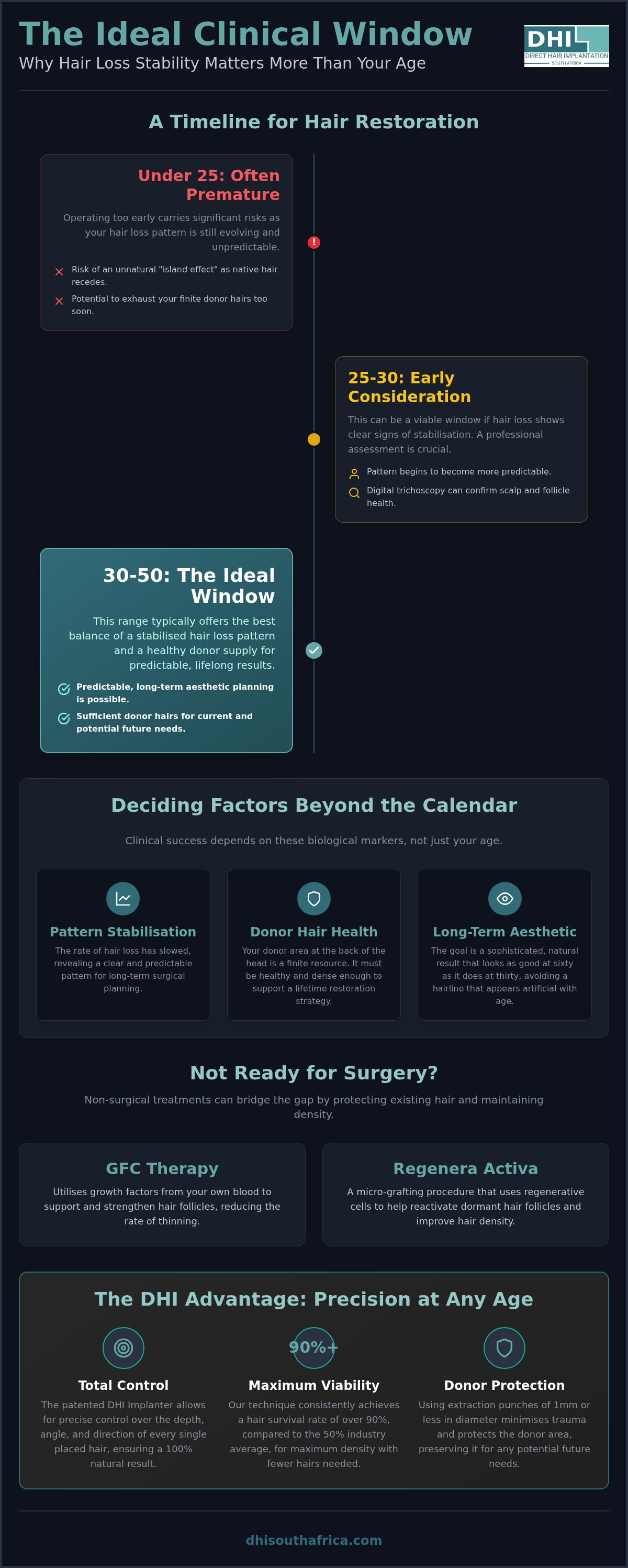
Bridging the Gap: Clinical Options for Younger Patients
Discovering that your hair is thinning in your early twenties can be distressing, especially when you're told you haven't yet reached the best age for hair transplant surgery. However, waiting for stabilisation doesn't mean you should leave your hair loss to progress unchecked. Clinical maintenance is the most vital step during this period. By intervening early with non-surgical therapies, we can often slow down the miniaturisation process and preserve your existing hairs until you are a better candidate for restoration.
These medical "bridges" are designed to keep your follicles in the active growth phase for longer. When you eventually reach the best age for hair transplant intervention, having more of your natural hair intact allows for a much more seamless and dense result. We focus on treatments that work with your body's own biology to strengthen the scalp environment without the need for invasive surgery.
GFC Therapy: The Modern Maintenance Standard
Growth Factor Concentrate (GFC) therapy represents a significant leap forward from traditional treatments. The process involves drawing a small volume of blood, typically between 15ml and 18ml, and using a specialised centrifuge to highly concentrate essential growth factors. These concentrated proteins are then delivered directly into the scalp to revitalise dormant follicles. This is a superior option for younger patients who want to curb miniaturisation whilst they wait for their hair loss pattern to declare itself. It's essentially a "lunch-hour" treatment with no downtime, making it ideal for busy professionals in South Africa.
Regenera Activa and PRP
For those experiencing early-stage androgenetic alopecia, Regenera Activa offers a multitargeted answer. This treatment uses progenitor cells, which are cells that can stimulate self-regeneration in thinning areas, to improve hair density and thickness. Similarly, PRP (Platelet-Rich Plasma) treatments work to nourish the scalp and strengthen existing follicles. We use a 360-degree diagnostic approach to see which of these Advanced Hair Loss Solutions fits your specific hair cycle and biological needs.
The DHI Advantage: Sophisticated Restoration at Any Age
Once you and your specialist have identified the best age for hair transplant surgery based on your unique biology, the choice of technique becomes the most critical decision for your long-term appearance. Direct Hair Implantation (DHI) is widely regarded as the gold standard for natural results because it offers unparalleled precision. Unlike older methods, DHI provides our medical experts with full control over the angle, depth, and direction of every hair placed. This ensures a seamless blend with your natural hair, making the restoration virtually indistinguishable from the original growth.
For the busy South African professional, the lifestyle benefits are just as significant as the aesthetic ones. The procedure involves no stitches and leaves no linear scars, meaning there's effectively no downtime. You can return to your routine quickly, confident that your restoration is progressing discreetly. Most importantly, our patented technique ensures a hair survival rate of over 90%. This high success rate is critical at any age, as it ensures we make the most efficient use of your finite donor hairs, protecting your resources for the future.
Precision in Implantation
The secret to our results lies in the patented DHI Implanter, a specialised tool that allows for a single-step placement process. By eliminating the need to create pre-cut channels in the scalp, we significantly reduce trauma to the skin and the follicles themselves. This delicate handling is what allows us to achieve natural density, often placing up to 4,000 hairs in a single session with meticulous care. Safety is never compromised for speed; every procedure follows a rigorous protocol that includes 18 mandatory clinic safety checks to ensure the highest medical standards are met at all times.
Your Next Steps
Whilst understanding the general guidelines is helpful, a professional consultation is the only way to accurately determine the best age for hair transplant intervention in your specific case. We begin this process with a digital trichoscopy, which is a high-magnification scalp analysis that allows us to see the health of your follicles and the degree of miniaturisation beneath the surface. This data-driven approach removes the guesswork from your restoration plan, giving you a clear, clinical timeline for when to act.
Taking control of your hair journey is a powerful step toward restoring your self-assurance. Whether you're ready for a procedure today or need a long-term maintenance plan to bridge the gap, we're here to provide the clinical expertise and compassionate guidance you deserve. You don't have to wait for total hair loss to start planning your future; precision restoration is about acting at the right time with the right team.
Securing Your Future Aesthetic
Choosing to restore your hair is a life-changing decision that requires a long-term perspective. We've explored how clinical stabilisation and the meticulous management of your donor supply are far more critical than the date on your birth certificate. Finding the best age for hair transplant surgery means waiting for a predictable biological pattern whilst utilising advanced non-surgical bridges to maintain your current density.
As a global leader with more than 75 clinics worldwide, DHI South Africa ensures your journey is guided by certified medical doctors at every stage. Our patented technique delivers a hair survival rate of over 90%, providing the precision needed for a result that ages gracefully alongside you. You don't have to navigate the anxieties of thinning alone or settle for conflicting online advice.
Your path to renewed self-assurance starts with a single, data-driven step. We're here to help you build a restoration plan that stands the test of time and preserves your natural appearance for decades to come.
Frequently Asked Questions
Is 21 too young for a hair transplant?
21 is usually considered too young because your hair loss pattern hasn't fully declared itself. If we act too early, you risk the "island effect" where transplanted hairs remain while your natural hairline continues to recede behind them. This can lead to a patchy, unnatural appearance. We typically recommend non-surgical maintenance like GFC therapy for patients in their early twenties to preserve density whilst waiting for clinical stabilisation.
Can I have a hair transplant if my hair is still falling out?
You can, but it requires a meticulous long-term strategy. Active shedding doesn't necessarily prevent a procedure, but we must ensure we aren't "chasing" a rapidly moving hairline. If your loss is still aggressive, we often combine the transplant with Regenera Activa or PRP treatments. These autologous therapies help strengthen your existing follicles and improve the survival rate of the newly placed hairs during the restoration process.
What happens if I get a hair transplant too early?
Acting prematurely can lead to aesthetic gaps as your genetic hair loss continues to progress. Since you have a finite supply of donor hairs, using them too early to fill small areas may leave you with no options if you experience significant thinning later in life. Finding the best age for hair transplant surgery ensures that your restoration plan accounts for your future appearance, resulting in a seamless look that ages gracefully.
Do I need to be completely bald before getting a transplant?
Absolutely not, and waiting until you're completely bald can actually limit your restoration options. To achieve natural density, we need a robust supply of healthy donor hairs from the back and sides of your scalp. If you wait until the donor area has also thinned, we may not have enough resources to provide full coverage. The ideal time is when you have visible thinning but still possess high-quality donor follicles.
Will I need a second hair transplant when I am older?
It is possible if your native, non-transplanted hair continues to thin over time. Whilst the hairs we move are genetically resistant to DHT, the original hair surrounding them remains vulnerable to the natural ageing process. This is why we use a 360-degree approach, combining surgery with medical maintenance. By utilising the DHI technique, which offers a survival rate of over 90%, we ensure the most efficient use of your hair supply from the start.
Are there non-surgical treatments that work better for younger men?
Younger men often see excellent results from non-surgical "bridges" like GFC (Growth Factor Concentrate) therapy. This treatment uses a small draw of your own blood to revitalise dormant follicles and curb miniaturisation without the need for surgery. Regenera Activa is another sophisticated option that uses progenitor cells to stimulate self-regeneration. These therapies are ideal for maintaining density until you reach the best age for hair transplant intervention.
How do doctors determine if my hair loss has stabilised?
Our certified medical doctors use a diagnostic tool called digital trichoscopy to assess your scalp. This high-magnification analysis allows us to measure your current hair density and the percentage of hairs in the anagen phase, which is the active growth stage of the hair cycle. By reviewing these metrics alongside your family history, we can determine if your loss has slowed sufficiently to allow for a predictable and successful surgical result.
Is there an age that is considered "too old" for a hair transplant?
There is no specific age that is considered "too old" for a restoration. As long as you are in good health and possess a stable donor area with sufficient hair density, you can be a candidate for a transplant. We have successfully restored the hairlines of many patients in their sixties and seventies. The focus is always on the quality of your donor follicles and ensuring your scalp condition is healthy enough for the procedure.


Comments