%20(1).jpg)
%20(1).jpg)
Anxiety About Hair Loss: Understanding the Stress-Loss Cycle in 2026
- Dhesan Moodley

- 8 hours ago
- 13 min read
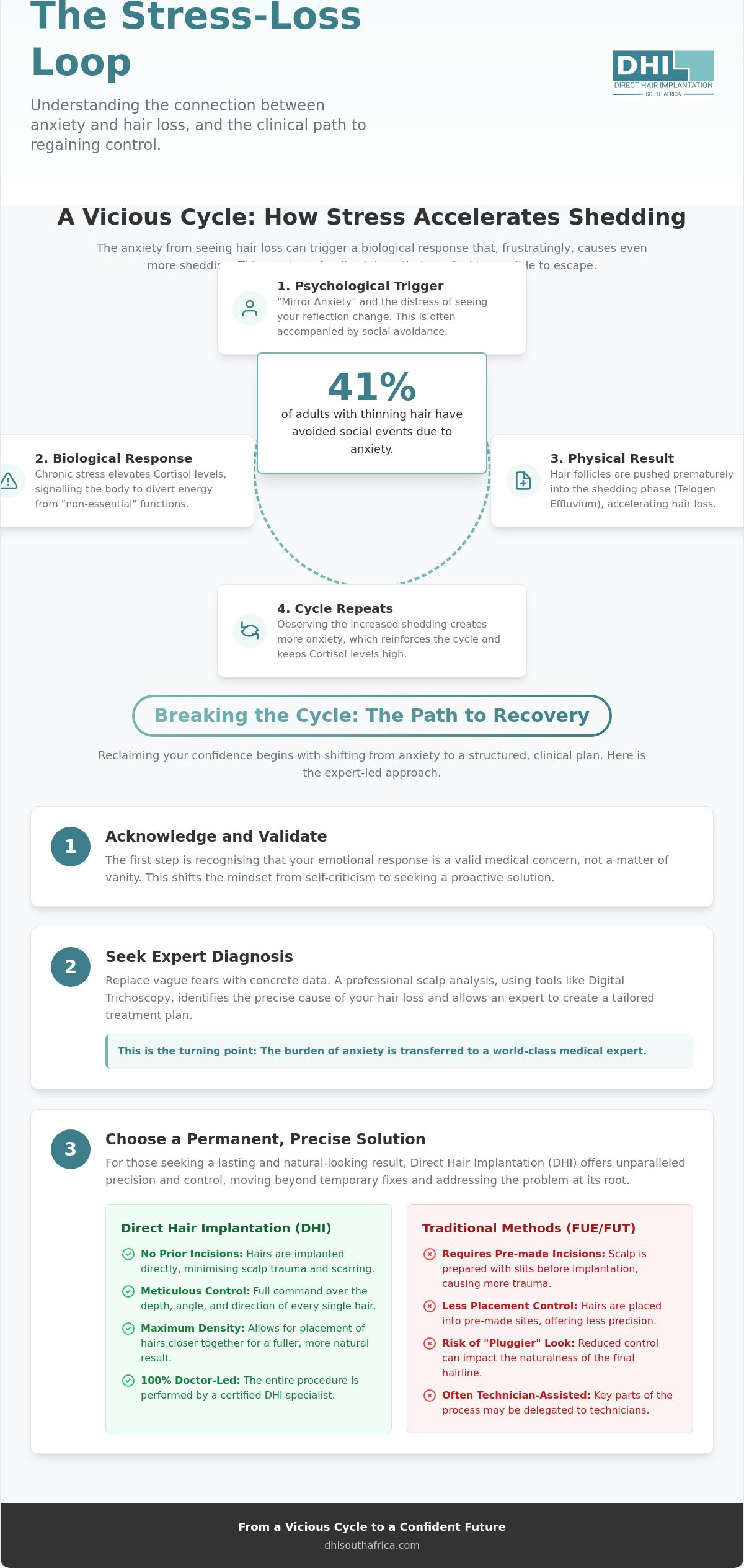
Imagine the quiet dread of checking your pillow every morning only to find more evidence that your identity is thinning away. If you find yourself obsessively monitoring the shower drain or feeling a surge of panic in front of the mirror, you aren't alone. In 2026, research shows that 41% of adults with thinning hair have avoided social events due to anxiety about hair loss. It's a heavy emotional burden; the most frustrating part is that this very stress can trigger a biological feedback loop where elevated cortisol levels actually accelerate shedding.
You deserve to feel like yourself again, and it's important to know that this cycle is entirely breakable. This article explores the science behind the stress-loss connection and provides a clear path toward reclaiming your confidence through advanced clinical restoration. We'll examine how modern diagnostics and specialised treatments like Direct Hair Implantation (DHI) offer a permanent, natural-looking solution that moves beyond temporary fixes. By combining psychological validation with world-class medical precision, you can stop the panic and start a journey toward lasting hair health.
Table of Contents
The Psychology of Thinning: Why Hair Loss Anxiety is a Valid Response
When you look in the mirror and notice a receding hairline or a widening part, the reaction isn't just about aesthetics. It's a deeply personal, often jarring experience that clinicians refer to as "Mirror Anxiety." This is a specific type of psychological distress where your reflection no longer matches your internal sense of self. For many, this shift feels like a betrayal by your own body, making your anxiety about hair loss a completely legitimate response to a significant life change.
For many, hair serves as a primary marker of youth, vitality, and identity. When it begins to thin, it can feel as though your very essence is slipping away. Research confirms that losing one's hair is a psychologically stressful event that fundamentally impacts social behaviour and self-esteem. You might find yourself avoiding bright lights, skipping social gatherings, or spending excessive time checking the pillow for fallen strands.
This state of hyper-vigilance is exhausting because the shedding feels unpredictable and entirely outside your control. You don't know if today will be a "good" hair day or if another patch will become visible under the office lights. This uncertainty creates a persistent background noise of worry that affects your focus at work and your presence in personal relationships. Societal standards often place an unfair emphasis on a full head of hair, making the thinning process feel like a public decline in status.
The Loss of Control and Self-Image
The emotional toll of "disguising" the problem often outweighs the physical loss itself. Whether it's strategically wearing hats or spending an hour styling your hair to cover thin patches, these behaviours reinforce a sense of secrecy. Acknowledging this burden is the first step toward reclaiming your confidence. You aren't just worried about your looks; you're grieving a version of yourself that felt certain and secure.
When you're caught in this cycle, every mirror becomes a critic rather than a tool. This constant self-monitoring drains your mental energy and can lead to a withdrawal from the activities you once loved. By validating these feelings as a real medical and emotional concern, we can begin to shift the focus from panic to a structured plan for restoration.
Breaking the Stigma of Seeking Help
There's a persistent myth that hair restoration is a matter of vanity, but we view it as a essential path to emotional recovery. Normalising this conversation is vital for both men and women in South Africa. Moving from a "victim" mindset to an action-oriented one changes the narrative entirely. Instead of wondering when the shedding will stop, you begin to ask how you can restore what's been lost.
A professional consultation serves as the ultimate turning point because it replaces vague fears with clinical data. By using tools like digital trichoscopy, which involves a high-magnification mapping of your scalp health, we move the conversation from "what if" to "what is." Sharing the burden with a certified expert provides the immediate relief of knowing you aren't navigating this alone. This clarity is the foundation of a successful journey toward permanent, natural-looking results.
The Biological Loop: How Stress and Cortisol Impact Your Hair Cycle
While the emotional weight of thinning is heavy, the physical mechanism behind it is a measurable biological process. Your body operates on a strict priority system for survival. When you experience chronic anxiety about hair loss, your brain perceives this as a persistent threat, triggering the release of cortisol. This "stress hormone" is essential for quick reactions, but when it remains elevated, it signals the body to divert energy away from non-essential functions, such as the production of new hairs.
This creates what we call the Stress-Loss Loop. The anxiety causes shedding, and the sight of that shedding causes more anxiety, keeping your cortisol levels high and your hair follicles in a state of suppressed growth. Understanding How Stress and Cortisol Impact Your Hair Cycle is the first step in regaining control. Most importantly, you should know that stress-induced loss is often manageable or reversible once the physiological trigger is addressed and the follicles are supported by clinical care.
Understanding Telogen Effluvium
The most common form of stress-related shedding is Telogen Effluvium. This condition occurs when a significant emotional or physical shock pushes a large percentage of your follicles out of their productive state prematurely. There is often a frustrating delay in this process; you might notice increased shedding three to six months after the initial stressful period. This happens because it takes time for the hair to move through the resting phase before finally falling out.
To understand this, we look at the hair's natural rhythm: the anagen phase represents the active growth period of the hair follicle, whilst the telogen phase is a resting state that concludes with the hair shedding from the scalp. Under normal conditions, only about 10% of your hairs are in the telogen phase at any given time. Stress can shock up to 30% or more into this resting state, leading to the alarming volume of hair you might see in your comb or shower drain.
The Chronic Stress Factor in Androgenetic Alopecia
While Telogen Effluvium is typically temporary, chronic stress can also exacerbate androgenetic alopecia, commonly known as male or female pattern baldness. Stress doesn't necessarily cause genetic thinning, but it can act as an accelerant, making a gradual process move much faster. It's vital to distinguish between "shedding," which is the loss of hairs from the root, and "thinning," which is the progressive miniaturisation of the hair shaft itself.
Because these conditions often overlap, a clinical diagnosis is essential to stop the guesswork and start an effective treatment plan. If you’re noticing increased shedding, a clinical assessment of your hair loss can provide the scientific clarity you need to break the cycle. Identifying whether your loss is purely stress-driven or a combination of factors allows us to tailor a restoration strategy that targets the root cause with precision.
Managing the Mental Load whilst Seeking a Permanent Solution
Managing the mental weight of thinning is a dual process. It requires immediate emotional relief whilst you navigate the medical path to restoration. While traditional support groups often focus on acceptance, we recognise that for many, the only true resolution for anxiety about hair loss is seeing the hair return. Understanding the biological link and how stress and cortisol impact your hair empowers you to stop being a passive observer of your condition.
Temporary "cover-ups" like hats, hair fibres, or strategic styling often provide short-term comfort but can inadvertently increase hyper-vigilance. You're constantly checking if the disguise is holding up under different lighting or weather conditions. Shifting from these reactive habits to a permanent clinical solution provides a profound sense of mental peace. It moves you from a state of concealment to one of authentic confidence where you no longer have to hide.
Practical Stress Management Techniques
One effective method to break the cycle of obsessive checking is the "mirror-free challenge." By limiting the number of times you check your reflection or scalp each day, you reduce the immediate cortisol spikes that fuel the Stress-Loss Loop. Instead of monitoring every fallen strand, focus on establishing a proactive hair-care routine using medical-grade products. This shift in behaviour reminds you that you're taking tangible steps toward health rather than just managing a decline.
Talking to others who've already walked this path is also incredibly beneficial. Hearing first-hand accounts of the transformation from panic to peace helps normalise your experience. It replaces the isolation of hair loss with a sense of community and shared success. Knowing that others have faced the same mirrors and come out the other side with a full head of hair provides the emotional anchor you need during the restoration process.
The Power of a Clinical Roadmap
A structured treatment plan is perhaps the most effective antidote to fear. When you have a clear timeline and a clinical roadmap, your mind stops spinning through "what if" scenarios and starts focusing on "when" the results will appear. We use advanced diagnostic tools like digital trichoscopy, which is a non-invasive, high-magnification mapping of your scalp, to provide objective data on your hair density and follicle health. This removes the subjective panic and replaces it with scientific facts.
This data-driven approach removes the guesswork that often fuels anxiety about hair loss. Seeing the actual state of your scalp and understanding the specific plan for the placement of new hairs provides immediate clarity. You can view the tangible outcomes of this structured approach by exploring the DHI South Africa results. Seeing visual proof of successful restoration helps bridge the gap between your current frustration and your future reflection.
Taking Back Control: From Scalp Analysis to Clinical Diagnosis
The moment you step into a professional consultation, the weight of your anxiety about hair loss begins to lift. You're no longer navigating the uncertainty alone; you're sharing the burden with a certified medical expert who understands the biological and emotional nuances of restoration. This shift from private worry to clinical partnership is the most significant step toward reclaiming your identity and breaking the stress cycle.
We begin with a comprehensive diagnostic phase, utilising advanced tools like digital trichoscopy. This involves a high-magnification mapping of your scalp that allows us to see exactly what's happening beneath the surface. By measuring follicle density and hair diameter with scientific precision, we can distinguish between temporary shedding and progressive thinning. This objective data forms the basis of your Total Medical Hair Restoration report, a medical-grade assessment that replaces guesswork with a clear, data-driven roadmap.
Personalised planning is where your future results take shape. We don't speak in vague generalities; we determine precisely how many hairs are required to meet your specific aesthetic goals. Whether your restoration requires the placement of 1,000 hairs for subtle density or 4,000 hairs for a complete hairline reconstruction, every detail is mapped out before any procedure begins. This level of precision ensures a natural, seamless result that respects your unique facial features and hair growth patterns.
Discreet and Private Diagnostic Options
We understand that privacy is paramount, especially when you're already feeling vulnerable. That's why we prioritise "unshaven" diagnostic options, allowing you to undergo a full scalp analysis without having to alter your current hairstyle. Our clinics in Ballito and Cape Town are designed to provide a comfortable, sophisticated environment that feels more like a private lounge than a cold medical facility. We aim for a relaxed atmosphere where you can discuss your concerns openly, ensuring your cortisol levels remain low throughout the consultation process.
Non-Surgical Interventions for Early Anxiety
For those in the earlier stages of thinning, non-surgical treatments can provide a vital psychological "win" by providing immediate stabilisation. Growth Factor Concentrate (GFC) is a highly advanced, minimally invasive boost that uses your body's own growth factors to revitalise weakened follicles. Similarly, PRP (Platelet-Rich Plasma) therapy can improve follicle vigour and help slow down active shedding. Seeing the hair stop falling out is often the first step in resolving anxiety about hair loss, providing the mental peace needed to consider permanent restoration at your own pace.
Restoring Confidence with Direct Hair Implantation (DHI)
Reaching the end of the stress-loss cycle requires a solution that is as permanent as it is refined. While the journey often begins with a quiet sense of anxiety about hair loss, it concludes when you finally choose a restoration method that prioritises both medical excellence and your personal comfort. Direct Hair Implantation (DHI) represents the gold standard for the modern patient because it removes the traditional fears associated with hair restoration; there are no stitches, no scalpels, and no visible scarring.
The "Direct" advantage lies in the absolute precision it offers the medical expert. Unlike older methods, DHI gives the doctor full control over the angle, depth, and direction of every hair placed. This isn't just a surgical procedure; it's an aesthetic refinement of your best self. Because we use a patented single-step technique, the follicles spend less time outside the body, ensuring survival rates of over 90%. This high level of follicle protection means your investment is secure and your results will look entirely natural as they grow in over the coming months.
The DHI Technique: Artistry Meets Science
The hallmark of our specialised approach is the patented DHI Implanter tool. This sophisticated instrument allows for the placement of hairs without the need for prior incisions or "slits" in the scalp. By eliminating these unnecessary cuts, we significantly reduce trauma to the skin and accelerate the healing process. Many of our patients describe the experience as a "lunch-hour" transplant because the lack of downtime allows them to return to their daily routines almost immediately, significantly lowering any social anxiety regarding the procedure.
This technical precision results in a seamless finish that even your barber or stylist won't notice. We follow the natural exit angle of your existing hair to ensure that the new growth blends perfectly with your original profile. Whether we are placing 1,000 hairs to fill a thinning crown or 4,000 hairs to redefine a receding hairline, the goal is always a result that looks like it has been there your entire life. You can see the artistry of these transformations by visiting our DHI South Africa results gallery.
Your Journey to Permanent Peace of Mind
Restoration doesn't end when you leave the clinic. We provide a comprehensive 18-month follow-up protocol to ensure your progress is monitored with the same care as the procedure itself. This long-term commitment helps resolve any lingering anxiety about hair loss, as you'll have a dedicated team of experts supporting you through every stage of growth. Reclaiming your social life and professional confidence becomes a reality when you no longer have to worry about the lighting in a room or the angle of a photograph.
Choosing to take action is the final step in breaking the Stress-Loss Loop for good. By moving from a state of worry to a state of restoration, you're not just changing your hair; you're reclaiming the version of yourself that feels certain and secure. Our team in Ballito and Cape Town is ready to guide you through this life-changing transformation with the compassion and clinical authority you deserve.
Your Path to Lasting Confidence and Peace of Mind
Recognising that thinning is part of a manageable biological cycle is the first step toward emotional relief. By addressing both the physiological impact of cortisol and the physical reality of shedding, you can move from a state of hyper-vigilance to one of active restoration. While anxiety about hair loss can feel like an all-consuming weight, the right clinical roadmap replaces that uncertainty with a permanent, natural-looking result.
Our certified medical specialists utilise the patented, scar-free DHI technique to ensure a hair survival rate of over 90%. This world-class approach prioritises your comfort and safety, providing a seamless transition back to the reflection you recognise. You don't have to navigate this journey alone; our team is here to provide the expertise and empathy needed to restore your hairline and your self-assurance.
You deserve to feel like yourself again. We look forward to helping you start this life-changing transformation and seeing you walk with renewed confidence.
Frequently Asked Questions
Can anxiety actually cause permanent hair loss?
Anxiety typically causes temporary shedding known as Telogen Effluvium, but chronic stress can accelerate permanent genetic thinning. While the initial shedding usually reverses once the stressor is removed, prolonged cortisol elevation can hasten the miniaturisation of follicles in those predisposed to pattern baldness. Seeking a clinical diagnosis early ensures that temporary shedding doesn't mask a more permanent condition that requires intervention.
What is the fastest way to stop hair loss caused by stress?
The most efficient way to halt stress-induced shedding is through targeted biological stabilisation. Treatments like Growth Factor Concentrate (GFC) or PRP therapy deliver concentrated nutrients directly to the follicles, helping them exit the resting phase and return to active growth. These non-surgical interventions provide the immediate physical "win" needed to lower your anxiety about hair loss and break the physiological loop.
Will my hair grow back once my stress levels go down?
Hair often regrows once stress subsides, but the process is slow and depends on the hair's natural rhythm. It can take several months to see new growth after your cortisol levels have normalised because the follicles must reset their cycle. If the hair does not return to its original density after six months, it may indicate that the stress has unmasked underlying genetic thinning.
Is a hair transplant a good idea if I am currently very anxious?
Restoration is often the most effective way to resolve persistent anxiety about hair loss because it addresses the root of the distress. While we recommend managing acute crisis-level stress, the confidence gained from a permanent solution like DHI often provides the mental peace needed to break the cycle. Because DHI is scar-free and minimally invasive, it is a low-stress option for those feeling emotionally vulnerable.
How do I know if my hair loss is genetic or stress-related?
A professional scalp analysis using digital trichoscopy is the only way to be certain. Genetic thinning follows specific patterns of follicle miniaturisation, whereas stress-related loss usually manifests as sudden, diffuse shedding across the entire scalp. Our specialists map your hair density and follicle health to provide a clear, scientific distinction between the two conditions.
Are hair restoration procedures in South Africa painful?
Modern restoration procedures are highly comfortable and performed under local anaesthetic. Our specialised DHI technique is particularly gentle because it eliminates the need for prior incisions or stitches. Most patients remain relaxed throughout the session and can return to their normal activities almost immediately with minimal post-procedure discomfort or downtime.
What is the 'unshaven' hair transplant, and does it help with privacy?
An unshaven transplant allows for the placement of hairs without shaving the recipient area. This is a significant advantage for privacy-conscious patients who wish to keep their restoration journey discreet. You can walk out of the clinic with your existing hairstyle largely intact, making the procedure virtually undetectable to colleagues or friends whilst you heal.
How many hairs will I need to restore a receding hairline?
The number of hairs required depends entirely on the extent of your recession and your desired density. A subtle refinement might involve the placement of 1,000 hairs, while a more extensive reconstruction of the hairline could require 4,000 hairs or more. We determine the exact requirement during your diagnostic report to ensure a natural result that complements your facial features.


Comments