%20(1).jpg)
%20(1).jpg)
Understanding Female Pattern Baldness: A Clinical Guide to Restoration
- Dhesan Moodley

- 7 hours ago
- 11 min read
Nearly 75% of women will experience some form of hair loss by age 65, yet the journey toward understanding female pattern baldness often feels like a lonely search through a sea of conflicting online advice. You've likely tried the "miracle" shampoos and the expensive vitamins, only to find the same thinning patches staring back at you in the mirror. It's deeply frustrating to feel like you're losing a part of your identity whilst everyone else suggests it's just a natural part of ageing.
We understand that this isn't just about aesthetics; it's about the restoration of your self-assurance. You deserve more than a temporary fix or a generic suggestion. This guide promises to reveal the medical science behind your hair's growth cycle and the advanced, autologous pathways available to reclaim your natural density. We'll explore how medical-grade treatments like Direct Hair Implantation and GFC therapy provide seamless results that blend perfectly with your existing hairs, moving from a clinical diagnosis to a clear, professional plan for your restoration.
Table of Contents
What is Female Pattern Baldness? The Science of Hair Miniaturisation
The first step in understanding female pattern baldness, medically known as androgenetic alopecia, is recognising it as a clinical condition rather than a simple cosmetic issue. It isn't just about hair falling out. It's about a fundamental change in how your scalp functions. Whilst men often face a receding hairline, women typically experience diffuse thinning across the top and crown of the head. This shift happens because the hair growth cycle begins to accelerate, leaving less time for actual growth.
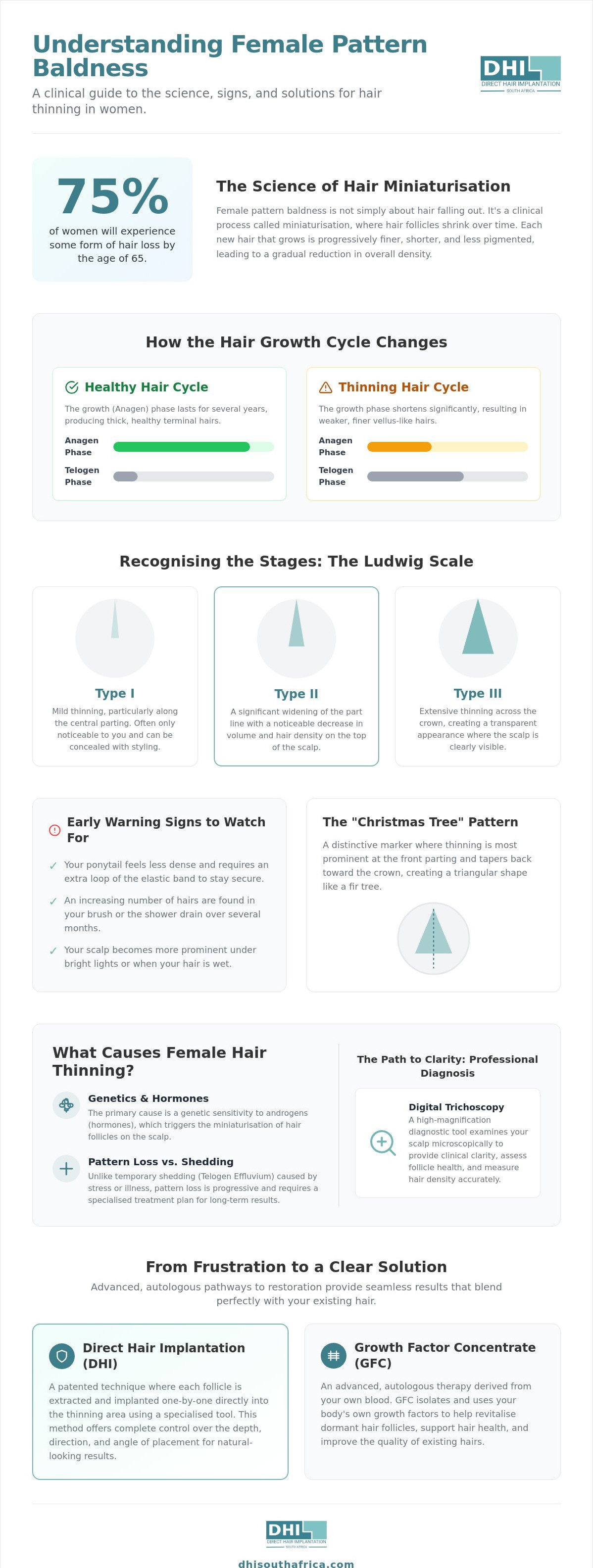
Think of your hair follicles as if they were in a relay race. The anagen phase is the active running part, which should last several years, whilst the telogen phase is the resting period where the hair eventually sheds to make room for a new strand. In cases of pattern hair loss, the "running" phase gets shorter and shorter. Each time a new hair grows back, it has had less time to develop, making it weaker than the one before.
This process is called miniaturisation. Follicles that once produced thick, vibrant hairs begin to produce strands that are finer, shorter, and less pigmented. Eventually, these follicles can become so small they stop producing visible hair altogether. It's a gradual shift that often goes unnoticed until a significant amount of density is already gone. Because the thinning is diffuse, you might only notice it when your ponytail feels lighter or your parting looks wider under bright lights.
The Biological Mechanism of Thinning
Follicles shrink over time due to specific hormonal sensitivities, particularly to androgens. As this happens, robust terminal hairs transform into vellus hairs. These are the soft, colourless "peach fuzz" strands you might notice in thinning areas. Early intervention is critical to rescue these follicles whilst they're still active. Once a follicle goes dormant for a long period, it's much harder to revitalise, making a timely, medical-grade approach essential for the best results.
Distinguishing Pattern Loss from Temporary Shedding
It's easy to confuse progressive pattern thinning with telogen effluvium, which is temporary shedding often triggered by surgery, high stress, or illness. Whilst temporary shedding usually resolves once the trigger is removed, pattern loss is progressive and requires a specialised hair loss treatment plan. We use digital trichoscopy, a high-magnification diagnostic tool, to examine your scalp at a microscopic level. This allows us to see what the naked eye cannot, providing you with the clinical clarity needed for true peace of mind.
Recognising the Stages: Identifying Your Pattern of Loss
Styling your hair should be a routine of self-care, yet for many, it becomes a stressful exercise in camouflage. If you've started noticing more scalp through your strands, it's natural to feel a sense of mounting anxiety. Moving toward a clinical understanding female pattern baldness requires looking at your hair through the same lens as a specialist. We don't rely on vague observations; we use established medical frameworks to pinpoint exactly where you are on the journey of loss.
One of the most distinctive markers we look for is the "Christmas Tree" pattern. This occurs when thinning is most prominent at the front of the hairline and tapers off as it moves toward the back of the crown. It creates a triangular shape that resembles the silhouette of a fir tree. To ensure clinical accuracy, we measure your density in hairs per square centimetre. This data-driven approach is vital for understanding female pattern baldness and creating a bespoke restoration plan.
The Ludwig Scale Breakdown
Clinicians use the Ludwig Scale to categorise the progression of loss into three distinct types. Type I involves mild thinning that might only be noticeable to you, often easily hidden with clever styling. Type II marks a significant widening of the part line and a visible decrease in volume. By Type III, the thinning is extensive across the top of the scalp, creating a transparent appearance where the skin is clearly visible.
Early Warning Signs to Watch For
Your ponytail requires an extra loop of the elastic to stay secure.
You find an increasing number of hairs in your brush or the shower drain over several months.
The scalp becomes prominent under bright bathroom lights or whilst your hair is wet.
According to MedlinePlus, Female pattern baldness usually doesn't result in total baldness, but the psychological impact of thinning can be profound. Identifying these signs early is the best way to protect your existing density and maintain your natural look. If these signs feel familiar, it's helpful to explore our hair loss resources to see how others have successfully navigated these stages.
Unpacking the Causes: Why Does Women’s Hair Thin?
Many women feel that thinning hair is an inevitable sign of ageing or a result of over-styling. However, understanding female pattern baldness requires a deeper look at your internal biology. The primary driver is often a sensitivity to androgens, which are hormones present in every woman's body. When these hormones interact with follicles that are genetically predisposed to sensitivity, the hair growth cycle begins to shorten. This isn't a personal failing or a sign that you've done something wrong; it's a physiological response dictated by your DNA.
Genetics play a significant role, but it's a common myth that you only inherit these traits from your father's side. In reality, the genetic blueprint for hair density can be inherited from either branch of your family tree. For a comprehensive overview of female pattern baldness, medical research indicates that these hereditary factors determine how your scalp responds to the hormonal shifts we all experience throughout life. Whilst pattern loss is the most common cause, we also see cases of traction alopecia, where tight hairstyles like braids or heavy extensions cause mechanical stress that leads to thinning around the hairline.
Hormones and the Ageing Process
Oestrogen is remarkably protective for hair, as it helps keep follicles in the anagen phase for longer periods. During life stages like menopause or the postpartum period, oestrogen levels drop or fluctuate significantly. This shift allows dihydrotestosterone (DHT) to exert more influence on the follicle, leading to the miniaturisation of the hair strand. This is why understanding hair loss through a medical lens is so vital. It allows us to address the chemical shifts happening beneath the surface of your scalp.
Lifestyle, Stress, and Nutritional Synergies
Your scalp doesn't exist in a vacuum, and your overall health directly impacts your hair's vitality. Factors such as iron deficiency or thyroid imbalances can often mimic the appearance of pattern loss or exacerbate existing thinning. We utilise a 360-degree approach to diagnosis, looking at the whole person rather than just the thinning areas. By identifying nutritional gaps or lifestyle stressors, we can ensure that your restoration plan is built on a foundation of total wellness. Understanding female pattern baldness as a manageable medical condition is the first step toward reclaiming your confidence and your hair's natural density.
Clinical Solutions: From Growth Factors to Direct Implantation
The transition from identifying thinning to actively treating it represents a significant shift in your restoration journey. Moving beyond topical high-street products requires understanding female pattern baldness as a medical condition that responds best to targeted, clinical interventions. We prioritise autologous therapies, which utilise your body’s own biological resources to stimulate the scalp. These pathways offer a sophisticated alternative to pharmaceutical-heavy approaches, focusing on long-term hair health and natural density, a standard also advocated by Hair Health Australia.
By deepening your understanding female pattern baldness, you can appreciate why generic solutions often fail to address the root of the problem. Clinical restoration is about precision. Whether we are waking up dormant follicles or meticulously placing new hairs, the goal is a seamless result that reflects your original hairline and volume. Our protocols are designed to be minimally invasive, ensuring your comfort whilst delivering world-class medical standards.
Non-Surgical Regeneration: GFC and PRP
Growth Factor Concentrate (GFC) represents a significant evolution of traditional PRP therapy. During this process, we extract a small amount of your blood and use advanced technology to isolate and concentrate specific growth factors. These concentrated proteins are then delivered directly to the scalp to "wake up" follicles in the telogen phase and increase the diameter of existing hair strands. Most patients begin to see visible improvements in density and texture after 3 to 4 sessions of specialised treatments, providing a non-surgical way to combat early-stage thinning.
The DHI Difference: Precision and Artistry
When thinning has progressed beyond the reach of non-surgical therapies, Direct Hair Implantation (DHI) offers the most advanced solution available globally. Unlike traditional methods that require creating pre-made slits or holes in the scalp, we use the patented DHI Implanter. This specialised tool allows our certified experts to have total control over the angle, depth, and direction of every hair placed. This level of precision is why we achieve a survival rate of over 90%, ensuring that your investment yields natural results that blend perfectly with your existing hair.
Because the DHI technique is so refined, the procedure involves no scalpels, no stitches, and leaves no linear scarring. You can return to your daily routine with minimal downtime, confident that your restoration is being handled by a "safe pair of hands" within a global network spanning 45 countries. This technique prioritises the health of the follicle, ensuring that every hair is handled with the meticulous attention to detail that medical-grade restoration requires.
Reclaiming Your Confidence: The Path to Restoration
Moving from the quiet anxiety of an online search to the proactive step of a clinical consultation is often the most empowering part of your journey. Understanding female pattern baldness is a vital foundation, but the true transformation begins when you apply that knowledge to your own unique scalp profile. We believe that hair restoration isn't just a cosmetic choice; it's a medical pathway to reclaiming the person you recognise in the mirror. You don't have to settle for thinning as an inevitable part of your story.
Our approach is built on the "Total Care System," a comprehensive protocol used by global leaders to ensure every patient receives a predictable, high-quality outcome. This system removes the guesswork from understanding female pattern baldness by providing transparent, data-driven insights into your specific condition. Whether you're dealing with early thinning or more advanced loss, the goal is always the same: a safe, artistic restoration that looks entirely natural. Many of our modern procedures are designed with your busy life in mind, offering minimal downtime that fits into your schedule with ease.
What to Expect During Your Consultation
Your journey starts with a detailed digital scalp analysis. This high-magnification diagnostic tool allows us to measure your exact hair density and identify the health of your existing follicles. During this session, a specialist will design a bespoke restoration plan, calculating the precise placement of hairs needed to achieve your desired density. We understand that privacy is paramount for our female patients. That's why we offer unshaven procedures as a standard option, allowing you to undergo restoration without any obvious signs that a procedure has taken place.
The DHI Global Standard in South Africa
Choosing a clinic is about finding a "safe pair of hands" you can trust implicitly. As part of a global network operating in 45 countries, we adhere to 18 mandatory safety checks and ISO-accredited protocols at every stage of your care. This rigorous attention to detail ensures that your health and your aesthetic results are never compromised. We combine the precision of a world-class medical institution with the warm, attentive care of a local specialist who understands your frustrations. We invite you to contact the team for a discreet, professional assessment to begin your path toward restoration.
Ultimately, hair restoration is about more than just the number of hairs we place. It's about the steady return of self-assurance and the freedom to style your hair without hesitation. By choosing a medical-grade solution, you're investing in a result that is designed to last a lifetime, supported by the genetic resistance of your own follicles. Take the first step today and move from searching for answers to experiencing a clear, clinical solution.
Your Journey Back to Natural Density
Gaining a clinical understanding female pattern baldness allows you to replace anxiety with a structured, medical-grade strategy for restoration. By focusing on the biological mechanism of miniaturisation and the regenerative power of autologous growth factors, you can move from temporary fixes to a permanent solution. You've learned that thinning is a manageable medical condition, and with the right expert guidance, your hair's volume and vitality can be reclaimed.
DHI has been a global pioneer in hair restoration since 1970, providing a "safe pair of hands" for patients across 45 countries. Every procedure is performed exclusively by certified medical specialists using our patented DHI technique, which ensures a hair survival rate exceeding 90%. This meticulous level of precision guarantees natural results that blend seamlessly with your existing hair, restoring the person you recognise in the mirror with absolute confidence.
You don't have to navigate the frustration of thinning hair alone. We're here to provide the world-class expertise and compassionate care you need to start your restoration journey today.
Frequently Asked Questions
Is female pattern baldness reversible or permanent?
While the genetic tendency remains, the visible effects are not necessarily permanent if you act early. Medical treatments like GFC or Regenera Activa can reverse the miniaturisation of follicles, effectively "waking them up" before they go dormant. Understanding female pattern baldness as a progressive condition is key; the earlier you intervene, the more existing density you can save and restore through clinical pathways.
How many hairs will I need to restore my density?
The number of hairs required is entirely unique to your stage on the Ludwig Scale. During a digital scalp analysis, we measure your current density to design a plan that might involve the placement of 2,000 to 4,000 hairs. This ensures the results blend seamlessly with your natural growth, providing the specific volume needed to close a widening part line or restore the crown area effectively.
Is the hair restoration procedure painful for women?
You shouldn't feel any pain during the procedure as we use a highly effective local anaesthetic. Most of our patients describe the experience as relaxing, often spending the time catching up on a favourite series or reading. Because our patented implanter tool is so precise, there's no need for scalpels or stitches, which significantly reduces post-procedure discomfort and ensures a smooth recovery process.
What is the difference between GFC and traditional PRP therapy?
Growth Factor Concentrate (GFC) is a more advanced, highly concentrated evolution of traditional PRP. While PRP uses your blood's platelets, GFC goes a step further by isolating the specific growth factors from those platelets before application. This results in a more potent, acellular treatment that delivers a higher "dose" of regenerative proteins directly to your follicles for superior density and hair diameter improvements.
Will I need to shave my head for a hair transplant?
You do not need to shave your head for a DHI procedure. We specialise in unshaven techniques specifically designed for women, where we work around your existing hair length. This allows you to maintain your current style throughout the process and return to your social or professional life without anyone knowing you've had a restoration procedure, ensuring total privacy and comfort.
How soon can I see results after a DHI procedure?
Patience is essential as your hair follows its natural biological rhythm. You will typically see the first signs of new growth around 3 to 4 months after your procedure. The density continues to improve significantly over the following months as the hairs thicken, with the final, polished results visible at the 12-month mark when the hairs have fully matured and reached their full potential.
Can hormone replacement therapy (HRT) stop female pattern hair loss?
HRT can be a helpful component in managing hair health, but it isn't always a complete solution on its own. While balancing oestrogen can slow down the impact of androgens on your follicles, it doesn't always "restart" follicles that have already begun miniaturising. Understanding female pattern baldness involves a multi-faceted approach, often combining hormonal management with direct regenerative therapies to achieve the best aesthetic outcome.
Are the results of a hair transplant permanent?
Yes, the results of a DHI hair transplant are designed to be permanent. We carefully select hairs from the "donor area" at the back of the scalp, which are genetically programmed to be resistant to the hormones that cause thinning. Once these hairs are successfully placed in the thinning areas, they retain this genetic resistance, continuing to grow naturally for a lifetime just as they did in their original location.


Comments