%20(1).jpg)
%20(1).jpg)
Causes of Sudden Hair Loss in Females Over 50: A Clinical Guide

You wake up and notice a cluster of strands on your pillow, or perhaps your hairbrush looks unusually full after a routine morning. For many women, seeing a wider part in the mirror or a sudden loss of density feels like a distressing loss of identity. It's a deeply unsettling experience that often leads to the same frantic question: why is this happening now? Understanding the causes of sudden hair loss in females over 50 is the first step toward regaining your confidence. While you might fear it's a permanent sign of illness, the reality is often linked to specific biological shifts that are entirely manageable with the right clinical expertise.
It's completely natural to feel anxious when your hair's volume seems to vanish overnight, and you aren't alone in wanting a clear, honest answer. We promise to help you decode the complex triggers behind rapid shedding, from hormonal fluctuations to nutrient deficiencies like low ferritin levels. This guide explores the difference between temporary shedding and progressive thinning; providing a clinical roadmap to help you understand your diagnosis. We'll look at modern diagnostic tools like digital trichoscopy, which is a high-definition microscopic analysis of your scalp, and explain how advanced restoration can reclaim your natural density.
Table of Contents
Understanding Sudden Hair Shedding vs. Gradual Thinning
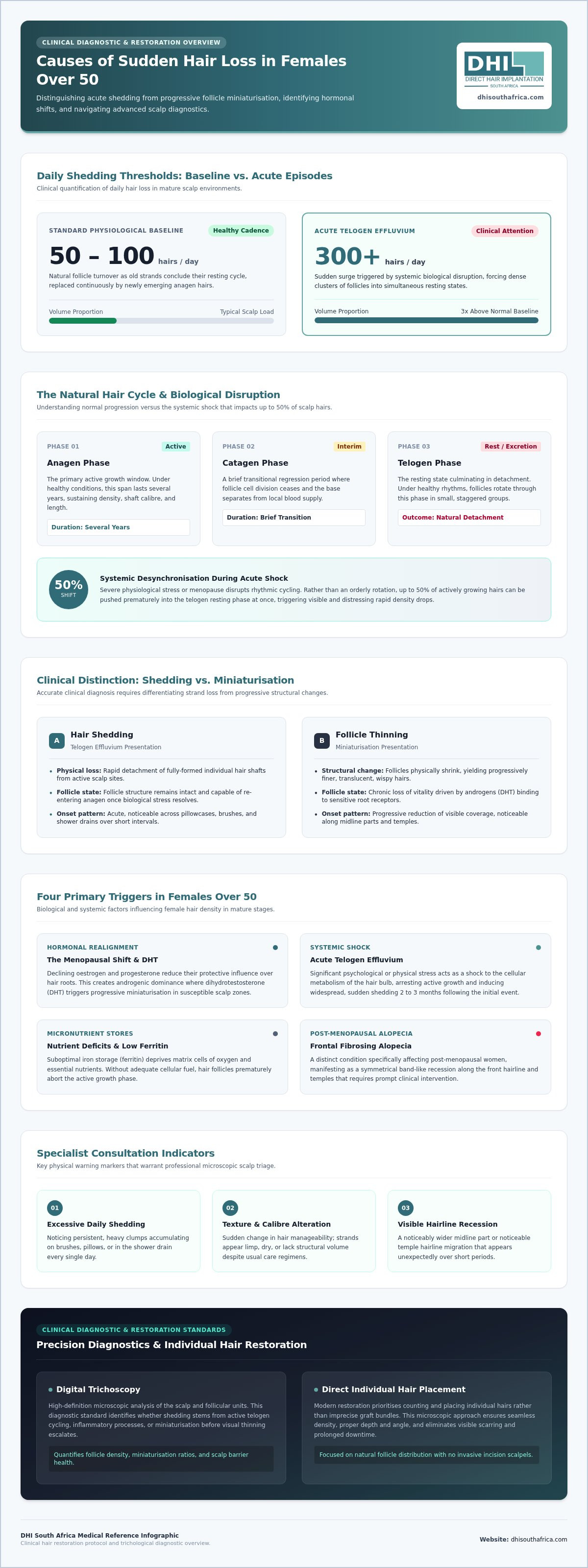
Noticing a few extra strands in your comb is normal, but finding clumps on your pillow is a different story entirely. Clinical research suggests that while a healthy scalp sheds between 50 and 100 hairs daily, acute episodes can see this number surge to 300 or more. This rapid shift often points toward telogen effluvium, a condition where a physiological shock forces a large percentage of follicles into the resting phase simultaneously. For women over 50, the psychological shock of this sudden change is often as taxing as the physical loss itself.
It's vital to distinguish between shedding and thinning. Shedding is the physical loss of the hair strand, whereas thinning, or miniaturisation, involves the follicle shrinking until it produces only fine, translucent hairs. For many women, these two processes occur simultaneously, making a professional hair loss diagnosis essential. Identifying the specific causes of sudden hair loss in females over 50 requires more than a glance in the mirror; it necessitates a clinical look at whether your hair is simply falling out or if the follicles themselves are losing their vitality.
To better understand how these hormonal shifts and shedding patterns interact, watch this helpful video from a specialist:
The Hair Growth Cycle Explained
Your hair follows a rhythmic life cycle that dictates its density and health. The anagen phase (the active growth window of the hair follicle) usually lasts several years, providing the length and volume you're accustomed to. This is followed by the catagen phase, a short transition period, and finally the telogen phase (the resting stage where the hair eventually sheds). When your system experiences a significant shift, such as menopause or extreme stress, it disrupts this cadence. Instead of a staggered rotation, up to 50% of your hairs can be pushed into the shedding phase at once, resulting in visible, rapid density loss.
Signs You Should Consult a Specialist
Early detection is your most powerful tool for restoration. You might notice your ponytail feels thinner when you wrap an elastic around it, or perhaps your part line looks wider under bathroom lighting. These physical markers are signals from your body that should not be ignored. Common signs include:
Excessive shedding: Finding large amounts of hair in the shower drain or on your hairbrush every single day.
Texture changes: A sudden change in hair "manageability" or a limp, dull appearance that doesn't respond to usual products.
Visible recession: A receding hairline or thinning at the temples that appears almost overnight.
If you recognise these indicators, seeking a precise, microscopic analysis of your scalp health is the most effective way to secure your hair's future. Modern diagnostics can pinpoint exactly why the cycle has been interrupted, allowing for a targeted, professional solution.
The Menopausal Shift: Why Hormones Trigger Hair Loss After 50
Reaching the milestone of 50 often brings a significant physiological shift as the body transitions through menopause. For many, this hormonal restructuring is one of the primary causes of sudden hair loss in females over 50. Whilst we often focus on hot flushes or sleep disturbances, the impact on hair density is rooted in the declining levels of oestrogen and progesterone. These hormones act as a protective shield for your hair follicles, keeping them in the active growth phase for longer periods. When these levels drop, the delicate balance shifts, allowing androgens, or male hormones, to exert a greater influence on the scalp.
This androgenic dominance is primarily driven by dihydrotestosterone (DHT). In genetically sensitive follicles, DHT binds to receptors and triggers a process of shrinkage. It's also common for thyroid fluctuations to occur during this life stage, which can complicate the clinical picture by causing diffuse thinning. Understanding these clinical causes of hair loss is essential because it helps distinguish between a temporary reaction and a permanent change in hair architecture. Without the buffering effect of female hormones, follicles that were once robust begin to struggle.
Hormonal Miniaturisation
As the protective effects of oestrogen wane, follicles undergo miniaturisation. This means each new hair produced is slightly finer, shorter, and less pigmented than the one before. Eventually, the hair becomes so thin that it fails to cover the scalp effectively. This leads to the "transparent" scalp effect, where skin becomes visible through the strands, particularly under bright light. This isn't a problem that a standard volumising shampoo can resolve. To truly address the root of the issue, a specialised female hair loss treatment is required to revitalise those shrinking follicles before they stop producing hair altogether.
Post-Menopausal Hair Health
Once hormone levels eventually stabilise, the focus shifts from panic to preservation. It's a common misconception that all post-menopausal hair loss is an inevitable part of ageing. Whilst pattern loss is progressive, early intervention can often halt the miniaturisation process and even restore lost density. Professional triage helps determine if you're experiencing temporary shedding or the onset of female pattern hair loss, which affects over 52% of postmenopausal women. If you've noticed your part widening, exploring a digital scalp analysis can provide the clinical clarity needed to choose a restorative path forward.
Telogen Effluvium: How Stress and Lifestyle Impact the Hair Cycle
While hormonal shifts are a significant factor, they often mask other underlying causes of sudden hair loss in females over 50. One of the most frequent clinical diagnoses in this age group is telogen effluvium. This condition occurs when a significant "shock to the system" prematurely pushes a large percentage of hairs into the telogen (resting) phase. Unlike the gradual miniaturisation seen in pattern thinning, this is a reactive process that leads to diffuse shedding across the entire scalp.
A unique and often confusing aspect of this condition is the "three-month delay". Because of the way the hair cycle functions, visible shedding usually manifests 60 to 90 days after the triggering event. This means that the clumps you see today might be the result of a severe illness, a major surgery, or a period of intense psychological stress that occurred months ago. Identifying these triggers requires a methodical look back at your recent health history to distinguish temporary shedding from the more permanent process of treating female pattern hair loss.
Nutritional Deficiencies and Hair Density
In South Africa, lifestyle factors and dietary choices can often mimic or exacerbate age-related thinning. For women over 50, iron stores (measured as serum ferritin) are a critical biomarker for hair health. If your ferritin levels drop below 50 ng/mL, your follicles lack the energy required for active regeneration. Vitamin D and B12 deficiencies are also common amongst health-conscious women who may have transitioned to more restrictive diets. "Crash dieting" or rapid weight loss, often pursued to manage mid-life metabolic changes, can deprive the scalp of essential amino acids, triggering an acute shedding episode that catches many by surprise.
Medication-Induced Shedding
As we age, it's common to begin new prescriptions for blood pressure, cholesterol, or even thyroid management. Some of these medications can inadvertently interfere with the hair's growth cycle. If you've started a new regime and notice a sudden change in hair density several weeks later, it's wise to investigate a potential link. It's essential to consult your doctor before altering any prescribed medication; however, bringing these concerns to a hair restoration specialist can help you determine if the loss is a side effect or a separate clinical issue. A professional scalp analysis can often provide the data your GP needs to adjust your treatment plan safely.
Identifying Frontal Fibrosing Alopecia and Pattern Thinning
While telogen effluvium is a common reaction to stress, some causes of sudden hair loss in females over 50 are more structural and permanent. Frontal Fibrosing Alopecia (FFA) is a primary cicatricial, or scarring, alopecia that predominantly affects women in the post-menopausal stage. It isn't merely a phase of shedding; it's an autoimmune response where the body's immune system attacks the hair follicles. Once the follicle is destroyed, it's replaced by fibrotic scar tissue, making early diagnosis vital for preservation.
FFA typically presents as a "receding headband" look. You might notice your hairline slowly moving backwards, leaving behind smooth skin where hair once grew. This condition affects roughly 1 in 50 postmenopausal women and often features the "lonely hair sign." This is where isolated terminal hairs remain scattered along the receded frontotemporal area. Unlike standard thinning, which leaves dormant follicles behind, FFA effectively closes the door on natural regrowth in the affected zones. This makes it one of the more urgent causes of sudden hair loss in females over 50 to address clinically.
The Symptoms of FFA
Early warning signs often appear long before the hairline begins its retreat. Many women report a partial or total loss of their eyebrows as the first indicator. You might also notice subtle skin changes, such as slight redness or inflammation around the base of the remaining hairs. Because this condition involves active inflammation, seeking medical hair restoration expertise is essential to stabilise the scalp before considering any restorative procedures.
FPHL vs. Sudden Shedding
It's important to distinguish these inflammatory conditions from Female Pattern Hair Loss (FPHL). While sudden shedding happens all at once, FPHL is a progressive miniaturisation of the follicles. It often follows a "Christmas Tree" pattern, where thinning is most visible along the central part and widens toward the front. The advantage of FPHL is that the hairs in the "donor zone" at the back of the head usually remain genetically resistant to thinning. This provides a stable source of follicles for restoration if the density in other areas becomes too low to manage.
Clinical Restoration: Modern Solutions for Female Hair Density
Finding a path back to your natural density requires moving beyond topical cover-ups and temporary fixes. Once a specialist identifies the specific causes of sudden hair loss in females over 50, the focus shifts to high-precision clinical intervention. Today's advanced hair loss solutions prioritise both medical efficacy and patient privacy. One of the most significant breakthroughs for women is the "Unshaven" Direct Hair Implantation protocol. This allows for the meticulous placement of hairs between existing strands, meaning you can achieve significant restoration without the need to shave your head or undergo visible scalp incisions.
Direct Hair Implantation stands as the gold standard for women who value a discreet journey. It's a patented method that eliminates the need for traditional scalp slits, ensuring the recovery is as seamless as the result. By focusing on the biological triggers we've discussed, such as hormonal shifts or telogen effluvium, we can pair surgical precision with biological stimulation. This multi-modal approach doesn't just replace lost volume; it works to revitalise the entire scalp environment, ensuring your results are built to last a lifetime.
Non-Surgical Revitalisation
Non-invasive treatments often serve as the first line of defence, especially when thinning is in its early stages. These options focus on biological stimulation rather than surgical replacement, making them ideal for women who want to thicken their existing hair without downtime. These solutions include:
GFC Therapy (Growth Factor Concentrate): This advanced protocol uses a highly concentrated preparation of your own growth factors to re-energise dormant follicles and boost scalp health.
PRP Therapy: A foundational treatment that improves circulation and encourages follicles to remain in the anagen (growth) phase for longer periods.
Regenera Activa: A specialised autologous micro-tissue technique that uses healthy cells to revitalise areas affected by hormonal miniaturisation.
The DHI Technique for Women
When density loss is more advanced, Direct Hair Implantation offers the most controlled and natural-looking result available. This patented technique uses a single-step implantation tool that gives the specialist total control over the angle, depth, and direction of every hair placed. Because donor hairs are often a limited resource in female patients, the survival rate is paramount. DHI consistently achieves a hair survival rate of >90%, which is significantly higher than the industry average of 50-60%. This ensures that every hair harvested is placed with intent, creating a seamless result that blends perfectly with your natural growth pattern. The journey from a clinical diagnosis to permanent restoration is methodical, unhurried, and focused entirely on restoring your self-assurance.
Securing the Future of Your Hair Health
Sudden thinning doesn't have to be a permanent part of your story. By identifying the specific causes of sudden hair loss in females over 50, you move from a place of uncertainty to a structured clinical path. Whether your shedding is triggered by the menopausal shift or acute telogen effluvium, modern restoration techniques ensure that you don't have to settle for anything less than total confidence. Diagnosis is the first step toward reclaiming your density and self-assurance.
As global leaders with over 75 clinics worldwide, we combine world-class expertise with a patient-centric approach. Every procedure is performed by certified medical doctors to ensure the highest standards of safety and artistry. With a 99% customer satisfaction rate, our focus remains on delivering life-changing results through precise, microscopic care. You aren't just another patient; you're an individual seeking a permanent, natural solution.
You deserve a solution that is as unique as your own biology. Take the first step toward restoration today and rediscover the density you thought was lost. Our experts are ready to guide you through a personalized journey back to the hair you love.
Frequently Asked Questions
Is sudden hair loss in women over 50 normal?
While thinning affects roughly 40% of women by age 50, a sudden surge in shedding is usually a signal of an underlying physiological shift rather than a standard byproduct of ageing. It often points to specific triggers like hormonal restructuring or nutritional gaps. Understanding the causes of sudden hair loss in females over 50 is essential for distinguishing between temporary shedding and progressive thinning that requires professional clinical intervention.
Can menopause cause hair loss to happen suddenly?
Yes, the precipitous drop in oestrogen and progesterone during menopause can trigger rapid changes in hair density. These hormones act as a protective shield for follicles; without them, androgens like DHT cause miniaturisation. This often results in a "transparent" scalp effect where skin becomes visible through the hair. Because these shifts happen relatively quickly, the resulting loss can feel sudden and distressing, requiring medical-grade solutions to revitalise dormant follicles.
Will my hair grow back after sudden shedding?
Regrowth depends entirely on the specific clinical diagnosis. If the shedding is caused by telogen effluvium, which is a reactive shedding phase, the hair typically returns once the trigger is resolved. However, if the cause is androgenetic alopecia or a scarring condition like FFA, the loss may be permanent without restoration. Early diagnostic triage, such as a digital scalp analysis, is vital to determine if your follicles are resting or permanently shrinking.
How much hair loss is considered "sudden" or excessive?
Clinical thresholds define excessive shedding as losing more than 125 hairs per day. While humans naturally shed 50 to 100 hairs daily, a sudden surge to 300 or more is a clear indicator of a disrupted growth cycle. If you notice clumps in the shower or a significantly wider part line appearing over a few months, it's considered an acute episode. This warrants a professional consultation to identify the specific biological trigger involved.
What vitamins should a 50-year-old woman take for hair loss?
Supplementation should focus on proven deficiencies identified through blood tests rather than generic multivitamins. Serum ferritin is critical, with targets for hair health often set at 50 to 70 ng/mL. Vitamin D and B12 are also essential for follicular energy. However, vitamins alone rarely fix complex causes of sudden hair loss in females over 50. We recommend a Total Medical Hair Restoration report to ensure your nutritional regime supports active regeneration.
Is a hair transplant suitable for women with thinning hair?
Direct Hair Implantation is highly suitable for women, provided there is sufficient density in the donor zone. The DHI technique is particularly effective because it uses an "unshaven" protocol, allowing us to place hairs between existing strands without visible scarring or the need to shave the head. With a survival rate of >90%, it offers a permanent, natural solution for those who have not responded to non-surgical revitalisation or medical treatments.
What is the difference between shedding and thinning?
Shedding refers to the physical falling out of the hair strand, often resulting in noticeable clumps. Thinning, or miniaturisation, is the process where the follicle itself shrinks, producing finer and shorter hairs until it eventually stops growing. While shedding is often temporary and reactive, thinning is usually progressive and genetic. Both conditions require distinct clinical approaches, which is why a high-definition microscopic analysis of the scalp is necessary for a correct diagnosis.
Can stress cause permanent baldness in women?
Stress typically causes telogen effluvium, which is a temporary, reversible shedding of hair. However, prolonged psychological or physical stress can exacerbate underlying genetic thinning, potentially leading to a permanent reduction in density if left untreated. It's also a known trigger for certain autoimmune conditions. Managing stress is important, but clinical treatments like GFC or PRP are often needed to "kickstart" the follicles back into the anagen phase, the active growth window.


Comments