%20(1).jpg)
%20(1).jpg)
Hairline Lowering Surgery: A Clinical Guide to Restoring Facial Harmony

What if the most common solution for a high forehead actually leaves you with a permanent reminder you'd rather hide? For many, the desire to lower a receding or naturally high hairline is about more than just aesthetics. It's about reclaiming a sense of self-assurance that has been tucked away behind carefully styled fringes for years. If you've spent time researching hairline restoration South Africa, you've likely felt the tension of choosing between a surgical procedure that might leave a linear scar and the anxiety of results that look "pluggy" or unnatural.
We understand that the decision to alter your facial profile is significant. You deserve a solution that prioritises both medical safety and artistic precision. In this clinical guide, we'll explore the nuanced differences between traditional surgical excision and the advanced Direct Hair Implantation technique. You'll discover how the meticulous placement of individual hairs can create a seamless, dense hairline that looks entirely your own. We will also examine how to achieve permanent facial harmony with minimal downtime, ensuring your journey to a balanced profile is as comfortable as the final result is beautiful.
Table of Contents
Hairline Lowering Surgery: Defining Facial Harmony and Proportions
Facial beauty isn't defined by a single feature but by the relationship between them. Clinical aesthetics often rely on the "rule of thirds" to assess this balance. This principle suggests that a harmonious face is divided into three equal horizontal sections. The lower third spans from the chin to the base of the nose; the middle third from the nose to the eyebrows; and the upper third from the eyebrows to the hairline. When the upper third is disproportionately large, it can dominate your profile, often making the forehead appear overly prominent and drawing attention away from your eyes.
The Science of Facial Proportions
In a clinical setting, the ideal distance between the glabella (the area between your eyebrows) and the hairline typically ranges from five to seven centimetres. Genetics often dictate this starting point, but external factors like traction alopecia, which is hair loss caused by persistent tension on the follicles, can gradually shift the hairline upwards. This change often happens slowly, yet the impact on your daily confidence is significant. Many patients tell us they feel limited to specific hairstyles or feel exposed in professional environments. Restoring these proportions is about more than just moving a line; it's about recreating a natural frame that complements your unique bone structure.
Why Patients Seek Hairline Refinement
Common triggers for seeking refinement include naturally high genetic hairlines or receding temples that have altered the face's original contour. By lowering the hairline, we can soften facial features and provide a more refreshed, youthful look. This is a vital consideration for those exploring female hair loss treatment, where the goal is often to restore a delicate, feminine curve to the forehead. A well-positioned hairline acts as a focal point that brings the rest of the face into focus, allowing your natural features to shine without distraction.
When investigating hairline restoration South Africa, you'll find two primary clinical paths. The first is surgical forehead reduction, an invasive procedure involving the excision of a strip of skin and the physical advancement of the scalp. The second is hair transplantation, a non-surgical alternative that builds density hair by hair. While both techniques aim to lower the hairline, they offer very different experiences regarding recovery and the final aesthetic result. Achieving a successful hairline restoration South Africa requires an understanding of how each technique interacts with your unique facial anatomy to create lasting harmony.
Forehead Reduction vs. Hair Transplantation: Comparing the Two Methods
When you're considering hairline restoration South Africa, the first major decision is choosing between a scalp advancement surgery and a modern hair transplant. Both techniques aim to reduce the height of the forehead, but they approach the problem from opposite directions. One removes skin to move the hair, while the other adds hair to cover the skin. Understanding these mechanics is vital for anyone who fears unnatural results or visible surgical marks. It's about finding the path that offers the most seamless transition for your specific facial structure.
Surgical Forehead Reduction (Excision)
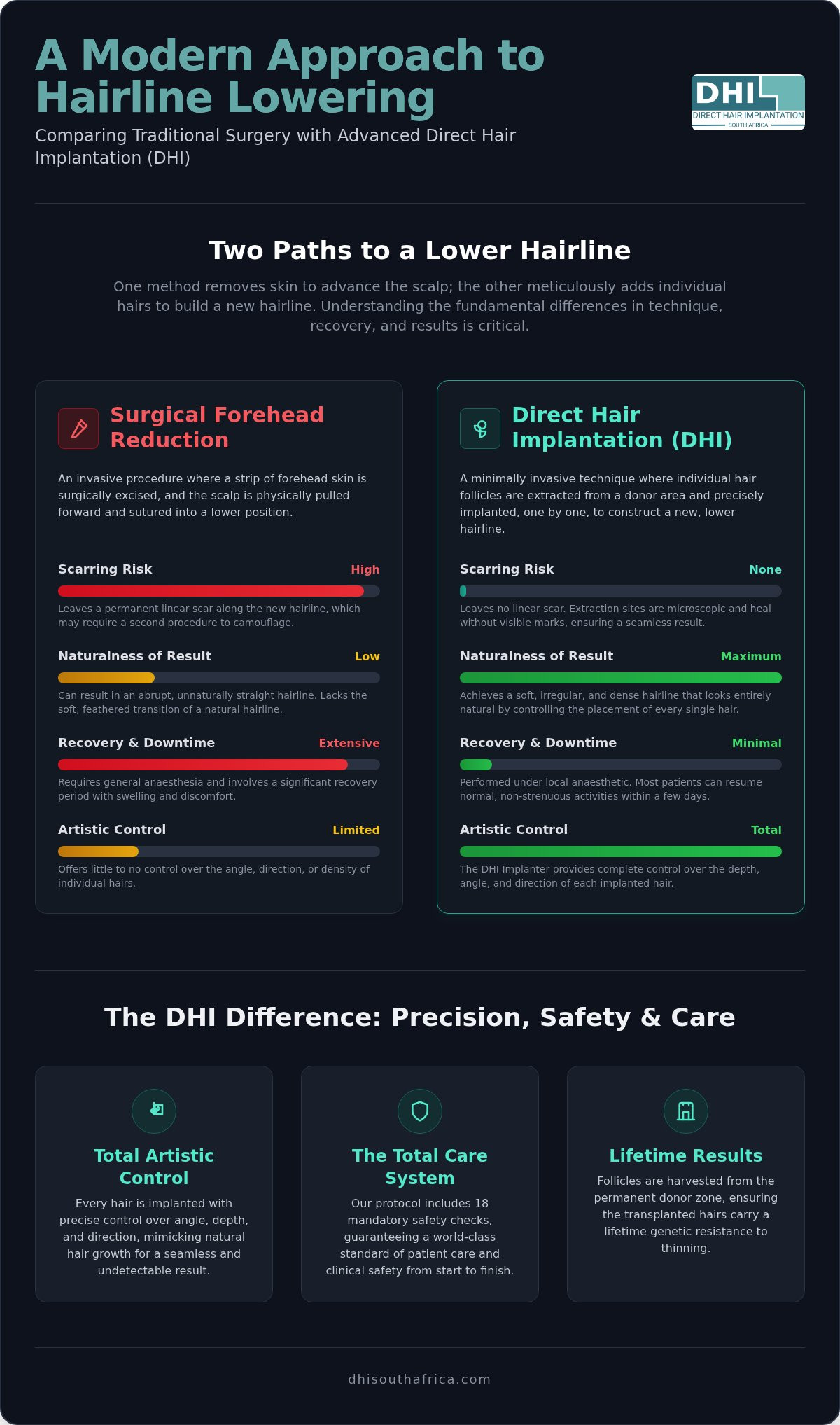
Surgical forehead reduction is an invasive procedure that requires a surgeon to make a long incision along the top of the forehead, often called a pretrichial incision. By removing a horizontal strip of non-hair-bearing skin, the scalp is physically stretched forward and sutured into place. While this offers an immediate change in the hairline's position, it comes with the weight of general anaesthesia and a lengthy recovery period. The primary concern for many is the permanent linear scar. If the hair doesn't grow through the scar tissue effectively, the mark remains visible, often requiring a secondary transplant anyway to camouflage the surgical line.
Hairline Lowering via Hair Transplantation
In contrast, hairline lowering via transplantation is a meticulous, artistic process that builds density where it's needed most. Instead of shifting the entire scalp, we harvest individual hairs from the permanent donor zone at the back of the head. These hairs are then placed one by one into the forehead region to create a new, lower border. This method excels at filling in the temples and creating a soft, irregular transition that mimics nature perfectly. Because we use local anaesthesia, you're awake and comfortable throughout the session. There are no stitches, no linear scars, and the "lunch-hour" convenience means you can return to your routine much faster than with excision surgery.
Which Method is Right for You?
Deciding which path to take involves assessing your scalp laxity and the specific density you desire. Surgical advancement is limited by how much your skin can naturally stretch, whereas transplantation allows for total control over the new hairline's shape and height. It's a sophisticated choice for those seeking a permanent, natural-looking change without the trauma of a scalpel. To explore your options further, it's helpful to read our guide on medical hair restoration South Africa. We also encourage you to book a professional consultation to receive a personalised assessment of your hair density and scalp health.
The Art of the Natural Hairline: Why DHI Precision Matters
While traditional excision focuses on skin removal, Direct Hair Implantation (DHI) shifts the focus to the individual follicle. It's the most sophisticated approach for those seeking hairline restoration South Africa. The goal isn't just to lower the line; it's to ensure that the new border is indistinguishable from the original. This level of realism depends on three fundamental pillars: angle, depth, and direction. Without total control over these variables, results can look "pluggy" or unnatural, which is a common anxiety for many patients.
Angle refers to the degree at which the hair exits the scalp. Depth ensures the follicle is placed perfectly within the dermis for long-term health. Direction determines how the hair flows alongside its neighbours. By mastering these, our doctors create a result that moves and styles exactly like your natural hair. Because follicles are harvested from the permanent donor zone, these transplanted hairs carry a lifetime genetic resistance to thinning, providing a permanent solution to a high forehead.
The Patented DHI Implanter Advantage
The secret to this level of control is the patented DHI Implanter. Unlike traditional methods that require the doctor to create "reception holes" or incisions before placing the hair, the DHI Implanter allows for a single-step process. This tool allows the doctor to place each hair with absolute precision, controlling the exit angle to within a fraction of a degree. By eliminating the need for prior incisions, we significantly minimise trauma to the scalp. This refined approach is why we achieve a hair survival rate of over 90%, which is considerably higher than the industry average of 50 to 60 per cent. It's a safer, more efficient way to achieve density.
Artistic Design and Density
Creating a natural hairline requires an eye for detail. We use a "feathering" technique at the very front, placing single, finer hairs in an irregular pattern to avoid a harsh, straight line. Behind this soft border, specialists carefully organise the placement of 2,000 to 4,000 hairs to build the necessary density. This layering effect ensures that the transition from forehead to hair is gradual and seamless. You can learn more about the technical methodology in our deep dive on Direct Hair Implantation: The Science of Natural Hair Restoration. This combination of medical rigour and artistic vision is what defines a world-class hairline restoration South Africa result.
Understanding the Patient Journey: Consultation, Procedure, and Recovery
Embarking on a journey to lower your hairline is a significant decision that requires more than just technical skill. We prioritise your peace of mind by adhering to the DHI Total Care System. This is a comprehensive medical protocol that governs every aspect of our practice to ensure consistency and safety. Central to this system are 18 mandatory safety checks. These checks cover everything from follicle handling to sterile environment protocols. It's this level of clinical rigour that has earned us a 99 per cent customer satisfaction rate globally, providing a "safe pair of hands" for your hairline restoration South Africa.
The Clinical Consultation and Diagnosis
Your path begins with a detailed diagnostic assessment. We don't just look at where you want your hairline to be; we look at the long-term stability of your hair. Using a specialised 9-angle photographic series, we document your profile to plan the most natural-looking restoration. It's vital that your hair loss has stabilised to ensure the results remain harmonious as you age. Every procedure at our clinic is performed from start to finish by certified medical doctors. We never delegate the delicate task of implantation to technicians, as the artistry of your results depends entirely on a physician's expertise.
Procedure Day and the Healing Phase
On the day of your hairline restoration South Africa, you'll find the experience surprisingly relaxed. Because the DHI technique is minimally invasive, it has a "lunch-hour" feel that sets it apart from traditional surgery. You can listen to music or chat with our team whilst we work. There are no stitches, no scalpels, and no visible linear scars to worry about. Most patients feel comfortable returning to their social or professional lives within a day or two, thanks to the lack of significant downtime.
The recovery timeline is a process of patience and transformation. Shortly after the procedure, the transplanted hairs will enter the telogen phase (a resting window for the hair follicle) and shed. This is a natural part of the cycle. The follicles remain healthy beneath the surface, and you'll begin to see permanent, new growth around the three-month mark. Full density is typically achieved by 12 to 18 months. Our commitment doesn't end when you leave the clinic; we provide structured post-procedure monitoring for up to 18 months to track your progress and ensure you're delighted with your new profile.
Hairline Lowering: Expert Advice and Candidacy
Determining whether you're a suitable candidate for hairline lowering is the first step toward reclaiming your facial harmony. While the desire for a more balanced profile is the starting point, a successful outcome depends on specific clinical factors. We look for a healthy "donor zone" at the back and sides of the head, as these hairs provide the foundation for your new hairline. Patients experiencing early-stage androgenetic alopecia often see the most transformative results, as we can proactively restore density before significant recession occurs.
Evaluating Your Candidacy
Scalp health is a primary consideration in our assessment. We evaluate the elasticity and density of your existing hair to ensure that moving follicles from one area to another will result in a seamless, natural look. It's a common misconception that hairline restoration South Africa is exclusively for men. In reality, many women seek our expertise to correct a naturally high forehead or to address thinning at the temples. Whether your goal is to soften your features or to lower a receding border, our doctors provide a candid evaluation of what can be achieved based on your unique physiology.
The DHI Commitment to Excellence
Choosing DHI South Africa means placing your trust in a global pioneer with over 50 years of specialised experience. We don't just follow industry standards; we set them through our ISO-accredited protocols and the DHI Total Care System. Our commitment to your safety is reflected in our use of single-use, titanium-coated instruments. These precision tools ensure maximum hygiene and minimal trauma to the scalp during the implantation process. This meticulous attention to detail is why we maintain a 99 per cent customer satisfaction rate across our global network.
Restoring your confidence is an artistic endeavour supported by world-class science. We invite you to take the next step in your journey by experiencing a professional clinical scalp analysis. This is an opportunity to discuss your aesthetic goals with an expert who understands the nuances of facial proportions and hair biology. You can view our patient results to see the life-changing impact of our work, or book your consultation today to begin your own transformation with the leaders in hairline restoration South Africa.
Reclaiming Your Natural Profile
Achieving a balanced facial profile is a precise medical journey that requires both scientific rigour and artistic vision. We've explored how modern hairline restoration South Africa has moved beyond the limitations of traditional excision surgery. By choosing a path that prioritises the meticulous placement of individual hairs, you avoid the trauma of linear scars whilst ensuring a dense, natural result that complements your unique features.
When you partner with our team, you gain access to a global network with over 50 years of clinical expertise. Every procedure is performed exclusively by our certified medical doctors, ensuring you receive the highest standard of care at every stage. Our patented technique delivers a hair survival rate of over 90 per cent, providing a permanent solution that restores your self-assurance for years to come.
You don't have to settle for feeling self-conscious about your forehead. A more harmonious version of yourself is within reach, delivered with the calm precision of world-class experts. We're here to help you start this transformation today.
Frequently Asked Questions
Is hairline lowering surgery permanent?
Hairline lowering via the DHI technique is a permanent solution because the follicles are harvested from the genetically stable donor area at the back of the head. These transplanted hairs retain their resistance to thinning for a lifetime, ensuring your new profile remains consistent. Unlike temporary fixes, this medical procedure provides a lasting change to your facial proportions, provided you follow the recommended long-term hair maintenance advice from our clinical experts.
How many hairs are typically needed for a hairline lowering procedure?
A typical hairline restoration South Africa procedure requires between 2,000 and 4,000 hairs to achieve optimal density and a natural look. The exact number depends on the height of your forehead and the specific thickness of your existing hair. During your clinical assessment, a certified doctor will meticulously map out the required density to ensure the new hairline blends seamlessly with your original hair, creating a frame that suits your facial structure.
What is the main difference between forehead reduction surgery and a hair transplant?
The primary difference lies in the methodology; surgical forehead reduction involves physically removing a strip of skin to advance the scalp, whereas a hair transplant builds a new border hair-by-hair. While surgery offers an immediate shift, it leaves a permanent linear scar and requires invasive cutting. DHI provides a non-surgical alternative that creates a soft, feathered transition without the need for scalpels, stitches, or significant downtime.
Will there be a visible scar along my new hairline?
There is no visible linear scar when you choose Direct Hair Implantation, as the procedure does not involve incisions or sutures. We use a patented DHI Implanter to place each hair individually, which minimises trauma to the scalp and allows for rapid healing. This approach is specifically designed to avoid the tell-tale surgical marks often associated with traditional excision methods, resulting in a completely discreet and natural restoration.
How long is the recovery period before I can return to work?
Most patients feel comfortable returning to their professional and social routines within one to two days after the procedure. Because the technique is minimally invasive and performed under local anaesthesia, there is no significant downtime or surgical fog to overcome. You might experience some minor redness or swelling in the treated area, but this typically subsides quickly, allowing for a discreet and efficient recovery that fits into a busy schedule.
Can men undergo hairline lowering surgery to fix a high forehead?
Does the procedure require general anaesthesia?
No, the DHI procedure is performed under local anaesthesia, ensuring you remain awake and comfortable throughout the session. This eliminates the risks and lengthy recovery times associated with general anaesthesia used in traditional forehead reduction surgery. Patients often describe the experience as relaxed, frequently listening to music or chatting with our medical team whilst their new hairline is meticulously crafted hair-by-hair with absolute clinical precision.
When will I see the final results of my hairline lowering?
You will see the final, dense results of your hairline restoration approximately 12 to 18 months after the procedure. While new growth begins to emerge around the three-month mark, it takes time for the hairs to mature and reach full thickness. We provide structured monitoring throughout this period to track your progress and ensure that every hair is growing exactly as planned for a perfect and harmonious aesthetic outcome.


Comments