%20(1).jpg)
%20(1).jpg)
Hair Transplant Success Rates: The Clinical Science of Permanent Results in 2026

Did you know that in the broader hair restoration industry, as many as four out of every ten transplanted hairs may never actually grow? While the global demand for restoration is surging, many patients are shocked to learn that standard hair transplant success rates often hover between 50% and 60% for follicle survival. It's a sobering reality for anyone worried about wasting their limited donor follicles or ending up with an unnatural, "pluggy" result that fails to meet expectations.
You're likely looking for a solution that doesn't just fill a gap but restores your confidence permanently. It's completely normal to feel anxious about the procedure failing or the results looking artificial. In this guide, we will explore the medical data and technical factors that determine hair transplant success, from follicle survival rates to long-term aesthetic density. We'll examine the difference between biological survival and aesthetic success, giving you the clarity needed to make an informed investment in your future self.
Table of Contents
What Defines Hair Transplant Success Rates?
Losing your hair can feel like losing a part of your identity. It's a deeply personal experience that often leads to a search for clinical certainty. When we discuss hair transplant success rates, we're looking at more than just a biological percentage. True success is the intersection of medical science and artistic precision. It's about ensuring that the investment you make today results in a look that is both permanent and undetectable.
This permanence is possible because of a principle called "Donor Dominance." Essentially, hairs taken from the back and sides of your head are genetically resistant to the hormone (DHT) that causes thinning. By utilising various hair transplantation techniques, doctors can move these hardy follicles to thinning areas where they'll continue to grow for a lifetime. However, the survival of these hairs depends heavily on how they're handled during the procedure.
To better understand how these results manifest in real-world scenarios, watch this helpful video:
Follicle Survival vs. Aesthetic Success
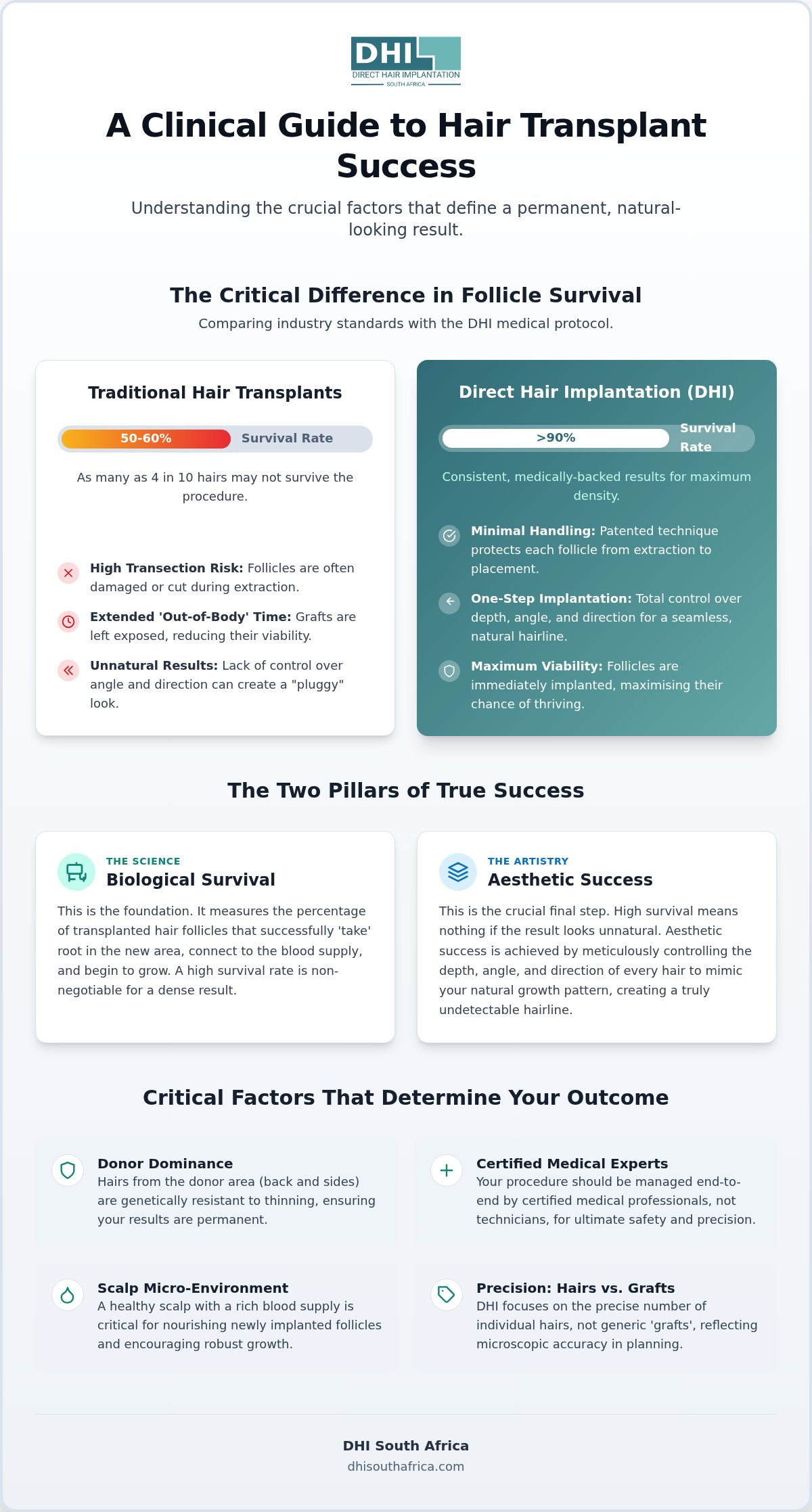
A high follicle survival rate is the foundation of a good result, but it's only half the story. You could have high survival, but if the hairs are placed at the wrong angle or in a "pluggy" pattern, the procedure hasn't truly succeeded. Aesthetic success depends on the meticulous control of the depth, direction, and angle of every single hair. We focus on creating natural density that mimics your original hair growth pattern. This ensures the transition from your forehead to your new hairline is completely seamless, avoiding the artificial look often associated with older methods.
The Industry Standard: Why 50-60% is No Longer Enough
For many years, the industry accepted that a large portion of moved hairs simply wouldn't survive the journey. Traditional methods often involve significant handling of the delicate follicles, leading to hair transplant success rates that sometimes hover around 50% or 60%. One major culprit is transection. Transection is the accidental damage or cutting of hair follicles during the extraction process, which renders them unable to grow. Modern patients should expect far better outcomes. At DHI South Africa, our protocols aim for survival rates above 90%, because we believe every hair is a precious resource that shouldn't be wasted through outdated handling or the use of unsupervised technicians.
The Biological Factors Influencing Hair Survival
Technical precision is only half the battle. Your body's biological response is the other silent partner in determining the final outcome. For a follicle to thrive, it needs a receptive environment rich in oxygen and nutrients. This is why blood supply to the scalp is so critical. If the local circulation is compromised, even the most perfectly placed hairs will struggle to "take" and establish a permanent root. Factors like smoking or poor nutrition can significantly hinder this healing process by restricting blood flow and slowing down cellular repair. We always encourage patients to view their procedure as a partnership between our clinical expertise and their own physical health.
The Importance of the Scalp Micro-Environment
Think of your scalp as the soil and the hair follicles as the seeds. If the soil is depleted, the seeds won't grow to their full potential. This is why we often recommend preparing the area with GFC (Growth Factor Concentrate) treatment. This protocol uses your own blood's growth factors to revitalise the scalp environment before surgery, essentially "pre-heating" the engine for better follicle survival. Adopting such a holistic approach is a cornerstone of medical hair restoration south africa. When the scalp is healthy and well-nourished, hair transplant success rates naturally climb because the follicles spend less time in a stressed state. If you're curious about how your scalp health might impact your journey, it's worth exploring our range of specialised hair treatments to ensure you're starting from the best possible baseline.
Understanding the Hair Growth Cycle Post-Procedure
Patience is perhaps the most difficult part of the recovery. A comprehensive clinical review of hair transplantation confirms that the follicles go through a specific physiological timeline after being moved. Initially, you'll experience "shock loss" between two and four weeks post-procedure. It can be alarming to see your new hairs shedding, but it's actually a sign of a successful journey. The follicle is simply entering a resting phase before it begins the anagen phase (the active growth window of the hair follicle).
You'll typically start to see fine, new growth at the three to four-month mark. However, the true hair transplant success rates aren't fully visible until about 12 months after the procedure. Because these hairs are harvested from the "safe" donor zone, they carry their genetic resistance to thinning with them. Once they've successfully rooted and passed through their first full growth cycle, they're there to stay for the long term. This genetic permanence is what transforms a temporary fix into a life-changing, "one-and-done" solution.
Why Implantation Technique Dictates the Final Outcome
While biology provides the foundation, the technique used during the procedure is what ultimately secures the result. Many patients are surprised to learn that hair transplant success rates are often compromised not by the body's rejection, but by the mechanical trauma follicles endure during the transition. In traditional methods, follicles are often handled with forceps and placed into pre-cut slits in the scalp. This multi-step process increases the risk of damage and extends the time the hairs spend outside the body. Every minute a follicle remains outside its natural environment, its chances of survival begin to diminish.
The DHI Implanter: Eliminating Human Error
The patented DHI Implanter tool represents a significant leap forward in hair restoration. Unlike traditional methods that require a doctor to first create incisions and then place the hairs, this tool allows for a single-step implantation. There's no need for pre-made slits. This approach significantly reduces trauma to the scalp and protects the delicate bulb of each hair. Because the follicle is loaded into the implanter and then placed directly into the skin, physical handling is kept to an absolute minimum. The result is a much higher density of growth and a healing process that is remarkably fast. You won't have to worry about the tell-tale scarring often seen with older, more invasive techniques.
Survival Rates: DHI vs. Traditional FUE
When we look at the data, the difference in hair transplant success rates becomes clear. Standard FUE procedures, which are often performed by technicians rather than specialised doctors, typically see survival rates between 50% and 60%. In contrast, the DHI protocol consistently achieves survival rates of over 90%. This is largely because we've minimised "out-of-body" time. We understand that the "out-of-body" window is the enemy of success, so our process is designed to be as swift and direct as possible.
For patients with limited donor hair, this efficiency isn't just a benefit; it's a necessity. Every hair is a finite resource. Choosing direct hair implantation ensures that the maximum number of harvested hairs actually grow in their new location. This precision allows our certified doctors to control the exact angle, depth, and direction of every placement. It ensures that your new hair flows naturally with your existing growth, providing a result that is both aesthetically perfect and biologically sound. If you're ready to see what this level of precision looks like, you can explore our patient results to witness the DHI difference firsthand.
Maximising Success: From Clinical Protocols to Aftercare
While the technology used in the procedure is vital, the human element and the surrounding medical protocols are what truly stabilise hair transplant success rates. We utilise the DHI Total Care System, a comprehensive framework that governs every aspect of the patient journey. This isn't just a set of guidelines; it's a rigorous medical standard that includes 18 mandatory clinic safety checks. These protocols ensure that the level of care and the biological survival of your hairs remain world-class, regardless of which of our global centres you visit.
The Role of Certified Medical Expertise
In many clinics, the actual implantation phase is often handed off to technicians to reduce operational costs. At DHI South Africa, we believe this is where many results fall short. Only certified doctors, who have undergone rigorous training at our global academy, are permitted to perform the implantation. This expertise is crucial because success isn't just a numbers game; it's an artistic endeavour. A specialised doctor understands the subtle nuances of hairline design, ensuring that the angle and direction of each hair mimic your natural growth. This high-level clinical oversight is a primary reason why our hair transplant success rates remain consistently high.
Post-Procedure Care: Protecting Your Investment
The DHI technique is often described as a "lunch-hour" procedure because there's no major downtime or visible scarring. However, the first 14 days are critical for graft stability. During this window, the newly placed hairs are establishing their permanent blood supply. You'll need to follow specific steps to protect them, such as avoiding strenuous activity, direct sunlight, and swimming. We provide a structured aftercare programme, including specialised washing protocols, to ensure your new hairs are protected during this vulnerable stage.
Understanding the long-term value of this care is essential, especially when researching the hair transplant cost south africa. It's not just about the day of the procedure; it's about the 18 months of support that follow. We use structured photographic documentation to track your progress at regular intervals. This allows us to monitor the transition from the initial shedding phase to the final, dense result, ensuring that your journey is as transparent as it is successful.
The Long-Term Success of Direct Hair Implantation
When we look at the legacy of hair restoration, the most telling metric isn't found in a laboratory; it's found in the lives of the patients we treat. Our 99% customer satisfaction rate, accredited by the IMRB, is a testament to the consistency and reliability of our medical protocols. High hair transplant success rates are not a matter of chance. They're the result of a rigorous adherence to a patented system that treats every hair as a vital asset. This commitment to excellence ensures that the transformation you see in the mirror is one that stands the test of time, providing a permanent boost to your self-assurance.
A Lifetime of Growth
Restoration is about more than just filling a gap on the scalp; it's about the restoration of your confidence. Because the follicles are harvested from the permanent donor zone, the results of DHI are considered permanent. This genetic resistance means you can organise your life without the constant anxiety of future thinning in the treated areas. The psychological impact of a natural hairline is profound, often marking the start of a new chapter in a patient's personal and professional life. To see the impact of this meticulous artistry, we invite you to view these natural hair transplant results. They represent the perfect marriage of clinical science and aesthetic vision.
Your Clinical Consultation in South Africa
Every journey begins with a clear, data-driven understanding of the road ahead. Our diagnostic process is designed to remove the guesswork from your decision and provide total peace of mind. Through a digital scalp analysis, we provide a personalised success forecast based on your specific hair density, scalp health, and donor availability. We value absolute transparency in our diagnostic reporting, ensuring you have all the facts before you commit to a procedure. It's about providing a "safe pair of hands" and a clear medical roadmap that respects your individual needs.
Our medical team is here to guide you through every single step, from the first consultation to the final growth cycle 18 months later. We understand the gravity of the decision you're making and the emotional weight of hair loss. With our world-class expertise and patient-centric approach, we're dedicated to helping you achieve the permanent, natural look you deserve. Your hair transplant success rates are our primary focus, and your transformation is within reach. It simply starts with a conversation based on clinical data, not just hope.
Securing Your Future Hairline
True restoration is an investment in your self-assurance that shouldn't be left to chance. We've explored how technical precision, biological factors, and the patented DHI Implanter work together to redefine hair transplant success rates. By achieving hair survival rates exceeding 90%, we ensure that every follicle is used to its full potential, providing the natural density you expect from a global leader. You deserve a solution that is as permanent as it is aesthetically perfect.
With over 50 years of global medical innovation and an IMRB-accredited 99% patient satisfaction rating, our protocols are designed to be a "safe pair of hands" for your transformation. Our certified doctors are ready to provide the clinical clarity and artistic vision needed for a lifetime of growth. You don't have to navigate the anxiety of hair loss alone; we're here to guide you toward a "one-and-done" result that restores both your hair and your confidence.
It's time to stop worrying about thinning and start looking forward to a lifetime of natural growth. Your new chapter begins with a single, data-driven step toward the transformation you deserve.
Frequently Asked Questions
Is a hair transplant permanent?
A hair transplant is considered a permanent solution because the follicles are harvested from the "safe" donor zone at the back and sides of the scalp. These specific hairs carry a lifetime genetic resistance to the hormones that cause thinning. Once they've successfully rooted in their new location, they'll continue to grow naturally for decades. It's this biological permanence that makes the procedure a "one-and-done" investment for most patients.
What is the success rate of DHI vs FUE?
The hair transplant success rates for the patented DHI technique are significantly higher than the industry average. Whilst traditional FUE methods often see follicle survival rates between 50% and 60%, our Direct Hair Implantation protocol achieves a survival rate of over 90%. This is due to the single-step implantation process which reduces the time follicles spend outside the body and minimises mechanical trauma during the procedure.
Can a hair transplant fail after 10 years?
It's highly unlikely for the transplanted follicles themselves to fail after a decade because they're genetically programmed to grow for a lifetime. However, your original, non-transplanted hair may continue to thin over time due to natural ageing or ongoing androgenetic alopecia. This is why we focus on a holistic approach, often recommending maintenance treatments to protect your native hair and ensure the overall aesthetic result remains dense and natural.
How many hairs are usually needed for a successful result?
The number of hairs required varies significantly based on your unique scalp laxity, donor density, and the size of the thinning area. During a professional consultation, we meticulously map out the exact placement of hairs rather than generic grafts to ensure microscopic precision. A typical procedure might range from 2,000 to over 5,000 hairs to achieve a natural-looking density that blends seamlessly with your existing growth patterns.
Does the success rate differ for female hair loss treatment?
Success remains high for women, though the diagnostic approach differs because female hair loss often presents as diffuse thinning rather than a receding hairline. We use digital trichoscopy to evaluate the scalp and ensure the patient has sufficient donor hair. When the underlying cause is correctly identified and the donor area is stable, women can achieve the same >90% follicle survival rates as men, resulting in restored volume and confidence.
What happens if my hair transplant does not work?
We mitigate the risk of failure through the DHI Total Care System and 18 mandatory clinic safety checks. If a patient doesn't see the expected results, we conduct a thorough medical review to identify biological or lifestyle factors that may have influenced the outcome. Because we use certified doctors rather than technicians, we maintain a 99% satisfaction rate and provide a lifetime guarantee on the growth of the transplanted follicles.
How much does a high-success hair transplant cost in South Africa?
The cost of a procedure is tailored to the individual needs of the patient and depends on the complexity of the restoration and the total number of hairs required. We provide transparent, medical-grade reports that outline the precise scope of the treatment. Since every case is unique, we recommend a personalised scalp analysis to receive a detailed breakdown of the investment required for your specific transformation goals.
Can I improve my hair transplant success rate with PRP?
You can certainly enhance your hair transplant success rates by integrating regenerative treatments like PRP or GFC (Growth Factor Concentrate). These therapies revitalise the scalp environment by boosting blood circulation and providing essential nutrients to the newly placed follicles. By "pre-heating" the scalp before the procedure or supporting the healing phase afterward, these treatments help the hairs root more effectively and accelerate the overall growth timeline.


Comments