%20(1).jpg)
%20(1).jpg)
Combining PRP with Hair Transplant: Maximising Follicle Survival in 2026

What if the success of your hair restoration depended less on the tools used and more on the biological "soil" of your scalp? Most people assume that once a hair is moved, the work is done, but the reality is that the first few days are a critical fight for survival. By combining PRP with hair transplant protocols, we're shifting the focus toward giving every hair the absolute best chance to thrive from the moment it's placed.
We understand that the anxiety of waiting for results can be overwhelming, especially when you're worried about low survival rates or a long, drawn-out recovery. You're looking for certainty, not just a "maybe." In this guide, you'll discover how integrating Platelet-Rich Plasma (PRP) acts as a biological catalyst to accelerate healing and significantly boost the survival rate of transplanted hairs. We'll look at the latest 2026 clinical data on how these autologous growth factors, which are natural healing proteins extracted from your own blood, protect your investment. We'll also explore how this approach helps you return to your social life with maximum hair density sooner than you thought possible.
Table of Contents
The Science of Synergy: Why Combine PRP with a Hair Transplant?
Think of your scalp as a garden. A hair transplant moves the seeds, or follicles, but the quality of the "soil" determines whether those seeds take root and flourish. By combining PRP with hair transplant procedures, we're essentially enriching that soil at a biological level. This isn't just an optional add-on; it's a multi-stage biological boost that transforms the restoration process from a simple relocation of hair into a comprehensive regenerative treatment. The primary goal is simple yet vital: increasing the survival rate of every single hair placed on your head.
This approach relies on the power of autologous treatment. Because we're using your own blood to heal your own body, the process is inherently safe and bio-compatible. We're simply taking the healing components already present in your system and concentrating them where they are needed most. It's a sophisticated way to harness your body's natural recovery mechanisms to ensure your results look as dense and natural as possible.
The Biological Mechanism of PRP
To understand the synergy, we must look at how platelet-rich plasma actually functions within the skin. PRP is a concentrated source of autologous growth factors. Platelets are the body's first responders to any injury; they release specific proteins that signal tissue repair and cellular growth. When these growth factors are introduced to the recipient area, they trigger angiogenesis, which is the formation of new microscopic blood vessels. This process can even help in activating dormant follicles amongst the transplanted hairs, providing a boost in overall density that a transplant alone might not achieve.
Why a Transplant Alone is Only Half the Story
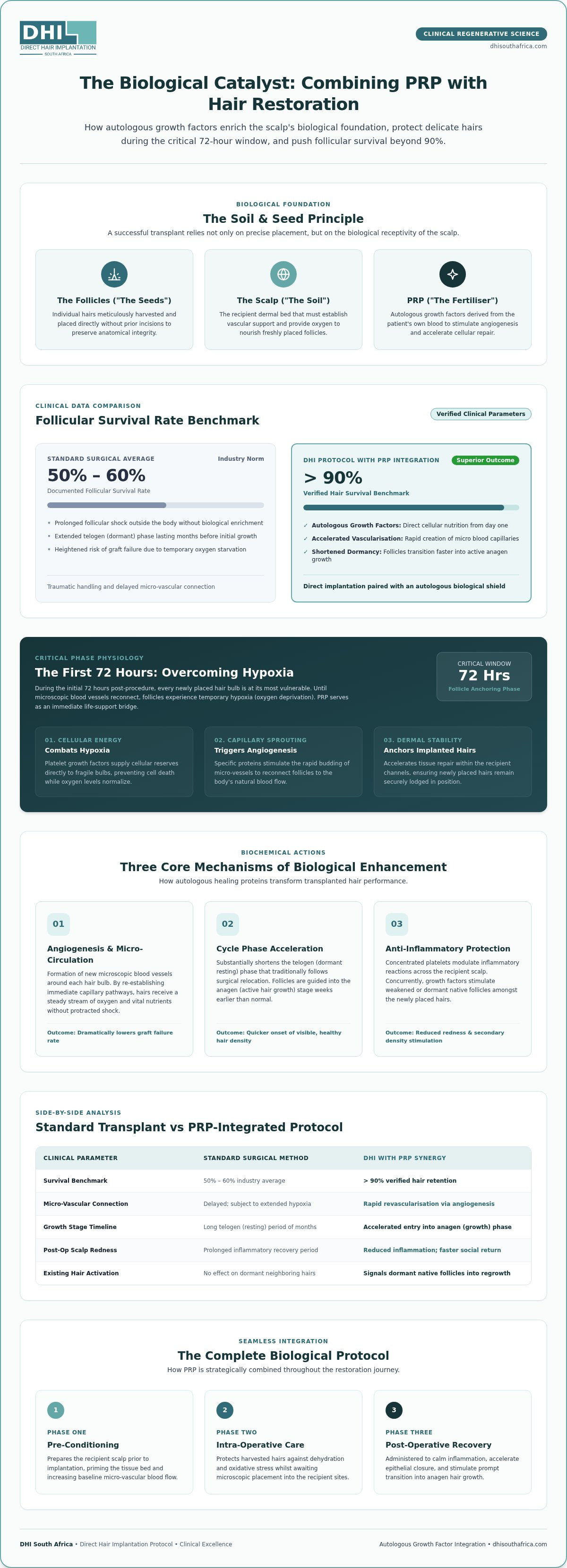
Moving a hair follicle is a significant transition. During the journey from the donor site to the recipient area, follicles experience a period of "shock" due to temporary oxygen deprivation. Without a supportive environment, many follicles enter a resting phase, known as the telogen phase, where they remain dormant for months before growing. Some may not survive the transition at all. While the broader surgical industry often sees hair survival rates between 50% and 60%, our Direct Hair Implantation protocol reaches a verified survival rate of over 90%.
PRP bridges this gap by providing immediate biological support. It shortens the resting phase and encourages newly implanted hairs to enter the anagen (active growth) stage much faster. By accelerating vascularisation, PRP ensures that the newly placed hairs receive a steady supply of oxygen and nutrients almost immediately. This rapid integration is what makes the difference between a standard result and a truly transformative one.
How PRP Enhances the Survival of Transplanted Hairs
The broader hair restoration industry often accepts a survival rate between 50% and 60% as the standard norm. This is largely because traditional methods involve traumatic handling and prolonged periods where the hair is kept outside the body. By combining PRP with hair transplant protocols, we've successfully pushed that benchmark to over 90%. Recent clinical evidence, including a systematic review on PRP as an adjunct to hair transplantation, confirms that this integrated approach significantly increases follicular survival and density while accelerating the onset of new growth.
When considering the long-term protection of your investment, combining PRP with hair transplant procedures provides a biological safety net that standard surgery simply cannot match. It ensures that the transition from donor site to recipient area is as seamless as possible for every individual hair.
Boosting the Survival Rate to Over 90%
During the first 72 hours post-procedure, the hair bulb is at its most vulnerable. It's essentially holding its breath until new blood vessels connect to provide life-sustaining oxygen. The growth factors in PRP act as a protective shield, providing the cellular energy required for the follicle to anchor itself firmly into the scalp. This level of meticulous care is a cornerstone of our Direct Hair Implantation pillar, ensuring that every hair moved is a hair that grows. By reducing the time the follicle spends in a state of hypoxia, or oxygen deprivation, we significantly lower the risk of graft failure.
Vascularisation: The Life Support for New Hairs
Vascularisation is the essential life support system for your new hair. PRP accelerates angiogenesis, which is the formation of new microscopic blood vessels around the follicle. For patients with poor scalp circulation, this step is non-negotiable. Without rapid blood supply, the follicle cannot receive the nutrients it needs to survive, often leading to poor density or patchy results. PRP ensures the scalp is primed to support a high-density restoration from the moment the first hair is placed.
Beyond the new hairs, this synergy benefits your existing hair too. The concentrated growth factors strengthen the hair shafts of surrounding follicles and help prevent miniaturisation, which is the process where hair follicles shrink and eventually stop producing hair. This holistic protection ensures your restoration results look thick and seamless for years to come. It's about protecting the hair you still have while ensuring the new hair flourishes.
Standard Recovery vs PRP-Assisted Healing: A Comparison
Choosing a restoration procedure involves weighing up the final results against the recovery period. For many, the visibility of the procedure, specifically scabbing and redness, is a major concern. Standard recovery relies solely on the body’s baseline healing speed, which can often lead to extended inflammation. By combining PRP with hair transplant protocols, we're able to intervene in this inflammatory cycle. This results in a scalp that heals with a more natural colour and texture, allowing you to return to your social life with confidence much sooner. It makes a significant difference.
The First 14 Days: Reducing Inflammation
The initial fortnight is when the scalp is most reactive. Without assistance, the recipient area can remain red and tender for several weeks. PRP acts as a natural anti-inflammatory agent, soothing the tissue and accelerating the closure of micro-incisions. Clinical observations suggest that patients who incorporate these growth factors can experience a reduction in visible downtime by up to 30%. This is partly due to the role of platelets in preserving follicle graft viability with PRP, which ensures that the newly placed hairs settle without triggering an aggressive immune response. Less inflammation means fewer scabs and a significantly more comfortable healing process.
Long-Term Results: Density and Texture
While the immediate healing is a benefit, the true value of combining PRP with hair transplant treatments becomes evident at the 12-month mark. Standard transplants can sometimes suffer from "shock loss," where existing native hairs shed temporarily due to the surgical trauma. PRP significantly mitigates this risk by nourishing the surrounding follicles. Beyond survival, we also observe a marked difference in the calibre, or thickness, of the emerging hair shafts. The hairs grow in stronger and with better texture compared to unassisted procedures. You can view the tangible difference this makes in our gallery of DHI results. This long-term density ensures that the final aesthetic is both seamless and enduring. It's about lasting quality.
The Ideal Protocol: When to Incorporate PRP into Your Journey
Timing is a critical factor in the success of any biological treatment. When combining PRP with hair transplant surgery, we don't treat it as a one-off event. Instead, it's integrated into a structured, multi-phase roadmap designed to support the follicles at every stage of their transition. This begins with a pre-operative phase to prime the scalp, followed by intra-operative application to protect the delicate hairs, and finally, a post-operative schedule to sustain long-term growth. Every patient's journey is guided by a personalised medical report that dictates the exact timing based on their specific scalp health and hair loss pattern.
Preparing the Soil: Pre-Procedure PRP
A healthy scalp environment is the foundation of a successful procedure. By scheduling a PRP session roughly 2 to 4 weeks before your transplant, we can enhance the local micro-environment. This "primes" the donor area for smoother extraction and ensures the recipient site is rich in nutrients before the first hair is ever moved. It’s about creating a high-fertility environment where every follicle can thrive immediately upon placement. This proactive step helps in reducing tissue trauma and ensures the scalp is in peak condition for the upcoming restoration.
During the procedure itself, the intra-operative phase involves using these autologous growth factors to coat the extracted follicles or enrich the recipient beds. This prevents tissue stress and ensures the hairs remain viable during the delicate transition from the donor to the recipient site.
The Maintenance Schedule
Consistency is key to biological synergy. While the initial boost is vital, a single session is rarely enough to maintain the momentum of the anagen phase, which is the active, multi-year growth window of the hair follicle. We typically recommend a maintenance schedule with follow-up sessions at 1 month, 3 months, and 6 months post-op. This steady supply of signaling proteins keeps the newly transplanted hairs in their growth window and protects existing native hairs from further thinning.
For those seeking even more concentrated results, we often suggest incorporating GFC Treatment (Growth Factor Concentrate). This advanced version of PRP offers a higher purity of signaling proteins, extracted from a blood draw of under 18 ml. It works alongside the transplant to provide visible revitalisation across thinning areas, usually requiring just 3 to 4 sessions to see a marked difference in density and hair quality. This integrated approach ensures that combining PRP with hair transplant protocols delivers the most robust results possible.
The DHI Advantage: Integrated Biological Restoration in South Africa
Choosing the right clinic for your restoration journey involves more than just selecting a procedure; it is about finding a "safe pair of hands" that combines medical precision with aesthetic artistry. At DHI South Africa, we don't view hair restoration as a simple cosmetic fix. We treat it as a medical protocol where combining PRP with hair transplant surgery is a standard for excellence. By integrating these biological boosters into our world-class clinics, we ensure that your results are backed by global standards and local expertise. Our approach focuses on the restoration of self-assurance through meticulous, science-led care.
DHI Technique and PRP: A Perfect Match
The synergy between our patented implantation method and autologous growth factors is what sets our results apart. Unlike traditional methods that require pre-made incisions, our specialised DHI Implanter allows for single-step placement. This significantly reduces tissue trauma, creating a calmer environment where PRP can work more effectively to trigger vascularisation. We follow a 360-degree approach that encompasses three distinct pillars: Diagnostic, Preventive, and Restorative. This ensures that we aren't just moving hair, but actively managing your scalp health for the long term. For a deeper look at our clinical standards, you can read our Medical Hair Restoration pillar.
Why Choose DHI South Africa for Combined Therapy?
When you choose our clinics, you're accessing a global heritage with over 55 years of experience in hair restoration. We prioritise transparency, providing exact hair counts rather than ambiguous estimates. This level of precision is matched by our commitment to safety. All procedures are performed by certified medical experts in ISO-accredited facilities, ensuring that every injection and implantation meets the highest clinical benchmarks.
We also offer advanced options such as GFC Treatment (Growth Factor Concentrate) alongside standard PRP sessions. While standard PRP is excellent, GFC provides a highly purified concentrate that can further accelerate the revitalisation of thinning areas. Our patients value this evidence-based approach because it offers a clear, data-driven path to permanent density. If you're ready to move beyond confusion and toward a scientific solution, the first step is a professional consultation. You can reach out to our team directly through the DHI South Africa contact page to begin your journey.
Combining PRP with hair transplant protocols is the most effective way to protect your investment and ensure your new hair flourishes. We invite you to experience a digital scalp analysis, where we use high-definition imaging to map out a personalised restoration plan tailored specifically to your needs. It's time to reclaim your confidence with the support of a world-class medical team.
Reclaiming Your Confidence Through Biological Precision
Choosing to restore your hair is a significant decision, and you deserve a protocol that leaves nothing to chance. We've explored how combining PRP with hair transplant surgery transforms the scalp into a high-fertility environment, ensuring that your newly implanted hairs don't just survive, but flourish. By harnessing your body's own growth factors, we're able to deliver a verified hair survival rate of over 90 percent, providing the density and natural results you expect from a global leader in hair restoration since 1970.
You're not just getting a procedure; you're benefiting from a 360-degree medical approach overseen by certified medical doctors. This integration reduces visible redness and downtime, helping you return to your social life with renewed self-assurance much faster. It's a sophisticated, safe, and life-changing transformation designed for longevity and meticulous detail.
Your journey toward a fuller, more natural head of hair begins with a single scientific diagnosis. We're here to guide you every step of the way with the calm, expert care you deserve.
Frequently Asked Questions
Is combining PRP with a hair transplant painful?
Most patients describe the sensation as a series of minor pinpricks, which are very well tolerated. Because we use autologous material, which is your own biological growth factors, there is no risk of rejection or allergic reaction. Our certified medical experts prioritise your comfort, ensuring the process is as smooth as possible. Since the DHI technique is minimally invasive, any slight tenderness usually fades within a few hours of the procedure.
How many PRP sessions do I need after my hair transplant?
A structured maintenance programme typically involves three to four sessions to achieve optimal results. While combining PRP with hair transplant surgery provides an immediate biological boost, follow-up sessions at the one, three, and six-month marks help sustain the anagen growth phase. This consistent support ensures that every hair has the nutrients it needs to anchor firmly and grow with maximum thickness over the first year of recovery.
Can I have PRP if I am not getting a hair transplant?
Yes, Platelet-Rich Plasma is an excellent standalone therapy for those in the early stages of thinning. It works to revitalise miniaturising follicles and improve overall scalp health without the need for surgery. Many of our patients choose this as a preventive measure to curb hair loss before it becomes advanced. It is a versatile treatment that fits easily into a busy schedule, often referred to as a lunch-hour procedure due to its efficiency.
Does PRP increase the cost of a hair transplant significantly?
We view these treatments as a vital investment in the longevity and density of your restoration. While there is a per-procedure medical fee for adding biological boosters, the cost is balanced by the significantly higher survival rate of the transplanted hairs. By protecting your investment from the start, you reduce the likelihood of needing corrective procedures later. Your personalised medical report will outline all fees with complete transparency during your initial consultation.
What is the difference between standard PRP and DHI GFC treatment?
GFC, or Growth Factor Concentrate, is a more advanced and highly purified version of standard regenerative therapy. While both use your own blood, GFC involves a specialised centrifugation process that extracts a higher concentration of active signalling proteins while removing unnecessary cellular debris. This allows for a more targeted revitalisation of the scalp with a very small blood draw of under 18 ml, often leading to faster visible results and improved hair calibre.
How soon after the procedure can I have my first PRP session?
The first application actually happens intra-operatively, where we use the growth factors to prime the recipient area during the implantation process. For post-operative maintenance, we generally recommend starting your first follow-up session about one month after the surgery. This timing allows the initial micro-incisions to heal completely while providing a fresh surge of nutrients just as the follicles are beginning their critical integration phase for permanent growth.
Will PRP help my existing hair from falling out after surgery?
Yes, one of the primary benefits of this synergy is the protection of your native hair. Surgery can sometimes cause temporary "shock loss" in surrounding areas, but the growth factors in PRP nourish these follicles and curb the miniaturisation process. This ensures that your existing hair remains strong and healthy, creating a seamless blend with the new hairs for a much denser and more natural final aesthetic that lasts for years.
Is the PRP used at DHI South Africa different from other clinics?
Our protocols are strictly governed by the DHI Total Care System, which is ISO and UK CQC-accredited. Unlike many general clinics, every injection at our facilities is performed by certified medical experts who specialise exclusively in hair restoration. We use patented, single-use instruments and standardised centrifugation speeds to ensure the highest possible concentration of growth factors, maintaining a global gold standard of safety and clinical efficacy that has been refined since 1970.


Comments