%20(1).jpg)
%20(1).jpg)
Is a Hair Transplant Worth the Investment? A 2026 ROI Guide

The most expensive hair restoration is often the one that costs the least at the outset. When you calculate the mounting costs of temporary solutions, asking is a hair transplant worth the investment becomes a vital financial decision rather than just an aesthetic one. You've likely felt the frustration of watching your hairline recede whilst your spending on powders or hairpieces only grows. It's a cycle of anxiety that leaves many South Africans wondering if a permanent solution is a genuine asset or merely a gamble with their hard-earned Rands.
We understand that you require more than just a change in appearance; you need the peace of mind that comes with clinical excellence. Discover the true financial and emotional return on investment of hair restoration and how to ensure your hairs reach their maximum survival potential. This guide provides a detailed breakdown of lifetime costs, the importance of doctor-led procedures under HPCSA standards, and the sophisticated techniques that guarantee a natural, scar-free result without the need for recurring maintenance. We will examine why the survival rate of every hair moved is the ultimate metric of your success.
Table of Contents
Beyond the Mirror: Evaluating the True Value of Hair Restoration
For many professionals in South Africa, a receding hairline feels like more than a physical change. It becomes a silent distraction in the boardroom or a source of hesitation during high-stakes social engagements. You might find yourself adjusting your behaviour, choosing specific seating, or avoiding bright overhead lighting. This emotional weight is significant, and it's why asking if a hair transplant is worth the investment is such a vital step. You aren't just buying hair; you're reclaiming the mental energy you currently spend on concealing loss and restoring the self-assurance necessary for a peak professional presence.
We believe in validating this hesitation. A hair transplant is a significant decision that requires a clear understanding of the long-term benefits. It's essential to distinguish between a "cheap" procedure, which often leads to disappointment and corrective costs, and a high-value investment in permanent restoration. When you view your hair as a personal asset, the focus shifts from the initial price to the lifetime value of the results.
The Hidden Costs of Prolonged Hair Loss
The financial impact of hair loss often hides in plain sight. Many individuals spend thousands of Rands annually on "confidence-boosting" temporary products like hair thickening fibres, specialised shampoos, or scalp concealers. Whilst these provide a fleeting sense of security, they represent a recurring expense with no permanent equity. There's also a biological "waiting cost" to consider. As genetic hair loss progresses, your available donor area may diminish over time. Utilising advanced hair transplantation techniques whilst your donor density is at its peak ensures the most robust and natural-looking outcome for your investment.
Shifting from Expense to Investment
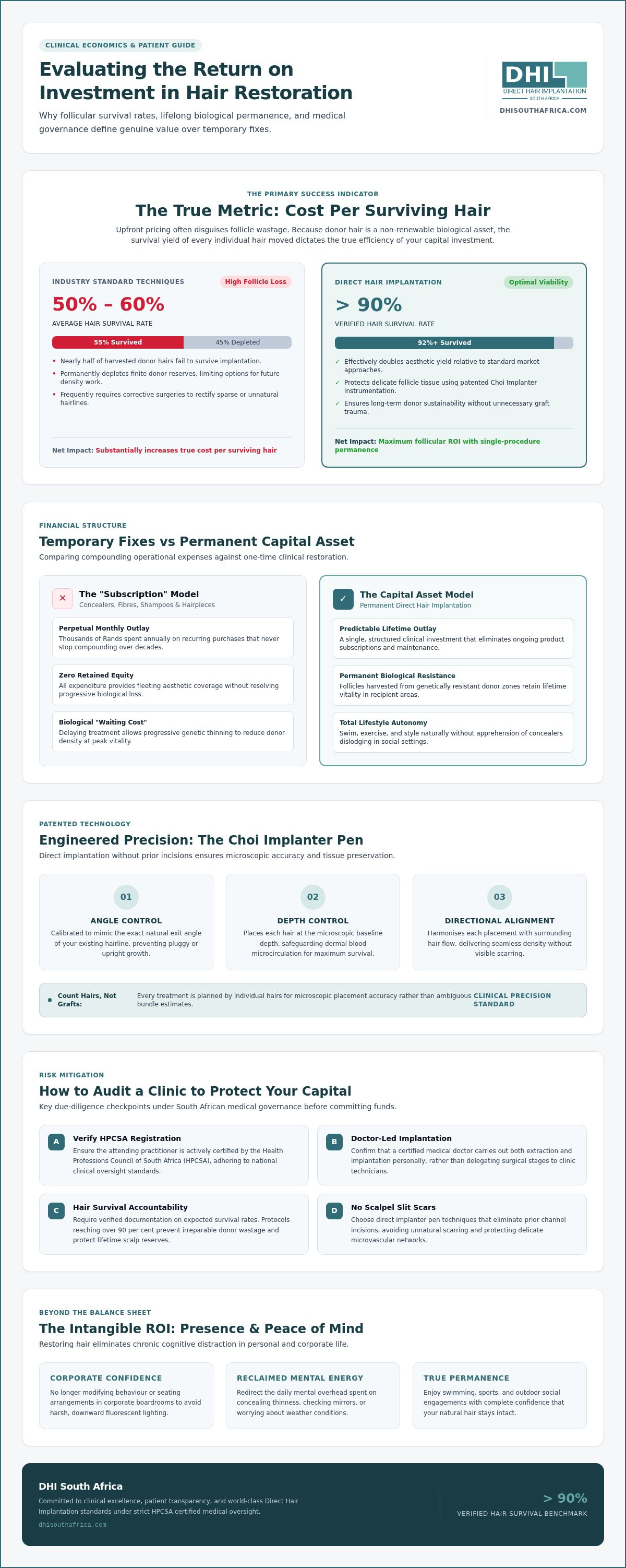
It's helpful to compare a one-time clinical procedure to a lifetime of topical treatments. Many temporary solutions operate on a "subscription" model, requiring monthly payments for years without ever solving the underlying issue. In contrast, a permanent restoration offers a predictable financial horizon. When evaluating if a hair transplant is worth the investment, the true metric is the "cost per surviving hair." A procedure that delivers high survival rates and a natural finish eliminates the need for future concealers or recurring hair system maintenance. True ROI is found in a hairline that grows naturally for a lifetime, allowing you to swim, exercise, and style your hair without the constant fear of your solution failing you.
Calculating the ROI: Why Survival Rates Define Your Investment
When assessing whether a hair transplant is worth the investment, the most critical metric isn't the upfront cost, but the cost per surviving hair. Many patients mistakenly compare clinics based on raw numbers, yet a lower price often masks a significant loss of viable follicles. If a procedure results in poor survival, the donor hair, which is a finite resource, is essentially wasted. This wastage doesn't just impact your wallet; it permanently limits your options for future restoration if your hair loss continues in other areas.
Precision in extraction and implantation is the only way to protect your investment. By ensuring that every hair moved has the highest chance of thriving, you avoid the high financial and emotional toll of repair procedures. Poorly executed transplants often require corrective surgery to fix unnatural hairlines or patchy density, which can cost significantly more than getting it right the first time. Adhering to the American Academy of Dermatology's transplant guidelines highlights why medical expertise is non-negotiable for achieving a result that lasts a lifetime.
The Mathematics of Hair Survival
A 90 per cent survival rate effectively doubles the value of the procedure compared to lower-tier clinics where survival rates often languish between 50 per cent and 60 per cent. This discrepancy is primarily due to how follicles are handled during the transition. Our patented Direct Hair Implantation technique uses the Choi Implanter Pen to provide full control over the angle, depth, and direction of every hair. This tool protects the delicate follicles, ensuring they remain viable and healthy. This level of meticulous care is what separates a world-class result from a mediocre one.
Permanent Results vs Recurring Costs
Determining if a hair transplant is worth the investment involves looking at the long-term stability of the donor hair. Hairs harvested from the permanent donor zone at the back and sides of the head carry a lifetime genetic resistance to thinning. Once successfully moved, these hairs continue to grow naturally for decades. For busy South African professionals, this one-and-done approach is far more efficient than the daily burden of applying topical foams or the monthly maintenance of hair systems. You can see our natural results to understand the aesthetic ROI that a permanent solution provides. To begin your journey, you can explore our specialised restoration reports to see what is possible for your specific hair profile.
Comparing Hair Restoration Options: Clinical Results vs Temporary Fixes
Choosing a path for hair restoration requires a clear-eyed look at the lifetime commitment involved. Whilst many South Africans begin with temporary fixes, these options often function as a financial treadmill. You pay a recurring fee to maintain a result that never truly belongs to you. In contrast, a clinical restoration is a one-time capital investment in a permanent biological asset. When you evaluate the total cost of ownership over a decade, the question of whether a hair transplant is worth the investment shifts from a matter of "if" to a matter of "when."
The "lifestyle ROI" is perhaps the most significant benefit that non-surgical options cannot provide. Temporary systems or fibres require constant vigilance. There is the persistent anxiety of detection during a workout or the fear that a swim might compromise your appearance. A permanent DHI procedure restores the freedom to live without these restrictions. You can style your hair, exercise vigorously, and enjoy the South African sun with the confidence that your hairline is natural and secure. This sense of normalcy is a vital component of the overall value proposition.
The Lifetime Cost of Temporary Solutions
High-end hair systems in South Africa often demand an annual commitment of R25,000 to R40,000 when you factor in unit replacements and monthly professional maintenance. Over a ten-year horizon, this accumulates to a staggering R250,000 to R400,000. This figure doesn't even account for the "invisible" costs, such as the time spent in maintenance chairs or the psychological toll of concealing a prosthetic. Similarly, medical stabilisations like minoxidil or finasteride can cost up to R8,650 annually. Over twenty years, these medical and surgical hair loss solutions can easily exceed R170,000 without ever restoring a single lost hair. Many patients also find that long-term use of adhesives leads to scalp irritation, which can further damage existing follicles.
Why the DHI Technique Offers Superior Value
The DHI technique is designed for the modern professional who values efficiency and discretion. Because the procedure involves no stitches and leaves no linear scars, it's often referred to as a "lunch-hour" restoration. You can return to your routine quickly, without the visible evidence of surgery. Our single-step implantation system ensures that every hair is placed with absolute control over depth and direction, creating the most natural hairline possible. To protect and enhance this investment, we often integrate GFC (Growth Factor Concentrate) treatment, which uses your own growth factors to accelerate healing and strengthen the newly moved hairs. If you're ready to move beyond temporary patches, you can explore our advanced hair loss solutions to find a permanent strategy that fits your lifestyle.
How to Audit a Clinic to Protect Your Investment
Protecting your capital is as important in hair restoration as it is in any other financial venture. When you ask is a hair transplant worth the investment, the answer depends heavily on the medical standards of the facility you choose. In South Africa, the regulatory environment is strict, yet some low-cost facilities bypass these essential safeguards. A successful audit of a clinic begins with verifying who actually performs the procedure. Under South African law, surgical steps must be handled by HPCSA-registered doctors. If a clinic delegates the implantation to a technician, the risk of poor hair survival increases, which directly diminishes your long-term ROI.
A "safe pair of hands" is not just a phrase; it's a clinical requirement. A doctor-led procedure ensures that the artistic design of your hairline is matched by medical precision. This reduces the likelihood of complications and ensures that the finite supply of donor hairs is managed with the respect it deserves. Choosing a clinic that prioritises medical expertise over high-volume turnover is the first step in securing a result that looks natural for a lifetime.
Look for Clinical Transparency
A reputable clinic should provide a "Total Medical Hair Restoration" report before you commit to any surgical intervention. This 360-degree diagnostic evaluation goes beyond a simple visual check. It examines your hair loss stage, donor density, and projected future loss to ensure that a transplant is the right move for your specific profile. Be wary of clinics that offer "unlimited hairs" for a flat, suspiciously low fee. This often indicates a lack of precision and a "quantity over quality" approach that can deplete your donor area. You should also demand to see unedited, high-resolution before-and-after photography series that show the hairline from multiple angles, ensuring the results are consistent and natural.
The Importance of Safety Protocols and Aftercare
Safety is the bedrock of a high-value investment. Our protocols are aligned with ISO and UK CQC-accredited standards, ensuring a level of global excellence that protects your health and your results. Every instrument used must be single-use and titanium-coated to prevent cross-contamination and ensure the cleanest possible extraction. Beyond the procedure, a structured 18-month post-procedure monitoring plan is essential. This ongoing clinical oversight ensures that the hairs are growing as expected and allows for immediate intervention if needed. You can learn more about protecting your investment with proper aftercare to ensure your new hairline reaches its full potential.
To ensure your restoration is handled by certified medical experts using the world's most advanced protocols, you can book a professional consultation with DHI South Africa today.
Securing Your Future with DHI South Africa
Choosing the right partner for your hair restoration journey is the final step in ensuring your capital is well-placed. DHI South Africa represents the logical conclusion for those who prioritise the highest possible hair survival rate and clinical excellence. As part of a prestigious global network spanning 75 clinics across 45 countries, we bring world-class standards directly to the South African market. When you consider if a hair transplant is worth the investment, the answer lies in the longevity and naturalness of the result, both of which are guaranteed by our patented protocols. Our survival rate of over 90 per cent ensures that your finite donor resource is managed with the utmost care.
Our approach relies entirely on autologous biological material. By using your own follicles and growth factors, we eliminate the risks associated with synthetic solutions and ensure a result that is biologically yours. This focus on natural restoration is why we maintain a 99 per cent customer satisfaction rate globally. We don't just move hair; we restore the self-assurance that comes with a permanent, undetectable hairline. This is a life-changing transformation delivered with the calm, measured composure of a medical expert.
World-Class Restoration Across South Africa
We have established a national footprint to ensure that busy South African professionals have access to elite restoration specialists. Our procedures are designed to be minimally invasive, often referred to as a "lunch-hour" transplant because of the lack of stitches or visible scarring. This allows you to maintain your professional and social commitments without interruption. Every hair is placed with absolute intent by a certified doctor, ensuring the angle and density match your natural growth patterns perfectly. This level of meticulous artistry is what defines the DHI difference and protects your aesthetic ROI.
Your Personalised Path to Confidence
No two hairlines are identical, and neither are our treatment plans. Every patient receives a bespoke strategy that accounts for their specific hair cycle and long-term aesthetic goals. This precision is why determining whether a hair transplant is worth the investment becomes clear once you see the personalised diagnostic data. By aligning our surgical expertise with your unique biological profile, we ensure that every hair moved reaches its maximum survival potential. You aren't just a patient; you are an individual receiving a tailored medical solution designed for a lifetime of growth.
The transition from frustration to confidence begins with a single, professional step. We invite you to experience a clinical consultation where we can map out your permanent restoration journey. You can book your consultation today to secure your future hairline with the global leaders in hair restoration.
Investing in a Lifetime of Confidence
Determining if a hair transplant is worth the investment requires shifting your perspective from short-term costs to long-term equity. We've explored how the compounding expenses of temporary fixes far exceed the one-time capital commitment of a permanent clinical solution. By choosing a procedure where certified DHI specialists perform every step, you ensure that your finite donor resource is managed with absolute precision. Our clinical protocols achieve a documented hair survival rate of over 90 per cent, providing a level of reliability that lower-tier clinics simply cannot match.
This is an investment in your professional presence and personal self-assurance. With an IMRB-accredited 99 per cent patient satisfaction rate, our global network offers a "safe pair of hands" for your transformation. You don't have to settle for the anxiety of thinning or the hassle of recurring maintenance. It's time to reclaim your natural hairline with the world's leading restoration technique. Book your professional hair restoration consultation today to begin your journey toward a permanent, natural result. Your future confidence is a choice you can make today.
Frequently Asked Questions
Is a hair transplant really permanent, or will I need another one in the future?
A DHI restoration is permanent because we move hairs from the donor zone, which is genetically resistant to the hormones that cause thinning. These follicles maintain their characteristics even after implantation. Whilst your native, non-transplanted hair may continue to thin without medical stabilisation, the restored hairs are intended to grow for a lifetime. This longevity is a key reason why many South Africans conclude that a hair transplant is worth the investment over temporary solutions.
How much does a hair transplant cost in South Africa compared to temporary fixes?
Temporary solutions like hair systems or medical subscriptions create a recurring financial burden. High-end hairpieces in South Africa can cost up to R40,000 annually when replacements and maintenance are included. Over a decade, these expenses far exceed the one-time capital outlay for a permanent procedure. When you calculate the cumulative cost of adhesives, styling, and medications, a clinical restoration offers a significantly better financial horizon for long-term hair maintenance.
Can I return to work immediately after a DHI hair transplant?
Most patients return to their professional routines within a few days, and some even the following day. Because the Direct Hair Implantation technique is minimally invasive and involves no stitches or linear scars, the recovery period is exceptionally short. We often describe it as a "lunch-hour" procedure for busy professionals. You won't have to manage visible wounds or significant downtime, making it a discreet and efficient option for restoration.
What happens if the transplanted hairs don't grow?
We mitigate this risk by utilising patented protocols that achieve a documented hair survival rate of over 90 per cent. This is significantly higher than the industry average of 50 to 60 per cent. Every procedure is performed by certified medical specialists who ensure the delicate follicles are handled with absolute precision. If you follow the structured 18-month monitoring plan, we can ensure every hair moved reaches its maximum survival potential for a natural result.
Are the results of a DHI transplant truly scar-free?
Yes, the results are truly scar-free in both the donor and recipient areas. Unlike older techniques that require a "strip" of scalp to be removed, our method uses specialised single-use instruments to extract and implant hairs individually. There are no incisions, no stitches, and no linear scars left behind. This allows you to wear your hair short or even shaved without any visible evidence that a clinical procedure has taken place.
Is the investment worth it for someone with early-stage thinning?
Early intervention is often the most strategic way to protect your donor resource. By addressing thinning at an early stage, we can create a dense, natural hairline that prevents the psychological toll of advanced hair loss. It's also an excellent time to combine surgery with medical treatments like GFC or PRP to stabilise your native hair. This proactive approach ensures you maintain a full head of hair without ever reaching a stage of visible baldness.
How do I know if I am a suitable candidate for the investment?
The only way to confirm suitability is through a professional clinical assessment. We provide a Total Medical Hair Restoration report that evaluates your hair loss stage, donor density, and scalp health. This 360-degree diagnostic ensures that we only proceed if we can guarantee a high-quality, permanent result. Determining if a hair transplant is worth the investment for your specific case starts with this data-driven evaluation of your unique biological profile.
Does a hair transplant look natural as I age?
A correctly designed hairline looks natural at any age. Our certified doctors focus on the "artistry of restoration," placing hairs with absolute control over angle, depth, and direction to mimic natural growth patterns. As you age, the transplanted hair will continue to grow and can be styled or groomed just like your native hair. Because we use your own biological material, the texture and colour remain a perfect match for a seamless, lifelong appearance.


Comments