%20(1).jpg)
%20(1).jpg)
Cost per Hair Graft: Hair Restoration Value in 2026

What if the cheapest quote you receive for your hair restoration is actually the most expensive mistake you'll ever make? When you're researching how to reclaim your hairline, seeing the term cost per hair graft explained is often the first step, yet it's also where most people get lost in a sea of confusing jargon. You might find yourself staring at quotes that range from R30,000 to over R100,000, wondering why the numbers don't seem to add up. It's completely natural to feel anxious about overpaying or, worse, investing in a procedure that doesn't deliver the permanent results you deserve.
We understand that you aren't just buying a medical procedure; you're investing in your self-assurance. This guide will help you look past simple graft counts to understand the intricate factors that truly define hair restoration value in 2026, specifically focusing on why hair survival rates matter more than the initial price tag. We'll break down how specialised tools and medical expertise influence your quote, giving you a clear framework to evaluate your options with absolute confidence. By the end, you'll see why a meticulous focus on individual hairs ensures your restoration is a permanent, life-changing investment rather than a temporary fix.
Table of Contents
Demystifying the Cost per Hair Graft: Why the Sticker Price is Only Half the Story
Hairs vs Grafts: Understanding the Mathematical Difference in Your Quote
The Hidden Variables: What Actually Drives Hair Restoration Pricing in South Africa
Survival Rates and Long-Term Value: Why a 'Cheap' Graft Can Be an Expensive Mistake
Choosing Your Path: Evaluating the DHI Total Care System for Permanent Results
Demystifying the Cost per Hair Graft: Why the Sticker Price is Only Half the Story
If you've spent any time looking for hair restoration in South Africa, you've likely encountered a confusing range of prices. Having the cost per hair graft explained often feels like trying to solve a puzzle where the pieces don't quite fit. One clinic might quote R40 per graft whilst another suggests R70, leaving you to wonder if you're paying for prestige or genuine quality. It's frustrating to feel like you're comparing apples to oranges when your appearance and health are on the line.
The reality is that "cost per graft" is simply an industry shorthand. It doesn't account for the survival rate of those hairs or the safety protocols in place. Choosing a bargain-basement option often results in a "cheap" procedure that becomes an expensive mistake. These low-cost attempts frequently require costly corrective surgery to fix unnatural hairlines or donor area depletion. True value lies in the clinical precision that ensures those hairs actually grow and stay for a lifetime.
To better understand this concept and explore how pricing reflects long-term quality, we examine the broader picture of surgical value below.
The Shift from Commodity to Clinical Investment
Viewing your procedure as a medical investment rather than a simple purchase changes your perspective on price. This isn't just about moving hair; it's a form of surgical hair restoration that uses autologous micro-grafting. This means we're working with your own living biological material. DHI South Africa organises fees around medical excellence, ensuring that every step, from extraction to placement, is handled with the composure of a specialist. We don't see you as a transaction. We see you as a patient whose self-assurance depends on a permanent, natural outcome.
Identifying the True Components of a Quote
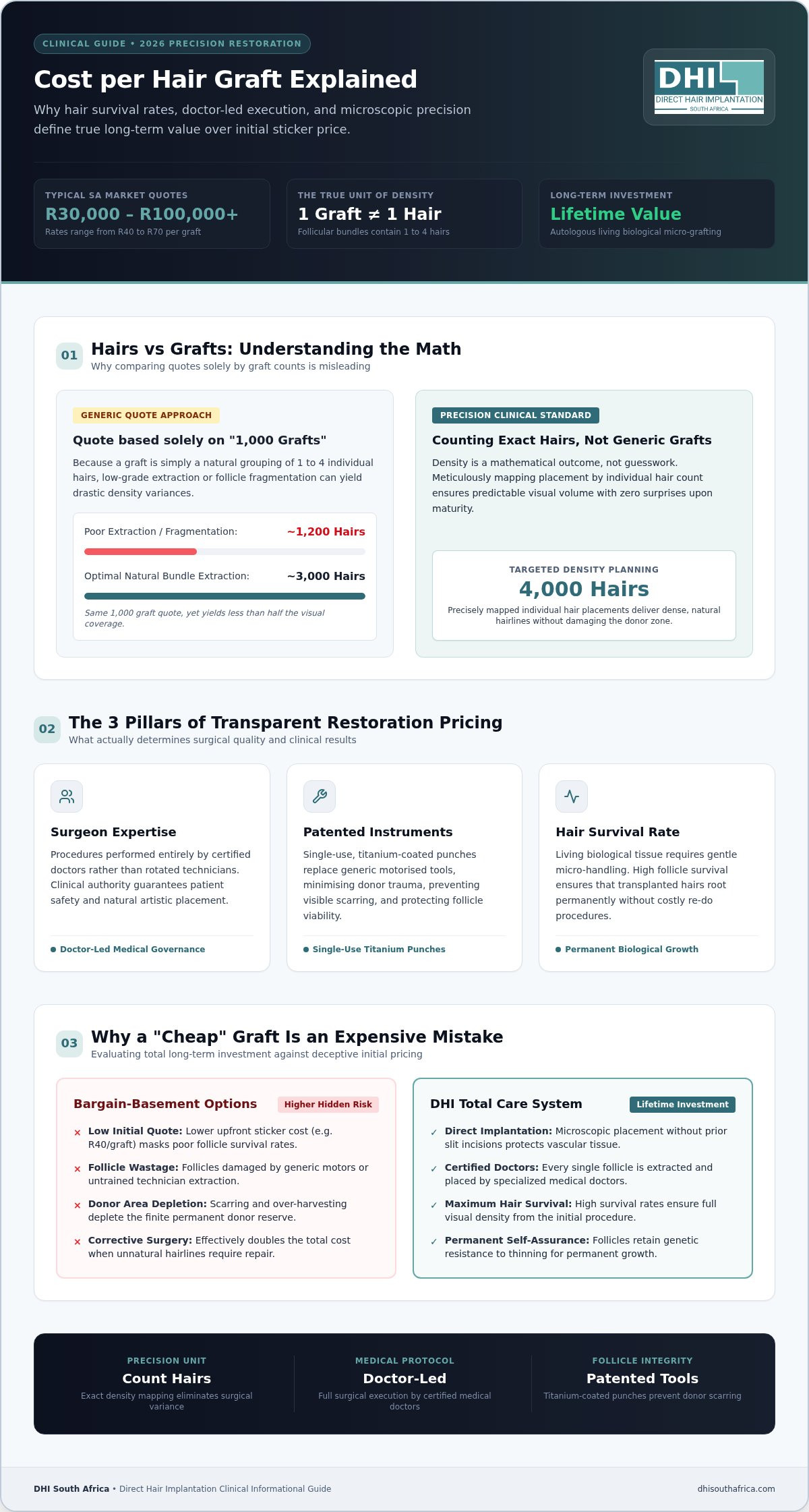
A transparent quote should clearly reflect three main pillars: surgeon expertise, facility standards, and the quality of specialised equipment. Many clinics use generic motors that can damage follicles, but premium care involves patented, single-use, titanium-coated punches. These tools are designed to prevent scarring in the donor area and ensure the highest possible survival rate. At DHI, only certified doctors perform the procedure, not technicians. This clinical authority ensures your investment is secure. Transparency isn't just a courtesy; it's the hallmark of a world-class institution that values your safety above all else.
Hairs vs Grafts: Understanding the Mathematical Difference in Your Quote
When you see the cost per hair graft explained, you might assume a "graft" is a single hair. It isn't. A hair graft is actually a follicular unit, a tiny bundle that naturally contains between one and four individual hairs. If a clinic quotes you for 1,000 grafts, you aren't necessarily getting a specific volume of hair. Depending on the quality of extraction and your own biology, those 1,000 grafts could result in 1,200 hairs or as many as 3,000. This massive variance is why comparing quotes based solely on graft counts is often misleading.
We always advise patients to ask for a "hair count" estimate. It's the only way to ensure you're comparing like-for-like when looking at different South African clinics. Without this clarity, you might pay for a high graft count but receive very low density because the units were fragmented or poorly selected. DHI South Africa focuses on counting "hairs" to provide a more precise map of your future density, ensuring there are no surprises when your results mature. If you are curious about the density we can achieve, you might want to explore our patient results to see the impact of this precision.
Why the Number of Hairs Defines Your Result
Density isn't a vague aesthetic term; it's a mathematical outcome. The visual volume of your restoration depends entirely on the total number of hairs successfully implanted. Meticulously mapping the placement of 4,000 hairs allows for a level of detail that a generic 1,500-graft plan simply cannot match. The hair-to-graft ratio is the key to understanding visual volume. By prioritising the hair count, we ensure that the donor area is managed sustainably whilst giving you the thick, natural look you expect.
The DHI Precision Advantage
Achieving a natural look requires more than just volume; it requires control. The specialised tools used in DHI hair implantation allow our doctors to place hairs closer together than traditional methods. This increased density is possible because the DHI Implanter controls the angle, depth, and direction of every single hair. Counting hairs instead of generic grafts allows for superior artistic control, particularly when designing a seamless hairline. You can learn more about this by reading Direct Hair Implantation: The Science of Natural Results. This level of precision is what transforms a standard procedure into a life-changing aesthetic result.
The Hidden Variables: What Actually Drives Hair Restoration Pricing in South Africa
Price transparency is vital, yet many clinics leave patients wondering what they're actually paying for. When you have the cost per hair graft explained, it becomes clear that the figure covers far more than just the time spent in the procedure room. In South Africa, the primary drivers of price include the level of medical expertise, the quality of technology, and the rigour of safety protocols. Choosing a clinic that cuts corners on these variables might save money initially, but it often leads to subpar growth or health complications.
One of the most significant hidden variables is who actually performs the surgery. In many low-cost clinics, a doctor might step in for the initial consultation, but the delicate work of extracting and implanting hairs is delegated to technicians. At DHI South Africa, every procedure is performed exclusively by certified doctors. This ensures that the clinical authority required for such a precise medical intervention is never compromised. Beyond the surgery itself, a world-class quote includes a comprehensive 18-month aftercare and monitoring programme to ensure the long-term success of your investment.
The Value of Specialised Medical Expertise
Artistry in hair restoration isn't accidental. DHI specialists undergo a rigorous training programme involving eight weeks of intensive study and approximately 20 supervised procedures before they're certified. This level of dedication is what allows a doctor to master the correct angle, depth, and direction of every single hair. We often see the results of "hair transplant tourism," where surgeries performed by non-medical staff lead to unnatural, "pluggy" hairlines. A certified specialist acts as a safe pair of hands, ensuring your results look seamless and age naturally with you.
Safety Protocols and Single-Use Instruments
Maintaining a safety-first environment requires significant clinical investment. Our clinics adhere to strict ISO and UK CQC-accredited protocols, which include 18 mandatory safety checks before and during every procedure. A major component of this cost is the use of single-use, titanium-coated instruments. These tools are non-negotiable for preventing cross-contamination and ensuring the health of each hair follicle. Furthermore, integrating advanced supportive therapies like GFC Hair Treatment during the process can significantly enhance graft health, adding immense value to the overall transplant experience. Investing in these protocols isn't just about luxury; it's about ensuring your hair restoration is a safe, one-time medical success.
Survival Rates and Long-Term Value: Why a 'Cheap' Graft Can Be an Expensive Mistake
When you're comparing quotes, the lowest price often seems like the smartest choice. However, once you have the cost per hair graft explained in terms of biological survival, the math changes completely. Most patients don't realise that the industry average survival rate for standard procedures often hovers between 50% and 60%. In contrast, DHI's specialised protocols consistently achieve a survival rate of over 90%. If you pay for 2,000 hairs but only 1,000 actually grow, you've effectively paid double for every surviving hair.
This is the "Effective Cost" of hair restoration. A cheap procedure isn't just a financial risk; it's an emotional one. Repairing a botched transplant or an unnatural hairline is far more expensive than getting it right the first time. Because follicles are harvested from the permanent donor zone, they carry a lifetime genetic resistance to thinning. You only have a limited supply of these hairs, so every single one must count. By understanding how the cost per hair graft explained relates to long-term density, you can avoid the trap of "bargain" surgery.
The Science of Graft Preservation
Follicle health depends on what happens while the hair is outside your body. We call this ischemia time (the window where the follicle is deprived of blood flow). DHI's single-step technique minimises this window to boost survival. By maintaining precise temperature and hydration levels, we protect the delicate biological structure of the hair. Graft survival is the only metric that guarantees a natural, thick result.
Preventing Donor Area Depletion
Your donor area is a finite resource, a "permanent hair bank" that must be managed with extreme care. Cheap clinics often over-harvest, leaving the back of the head looking thin or patchy. DHI uses motorised, low-transection extraction tools (minimising the accidental cutting of follicles) to ensure hairs are removed without damaging neighbours. This precision results in a scar-free look that allows you to wear your hair at any length. It's about protecting your future options, not just fixing today's problem.
Choosing Your Path: Evaluating the DHI Total Care System for Permanent Results
Deciding on the right clinic is the final hurdle in your restoration journey. After having the cost per hair graft explained and understanding the critical role of survival rates, the focus naturally shifts from a raw number to a clinical outcome. The DHI Total Care System stands as the gold standard for South African patients because it addresses the complexities of hair loss through a holistic, medical lens. It's a protocol that ensures every step, from the initial diagnostic scalp analysis to the final follow-up, is executed with world-class precision.
We encourage you to look beyond the "per graft" price during your research. A quote is only as good as the density and survival it guarantees. When you prepare for a professional consultation, come ready to ask about specific hair count estimates and the specialised tools the clinic uses. A specialist should be able to explain exactly how they will protect your donor area whilst achieving your desired aesthetic. This level of detail is what separates a standard procedure from a lifetime investment in your self-assurance.
Transparency and Education as Brand Pillars
DHI South Africa prioritises patient education over high-pressure sales tactics. We believe a well-informed patient is a confident one. Part of our commitment to transparency involves rigorous photographic documentation, including a comprehensive 9-angle series to track your progress with absolute clarity. This ensures you can see the tangible results of your investment as the hairs mature. You won't find hidden fees or surprise costs here; our goal is to provide a clear, honest roadmap to restoration that respects your time and your budget.
Your Next Steps Toward Confidence
Whilst the initial cost is an important factor to consider, the quality of the result is what you live with every day. A successful restoration is seamless, natural, and permanent. DHI's clinical approach is specifically designed for busy professionals who require discreet results without the long recovery times associated with older methods. You deserve a solution that reflects the gravity of your decision. If you're ready to move past the confusion of generic quotes and seek a tailored plan, the first step is a personalised assessment with our medical team.
Take the next step and visit our contact page to book your diagnostic scalp analysis.
Securing Your Lifetime Investment in Self-Assurance
Having the cost per hair graft explained reveals that true value isn't found in the lowest quote, but in the long-term density of your results. By choosing a clinical path that prioritises hair survival rates above 90%, you ensure your restoration is a one-time success rather than a recurring expense. Every procedure at DHI South Africa is performed exclusively by certified medical specialists, providing the precision and artistry your appearance deserves.
As part of a global pioneer network with over 75 clinics, we combine world-class standards with personalised care. It's about more than just numbers; it's about the restoration of your confidence through safe, permanent science. You don't have to navigate the complexities of hair restoration alone. Our team is here to guide you toward a solution that reflects your individual needs and long-term goals.
Your journey toward a full, natural hairline starts with a single, informed decision. We look forward to helping you reclaim your best self.
Frequently Asked Questions
How much does a hair transplant cost per hair in South Africa?
Pricing for hair restoration in South Africa isn't a fixed commodity. It varies significantly based on the chosen technique, the complexity of your hair loss, and the level of medical expertise involved. While you might seek to have the cost per hair graft explained as a simple number, a professional quote is always bespoke. It reflects the clinical time and specialised instruments required to ensure a permanent, natural result for your specific scalp condition.
Why do clinics use 'graft' instead of 'hair' when quoting?
Clinics traditionally use "grafts" because hair grows in natural bundles of one to four follicles. However, this can be misleading because one patient's 1,000 grafts might contain significantly more hair than another's. We focus on counting individual hairs to provide absolute precision in density mapping. This ensures you know exactly what visual volume to expect, rather than relying on a generic unit that masks the true hair count.
Is a higher cost per graft always indicative of better quality?
A higher price tag doesn't automatically guarantee success, but premium value is often linked to clinical standards. You're paying for certified medical specialists, patented single-use tools, and rigorous safety protocols. The real metric of quality is the survival rate. A cheaper procedure that results in poor growth is ultimately a poor investment. True value lies in achieving a natural, permanent result that doesn't require corrective surgery later.
Can I get a discount if I need a large number of hairs restored?
Restoration plans are tailored to the individual's needs rather than being a bulk-buy commodity. While larger procedures involve more clinical time, the focus remains on the meticulous placement of every single hair. We provide a detailed medical report during your consultation that outlines the scope of work. This ensures you receive a fair, transparent assessment of the investment required to reach your specific goals for density and coverage.
What happens if my transplanted hairs don't survive?
Survival is the cornerstone of a successful transplant. While industry averages for graft survival can be as low as 50% to 60%, our patented protocols consistently achieve rates above 90%. If hairs don't survive, it's often due to poor extraction techniques or lengthy ischemia time (the time a follicle is outside the body). We mitigate this through our Total Care System and 18 months of post-procedure monitoring, ensuring your investment results in a lifetime of healthy growth.
Are there hidden costs in the hair restoration process?
Reputable clinics ensure their quotes are comprehensive, covering everything from the diagnostic scalp analysis to long-term aftercare. However, you should always check if specialised tools, facility fees, and follow-up appointments are included. When you have the cost per hair graft explained by a specialist, they should outline all components of the care plan. This prevents unexpected expenses for medications or additional sessions that weren't part of the initial clinical strategy.
How does the DHI technique compare to FUE in terms of price and value?
The primary difference lies in the implantation method and the resulting survival rate. Traditional FUE involves creating slits in the scalp before inserting hairs, whereas DHI uses a specialised implanter for a single-step process. This reduces the time follicles spend outside the body, leading to survival rates above 90%. While the initial investment might be higher, the superior density and natural artistry provide significantly better long-term value than generic FUE alternatives.
Is hair restoration covered by medical aid in South Africa?
Most medical aid schemes in South Africa classify hair restoration as a cosmetic procedure. Consequently, they don't typically cover the costs. However, if hair loss is the result of a specific medical condition or trauma, it's worth checking your individual policy. We provide detailed medical grade reports that you can submit for review, though most patients treat this as a private investment in their long-term self-assurance and professional image.


Comments