%20(1).jpg)
%20(1).jpg)
Premium Hair Replacement Systems in South Africa: A 2026 Clinical Guide

What if fuller-looking hair didn’t mean worrying that everyone would notice? If thinning has left you relying on sprays or powders, it’s understandable to want a more dependable option. Premium hair replacement systems offer a non-surgical way to restore the appearance of density. Careful fitting and bonding can help create a natural-looking hairline.
The finish matters, but so does the scalp beneath the system. DHI South Africa offers hair systems and hairpieces, with a focus on natural aesthetics and scalp care. With professional guidance, you can discuss how a system may fit your routine, including exercise and swimming, and what maintenance it requires.
This 2026 clinical guide explains what to consider when choosing a system, how fit, bonding and maintenance affect comfort and discretion, and why scalp health deserves attention. You’ll also learn when a hair system may be an option if donor hair is limited, and what to ask a clinical professional before deciding whether it’s right for you.
Table of Contents
What defines a modern hair replacement system?
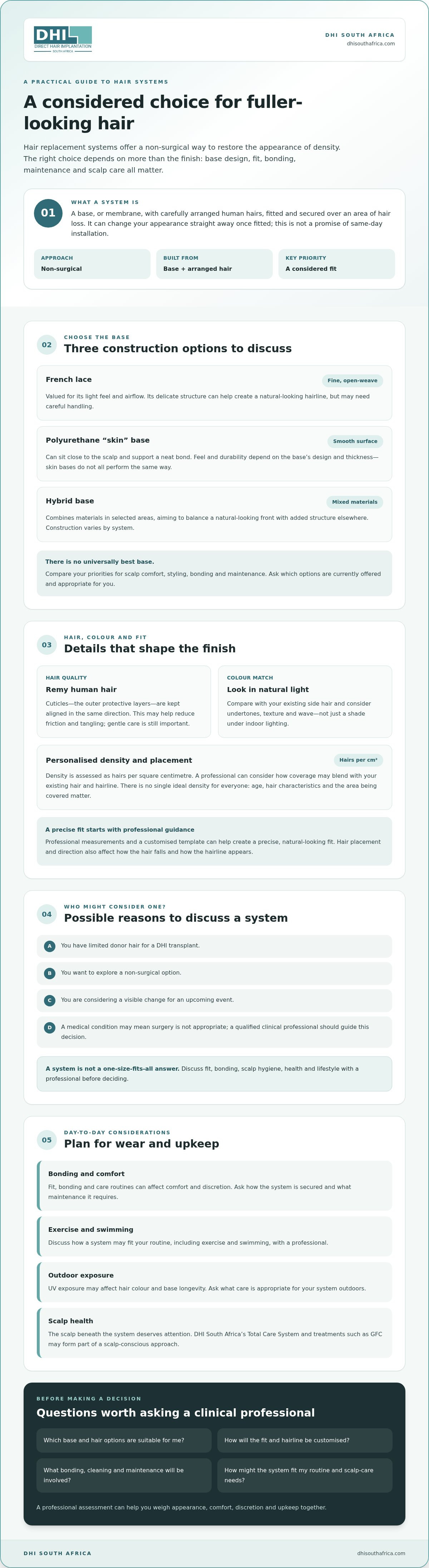
A modern hair replacement system is a non-surgical way to restore the appearance of coverage. It combines a base, or membrane, with carefully arranged human hairs, then is fitted and secured over an area of hair loss. Once fitted, it can change your appearance straight away. That describes the visual effect, not a promise that every system can be installed on the same day.
Unlike the bulky wigs or toupees many people picture, contemporary systems are designed to sit close to the scalp and follow its contours. Depending on the design, a base may use fine lace or thin polyurethane, sometimes called a “skin” base. These materials can create a close-fitting appearance, although comfort, breathability and discretion depend on the system, fit and care routine. For medically related hair loss, the term cranial prosthesis may be used for a custom-made hair covering, distinguishing it from a standard fashion wig.
The transition from wigs to integrated systems
Modern bases are designed to balance a close fit with airflow and practical wear. The hairs are positioned to follow natural growth direction, rather than forming a uniform surface. Density is assessed as hairs per square centimetre, helping a professional consider how coverage will blend with your existing hair and hairline. There isn’t one ideal density for everyone. Age, hair characteristics and the area being covered all matter.
“Hairpiece” remains a valid general term, and DHI South Africa offers hair systems and hairpieces. In a clinical restoration conversation, “hair system” can be more descriptive because it draws attention to the base, fitting and scalp-care considerations, not just the added hair.
Who may consider a hair system?
A system may be worth discussing if you have limited donor hair for a DHI transplant, want a non-surgical option, or need a visible change for an upcoming event. It may also be considered when a medical condition means surgery may not be appropriate, but a qualified clinical professional should guide that decision.
Think of a system as a possible option, not a one-size-fits-all answer. A professional assessment can help you discuss fit, bonding, scalp hygiene and whether a system suits your health and lifestyle before you decide.
Evaluating base materials and hair quality
The base and the hairs work together to shape a system’s appearance, comfort and upkeep. A fine base may help create a discreet hairline, while how the hairs are attached, their colour, texture and direction all influence how naturally the system blends. No single material suits everyone, and availability can vary. Ask a professional to confirm which options are currently offered and appropriate for you.
Modern hair replacement systems can use materials such as lace and polyurethane, each with different practical trade-offs. Choosing between them is less about finding a universally “best” base and more about balancing your priorities, scalp comfort, preferred styling and maintenance routine.
Lace vs. skin: balancing discretion and durability
French lace is a fine, open-weave material valued for its light feel and airflow. Its delicate structure can help create a natural-looking hairline, but it may need careful handling. Polyurethane, often called a skin base, has a smoother surface that can sit close to the scalp and support a neat bond. Its feel and durability depend on the base’s design and thickness, so don’t assume every skin base performs the same way.
Hybrid bases combine different materials in selected areas, aiming to balance a natural-looking front with added structure elsewhere. Construction varies, so ask how the base is made, which areas use each material, and what that means for cleaning, bonding and everyday wear.
Hair quality, colour and ventilation
Human hair moves and reflects light differently from synthetic fibres, which can look more uniform. Remy hair is processed with the cuticles, the outer protective layers of each hair, kept aligned in the same direction. This alignment may help reduce friction and tangling, although gentle care is still important. Ask about the hair type and how to maintain it rather than relying on a label alone.
Colour matching involves more than choosing a shade that looks close under indoor lighting. A professional should compare the system with your existing side hair in natural light and consider undertones, texture and wave. Matching those details helps avoid a visible difference between the system and your own hair.
“Ventilation” describes how individual hairs are attached to the base. They may be knotted through lace or secured using another construction method suited to the material. The placement and direction of the hairs affect how they fall and how the hairline appears. Ask to see the base and discuss how its ventilation will support your preferred parting and style. For guidance on available hair systems and fitting considerations, explore DHI South Africa’s hair restoration options.
The professional fitting and bonding process
A precise fit helps a hair system sit naturally and can reduce avoidable pulling, lifting or pressure at the edges. A professional fitting starts with assessing the area to be covered and creating a template that reflects its shape and size. Bonding choices should take your scalp sensitivity and hygiene needs into account, rather than relying on a one-size-fits-all adhesive.
From consultation to finished style
The fitting process should be explained before any work begins. Ask what each step involves and what care your scalp will need afterwards.
Assessment and template: A practitioner reviews your scalp and discusses the coverage you want. A template records the area and helps guide the system’s shape and fit.
Scalp preparation: The area is prepared for attachment. If existing hairs need to be trimmed or cleared beneath the base, ask why, how much is involved and whether it is necessary for your fit.
Bonding: The base is positioned and secured using a suitable attachment method. Medical-grade protocols should include attention to cleanliness and scalp comfort, but no adhesive can be assumed to suit everyone.
Cut-in and blend: Once fitted, the system is styled to work with your existing hair. A careful cut-in shapes the transition around the sides and hairline, helping the finished look feel cohesive rather than separate.
Bond strength, sensitivity and re-servicing
Medical bonding is a non-surgical way to attach a hair system using an adhesive selected to balance hold, scalp tolerance and hygiene. That doesn’t mean reactions are impossible. Discuss any history of sensitivity and ask how the chosen product is tested and removed.
Daily-wear tapes and liquid adhesives involve different application and maintenance approaches. The right option depends on the system, your skin and your routine. Don’t judge suitability by “strongest hold” alone. A secure bond must also allow appropriate removal and scalp care. The overview of hair replacement procedures from WebMD provides wider context on non-surgical cosmetic approaches to hair loss.
Re-servicing is part of responsible wear, not simply a styling refresh. A professional can remove and reapply the system as appropriate, clean the base and check the skin beneath for discomfort or irritation. The interval varies, so ask for a care plan based on your system and scalp rather than following a generic timetable. DHI South Africa describes medical-grade protocols for scalp hygiene and system bonding. Explore its hair restoration options to learn more.
Living with your system: Maintenance and lifestyle
A hair system doesn’t have to mean giving up your usual routine. Exercise and swimming may be possible, but how well a system stays in place depends on its base, bonding method, fit and maintenance. Ask your provider what your specific system can handle and whether you need to wait after bonding before getting it wet.
Sun exposure also calls for thoughtful care. Ultraviolet exposure can gradually affect hair colour and may contribute to wear of the base. A hat can offer shade outdoors, while a UV-protectant product should only be used if it’s suitable for your system. Ask your provider to recommend products that won’t interfere with the hair or attachment.
Exercise, swimming and everyday care
Heat and perspiration during high-intensity training can make the bond feel less comfortable. Avoid pulling or repeatedly adjusting the system, and follow the maintenance guidance you’ve been given. After swimming, rinse the hair with fresh water to remove chlorine or salt, then gently pat it dry rather than rubbing. Use shampoo and conditioner confirmed as suitable for the base and hair. Unsuitable products may affect the materials or attachment.
At night, friction against a pillow can contribute to tangling, particularly if the hair is long. Brush gently before bed using the technique recommended for your system, and consider a smooth pillowcase to reduce friction. Don’t sleep with wet hair if your care instructions advise against it.
Re-servicing and scalp checks
Regular professional re-servicing helps keep both the system and the scalp beneath it clean. There isn’t a single interval that suits everyone, so don’t treat a three-to-four-week schedule as universal. Ask your provider how often your system should be removed, cleaned and re-bonded, taking your scalp, activity level and attachment method into account.
During re-servicing, the system can be detached carefully, its base cleaned, and the scalp checked before it is secured again. This is also a useful opportunity to inspect the natural hair underneath. Persistent pulling, soreness, redness or itching should be raised with your provider rather than ignored, as it may mean the fit, bond or care routine needs review.
With clear aftercare guidance and appropriate maintenance, hair replacement systems can be managed alongside an active lifestyle. Follow advice for your particular base instead of guessing which products or routines are suitable.
Why a medical-grade approach leads to superior results
A natural-looking result depends on more than the system itself. Your scalp, existing hair, hair-loss pattern and day-to-day needs all matter. DHI South Africa’s Total Care System reflects a broader approach to hair restoration, with attention to individual needs and scalp health rather than treating hair replacement systems as a simple retail purchase.
A proper assessment can help clarify what may be contributing to hair loss and whether a system is suitable. It also gives you a chance to discuss scalp comfort, cleaning and maintenance, and how to care for the hair you still have. Depending on your needs, Growth Factor Concentrate (GFC), a treatment that concentrates growth factors from your own blood, may be discussed as one of the available hair-loss treatments. Whether it’s appropriate for you requires individual clinical guidance. It shouldn’t be assumed to improve the performance of a hair system.
A 360-degree view of hair restoration
Different areas may call for different approaches. For example, a clinical team could assess whether Direct Hair Implantation is suitable for one area and a system for another, such as the temples and crown. This is an example to discuss, not a recommendation for every patient. Your donor hair, scalp and goals determine which options may be appropriate.
DHI South Africa brings decades of expertise to the field, informing a focus on careful planning and natural aesthetics, including how a system’s hairline and density relate to your features and existing hair. Ask who will assess your scalp, what the assessment includes, and how follow-up care will be managed. Clear answers matter as much as the initial appearance.
Confidence through informed care
Seeing fuller-looking hair in the mirror can feel meaningful, particularly after a long period of thinning. Confidence also comes from knowing what to expect, how to care for your scalp and whom to contact if something feels uncomfortable. A supportive consultation should make room for questions without pressure and explain the benefits and practical commitments of a system clearly.
If you’re considering a system, ask about an assessment of your scalp and hair-loss history before deciding. You can use the DHI South Africa contact page to enquire about whether a digital scalp analysis is available and discuss whether a system may suit your needs.
Choose a system with confidence and ongoing care
The right hair replacement system is about more than added coverage. Base material, colour and hair quality all contribute to a natural-looking result, while professional fitting, suitable bonding and regular scalp care help support comfort and hygiene. A personalised assessment can also clarify whether a system is the right option for you.
DHI South Africa brings more than 50 years of global hair restoration experience to its work and follows medical-grade protocols for system bonding and scalp hygiene. The business also reports a 99% customer satisfaction rate, accredited by IMRB. These details offer context as you weigh your options, alongside a clear discussion of fitting, maintenance and what to expect.
You don’t have to make the decision alone. A discreet conversation can help you understand your choices and take a considered next step.
Frequently Asked Questions
How long does a premium hair replacement system last?
It depends on the base, hair quality, bonding method, care routine and how often the system is worn. Some non-surgical systems may last up to six months, but this isn’t a guaranteed lifespan for every system. Regular cleaning and careful handling can help preserve its condition. Ask the provider how often your system needs maintenance or replacement, and what signs of wear to look out for.
Can people tell that I am wearing a hair system?
A well-fitted system can look natural, but no provider can guarantee that it will be undetectable in every situation. A precise fit, a hairline suited to your features, careful colour matching and a professional cut-in all influence the result. Discuss your preferred style and how it will blend with your existing hair. The fitting, base design and ongoing care matter too.
Can I swim, shower, and exercise with the system on?
Often, but it depends on the system, bond and care instructions. Exercise, heat and perspiration may affect comfort or attachment, while chlorine and saltwater can dry or damage the hair. Ask your provider how long to wait after bonding before swimming or showering, and how to care for the system afterwards. After swimming, rinsing gently with fresh water may help remove pool chemicals or salt.
Does a hair replacement system cause damage to my scalp?
A hair system doesn’t automatically damage the scalp, but poor fit, unsuitable bonding, prolonged irritation or inadequate cleaning can cause problems. A professional should consider your scalp and explain how the system will be secured and maintained. Contact your provider if you notice persistent redness, itching, soreness or discomfort. Don’t ignore symptoms or try to resolve them by applying unapproved products beneath the system.
How often do I need to visit the clinic for maintenance?
There isn’t one maintenance schedule that suits everyone. The interval depends on the system, adhesive, scalp and activity level. Some systems need reapplication every two to three weeks, but confirm what applies to yours. Professional servicing can involve removing the system, cleaning the base and scalp, checking the skin and re-bonding it. Ask for a personalised schedule and guidance on what to do if the bond loosens.
What is the cost of a hair replacement system in South Africa?
The cost varies according to the system, its fit and the ongoing maintenance required. DHI South Africa offers hair systems and hairpieces, but a price shouldn’t be assumed from a general industry estimate. Ask the provider for a personalised quote and clarify what it includes, such as fitting, bonding, servicing and replacement. This helps you understand the overall commitment, not just the initial cost of the system.
Can I use a hair system if I still have some of my own hair?
Yes, having some of your own hair doesn’t automatically rule out a system. A professional can assess the areas you want covered, the hair you’d like to retain and how the system could blend with it. The approach depends on your pattern of loss and the system’s fit. If you’re also considering DHI or another treatment, ask a clinician to explain which options may be suitable for you.
Is the bonding adhesive safe for sensitive skin?
Sensitive skin needs individual consideration. No adhesive can be assumed to suit everyone, and medical-grade bonding doesn’t mean irritation is impossible. Tell your provider about any previous reactions or skin sensitivities before fitting, and ask what adhesive is proposed, how it will be applied and removed, and what to do if irritation develops. Follow professional advice rather than switching products or re-bonding the system yourself.


Comments