%20(1).jpg)
%20(1).jpg)
Dating with Hair Loss: Build Confidence and Date on Your Terms

What if dating with hair loss didn’t require you to hide, explain or fix anything before you felt ready? It’s understandable to worry about first impressions, dating profile photos or when to tell someone you’re seeing. Those concerns can feel personal, but hair loss isn’t a failing, and it doesn’t have to decide whether or how you date.
Feeling more comfortable starts with choices that are yours. You can decide which photos feel authentic, when to talk about your hair and how much you want to share. You don’t owe a date an explanation on a particular timeline, and you don’t need to pursue treatment to be attractive or ready for a relationship.
This article offers practical ways to build confidence, handle questions about your appearance and approach disclosure at a pace that feels comfortable. It also explains when professional guidance might help you understand your hair loss or explore options, if you want it. The aim is simple: to help you connect on your terms, without letting hair loss write the rules.
Table of Contents
Dating with hair loss: why it can feel more difficult than expected
Dating with hair loss is possible. A change in your hair doesn’t determine your relationship potential, and no single aspect of your appearance can predict how a particular date will respond. Still, if your hair has changed in a way you didn’t expect, dating may feel more exposing than before. You might think about photographs, anticipate a first meeting or wonder whether someone has noticed. Those feelings deserve care, but they aren’t proof that rejection is inevitable.
Why hair loss can affect dating confidence
Self-consciousness can draw your attention towards your appearance when you’d rather focus on getting to know someone. You might scrutinise a profile photo, feel uneasy under bright lighting or interpret a date’s pause as a reaction to your hair. But a pause can have many explanations. Without asking, it’s difficult to know what another person is thinking.
The emotional impact differs from person to person. Your personal history, the pace or visibility of hair changes and previous experiences can all shape how you feel. Hair loss is also discussed in relation to psychological distress, but that doesn’t mean everyone will experience distress or respond in the same way. Noticing your own concerns can help you decide what support, if any, feels useful.
What hair loss does not decide for you
Your hair is one part of your appearance, not a measure of your worth, character or capacity to build a connection. Dating preferences vary between individuals, so you can’t reliably predict someone’s response from their age, background or what you assume they value. One person’s reaction is information about that interaction, not a verdict on your desirability as a whole.
Hair may shape how you feel about being seen, but it doesn’t define your value or your ability to connect. You don’t have to feel completely confident before you date. You can take a manageable step, such as arranging a low-pressure first meeting, while making room for nerves without treating them as a reason to withdraw.
This guide focuses on practical ways to approach photos, conversations and in-person questions. It can’t promise romantic success, and it isn’t a recommendation to pursue treatment. If you want to understand changes in your hair, professional guidance is a separate, optional choice. Your dating life doesn’t need to wait for a particular appearance or decision.
How to feel more confident dating while experiencing hair loss
Confidence doesn’t have to mean feeling completely at ease with every part of your appearance. It can mean taking a manageable step, even if you feel nervous. Dating with hair loss doesn’t require you to change your look first. A little preparation can help you feel more present and less caught up in checking how you appear.
Prepare for a date without trying to hide yourself
Choose a familiar, comfortable setting and a plan that leaves room for conversation, such as meeting for a drink or taking a relaxed walk in a public place. Pick clothes you already feel good in, rather than an outfit chosen to disguise or compensate for hair loss. Grooming is personal: style your hair, wear a hat or go without one according to your preference, not because you feel you must correct something.
For a dating profile, use recent photos that represent how you look now, including images you feel comfortable being recognised by when you meet in person. You don’t need to make your hair the focus of every photo. However, relying only on angles, filters or headwear that conceal it may leave you worrying about the difference between your profile and the date. Aim for an honest impression, not a perfect image.
Manage worries before and during a date
Before meeting, notice the thought that’s making you anxious. “They’ll reject me because of my hair” may feel convincing, but it’s an assumption, not something you know about this person. Ask yourself what you’d focus on if that worry weren’t taking up so much space.
During the date, gently bring your attention back to what’s happening: listen to the answer, ask a follow-up question or notice your surroundings. You could plan a simple reset, such as taking a slow breath or pausing to sip your drink. The aim isn’t to force anxiety away; it’s to give the conversation some of your attention too.
If dating worries feel difficult to carry alone, consider talking with someone you trust before or after a date. A patient advocacy organisation such as the National Alopecia Areata Foundation also offers information on seeking support for emotional wellbeing. Reaching out is a personal choice, not a requirement for dating.
Small steps count. You might update one profile photo, choose a setting that feels comfortable or agree to a short first meeting. Confidence can grow through experience; it doesn’t need to be a condition you meet before you start. If you’d like to understand your hair loss separately from dating concerns, explore hair-loss guidance and assessment options from DHI South Africa.
Should you tell someone you are dating about your hair loss?
There’s no rule that says you must mention hair loss before a first date, or that keeping it private means you’re being dishonest. Dating with hair loss can bring up questions about openness, but sharing personal information is your choice. You might decide to talk about it because you feel comfortable, because it comes up naturally or because you want to explain something about your experience. You can also choose not to discuss it.
You can choose whether and when to talk about your appearance; the right moment is the one that feels comfortable and appropriate to you.
Choosing whether and when to bring it up
Consider what you want from the conversation. Would sharing help you feel more at ease, or would you prefer to get to know each other first? Your answer may depend on the person, the stage of the relationship and how private you feel about your hair loss. There’s no universally correct point, and you don’t need to disclose before a first date to prove your intentions.
If you choose to share, look for a calm moment when you have privacy and time to talk. You could bring it up if appearance, health or personal experiences come up naturally. You’re allowed to keep the conversation brief and decide later whether you want to say more.
Simple ways to talk about hair loss
A straightforward sentence is often enough. For example: “My hair has been thinning, and I’m still getting used to it,” or “I’ve experienced some hair loss, but I don’t feel like going into the details just now.” You don’t have to apologise, make a joke or offer a medical explanation. Choose words that sound like you.
If someone asks respectfully, answer only as much as you want: “I’m happy to talk about it a little,” or “I’d rather keep that personal for now.” A question doesn’t require a full account of your health or feelings.
If you welcome the question: Share a little, then see how the conversation feels.
If you’re unsure: Say, “I’m not ready to talk about that yet.”
If a comment feels intrusive: Set a clear boundary, such as, “I’d rather not discuss my appearance.”
Pay attention to how the other person responds to your boundary. You can pause, change the subject or end the conversation if you feel uncomfortable. Disclosure should support a connection you want to build, not become a test you have to pass.
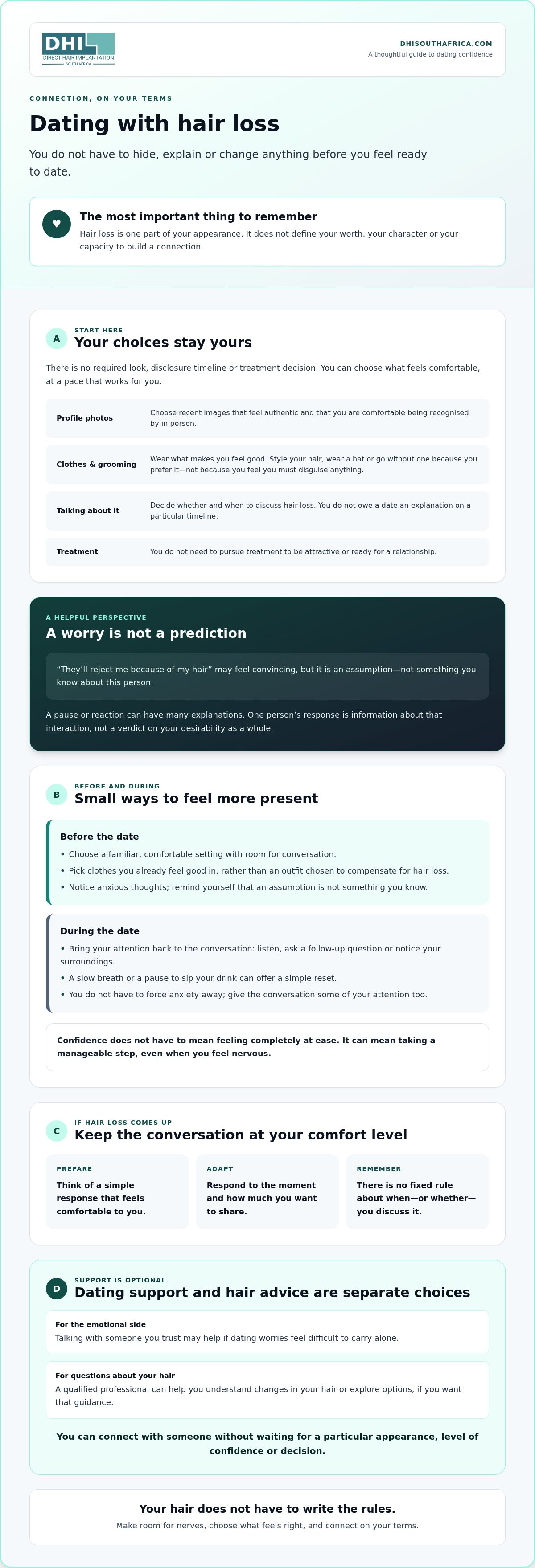
What to do if hair loss comes up on a date or dating profile
If hair loss comes up, you can respond in a way that feels natural to you. You don’t need a perfect line, a detailed explanation or a response designed to win someone over. When dating with hair loss, the aim is to communicate honestly if you choose, while keeping your comfort and boundaries in view.
Photos and profile descriptions
Use recent photos that give a fair impression of how you look now. You don’t need to make hair loss the subject of your profile or mention it in your written description. Both are personal choices. Avoid heavily filtered images or angles selected to create a misleading impression, as they may leave you more self-conscious about meeting in person. Skip self-deprecating remarks too; your profile can show your personality without making your appearance a punchline.
Early conversations
If hair loss comes up in a message or early conversation, decide how much you want to share. A brief, matter-of-fact reply can keep the exchange moving without turning the subject into a bigger discussion. For example, you might say, “My hair has changed over time, but I’d rather hear more about your weekend,” or, “Yes, I’ve noticed some thinning. I’m comfortable talking about it briefly.” Adapt the wording so it sounds like you.
Responding to questions and awkward comments
A respectful question gives you the option to answer, not an obligation to explain. You could say, “I’m happy to share a little,” or, “I’d prefer to keep that private.” If a remark feels uncomfortable, redirect the conversation or set a clear boundary: “Let’s talk about something else,” or, “I don’t want comments about my appearance.”
Pay attention to how the person responds. A respectful reaction may tell you something useful about how they handle personal boundaries, but one interaction doesn’t define you or everyone you might meet. If someone continues to make you uncomfortable, you can end the conversation or leave. Your safety comes first, and you don’t need to stay to justify that choice.
If you’d like separate guidance on understanding your hair loss, explore DHI South Africa’s hair-loss information.
When to seek support or explore hair-loss options
Dating concerns and questions about hair loss can overlap, but they don’t require the same kind of support. You might talk with someone you trust about confidence, seek professional advice about changes in your hair, choose both or decide neither is right for you at present. None of these choices is a condition for dating.
Finding support for confidence and dating concerns
If worry about dating starts to weigh on you or affects your everyday life, consider speaking with someone you trust. If you’d like more structured support, an appropriate mental-health professional can help you explore what you’re feeling. That doesn’t mean you have a particular condition, and support can be valuable without being a step towards hair restoration.
You can also keep the next step small: talk through a specific dating concern with someone you trust, or take time away from dating if that feels right. There’s no single route to feeling more at ease, and you don’t need to resolve every concern before deciding what you want.
Exploring hair-loss information at your own pace
If you want to understand changes in your hair, a qualified professional can assess your situation and discuss options that may be suitable for you. DHI South Africa offers hair-loss assessments and professional consultations. This is separate from dating advice, and choosing to seek an assessment doesn’t commit you to pursuing treatment.
Hair-loss treatment is a personal decision, and suitability should be discussed through an individual assessment. You can take time to consider what matters to you, ask questions and weigh any options without pressure. No treatment decision is required to date or to be attractive.
For general clinical context, read DHI South Africa’s hair-loss information. If you want to explore options beyond the dating concerns discussed here, the clinic’s treatments information may also be useful. These resources are there if you want them, not as a checklist you need to complete.
If it would help to talk through your hair-loss concerns, you can ask questions or explore whether a consultation feels useful. The choice, and the timing, are yours.
Date on your terms, with support if you want it
Dating with hair loss doesn’t require you to hide, explain or change your appearance before you begin. You can choose photos that feel true to you, decide for yourself whether and when to discuss hair loss, and set boundaries around questions. Confidence can grow as you date; it doesn’t have to come first.
If hair-loss concerns are on your mind, you can seek professional guidance separately from any dating decisions. DHI South Africa offers hair-loss diagnosis and professional consultations, with hair-restoration options considered through individual assessment. Exploring them is a personal choice, not a requirement for dating or for being attractive.
Whatever you choose, you’re allowed to move at your own pace. Let your next step be one that feels right for you.
Frequently Asked Questions
Is dating with hair loss difficult?
Dating with hair loss can feel difficult if you’re self-conscious about photos, first impressions or how someone might respond. But that worry can’t predict what a particular date will think, and hair loss doesn’t determine your potential for connection. Take things at a pace that feels manageable. Focus on learning about the person in front of you rather than reading every reaction as a judgement about your appearance.
Should I tell someone I am dating that I have hair loss?
It’s your choice whether to tell someone you’re dating about hair loss. You don’t have to disclose it to prove you’re honest, and you’re entitled to privacy about your appearance and health. You might choose to share because it feels comfortable or comes up naturally, or keep the subject private. Consider what you want from the conversation and how much you’re ready to say; you can share a little without giving a full explanation.
When should I mention hair loss on a first date?
There’s no required moment to mention hair loss on a first date, and you don’t need to raise it before meeting. If it comes up naturally and you want to talk about it, choose a simple response that feels comfortable. You could say, “My hair has been thinning, and I’m still getting used to it.” If you’d rather not discuss it yet, a calm “I prefer to keep that personal for now” is enough.
Can hair loss affect a dating profile?
Hair loss may affect how you feel about creating a profile, but you decide how to represent yourself. Recent, representative photos can help set a realistic impression for an in-person meeting. You don’t have to mention hair loss in your profile description, and there’s no need to make it the focus. Avoid filters or misleading photos that create a version of your appearance you’re uncomfortable presenting face to face.
What should I say if someone asks about my hair loss?
Answer only as much as you want. If the question feels respectful, you might say, “I’ve noticed some thinning,” or “I’m comfortable talking about it briefly.” You can also redirect the conversation: “I’d rather hear about what you were saying.” If a comment feels intrusive, set a boundary such as, “I don’t want to discuss my appearance.” You’re free to end an interaction if someone ignores that boundary or makes you feel unsafe.
Should I get hair-loss treatment before I start dating?
No, you don’t need hair-loss treatment before you start dating. Choosing whether to explore treatment is separate from deciding to meet people, and it’s a personal decision. If you want to understand changes in your hair or consider options, a qualified professional can assess your situation and discuss what may be suitable. An assessment doesn’t commit you to treatment, and treatment isn’t a requirement for being attractive or forming a relationship.
How can I feel more confident dating with thinning hair?
Start with manageable steps rather than waiting to feel completely confident. Choose recent photos and clothes that feel like you, make a first-date plan that feels comfortable, and bring your attention back to the conversation if you catch yourself monitoring your appearance. Confidence can develop with experience. If dating worries continue to weigh on you, consider talking with someone you trust or an appropriate mental-health professional.


Comments