

Does Medical Aid Cover Hair Transplants in South Africa?

Usually, no: medical aid in South Africa generally excludes hair transplants as cosmetic procedures. If you’re asking whether medical aid covers a hair transplant in South Africa, the key distinction is whether the procedure is cosmetic or reconstructive. The Medical Schemes Act 131 of 1998 governs medical schemes in South Africa, according to the South African Government.
It’s understandable to hope that a medical procedure might be covered, particularly when hair loss affects your confidence and wellbeing. The circumstances matter: hair replacement surgery may be covered when it is reconstructive treatment for hair loss caused by burns or trauma, rather than an elective cosmetic procedure. This article explains the general coverage position, why the reason for treatment matters and what to consider when planning hair restoration in South Africa.
Table of Contents
Medical aid coverage and cosmetic-procedure exclusions in South Africa
In South Africa, hair transplants are generally considered cosmetic procedures, so medical aid usually does not cover them. The key distinction is whether the treatment is cosmetic or reconstructive.
Medical schemes in South Africa are governed by the Medical Schemes Act 131 of 1998, according to the South African Government. The Act’s governing role is separate from the usual coverage position for cosmetic procedures.
Medical aid cover for hair transplants
Medical aid cover means a scheme pays for treatment under its benefits. Hair transplants are generally excluded as cosmetic procedures, so wanting to restore hair does not by itself make a procedure eligible for cover. A transplant following burns or trauma raises a different question: whether it is reconstructive treatment.
Cosmetic procedure exclusions
A cosmetic-procedure exclusion means that a scheme generally does not pay for treatment intended to change appearance. Hair transplantation is commonly placed in this category in South Africa, so an elective transplant is unlikely to qualify under usual medical aid coverage. The purpose of treatment matters: reconstructive surgery for hair loss caused by burns or trauma may be treated differently.
Consider two examples. Someone seeking a transplant to address ordinary hair loss is asking about cosmetic treatment. Someone whose hair loss followed burns or trauma is asking about reconstructive treatment. Both involve hair restoration, but the reason for treatment changes the coverage question.
This distinction is a useful starting point when discussing benefits. Explain the cause of the hair loss and whether the proposed surgery is intended to reconstruct an area affected by burns or trauma. Simply calling it a hair transplant may not convey the clinical purpose.
The word “usually” matters. General coverage patterns do not mean every medical scheme applies the same benefit wording in every circumstance. Still, cosmetic intent is central in the ordinary hair-transplant scenario, while documented burns or trauma may place treatment in a reconstructive context.
For a South African overview of hair transplant treatment in South Africa, keep the coverage question separate from the treatment decision. Establishing whether medical aid is likely to contribute is one consideration; understanding the purpose of the procedure is another.
Start with the reason for treatment, then consider whether the proposed procedure is cosmetic or potentially reconstructive. This helps explain why a routine elective transplant is generally excluded, while hair replacement surgery following burns or trauma may be considered differently.
Risks including infection, scarring, swelling and bruising
Hair transplant surgery can carry risks, including infection, scarring, swelling and bruising. Understanding these possible effects helps you discuss the procedure and know what to monitor during recovery. Infection concerns the surgical area, swelling and bruising describe physical changes around it, and scarring relates to how the treated skin heals.
Discuss infection risk before surgery. Because the procedure involves the scalp, ask how the clinic explains wound care and which signs it wants you to report. Clear instructions help you distinguish routine aftercare from symptoms that need attention. Follow the specific guidance for your procedure rather than relying on general advice.
Scarring is another consideration. Hair transplantation involves treated areas, and healing can leave marks. The location and appearance of any scarring may matter when considering how your scalp could look after treatment. Ask the surgeon to explain how the planned approach relates to your scalp and where scarring could occur.
Swelling and bruising can also follow hair transplant surgery. The recovery timeline described for the procedure in South Africa includes mild redness, swelling or scabbing during the first week. Discuss this timeframe when planning work, social commitments or travel. Not everyone experiences the same changes, and not every symptom should be treated as routine.
Keep the four risks distinct when discussing them:
Infection: Ask how the surgical area should be cared for and which concerns to raise.
Scarring: Discuss where marks may form and how the treatment plan accounts for them.
Swelling: Ask how it fits into the first-week recovery period.
Bruising: Include it in your discussion of possible post-procedure changes.
Before deciding, use a consultation to explain your concerns and clarify the expected recovery process. Ask the surgeon which changes are anticipated, how long the aftercare instructions apply and what to do if something concerns you. These questions are useful whether you are considering treatment for the first time or comparing options.
Make sure you leave with clear, written aftercare guidance and know whom to contact about a concern. The first-week timeline for redness, swelling or scabbing provides a useful discussion point, but your instructions should relate to your own procedure. For further context on hair transplant treatment, consider how recovery and potential risks fit into your decision.
Choosing a clinic and surgeon
Choosing a clinic involves more than comparing procedures. Start with a consultation that explains why a treatment is recommended and how it relates to your pattern of hair loss. For example, if your main concern is a receding hairline, the discussion should address that area rather than rely on a standard plan. Clear reasoning helps you understand the recommendation before deciding whether to proceed.
Prepare for the consultation by noting when you first noticed hair loss, which areas have changed and what you hope treatment will achieve. Bring a list of treatments you have tried and relevant health information. These details give the surgeon practical context. For instance, describing how thinning has changed over time is more useful than describing only how your hair looks today.
Ask how the assessment informs the proposed plan. A useful explanation connects your hair-loss pattern, donor area and intended treatment zones. If you want coverage across the crown and hairline, ask how the plan addresses both areas and what determines the priorities. The reasoning should be clear, not just a procedure name without an explanation of its purpose.
Ask for technical terms to be explained in plain language. If the surgeon refers to a “donor area”, ask where it is and how it relates to your proposed treatment. If the plan includes implantation, ask how placement relates to your hairline shape. A clear explanation can help you picture what is proposed without assuming every patient needs the same approach.
Discuss expectations as directly as the treatment itself. A transplant moves follicles into selected areas; it does not mean every part of the scalp will have the same density. Ask which area the plan aims to address and how ongoing hair loss may affect your overall appearance. This helps you judge whether the proposed change aligns with your goals.
Assessment: Share your hair-loss history, health information and treatment goals.
Planning: Ask how the donor area and treatment zones shape the recommendation.
Explanation: Request plain-language descriptions of unfamiliar terms and techniques.
Expectations: Clarify the intended change and how future hair loss may affect it.
Before deciding, compare the written plan with what the surgeon explained. Check that it describes the areas being treated, the proposed approach and the recovery guidance discussed. If you attend more than one consultation, ask the same questions each time. This makes it easier to compare how each plan addresses your concerns, rather than judging by the procedure name alone.
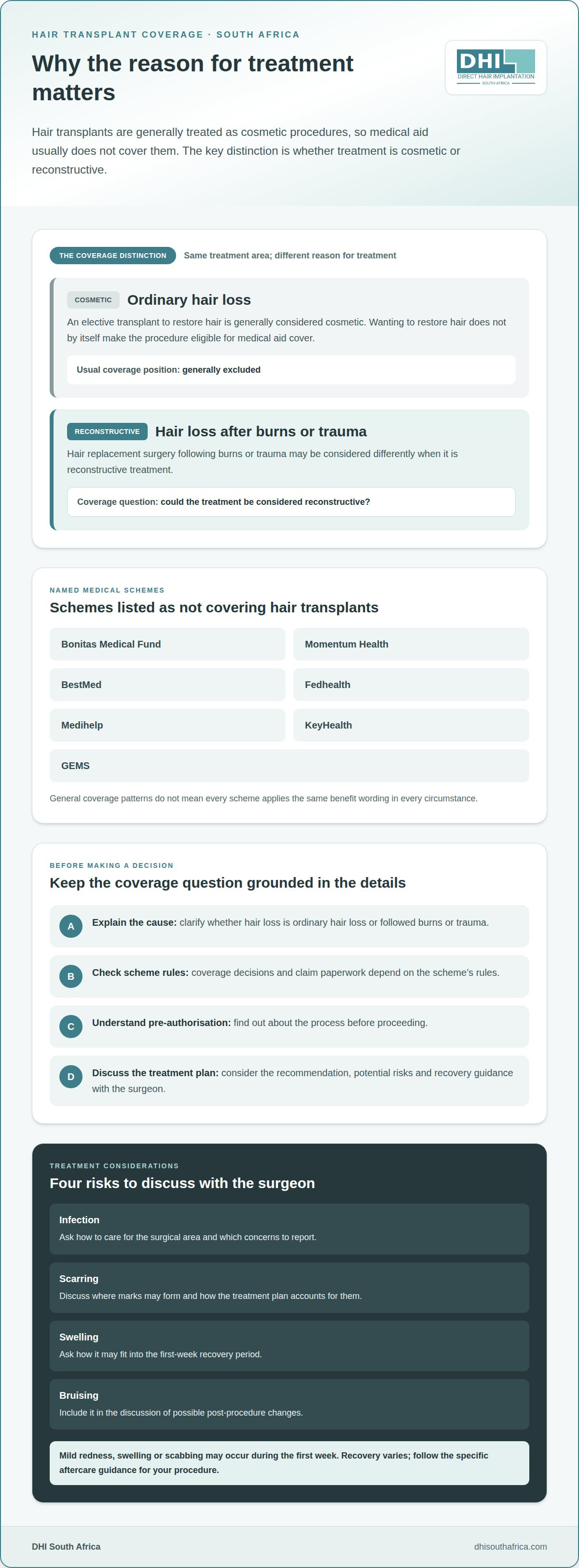
Coverage information for named medical aid schemes
Bonitas Medical Fund, Momentum Health, BestMed, Fedhealth, Medihelp, KeyHealth and GEMS are listed as not covering hair transplants. Their names provide a starting point for understanding the reported coverage position in South Africa.
Scheme-specific coverage information
Scheme-specific coverage information describes whether a named fund pays for hair transplantation. The listed position is that Bonitas Medical Fund, Momentum Health, BestMed, Fedhealth, Medihelp, KeyHealth and GEMS do not cover hair transplants. If you belong to one of these schemes, do not plan an elective transplant on the assumption that your medical aid will fund it.
The list gives an overview, but the reason for treatment also matters. A hair transplant sought for appearance differs from hair replacement surgery following burns or trauma, which may be considered reconstructive treatment. Keep these circumstances distinct when discussing the procedure and its purpose. For example, a clinical report describing trauma-related hair loss provides context that a routine description of thinning does not.
For a named scheme, organise the question around three details: your membership, the proposed treatment and its clinical purpose. A BestMed member considering an elective transplant can start from the listed exclusion. A Medihelp member whose hair loss followed trauma faces a different coverage question because the reconstructive context matters. This distinction helps avoid treating all transplant claims as identical.
Claim documents and pre-authorisation
Pre-authorisation is a scheme’s assessment of a proposed procedure before treatment. Claim documents explain the patient’s circumstances and planned care. These records matter because they show whether a request concerns an elective transplant or reconstructive treatment after burns or trauma. A clear file presents the reason for treatment alongside the proposed procedure.
Prepare focused information for a coverage request. Include your scheme and membership details, a description of the hair loss, its cause and the proposed treatment plan. For a reconstructive request, include relevant records describing the burns or trauma and resulting hair loss. A report should connect the cause with the area requiring treatment, rather than simply name a transplant.
Keep copies of the documents and any written response together. If your request relates to trauma, make sure the records clearly describe that connection. If it concerns an elective procedure, remember that the named schemes are listed as excluding hair transplants. Pre-authorisation paperwork presents the case; it does not turn an excluded cosmetic procedure into covered treatment.
Use the scheme name, treatment purpose and supporting records to understand the next step. For example, a request linked to trauma should focus on reconstructive need, while an elective hair transplant falls under the listed exclusion. Keeping the categories separate makes the coverage position easier to interpret.
Hair transplant claim: documents and pre-authorisation
A claim and pre-authorisation are different parts of a funding decision. Pre-authorisation means seeking a scheme’s view before treatment; a claim concerns payment for care under a benefit. Understanding the distinction helps you avoid treating an administrative response as proof that every cost will be paid.
First ask whether the proposed treatment falls within a benefit at all. An elective hair transplant is generally treated as cosmetic, while reconstructive hair replacement following burns or trauma may be considered differently. These categories describe the treatment’s purpose; they do not create a universal claim process or guarantee a particular outcome.
When reading a scheme communication, it helps to separate three ideas:
Eligibility: whether the treatment fits a benefit under the scheme’s rules.
Authorisation: the scheme’s response to a request made before treatment.
Payment: whether a claim is paid under the applicable benefit terms.
These ideas are related, but not interchangeable. Authorisation concerns a proposed procedure; a claim concerns payment. The distinction matters because “approved” can be understood too broadly if you assume it answers every question about payment. Read the response in the context of the treatment and benefit it addresses.
For an elective procedure, the general cosmetic exclusion is the central issue, not the amount of paperwork. The information you provide may help clarify the treatment’s purpose, but it does not guarantee coverage. For reconstructive treatment, the reason for the procedure is relevant to how the request is considered, but the possibility of cover does not establish what a particular scheme will pay.
Before making financial plans, frame the conversation around the proposed treatment and the decision you need. Are you asking whether the procedure falls under a benefit, whether it can be considered before treatment, or whether a submitted claim will be paid? Keeping these questions separate makes scheme wording easier to interpret and helps prevent assumptions based on a single response.
There is no single document checklist that applies across South African schemes. Avoid treating a generic list as a universal requirement. The scheme’s own terms and its response to the specific request are the relevant reference points, especially when the treatment’s purpose differs from an elective transplant.
In short, pre-authorisation is an advance assessment, while a claim concerns payment. Neither term promises funding automatically. Read the scheme’s decision carefully alongside the treatment purpose to plan more clearly, without assuming an administrative step changes the coverage category.
DHI South Africa: Direct Hair Implantation (DHI)
DHI South Africa offers Direct Hair Implantation (DHI) for people considering surgical hair restoration. If your next step is to explore treatment after reviewing medical aid coverage, a discussion can help clarify whether DHI fits your hair-restoration goals. The procedure is one option; non-surgical treatments may also be relevant to your concerns.
Alongside DHI, options include GFC Treatment, Regenera Activa and PRP Hair Loss Treatment. These are distinct approaches, so the right discussion starts with your hair-loss concerns and the outcome you hope to achieve. A consultation can help you understand the available pathways without assuming a transplant is the only option.
Make your next step a considered one
Separate your treatment goals from the funding question. If you are still weighing whether medical aid covers a hair transplant in South Africa, use that information to guide your planning without letting it define what you want for your hair. Consider what matters most: addressing a particular area, exploring different approaches or taking time to understand the change you hope to achieve.
Hair loss can feel deeply personal, and there is no need to rush a decision. A focused conversation about your priorities can help you identify which questions to ask and whether a treatment approach suits your needs. Give yourself space to reflect, clarify your expectations and make a considered choice.
A calm, informed next step is progress in its own right. You can move forward at a pace that feels right for you.
Frequently Asked Questions
Do South African medical aids cover hair transplants?
Usually, no for elective procedures. If you are weighing treatment, separate the clinical decision from your financial planning: do not assume a possible medical benefit will contribute to the procedure. Consider how you would manage the expense if the scheme does not pay, and distinguish a response about eligibility from a confirmed payment decision. This helps you plan without treating an anticipated benefit as available funds.
Are hair transplants considered cosmetic surgery by South African medical schemes?
Generally, yes. A transplant intended to address appearance is commonly treated as cosmetic, while reconstructive treatment is considered in a different context. Describe the reason for treatment accurately rather than relying on a broad label such as “hair restoration”. This distinction helps keep conversations about procedure type, clinical purpose and funding clear, especially when the same treatment term is used for different circumstances.
Which South African medical schemes or plans cover hair restoration?
The named schemes discussed in this article are listed as excluding hair transplants; none in that group is identified as covering the surgery. This answer concerns transplantation, not every product or treatment for hair loss. When comparing plan benefits, distinguish surgical transplantation from medication or non-surgical scalp treatments: coverage for one does not establish coverage for another.
Can medical aid cover a hair transplant for a medical condition or injury?
Coverage may be considered when hair replacement is reconstructive treatment for hair loss caused by burns or trauma. The cause matters because the request is considered in a reconstructive context, rather than as an elective change to appearance. Do not assume that any diagnosis associated with hair loss automatically qualifies; the relevant distinction is the connection between the injury and the proposed reconstruction.
What exclusions and waiting periods apply to hair transplant claims in South Africa?
Cosmetic-procedure exclusions are relevant to elective transplantation. A waiting period is a separate policy term that may affect when a benefit can be accessed; it is not the same as excluding a treatment category. Do not assume a particular waiting period applies to hair transplants. Read the wording for your plan and distinguish eligibility from any timing condition.
Can South African medical aid funds or gap cover pay for hair transplant surgery?
There is no general basis to assume that medical aid or gap cover will pay for an elective hair transplant. Gap cover is governed by its own policy wording, so its terms are not identical to a medical scheme’s benefits. Before relying on either in your budget, establish whether the specific procedure is eligible under that cover.
Are hair-loss treatments such as medication or scalp procedures covered by medical aid in South Africa?
Coverage for medication or scalp procedures cannot be inferred from the rules for transplant surgery. These treatments differ from an operation and may be assessed under different benefit terms. A medicine and an in-clinic scalp treatment, for example, are separate items to consider, not one general category of “hair restoration”. Do not assume that cover for one means cover for the other.
How can patients check hair transplant coverage with their medical scheme?
Ask a focused question about the exact procedure and why it is proposed. Request a clear explanation of whether the response concerns eligibility, pre-authorisation or payment, as these terms refer to different stages. Keep the scheme’s answer with your treatment-planning records and ensure it refers to the procedure you are considering. This helps prevent a general benefits discussion from being mistaken for a decision on your case.


Comments