%20(1).jpg)
%20(1).jpg)
Hair Transplant Donor Area Management: Protecting Your Lifetime Hair Supply

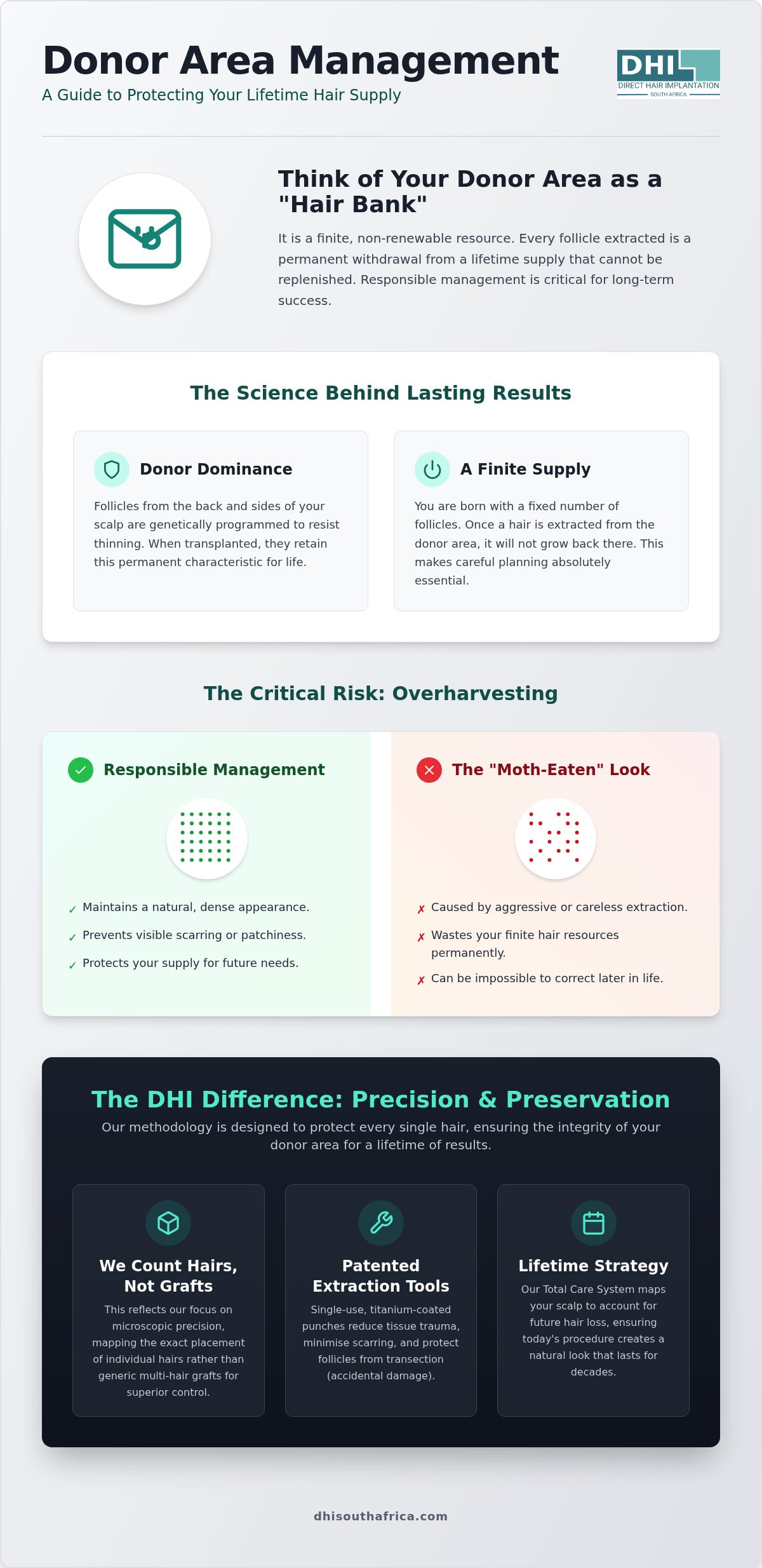
Think of the hair on the back of your head as a high-interest savings account rather than an endless well. Every follicle removed is a permanent withdrawal from a finite lifetime supply that cannot be replenished. This is why professional hair transplant donor area management is the most critical factor in your long-term restoration journey. If a clinic extracts too aggressively, you risk a patchy, moth-eaten appearance that no amount of clever styling can hide.
It's completely natural to feel anxious about visible scarring or the fear that a surgeon might overharvest your limited resources. You deserve the confidence that your hair bank is being managed with the highest level of clinical precision. This article explains how responsible extraction protocols preserve your supply for a lifetime of natural results. We'll explore the vital difference between reckless harvesting and the meticulous approach used by our HPCSA-registered doctors in South Africa to ensure your donor zone remains as healthy and dense as your new hairline.
Table of Contents
Understanding the Donor Area: Your Finite Natural Resource
The donor area is the horseshoe-shaped region at the back and sides of your scalp. In the field of Hair transplantation, this zone is revered because the follicles here are genetically programmed to grow for a lifetime. Unlike the hair on the top of your head, these follicles are resistant to the hormone DHT, which is the primary driver of male pattern baldness. This biological trait is known as donor dominance, meaning these hairs keep their permanent characteristics even when we move them to a thinning crown or a receding hairline.
To better understand this concept, watch this helpful video:
Think of this region as your personal "Hair Bank." It's a non-renewable resource that requires careful stewardship. Many patients come to us with deep anxiety about the "moth-eaten" or patchy look often seen after low-quality procedures. This happens when a clinic treats the donor area like an infinite well rather than a finite supply. Effective hair transplant donor area management ensures we protect your future options while achieving your goals today.
Why Your Donor Supply is Non-Renewable
Every human is born with a fixed number of hair follicles. When we perform a transplant, we aren't creating new hair; we are physically relocating it. Once a hair is extracted, the root is gone from that original spot forever. It won't grow back in the donor zone. This is why our specialists in South Africa prioritise calculating your total lifetime supply before a single extraction occurs. We must account for your future hair loss patterns to ensure you don't "spend" all your hairs in one session, leaving nothing for potential touch-ups as you age.
The Role of Hair Density and Scalp Laxity
Determining your donor capacity involves more than a quick visual check. We use high-resolution digital tools to measure exactly how many hairs you have per square centimetre. Some patients have high density but fine hair, whilst others have lower density but thicker hair shafts. Both factors influence how many hairs we can safely harvest without making the back of your head look thin. Donor capacity is the precise number of follicles that can be extracted without compromising the visual integrity and natural coverage of the donor site.
The Science of Donor Dominance and Why Precision Matters
The success of any restoration depends entirely on the survival of every follicle moved. In clinical literature such as Hair Transplantation - StatPearls, the "safe donor zone" is defined by its resistance to thinning, but accessing this zone requires extreme finesse. Precision is the difference between a successful transplant and a depleted donor area. If a surgeon lacks the right tools or expertise, they risk transection. This is the accidental cutting of the hair bulb during extraction. When a hair is transected, it's effectively destroyed. It won't grow in the new site and it's gone from the back of your head. This is a tragic waste of your finite supply.
Our approach ensures that every hair is treated with the respect it deserves. DHI specialists are trained to select specific hairs that will provide the best aesthetic coverage while leaving the donor area looking untouched. This meticulous selection process is a core pillar of effective hair transplant donor area management. It prevents the "see-through" look that occurs when too many hairs are taken from a single cluster.
Microscopic Precision in Extraction
DHI specialists focus on the three-dimensional exit angle of each hair. We don't just pull hairs out; we carefully navigate the depth and direction of the follicle. This level of care prevents "shock loss" in neighbouring hairs. When extraction is reckless, the surrounding tissue becomes inflamed, which can cause healthy, non-extracted hairs to fall out. By maintaining a "halo" of healthy tissue around each extraction site, we ensure the donor area remains vibrant and full. You can see the difference this level of care makes by viewing our patient results.
Counting Hairs vs. Grafts: A Crucial Distinction
Traditional clinics often talk about "grafts," but a graft can contain anywhere from one to four hairs. If you're quoted for 2,000 grafts, you might receive 3,000 hairs or 5,000 hairs, depending on the surgeon's selection. This ambiguity makes effective hair transplant donor area management nearly impossible. DHI South Africa prioritises the hair count. This allows for far more natural density planning. Pricing based on grafts can lead to misleading expectations and, more dangerously, the unnecessary "spending" of your donor resources. By focusing on individual hairs, we ensure every extraction serves a specific aesthetic purpose in your new hairline without overdrawing from your "hair bank."
FUE vs. DHI: Comparing Extraction Methods for Donor Preservation
While motorised Follicular Unit Extraction (FUE) is often marketed as a modern standard, it has inherent limitations when it comes to long-term scalp health. Many clinics use motorised punches to speed up the process, but this speed often comes at a cost. High-speed rotation can generate heat and mechanical vibration, which risks damaging the delicate follicles being extracted and the surrounding tissue. In contrast, the DHI patented extraction protocol prioritises manual control and microscopic precision. This is the cornerstone of superior hair transplant donor area management, ensuring that every hair is removed with minimal disruption to the donor site.
One of the most common complaints after aggressive motorised FUE is the appearance of "white dot" scarring. These circular, hypopigmented scars occur when the extraction tools are too large or the harvesting pattern is too dense. DHI avoids this by using significantly smaller tools and a strategic extraction pattern that maintains the natural look of your hair. Our approach is standardised through the DHI Total Care System, ensuring that every patient receives the same world-class level of donor safety across our South African clinics.
The DHI Titanium-Coated Punch Advantage
The quality of the extraction tool is just as important as the skill of the doctor. DHI uses specialised, single-use titanium-coated punches for every procedure. The titanium coating is a critical detail because it reduces friction and heat during the extraction phase. Less friction means less trauma to the skin and a higher survival rate for the hairs. Because these instruments are single-use, they're always at their peak sharpness. A dull punch requires more pressure to penetrate the skin, which increases the risk of damaging the follicle or causing unnecessary bruising. By using the sharpest, most refined tools available, we ensure the fastest possible healing for your scalp.
Recovery and Healing in the Donor Zone
Patients are often surprised by how quickly the donor area recovers after a DHI procedure. During the first 48 hours, you'll notice slight redness and tiny scabs where the hairs were removed. This is a normal part of the body's inflammatory response. However, because our technique causes minimal tissue trauma, these signs usually fade within a few days. Most of our patients find they can return to their professional lives much faster than those undergoing traditional surgeries. Understanding your hair transplant recovery time is essential for planning your journey, and our gentle extraction method is designed to make that journey as seamless as possible. This meticulous care is what defines responsible hair transplant donor area management at DHI South Africa.
Identifying Overharvesting: How to Protect Your Future Results
Overharvesting is a permanent medical error that occurs when too many follicles are extracted from the donor zone. It leaves the back of the head looking thin, patchy, or "see-through," a visual complication that no amount of styling can easily conceal. This condition is almost always the result of poor hair transplant donor area management, where a clinic prioritises immediate coverage over the long-term health of your scalp. While a restored hairline can change your life, the psychological toll of a ruined donor area can be equally heavy, often leading to regret and a loss of confidence.
You shouldn't have to choose between a full hairline and a healthy donor zone. Meticulous planning ensures that both areas remain aesthetically pleasing. In South Africa, the rise of unlicensed "dark clinics" has made this issue more prevalent. These providers often lack the clinical oversight to manage your "hair bank" responsibly. However, when your restoration is handled by experts, your donor area remains a resilient resource that can support multiple procedures over your lifetime as your natural hair loss progresses.
The Dangers of 'Graft-Hungry' Procedures
Low-cost clinics often market "mega-sessions" that promise to move thousands of hairs in a single day. While this sounds efficient, it's often a trap. Moving too much volume at once forces the surgeon to extract follicles in close proximity, which can create permanent bald patches. Responsible hair transplant donor area management requires a strategic "spacing" technique. By leaving enough healthy follicles between extraction sites, we maintain the visual density of the donor area. This ensures the back of your head looks naturally full, even under bright lights or when your hair is cut short.
Questions to Ask Your Surgeon About Donor Management
Before committing to a procedure, you must feel empowered to vet your medical team. In South Africa, hair restoration must be performed by a medical doctor registered with the Health Professions Council of South Africa (HPCSA). Use the following checklist during your consultation to ensure your donor supply is in safe hands:
Who is performing the extraction? At DHI, only certified doctors perform the procedure, not technicians.
How do you calculate my lifetime donor capacity? A specialist should use digital analysis to map your current density and future loss.
What is your transection rate? High-quality clinics aim for a survival rate above 90 percent, ensuring very few hairs are wasted during the process.
Long-Term Planning with DHI South Africa: Beyond the First Procedure
Restoration is a marathon, not a sprint. Whilst the immediate transformation of a new hairline is exhilarating, your scalp will continue to age and your hair loss patterns may evolve over the next decade. This is why the DHI Total Care System was developed. It provides a comprehensive framework that goes beyond simply filling a gap. We don't just look at where you're thinning today; we map your scalp to predict where you might lose hair tomorrow. This foresight is the ultimate form of hair transplant donor area management, ensuring you never "spend" your resources too early.
By integrating Direct Hair Implantation into a long-term strategy, we ensure that your donor resources are never exhausted prematurely. This forward-thinking approach separates a world-class medical institution from a high-volume clinic. You aren't just getting a procedure; you're securing a lifetime of natural density. We treat your donor area as a precious asset that must be managed with clinical precision to support your appearance as you age.
The 360-Degree Approach to Hair Restoration
We believe in a holistic strategy that prioritises the health of your existing follicles alongside those we move. This often involves combining your transplant with preventive treatments such as GFC (Growth Factor Concentrate) or PRP (Platelet-Rich Plasma) hair loss treatment. These therapies work to strengthen the donor area and improve the vascularity of the scalp, creating a more robust environment for transplanted hairs to thrive. By fortifying the "hair bank," we improve the quality of the hairs available for any future sessions.
We also utilise digital trichoscopy, which is a specialised microscopic analysis, to monitor your donor health over many years. This allows us to track hair diameter and density with scientific accuracy rather than guesswork. Our commitment to your results includes regular follow-ups for up to 18 months. These sessions ensure that your healing is perfect and that the hair transplant donor area management plan we created is delivering the expected longevity.
Your Journey Starts with a Scientific Diagnostic
Every successful restoration begins with a deep-dive consultation. This is a medical assessment where we count every hair and design an aesthetic design that matches your facial structure. We take pride in our transparency regarding your donor capacity. If your "hair bank" is limited, we'll tell you honestly and adjust the plan to ensure the most natural result possible without overharvesting.
Choosing a clinic is a significant decision that affects your appearance for life. You deserve a partner who values medical ethics and research as much as artistic precision. If you're ready to understand the true potential of your hair and how to protect it for the future, the first step is a professional assessment. We invite you to contact DHI South Africa to begin your personalised journey with a team that puts your long-term confidence first.
Securing the Future of Your Natural Hairline
Your journey toward restoration shouldn't compromise the health of your scalp. By prioritising precise hair transplant donor area management, you ensure that your finite "hair bank" remains a resilient resource for years to come. We've explored how the DHI technique moves beyond simple graft counts, focusing instead on the microscopic survival of every individual hair. This scientific approach preserves your options for the future while delivering immediate density.
Our certified medical doctors use patented single-use titanium-coated punches and the DHI Implanter to maintain total control over depth, angle, and direction. This meticulous protocol is why we achieve a graft survival rate of over 90 percent, ensuring that very few of your precious hairs are wasted. You can move forward with the confidence that your results will look seamless, both in the new hairline and the donor zone.
Take the first step toward a permanent transformation with a team that values your long-term aesthetic health and medical safety.
You deserve a sophisticated solution that stands the test of time and restores your self-assurance for life.
Frequently Asked Questions
What exactly is donor area overharvesting in a hair transplant?
Overharvesting is a permanent medical complication where too many follicles are extracted from the donor site, leading to a visible "see-through" or patchy appearance. It typically happens when clinics prioritise high volume over long-term scalp health. Effective hair transplant donor area management involves spacing out extractions to ensure the remaining hair provides enough coverage to hide the extraction points. This is why we prioritise medical expertise over volume-driven "mega-sessions."
Does the hair in the donor area grow back after extraction?
No, the hair follicles extracted from the donor area don't grow back in their original location. When we move a hair, the entire root is relocated to the recipient site. This is why your donor area is considered a finite resource. Because the supply is non-renewable, our doctors meticulously map your scalp to ensure we only harvest what's necessary to achieve a natural result without depleting your future "hair bank."
How many hairs can safely be taken from the donor area?
The number of hairs that can be safely harvested varies for every individual and depends on your specific hair density and scalp laxity. On average, a person may have between 6,000 and 10,000 hairs available in the permanent donor zone. However, we never extract more than a safe percentage in a single session. Our goal is to maintain the visual integrity of the donor site so it looks untouched after healing.
Will I have visible scars at the back of my head after a DHI transplant?
DHI procedures are designed to be scar-free because we use specialised, single-use titanium-coated punches with very small diameters. Unlike traditional strip surgery that leaves a linear scar, or aggressive motorised extraction that can cause "white dot" scarring, our technique leaves microscopic points that heal quickly. These points are virtually invisible to the naked eye once the surrounding hair grows back, even with shorter hairstyles.
Can a damaged or overharvested donor area be repaired?
While the lost follicles can't be replaced, the appearance of an overharvested donor area can often be improved using Scalp Micropigmentation (SMP). SMP uses medical-grade pigment to replicate the appearance of hair follicles, effectively camouflaging the patchy or thin areas. In some cases, if there's still enough density elsewhere, a limited redistribution of hairs might be possible, though prevention through responsible hair transplant donor area management is always the best approach.
How long does the donor area take to heal after a DHI procedure?
The donor area typically begins to look normal within three to seven days after a DHI procedure. You might experience minor redness or tiny scabs in the first 48 hours, but these heal rapidly due to the minimal tissue trauma caused by our refined tools. Most patients feel comfortable returning to their daily routines almost immediately. We provide a structured after-care protocol to ensure perfect healing and long-term scalp health.
Why does DHI have a higher graft survival rate than traditional FUE?
DHI achieves a graft survival rate of over 90 percent because it reduces the time follicles spend outside the body and minimises handling. In traditional motorised FUE, follicles are often subject to mechanical heat or vibration during extraction and multiple handling steps before implantation. Our patented protocol involves a single-step implantation using the DHI Implanter, which protects the delicate hair bulb and ensures every hair is placed with the correct depth and angle.
Is it possible to use body hair as a donor source if my scalp supply is low?
Yes, beard or body hair can sometimes be used as a secondary donor source if the scalp supply is insufficient. Beard hair is often the preferred alternative because it's typically thicker and has a similar growth cycle to scalp hair. However, this is only considered after a thorough clinical diagnostic. Our doctors will assess the quality and density of these alternative sources to ensure they'll blend naturally with your existing hair.


Comments