%20(1).jpg)
%20(1).jpg)
Permanent Hair Loss Clinic: Reclaiming Your Confidence with Direct Hair Restoration
- Dhesan Moodley

- 13 minutes ago
- 12 min read
What if the secret to a full head of hair isn't found in a "miracle" lotion, but within the genetic resilience of your own follicles? You've likely spent months navigating a maze of conflicting medical jargon and shampoos that promise much but deliver very little. It's exhausting to check the mirror every morning for progress that never arrives, especially when you're feeling anxious about how thinning hair affects your professional image. Choosing a specialised permanent hair loss clinic is about moving past these temporary frustrations and towards a medically-backed restoration that offers a lifetime of confidence.
We agree that you deserve a solution that's as permanent as it is natural. This article will show you how to achieve a dense, seamless hairline through techniques that prioritise both medical safety and aesthetic artistry. We'll explore the DHI method, where certified doctors carefully manage the placement of thousands of hairs to ensure a survival rate of over 90%. You'll learn how this sophisticated approach provides a discreet recovery with no visible scarring, giving you the tools to reclaim your self-assurance without the fear of unnatural results.
Table of Contents
What Defines a Permanent Hair Loss Clinic?
A permanent hair loss clinic is a medical facility specialising in autologous hair transplantation. When you step into this type of environment, the focus shifts from hope-based marketing to evidence-based science. Unlike general aesthetic centres, a permanent hair loss clinic prioritises the long-term viability of every follicle moved. It isn't about a quick fix that washes out in the shower; it's about a medical intervention that changes the landscape of your scalp for good. We often see patients who have spent years on "miracle" cures, only to realise that true restoration requires a clinical approach.
To better understand this concept, watch this helpful video:
Management vs Restoration: Knowing the Difference
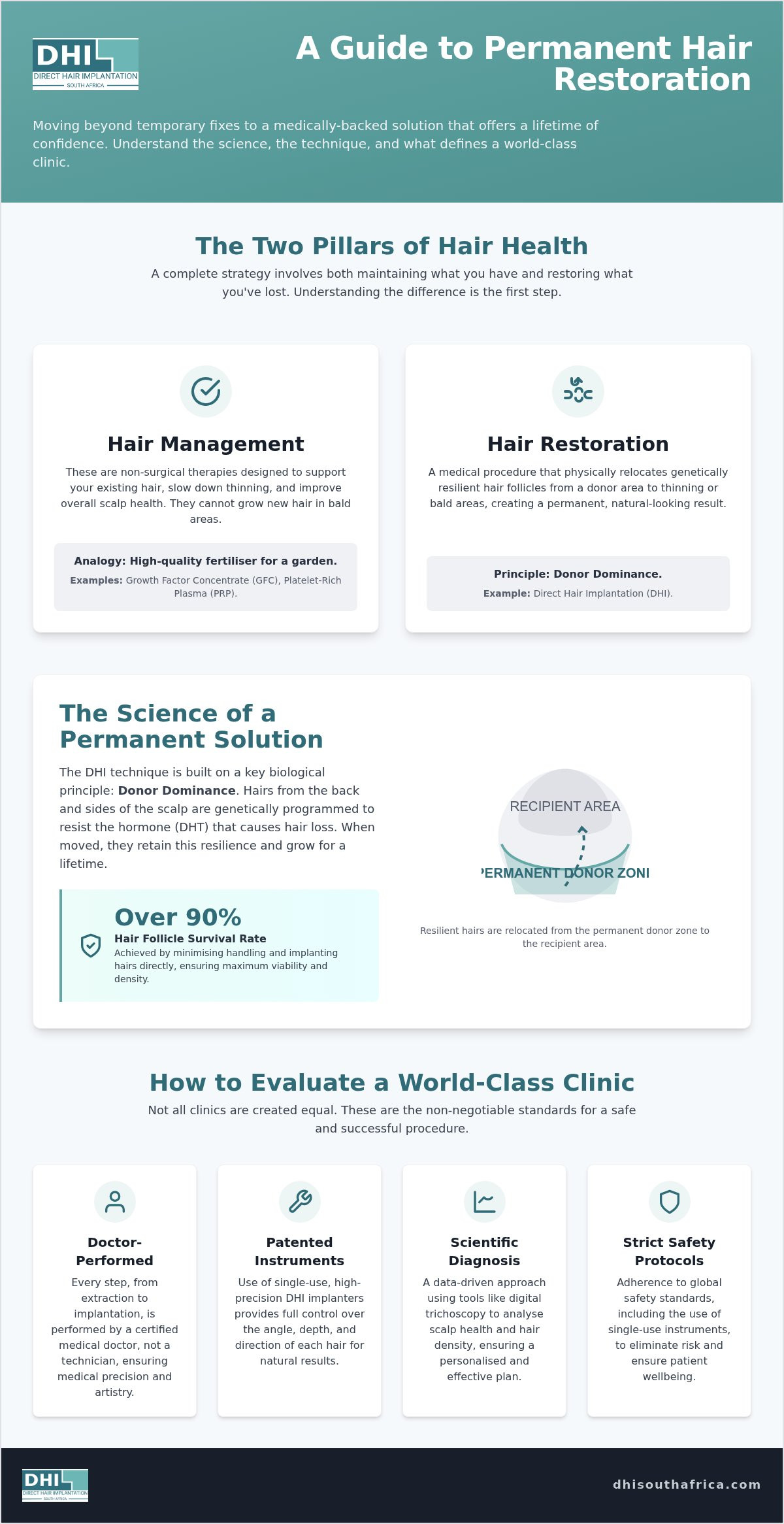
It's helpful to think of your hair journey in two distinct phases: management and restoration. Management involves maintenance therapies like Platelet-Rich Plasma (PRP) or Growth Factor Concentrate (GFC). These treatments are fantastic for supporting your existing hairs and slowing down the thinning process, but they can't bring back what's already gone. They act like a high-quality fertiliser for a garden that's still growing. Restoration, on the other hand, is the physical relocation of follicles that are genetically resistant to DHT, the hormone responsible for male pattern baldness.
This specialised surgical technique relies on the principle of donor dominance. Hairs taken from the back and sides of your head are "hard-wired" to grow for a lifetime, regardless of where they're moved. Whilst maintenance therapies keep your current hair healthy, restoration fills the gaps. A sophisticated aesthetic result usually comes from a combination of both; we restore the hairline with new hairs and manage the surrounding area to prevent future thinning.
The Role of the Medical Specialist
One of the most critical markers of a world-class clinic is who actually performs the procedure. In many budget-focussed facilities, technicians handle the delicate work of implantation. In a dedicated permanent hair loss clinic, every step should be performed by a certified medical doctor. The artistry involved in determining the angle, depth, and direction of thousands of hairs is a medical task that requires years of specialised training. It's the difference between a hairline that looks "pluggy" and one that is indistinguishable from nature.
Before any procedure, it's vital to understand hair loss causes through a proper medical lens. We use diagnostic tools like digital trichoscopy, which is a high-magnification scalp analysis, to measure hair density and follicle health. This data-driven approach ensures we aren't just guessing. By choosing a doctor-led clinic, you're placing yourself in a "safe pair of hands" where medical ethics and patient safety always come before sales targets.
The Science of Permanence: Why Direct Hair Implantation Lasts
The foundation of any reputable permanent hair loss clinic lies in a biological principle known as "Donor Dominance." If you look at most men experiencing thinning, you'll notice that the hair on the back and sides of the head usually remains thick and healthy. These specific hairs are genetically programmed to resist the effects of Dihydrotestosterone (DHT), the hormone responsible for shrinking follicles. Understanding hair follicle development and regeneration is key to appreciating why these hairs remain permanent even after they are relocated to the top of the scalp. Once they are moved, they retain their genetic "memory" and continue to grow for a lifetime.
Whilst traditional methods often involve handling the follicles multiple times, the DHI technique uses a refined, single-step implantation process. This approach is designed to protect the delicate life force of each hair. By minimising the handling of the follicles, we achieve a survival rate of over 90%, which is significantly higher than the industry average of 50-60% seen in older methods. By utilising the specialised DHI Implanter, our certified doctors maintain absolute control over the angle, depth, and direction of each follicle, which is essential for creating a dense, natural-looking result that lasts a lifetime.
Protecting the Biological Integrity of Hairs
The vitality of a hair depends heavily on its "out-of-body" time. In a permanent hair loss clinic, we prioritise keeping this window as short as possible. We use autologous micro-grafting, which simply means using your own biological material to ensure there is no risk of rejection. Our patented titanium-coated punches are incredibly fine; they allow for the extraction of hairs with minimal trauma to the surrounding tissue. This level of precision means your scalp heals much faster, and the biological integrity of the hair remains intact, ensuring it thrives in its new location.
Achieving Undetectable Density
True artistry in hair restoration is about more than just filling gaps; it's about matching the unique growth pattern of your original hair. We don't just talk about "grafts" in a clinical, detached way. Instead, we focus on the precise placement of thousands of individual hairs to create the right density and flow. This meticulous planning ensures that your new hairline looks completely natural, even under close inspection. If you're curious about how this translates to real-world outcomes, you can View our natural hair transplant results to see the seamless transitions we achieve.
If you're wondering whether your donor area is strong enough for this type of restoration, you might want to explore our diagnostic approach to get a clearer picture of your options.
Comparing Permanent Restoration to Maintenance Therapies
Deciding on a therapy often feels like a balancing act between immediate cost and long-term longevity. Maintenance therapies like Platelet-Rich Plasma (PRP) and Growth Factor Concentrate (GFC) offer excellent support for existing hairs, but they aren't a final solution for areas where the scalp is already visible. A specialised permanent hair loss clinic focuses on the physical relocation of follicles, whereas maintenance therapies simply nourish what you already have. For those dealing with hereditary-pattern baldness, understanding that non-surgical options cannot "grow" hair on a completely smooth scalp is vital for managing expectations. We also utilise Regenera Activa, which stimulates self-regeneration using your own tissue cells, to jump-start follicle health during the early stages of thinning.
When we look at the financial commitment, the numbers tell an interesting story. One-time restoration through DHI may seem like a larger upfront investment, but it eliminates the need for decades of expensive topical applications or recurring clinic visits. Lifetime maintenance can quickly surpass the cost of a permanent procedure without ever providing the same level of density or permanence. It's about choosing between a recurring expense and a permanent asset.
When to Choose Non-Surgical Solutions
Non-surgical treatments have a specific, valuable place in a comprehensive care plan. GFC therapy is a brilliant option for revitalising follicles before they become dormant, making it ideal for those who have only just noticed their hair is losing its volume. We also use Scalp Micropigmentation (SMP) to create a sophisticated visual illusion of density for patients who prefer a non-invasive approach. These specialised treatments also serve a dual purpose by protecting your non-transplanted hairs after a procedure, ensuring your overall look remains thick and uniform as you age.
The Limitations of Topical and Oral Medications
Many patients arrive at our clinic after years of using oral medications or foams. Whilst these can be effective for some, they require a lifetime commitment; if you stop the treatment, the results often vanish within months. The "shedding phase" often associated with these chemical treatments can also trigger significant anxiety for men already worried about their appearance. Transitioning from "hiding" your thinning to "fixing" it permanently allows you to step away from the cycle of daily chemical applications. It is a shift from managing a condition to reclaiming your natural hairline for good.
How to Evaluate a Permanent Hair Loss Clinic in South Africa
Choosing a permanent hair loss clinic in South Africa is a decision that requires both your head and your heart. Whilst it's natural to feel an emotional pull toward a quick fix, your priority must be clinical excellence and long-term safety. Start by confirming that the facility is registered with the Health Professions Council of South Africa (HPCSA). This isn't just a suggestion; it's a legal requirement that ensures your doctor is qualified to perform surgical procedures. You should verify that a certified medical doctor, rather than a technician, will be performing the entire implantation process. This level of oversight is what separates a world-class institution from a high-volume hair mill.
Enquire deeply about the technology and hygiene standards used during the procedure. A premium permanent hair loss clinic will utilise single-use, patented instruments like the DHI Implanter, which allows for absolute precision without the need for prior incisions. This "lunch-hour" approach reduces trauma and speeds up your recovery time significantly. Don't be afraid to ask for data on hair survival rates. A clinic that can't or won't provide evidence of a survival rate above 90% may not be using the most advanced techniques available today. Whether a doctor is performing a placement of 4,000 hairs or a minor touch-up, the tools they use define the final aesthetic result.
Safety Benchmarks and Clinical Standards
ISO certifications are the benchmark for quality management, and they're especially vital in a medical setting. You should look for a clinic that operates under a Total Care System, which includes 18 mandatory safety checks designed to protect your health. These protocols cover everything from the initial diagnostic phase to the post-operative care. We often use digital trichoscopy, which is a high-definition scalp analysis, during these checks to ensure your donor area is healthy enough for a successful procedure. By choosing a facility that meets these international standards, you're ensuring that your journey is as safe as it is successful.
Transparency in Results and Reviews
Transparency is the hallmark of a trusted medical partner. When you browse "Before and After" galleries, pay close attention to the photography. A professional clinic will use standardised angles and lighting to show you the most accurate results possible. Avoid galleries that look overly filtered or inconsistent. We encourage you to Read our patient reviews to get a sense of the personal care and professionalism you can expect from our global network. South Africa is becoming a global destination for hair restoration, so you have access to world-class care right here in Johannesburg or Cape Town.
DHI South Africa: A Global Standard in Permanent Restoration
DHI South Africa isn't just a local practice; it's the gateway to a prestigious global network of over 75 clinics spanning 45 countries. This international presence means that when you visit our permanent hair loss clinic, you're benefiting from decades of collective research and refined medical protocols. Our Total Care System isn't a mere checklist. It's a 360-degree approach that ensures every patient receives the same world-class standard of care, whether they're in London, Athens, or Johannesburg. Our 99% customer satisfaction rate stands as a powerful testament to this clinical excellence and our commitment to life-changing results.
The expertise we bring to South Africa is rooted in specialised education. Every one of our specialists undergoes rigorous training at the DHI Academy, the only international institution dedicated solely to the artistry and science of hair restoration. This ensures that every doctor masters the patented Direct Hair Implantation technique before they ever treat a patient. By choosing a global leader, you're placing your trust in a "safe pair of hands" that values safety and ethics above all else.
The DHI Aesthetic Advantage
The hallmark of our technique is what we often call the "lunch-hour" restoration experience. Because we use the patented DHI Implanter, there are no stitches, no scars, and virtually no downtime. This specialised tool gives our doctors full control over the angle, depth, and direction of every hair, ensuring a seamless finish that is completely undetectable from your original hair. To understand why this level of precision is the industry gold standard, you can read more about Choosing an Elite Hair Transplant Clinic and the protocols we uphold.
Your Journey to Restoration
Your path to reclaiming your confidence begins with a comprehensive consultation. We perform a digital scalp analysis, which is a detailed microscopic evaluation, to assess your hair density and donor health. This data allows us to create a personalised restoration plan tailored to your specific needs. Our commitment to your results extends far beyond the procedure day through a structured monitoring process that includes:
Initial diagnostic digital scalp analysis to evaluate follicle health.
Personalised hairline design performed by certified medical doctors.
Structured after-care and hygiene protocols for a discreet recovery.
Long-term monitoring and follow-up sessions for up to 18 months.
This methodical follow-up ensures your new hairs are thriving and that you feel supported at every stage of your transformation. We invite you to take the first step towards a permanent solution. Book your consultation at DHI South Africa to begin your journey with a world-class team.
Take Charge of Your Hair Restoration Journey
We've explored how a specialised permanent hair loss clinic utilises the biological resilience of your own follicles to provide a final solution for thinning. You now understand that Direct Hair Implantation moves beyond the limitations of daily medications, offering a sophisticated path to a natural hairline. By selecting a facility that upholds ISO-accredited medical standards and Red Dot Award-winning design protocols, you're ensuring that your restoration is both safe and artistically precise.
Our focus on clinical excellence results in a hair survival rate of over 90%, which far exceeds traditional industry averages. It's time to stop merely managing the loss and start investing in a permanent asset that restores your self-assurance. This transition from temporary fixes to a medically-backed solution is the key to achieving results that look natural and last a lifetime.
Reclaiming your confidence is a journey that deserves the attention of a global expert. We're here to provide the clarity and compassionate care you need to look and feel your best again.
Frequently Asked Questions
Is the hair restoration truly permanent?
Yes, the results are permanent because we use follicles that are genetically resistant to the hormones that cause thinning. These hairs are harvested from the "donor area" at the back of your head, where they are biologically programmed to grow for a lifetime. Even after they are moved to a new location, they retain this genetic resilience and continue their natural growth cycle indefinitely.
How many hairs will I need for a full restoration?
The exact number of hairs depends entirely on the size of the thinning area and your desired density. A minor refinement of the hairline might require the placement of 1,500 to 2,000 hairs, whilst more extensive restoration can involve 4,000 hairs or more. We determine the precise requirement during a digital scalp analysis to ensure we achieve a result that looks both thick and natural.
What is the recovery time after a procedure at a permanent hair loss clinic?
Most patients are able to return to their professional routine within two to three days. Because the DHI technique is minimally invasive and requires no scalpels or stitches, the healing process is remarkably swift. You may notice some slight redness in the first 48 hours, but this typically fades quickly, allowing for a very discreet recovery process.
Will the transplanted hair look natural?
Your new hair will look completely natural because our certified doctors have absolute control over the angle, depth, and direction of every placement. By using the specialised DHI Implanter, we can match the unique growth pattern of your original hair. This level of precision ensures that the transition between your existing hair and the restored areas is seamless and undetectable.
Can women receive treatment at a permanent hair loss clinic?
Yes, women are excellent candidates for restoration, particularly when dealing with female pattern thinning or high hairlines. We often employ specific protocols that allow us to increase density without the need to shave the entire head. This makes the procedure a popular choice for women seeking a permanent solution to thinning whilst maintaining their current hairstyle.
How do I know if I am a good candidate for a hair transplant?
The best way to determine suitability is through a professional consultation and a digital scalp analysis. We evaluate the health of your donor area and the stability of your hair loss to ensure a successful outcome. Generally, anyone with healthy hair growth at the back and sides of their head can benefit from a procedure at a permanent hair loss clinic.
Are there any risks involved in permanent hair restoration?
Minor risks such as temporary swelling or redness are common but usually resolve within a few days of the procedure. Because we use your own biological material, there is no risk of rejection or an allergic reaction. Our facilities follow strict ISO safety standards and 18 mandatory clinic checks to ensure that every procedure is as safe as it is effective.
Does the procedure hurt?
You won't feel any pain during the implantation because the procedure is performed under a local anaesthetic. Most patients find the experience quite comfortable and spend the time watching a film or relaxing whilst the doctor works. After the anaesthetic wears off, any mild tenderness can usually be managed with standard over-the-counter medication.


Comments