%20(1).jpg)
%20(1).jpg)
Regenera Activa for Female Hair Loss: A Clinical Guide

Updated: 13 hours ago
What if the most reliable way to halt a widening hair parting didn't involve surgical incisions, shaved donor areas, or endless bottles of biotin? If you've spent months watching your crown volume diffuse whilst testing topical serums that fail to deliver measurable results, your frustration is entirely valid. Exploring regenera activa for female hair loss offers a scientifically validated turning point, designed specifically for women seeking meaningful restoration without dramatic downtime.
You shouldn't have to choose between invasive, scar-inducing procedures and unproven remedies. In this guide, discover how autologous micrografting with Regenera Activa restores female hair density using your body’s own regenerative cells to arrest follicular miniaturisation; the biological process where follicles gradually shrink and produce progressively finer strands. We'll walk you through how this lunch-hour treatment works, explore its verified safety profile, and outline the clinical timeline you can expect as thicker, healthier hairs return to your scalp.
Table of Contents
Understanding Female Hair Thinning and How Follicular Miniaturisation Occurs
What Is Regenera Activa and How Does Autologous Micrografting Work?
Regenera Activa vs PRP, GFC, and Hair Implantation: Choosing Your Treatment
What Results Can Women Expect from Regenera Activa? Timelines and Longevity
The Patient Journey: Determining Your Candidacy and Preparing for Treatment
Understanding Female Hair Thinning and How Follicular Miniaturisation Occurs
Catching sight of a wider parting under bright bathroom downlights brings an immediate, sinking feeling. Hair loss carries immense emotional weight, yet society frequently overlooks how deeply diffuse shedding impacts female identity and daily confidence. Unlike male thinning, which typically creates receding temples or distinct bald spots, female pattern hair loss spreads evenly across the mid-scalp and crown while preserving the frontal hairline.
At the heart of this progression lies the biological mechanism of androgenetic alopecia and follicular miniaturisation. When individual follicles become sensitive to circulating hormones, their blood supply constricts and their growth cycles degrade. Exploring modern protocols like regenera activa for female hair loss helps halt this decline before miniaturised follicles undergo permanent scarring, preserving the hairs you still have.
To better understand how cellular micrografting addresses these biological changes directly, watch this doctor-led clinical explanation:
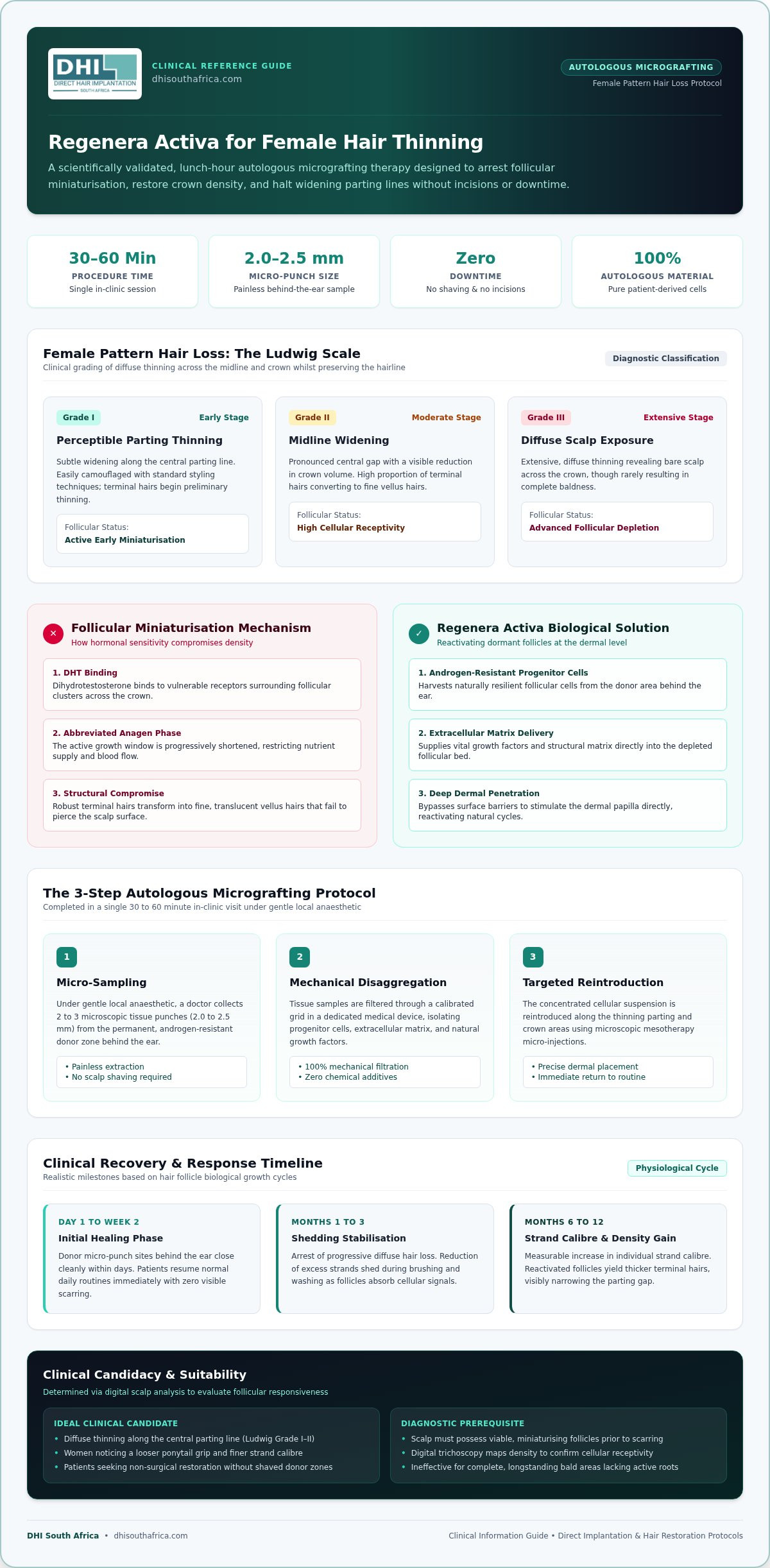
Specialists grade this diffuse pattern using the Ludwig scale:
Grade I: Perceptible thinning along the central parting, easily camouflaged with styling.
Grade II: Pronounced widening of the midline with a visible reduction in crown volume.
Grade III: Extensive, diffuse thinning revealing scalp skin, though rarely causing complete baldness.
The Biology of Androgenetic Alopecia in Women
Miniaturisation occurs when dihydrotestosterone (DHT) binds to susceptible receptors around follicular clusters. This interaction progressively abbreviates the anagen phase; the active growth window of the hair follicle. With each shortened cycle, hairs emerge finer, lighter, and structurally compromised, eventually failing to penetrate the scalp surface entirely.
Recognising the Warning Signs of Progressive Miniaturisation
Subtle physical indicators usually emerge months before actual density vanishes. You might observe a looser ponytail grip, excess strands collecting on pillows, or terminal hairs transforming into translucent vellus hairs. Cosmetic serums cannot reverse this shift because topical molecules cannot penetrate deeply enough into the dermal papilla. That biological barrier explains why regenera activa for female hair loss targets the tissue bed directly, delivering concentrated cellular signals right where follicles require renewal.
What Is Regenera Activa and How Does Autologous Micrografting Work?
Regenera Activa is an autologous micrografting protocol that reactivates miniaturising hair follicles using your scalp's own regenerative biological material. While surface-level serums cannot penetrate deep tissue layers, this treatment delivers active cellular support directly into the follicular bed. Clinical consensus, including the American Academy of Dermatology guidance on female pattern hair loss, emphasises that protecting existing hair roots early prevents permanent structural depletion.
Completed in 30 to 60 minutes, the procedure follows three precise clinical steps:
Micro-sampling: Under gentle local anaesthetic, a doctor takes two or three tiny tissue punches (2.0 to 2.5 mm) from the androgen-resistant zone behind the ear.
Mechanical disaggregation: A specialised medical device mechanically filters the tissue through a calibrated grid, isolating vital progenitor cells, extracellular matrix, and natural growth factors without chemical additives.
Targeted reintroduction: The resulting cellular suspension is reintroduced into thinning areas along your parting and crown using microscopic mesotherapy needles.
The Science of Autologous Progenitor Cells
Autologous simply means biological material harvested entirely from your own body. Once reintroduced, these progenitor cells stimulate neo-vascularisation, the rapid development of new micro-capillaries around starved hair roots. Supplying dormant follicles with fresh oxygen and nutrients helps push them back into active production. Because the solution uses your own cells, there is zero risk of allergic rejection or systemic reaction. For those interested in how specialised medical centres provide advanced cellular therapies as a non-surgical alternative, check out Medica Komórki Macierzyste.
The Lunch-Hour Procedure: Step-by-Step Patient Experience
Patient comfort remains paramount from start to finish. The retroauricular harvest area is completely numbed beforehand, meaning you feel negligible discomfort during sampling. There is no head-shaving, no scalpels, and no stitching. The microscopic punch sites close on their own within days beneath your hair, letting you return to work immediately without visible bandages or social downtime.
Safety Standards and Clinical Rigour
Treatments are performed exclusively by qualified medical doctors utilising single-use, sterile processing kits to ensure uncompromising clinical safety. Choosing regenera activa for female hair loss provides a safe, drug-free pathway to revitalise thinning hair naturally. If you want to understand how cellular therapy fits your pattern, exploring accredited hair restoration treatments can help clarify the right biological path for your scalp.
Regenera Activa vs PRP, GFC, and Hair Implantation: Choosing Your Treatment
Selecting the right clinical intervention depends on whether your hair follicles are currently miniaturising or have ceased functioning altogether. Patients often confuse blood-derived therapies, tissue-derived cellular concentrates, and surgical procedures. Each treatment serves a distinct biological purpose, and matching your specific pattern of loss to the correct protocol ensures predictable results.
To help clarify the core differences, the following matrix compares these four clinical approaches side by side:
Regenera Activa: Harvests scalp tissue micro-biopsies containing progenitor cells and vascular stromal cells. Administered as a single in-clinic session lasting 12 to 24 months for early-to-moderate thinning.
Platelet-Rich Plasma (PRP): Uses centrifuged whole blood to extract platelets and growth factors. Requires monthly injections over three to four months, followed by quarterly maintenance sessions.
Growth Factor Concentrate (GFC): Processes a small blood draw (under 15 to 18 ml) to extract concentrated growth factors without platelets. Typically completed in three to four targeted sessions for diffuse thinning.
Direct Hair Implantation (DHI): Meticulously extracts individual healthy hairs from the donor area and implants them directly into bare patches. Delivers permanent follicle survival above 90% for areas with complete hair loss.
Autologous Micrografts vs Blood-Derived PRP and GFC
While PRP and GFC supply circulating healing factors, they originate from blood rather than scalp architecture. Micrografting takes cells directly from your permanent hair-bearing zone. These progenitor cells carry intrinsic genetic signalling designed specifically to support follicular structures and stimulate vascular renewal. Exploring advanced hair loss solutions provides further clinical context on how these cellular mechanisms diverge.
For patients experiencing widespread thinning across the crown, combining biological therapies often yields superior tissue priming. GFC therapy helps calm active scalp inflammation, while autologous micrografts deliver long-term inductive signals directly to struggling hair roots.
When Is Non-Surgical Therapy Preferred Over Surgical Hair Implantation?
Non-surgical cellular therapy works exclusively on existing, struggling follicles. It cannot regenerate hairs where follicles have fibrosed and disappeared entirely. When bare scalp skin becomes visible and no dormant roots remain, Direct Hair Implantation is necessary to restore density by placing individual donor hairs into the depleted zones.
Conversely, undergoing regenera activa for female hair loss is ideal when hairs are still present but shrinking in diameter. Reading our compassionate guide to female hair loss treatment illustrates how early non-surgical preservation protects your natural coverage, helping you avoid or postpone surgery altogether.
What Results Can Women Expect from Regenera Activa? Timelines and Longevity
Biological regeneration works in harmony with natural follicular cycles rather than providing an artificial overnight fix. Because cellular restoration operates from within the deep dermal layers, visible changes unfold gradually. Understanding the timeline for regenera activa for female hair loss helps set honest, reassuring expectations as your scalp transitions back toward healthy growth.
Clinical improvements generally progress through distinct biological milestones:
Months 1 to 2: Excessive daily hair shedding decelerates visibly. Follicular micro-inflammation subsides, creating an optimised micro-environment across the crown.
Months 3 to 6: Existing miniaturised hairs begin to thicken. Strands gain increased structural calibre, and early nascent hairs start breaking the scalp surface.
Months 9 to 12: Peak cosmetic density and volume become evident. The central parting appears noticeably tighter, and scalp visibility beneath direct light is reduced.
For most women, the therapeutic benefits of a single autologous micrografting session endure for 12 to 24 months. At that stage, a routine clinical review determines whether a maintenance session is warranted to sustain follicular vigour.
The Biological Timeline of Hair Regeneration
Visible changes require patience because dormant follicles must transition through the telogen phase; the resting interval of the hair follicle. During the initial four to eight weeks, you might even notice a brief, mild increase in hair fall. Don't be alarmed by this response. It signifies that newly stimulated roots are shedding weak, telogen-stage hairs to clear the pathway for stronger, anagen-phase growth.
Maximising and Sustaining Your Micrografting Results
Protecting your follicular investment involves sensible everyday scalp care. In the months following treatment, doctors often recommend complementary medical hair-loss lotions, gentle washing techniques, and balanced nutritional support to keep follicular cells well nourished. When monitoring outcomes from regenera activa for female hair loss, scheduling a diagnostic review at month six allows your clinician to track follicular diameter changes accurately with digital imaging.
The Patient Journey: Determining Your Candidacy and Preparing for Treatment
Every successful hair restoration plan begins with an accurate clinical picture. Before scheduling any procedure, a specialist must verify whether your thinning stems from reversible follicular distress or permanent cellular depletion. Undergoing regenera activa for female hair loss offers an effective, biologically sound pathway for women whose follicles retain cellular viability, but clear candidacy rules apply.
Clinicians evaluate prospective patients based on specific dermatological criteria:
Strong Candidates: Women experiencing Ludwig Grade I or II diffuse thinning, postnatal density drops that fail to rebound, or perimenopausal hormone-related hair changes.
Poor Candidates: Patients presenting with complete follicular fibrosis, advanced scarring alopecias like frontal fibrosing alopecia, active scalp infections, or systemic autoimmune flares.
Preparation Protocol: Refrain from chemical colouring or harsh exfoliants for one week prior, and avoid non-steroidal anti-inflammatory medications for forty-eight hours to promote optimal vascular healing.
Ideal Candidates for Autologous Micrografting
If you're noticing your parting broaden or your crown hair feeling wispy under strong sunlight, you're likely in the sweet spot for treatment. Because this biological therapy requires zero head-shaving and leaves no perceptible markings, working professionals can complete their session and return to work the same afternoon. Miniaturised follicles respond best when caught early, preserving your native coverage before strands disappear permanently.
Diagnostic Scalp Analysis and What to Expect
Your journey should always start with digital trichoscopy; an advanced microscopic scalp analysis that measures precise hair shaft calibre, follicular unit spacing, and active follicular openings. This assessment confirms whether dormant roots remain present beneath the surface. It also rules out common secondary triggers such as acute iron deficiency, thyroid dysfunction, or autoimmune alopecia areata. When you're ready to explore an objective, medical-grade assessment of your scalp's potential, reach out through our contact page to begin your clinical diagnosis.
Taking the Next Step Toward Restoring Your Hair Density
Progressive thinning along your central parting doesn't have to dictate your everyday confidence. By deploying your scalp's own regenerative progenitor cells, regenera activa for female hair loss effectively halts active miniaturisation and revitalises compromised follicles from within the dermal bed. It provides lasting, measurable biological stimulation for 12 to 24 months without surgical incisions, head-shaving, or social downtime.
Backed by medical restoration protocols pioneered globally since 1970 and over 500,000 procedures completed worldwide, our certified medical doctors uphold uncompromising safety at every step. You don't have to navigate diffuse thinning alone or waste energy on unproven cosmetic solutions; an objective scalp assessment delivers the clinical clarity you deserve.
Your restoration journey is deeply personal, and taking timely action today ensures your native follicles receive the targeted cellular support they need to flourish.
Frequently Asked Questions
Is Regenera Activa painful for women undergoing the treatment?
Discomfort is minimal because your clinician numbs the retroauricular donor site with a mild local anaesthetic before sampling begins. Most women feel a brief pinch during the numbing injection, followed by light pressure as the micro-punches are taken. The subsequent mesotherapy delivery across thinning scalp areas uses ultrafine needles that cause negligible sensation. You won't require general anaesthesia or heavy analgesics, and can comfortably chat or relax throughout.
Can Regenera Activa completely replace a surgical hair transplant?
No, it cannot replace a hair transplant if your follicles have already fibrosed and disappeared completely. Micrografting relies on existing, miniaturising hair roots to stimulate biological recovery. If smooth, bare patches have formed along your hairline or crown, Direct Hair Implantation is required to implant individual donor hairs. However, for diffuse thinning without slick-bald patches, regenera activa for female hair loss offers a highly effective non-surgical preservation alternative.
How much recovery downtime is required after autologous micrografting?
There is virtually zero downtime required after autologous micrografting. Because the micro-punch collection sites measure just over two millimetres and sit hidden beneath existing hair, they heal naturally within days without bandages or stitches. You can drive home immediately, return to work the same afternoon, and resume regular daily routines right away. We simply advise skipping heavy cardiovascular workouts and chlorinated swimming pools for forty-eight hours.
What happens if my hair loss is caused by scarring alopecia or thyroid issues?
Active scarring alopecias and untreated systemic conditions require medical stabilisation before considering cellular micrografts. Regenerative treatments cannot revive tissue destroyed by active autoimmune inflammation or persistent endocrine imbalances. A thorough diagnostic scalp analysis and blood panel determine the underlying trigger first. If thyroid or iron deficiencies exist, correcting those imbalances with your physician takes clinical priority before initiating biological scalp therapies.
Is it necessary to shave my head or cut my hair short for this procedure?
No, head-shaving or hair-trimming is not required for this treatment. Your doctor merely parts a small section of hair behind your ear to access the androgen-resistant donor tissue. Once the tiny micro-biopsies are collected, your existing hair falls back naturally over the area, concealing it completely. The microinjections are administered directly between your natural strands, preserving your routine hairstyle without any visible telltale signs.
How long does a single Regenera Activa treatment session take?
A standard in-clinic appointment takes between 30 and 60 minutes from start to finish. The sampling step takes roughly ten minutes, followed by mechanical tissue disaggregation to separate the cellular suspension, and ends with targeted microinjections into thinning zones. Because the protocol is so swift and gentle, many patients comfortably complete their session during an extended lunch break and carry on with their planned daily schedule.
Can Regenera Activa be combined with other hair growth therapies?
Yes, combining autologous micrografting with complementary biological therapies often delivers superior density. Clinicians frequently integrate regenera activa for female hair loss with Growth Factor Concentrate (GFC) therapy to calm micro-inflammation and nourish the scalp bed. It can also serve as a pre-treatment before Direct Hair Implantation, conditioning surrounding miniaturised hairs whilst newly implanted hairs establish root vascularity across adjacent compromised zones.
How soon will I notice visible improvements in hair thickness?
Visible changes usually begin appearing between three and six months post-procedure. The earliest indicator, noted within the opening eight weeks, is a distinct reduction in daily shedding as compromised follicles stabilise. As stimulated hairs advance from their resting phase into anagen growth, strands emerge thicker and stronger. Full cosmetic volume and improved crown density reach their peak between nine and twelve months.


Comments