

Second Hair Transplant: When Another Procedure May Be Needed

Could a second hair transplant be the right next step, even if your first procedure worked? If you’re asking, “Will I need a second hair transplant?”, the answer is: possibly, but it isn’t automatic. Another procedure may be considered if you want more density or coverage, hair loss has continued in untreated areas, and enough healthy donor follicles remain.
It’s understandable to feel uncertain if your result looks thinner than expected or your hairline has changed since surgery. The appearance of your transplant can evolve as new hairs grow, while ongoing hair loss may affect areas that weren’t treated.
This article explains why a second procedure may be considered and how donor availability affects what is feasible. You’ll also learn how temporary shock loss can affect your hair’s appearance, why timing matters before assessing the result, and what careful surgical planning involves. The aim is to help you understand the factors behind the decision and approach your next steps with greater clarity and realistic expectations.
Table of Contents
Donor follicle availability and overharvesting
Whether a second hair transplant is possible depends on whether enough healthy follicles remain in the donor area. This is usually at the back and sides of the scalp, where hair is selected for areas such as a thinning crown or receding hairline. Donor capacity is finite. Planning must balance the coverage you want with preserving natural-looking density where hair is taken.
Donor suitability is assessed through density, scalp elasticity and previous extraction patterns. These details help show how much hair may be available and how earlier surgery has affected the donor area. For example, widespread thinning at the back can limit safe harvesting, even if the front still needs coverage. A hair transplant in South Africa should be planned around both the recipient area and the hair that can be safely preserved.
Overharvesting means removing too much hair from a limited area. The donor region may then look patchy or visibly thin, particularly if extraction is concentrated in one section. Surgeons should extract no more than 25% of the available donor hair in one session. This limit helps protect surrounding density, but the scalp’s actual condition still guides how much can be taken.
Available donor hair varies from person to person. Density, hair characteristics, scalp condition and previous procedures all affect what remains for further restoration. A first transplant may already have used a significant part of the donor reserve. If further extraction could make another area look thinner, the plan may need to focus on less coverage rather than taking more hair.
Future hair loss also matters. If thinning progresses around transplanted hair, a carefully designed hairline should still look natural as surrounding hair changes. Planning therefore weighs the area you want covered against donor density, previous extraction and the risk of visible depletion. The aim is to preserve a balanced appearance across the scalp, rather than create density in one area at another’s expense. When donor supply is limited, a smaller treatment area may better protect the overall result.
How Long Should You Wait Between The Procedures?
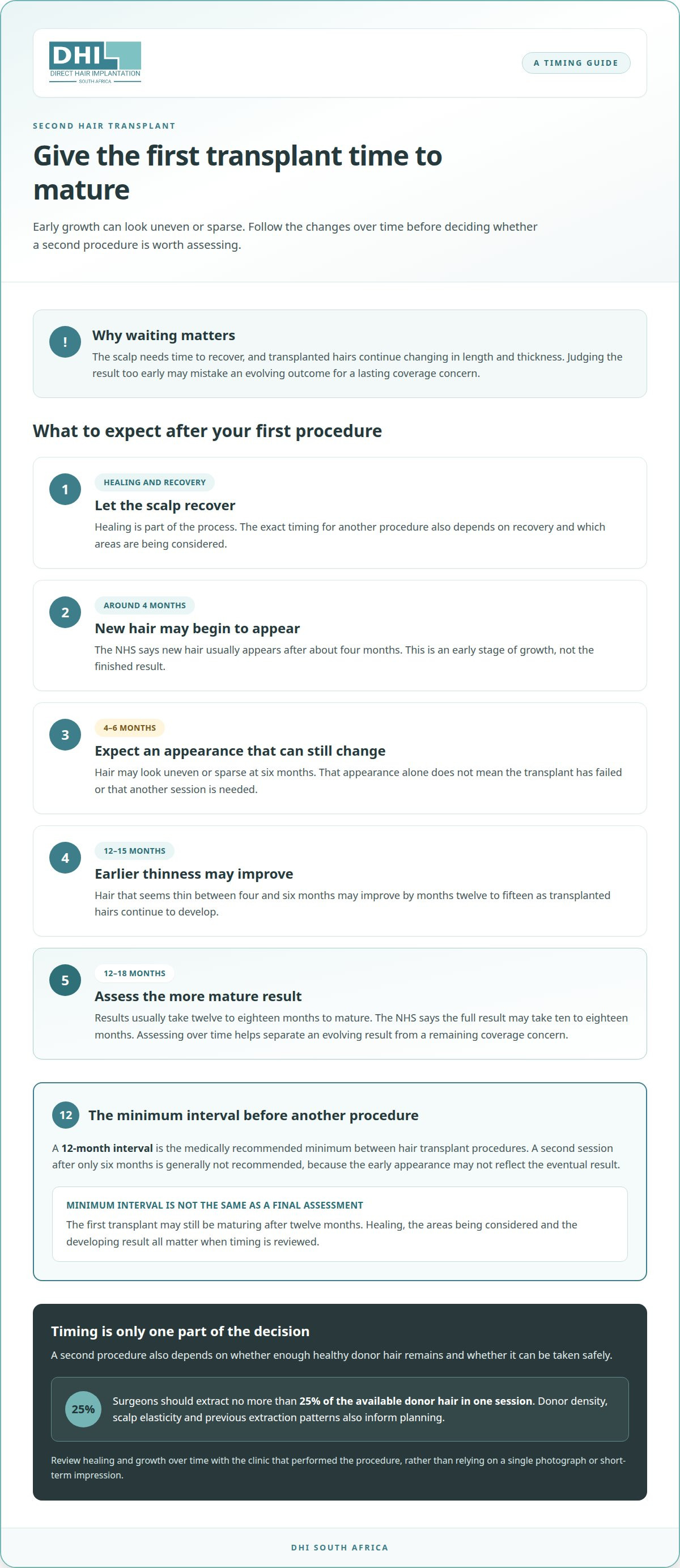
Timing matters because the scalp needs to heal and the first transplant needs time to develop. Deciding while growth is still changing may lead to unnecessary treatment.
Waiting between procedures
A 12-month interval is the medically recommended minimum between hair transplant procedures. Waiting gives the scalp time to recover and allows the first procedure’s progress to become clearer. A second session after only six months is generally not recommended, since the early appearance may not reflect the eventual result. The exact timing also depends on healing and the areas being considered.
Allowing first-procedure results to mature
Results usually take 12-18 months to mature, so the first transplant should be judged over that period. The NHS says the full result may take ten to eighteen months, while new hair usually appears after about four months. Early growth is only one stage; transplanted hairs continue to develop in length and thickness. Waiting helps distinguish a genuine coverage concern from an evolving result.
At six months, a transplant can look uneven or sparse because growth is still underway. That appearance alone doesn’t mean the procedure failed or that another session is needed. Hair that seems thin at four to six months may improve by months twelve to fifteen. Assessing density too early can lead to a decision before the outcome is established.
During the first year, transplanted hairs grow in and change in diameter, texture and length. These changes can alter how density looks from month to month. The surrounding hair may also continue thinning, making the overall appearance different from the transplanted area alone. A realistic assessment considers both the developing transplant and changes associated with ongoing hair loss.
Use the waiting period to follow the healing and growth pattern with the clinic that performed the procedure. Review changes over time, rather than relying on a single photograph or a short-term impression. Once the result has had time to mature, the remaining coverage concerns are easier to describe and assess. For more on planning hair restoration, explore this hair restoration information.
Shock loss after a second transplant
Shock loss is temporary shedding that may follow a hair transplant, including a second procedure. It’s part of the hair-growth cycle, so early shedding doesn’t by itself show that transplanted follicles have failed. Finasteride or minoxidil may be used to manage ongoing pattern hair loss. Medication and surgery have different roles, and medication use alone doesn’t determine whether another transplant is needed.
The NHS notes that hair may continue thinning around the transplanted area after surgery. Transplanted hairs can remain while untreated hair gradually recedes, changing the overall pattern. For example, a previously restored hairline may look less dense if native hair behind it continues to thin. That change may prompt a new assessment, but it doesn’t automatically mean another procedure is appropriate.
Ageing and genetics can influence how hair loss progresses over time. A transplant moves follicles to an area, but doesn’t stop the underlying pattern affecting untreated hair. Stress, injury or other health changes may also coincide with shedding. The causes vary, so new or sudden loss shouldn’t simply be assumed to be ordinary pattern baldness.
After a second transplant, shock loss can make density appear temporarily reduced. Timing and distribution help distinguish short-term shedding after surgery from gradual thinning across untreated areas. Tracking changes in the recipient and donor areas can clarify the pattern. Consistent photographs taken under similar lighting can make changes easier to discuss than a single close-up image.
Hair loss can continue after one or more transplant procedures, particularly where follicles weren’t transplanted. A second session may be considered if progression creates a new area of concern and donor availability allows for a considered plan. The aim is to preserve a natural-looking pattern, rather than repeatedly filling every new gap. Overly concentrated coverage in one area may look unnatural as surrounding hair changes.
Medication can be part of managing ongoing hair loss, while a transplant addresses coverage in selected areas. Finasteride and minoxidil are different treatments, and suitability, use and response depend on the treatment plan. They can’t prevent all future hair loss, so changes in thinning still matter when assessing long-term restoration. A medical review can help distinguish temporary shock loss, continuing pattern loss and shedding linked to another cause.
Choosing a surgeon and avoiding further procedures
A second transplant requires fresh planning, not simply repeating the first operation. The surgeon needs to consider your current coverage, previous extraction and remaining donor reserve together. The aim is a natural result that accounts for future hair loss, rather than maximising the number of hairs in one session.
The ISHRS census reports that 68.2% of patients needed one procedure to achieve their desired restoration results, while 28.6% required a second. These figures show that treatment plans vary. They don’t predict your individual outcome. Some people may need another session for coverage; others may be satisfied after one procedure.
Choose a surgeon who explains how the proposed plan relates to your first procedure. The discussion should cover areas already treated, remaining donor supply, and how your hairline and surrounding pattern may change. Ask for a clear explanation of why further coverage is being considered and how the plan avoids an unnatural distribution. A sound plan addresses both what can be improved and what should be preserved.
Later procedures can be more demanding than the first. Previous extraction may reduce available donor follicles, while scar tissue can affect planning in a treated area. The surgeon may need to adapt the technique and placement to existing hair, tissue and coverage. A second operation should respond to your scalp’s current condition, not copy the first procedure’s design.
Preparation also means setting realistic expectations. Before deciding, write down what bothers you most, such as a visible gap behind the hairline or reduced density at the crown. Separate that concern from any expectation of restoring every area to its earlier appearance. A focused goal helps you understand the trade-offs between added coverage and preserving donor hair.
It’s natural to feel hopeful and apprehensive at once. Give yourself time to consider the plan, recovery demands and the possibility that hair loss may continue. A follow-up discussion can clarify how the proposed procedure fits your long-term restoration goals. You can also explore hair restoration planning as you consider your next step.
Why a second hair transplant may be considered
Whether another procedure is needed depends on the first result, your goals, ongoing hair loss and remaining donor hair. A second session may be considered when coverage remains sparse, thinning has progressed elsewhere, or the original plan addressed only part of the affected area. Consider these factors together, rather than treating one visible gap as the only measure.
Density is one reason people seek further treatment. For example, someone may have a defined hairline but still want more coverage behind it. Expectations matter too: a transplant redistributes available follicles, but cannot restore every area to its earlier density. The practical question is whether the remaining concern is specific and achievable without compromising the donor area.
Continued hair loss can change the appearance of a successful transplant. Hair placed during the first procedure may remain while untreated areas continue thinning, creating a new contrast over time. Someone who had a transplant a decade earlier, for instance, may now be concerned about a newly affected area. Norwood Scale grades 5, 6 and 7 describe advanced patterns that may require treatment planned across more than one session.
Repair is another reason for considering another procedure. A first transplant may leave uneven coverage, an unsatisfactory hairline or visible gaps that the patient wants addressed. The ISHRS reported that repair procedures accounted for 6.9% of hair transplants in 2024, compared with 5.4% in 2021. These figures describe repair work, not the likelihood that any particular patient will need it.
Recovery and timing also shape the decision. If the first transplant is still developing, its appearance can change, so an early concern about density may not represent the final result. A second procedure planned after ten years may address a new area, while a repair session may focus on a specific issue from the original work. In either case, the goal, donor supply and current hair-loss pattern guide the plan.
DHI South Africa: Hair Systems & Hairpieces
DHI South Africa can help you consider a second transplant alongside other hair restoration options. The right direction depends on what you want to address, your existing hair loss and whether further surgery suits your situation. Another procedure is one possibility, not an automatic next step after an earlier transplant.
Hair Systems & Hairpieces may be relevant if you want a non-surgical option for the appearance of thinning or baldness. They may also be worth discussing if further surgery isn’t your preferred approach. Direct Hair Implantation (DHI), by contrast, is a hair transplant option for people considering surgical coverage. The difference is practical: one involves a hair system, while the other involves implanting hair.
For those considering DHI, the question is whether the treatment plan can address the desired area while accounting for previous surgery and remaining donor hair. A second procedure may not suit every hair-loss pattern or donor area. Discussing your goals and treatment history can help clarify whether DHI is relevant or another approach better fits what you’re seeking.
GFC Treatment and Regenera Activa are also options to explore as part of hair-loss care. They aren’t the same as a transplant and shouldn’t be presented as a way to add donor follicles or guarantee coverage. Their relevance depends on the concern being addressed and how they fit into your broader hair restoration plan. The useful first step is understanding what each option is intended to address.
It can help to describe the change that prompted you to consider another procedure. For example, you may want more density behind a previous hairline, be concerned about thinning in a new area, or prefer to avoid further surgery. Your treatment history, current pattern and expectations all matter. A clear conversation can put the available options in context without assuming a transplant is necessarily the answer.
If you’re weighing another transplant against Hair Systems & Hairpieces, GFC Treatment or Regenera Activa, contact DHI South Africa to discuss your options.
Choose a considered next step
If you’re still asking whether you will need a second hair transplant, focus first on the outcome you want now, rather than feeling you must decide immediately. A clear conversation about your hair-loss pattern, previous treatment and priorities can help you explore the right direction.
Direct Hair Implantation (DHI) may be relevant if you’re considering another surgical procedure. GFC Treatment and Regenera Activa are other options to discuss as part of your hair restoration plan. Understanding how these offerings relate to your concern can help you make an informed choice without assuming another transplant is the only path forward.
You deserve space to ask questions and weigh your options at your own pace. Contact DHI South Africa when you’re ready to discuss the next step.
Whatever you decide, a thoughtful plan can help you move forward with greater clarity and confidence.
Frequently Asked Questions
Do Multiple Surgeries Affect The Quality Of Transplanted Follicles?
The number of procedures alone doesn’t determine the quality of transplanted follicles. Each session’s result also depends on how follicles are selected, handled and placed. If you’re reviewing an earlier transplant, bring any available treatment records and photographs to the discussion. These can help the surgeon understand what was done previously and distinguish a concern about the original result from changes that have developed since.
Is There Adequate Donor Hair Remaining?
There isn’t one donor-supply figure that applies to everyone. A useful assessment maps the donor area and considers how hair is distributed, rather than focusing on a single patch. The surgeon can then compare that map with the area you hope to address. This helps clarify whether the intended coverage fits the available donor hairs and what adjustments to the treatment goal may be appropriate.
What About After 10 Years?
A long gap since your first transplant doesn’t, by itself, rule another procedure in or out. Your current hair-loss pattern and priorities may differ from those you had originally. If you still have photographs or records from the first treatment, they can help show how your appearance has changed. The discussion can then focus on your present goals, rather than simply recreating an earlier hairline.
How can I tell if I will need a second hair transplant?
Start by identifying the specific outcome that still concerns you. For example, you may be unhappy with the shape of your hairline or notice that your current coverage no longer feels balanced. Describe that concern alongside what you expected from the first procedure. This makes it easier to discuss whether another transplant could address the issue or whether your expectations call for a different approach.
How often do people need a second hair transplant?
There isn’t a single frequency that predicts an individual’s treatment journey. Some people seek further work because they want a different level of coverage, while others don’t want another procedure. The useful comparison is between your present result and your own restoration goals. A population figure cannot tell you whether a second session suits your circumstances or priorities.
How long should I wait between hair transplant procedures?
Plan the timing around your recovery and the stage of the first result, rather than a calendar date alone. At a review, discuss any areas that remain unsettled and whether the scalp has recovered sufficiently for another treatment plan. Keeping photographs from different stages can help show the pattern of change. This gives the conversation a clearer basis than relying on one recent impression.
How many donor hairs are available for a second hair transplant?
The number of hairs available for another procedure depends on your donor area and the work already carried out. A useful assessment looks at distribution across the scalp, not simply a total count. It also considers how much coverage you hope to achieve. These details help frame a realistic treatment area without treating a general average as your personal allowance.
What are the risks of having multiple hair transplants?
Repeated procedures can leave less flexibility for future restoration, particularly if the donor area has already been heavily used. Treatment in a previously operated area may also require more careful planning. Before proceeding, discuss the intended coverage, the appearance of the donor area and how the plan accounts for future hair changes. These points help you weigh the potential benefit against the effect on your overall appearance.


Comments