%20(1).jpg)
%20(1).jpg)
SMP for Thinning Hair: A Clinical Reference to Scalp Micropigmentation
- Dhesan Moodley

- 3 days ago
- 12 min read
What if the most effective way to restore the look of a full head of hair didn't involve a single surgical incision or the daily frustration of messy concealers? You've likely spent far too many mornings under harsh bathroom lights, tilting your head to gauge exactly how much scalp is visible through thinning patches. It's a deeply personal anxiety that many of our clients share, especially when temporary hair fibres fail to provide the security you need. This clinical reference explores how smp for thinning hair provides a sophisticated, non-surgical solution to restore the visual appearance of hair density with absolute precision.
We understand that you're looking for results that look natural and last for years, not just until your next shower. By reading this guide, you'll discover the medical artistry behind replicating the shadow of thousands of individual hairs to eliminate scalp contrast and restore your profile. We will walk you through the structured process of scalp micropigmentation, from the meticulous selection of pigments to the long-term benefits of this low-maintenance transformation, ensuring you have the clarity needed to reclaim your self-assurance.
Table of Contents
What is SMP for Thinning Hair and How Does it Differ from Tattoos?
The Science of Scalp Micropigmentation: Creating the Illusion of Density
SMP vs Hair Transplants: Which Solution Suits Your Thinning Hair?
The Treatment Journey: What to Expect During Your SMP Sessions
Why DHI South Africa is the Gold Standard for Scalp Micropigmentation
What is SMP for Thinning Hair and How Does it Differ from Tattoos?
Watching your scalp become more visible under bright lights can be a frustrating experience that slowly chips away at your confidence. You might find yourself constantly adjusting your style or reaching for temporary concealers that smudge or run. smp for thinning hair offers a sophisticated way out of this cycle. It's a specialised medical-grade pigmentation process that focuses on one specific goal: reducing the stark contrast between your natural hair colour and the scalp. By doing so, we can restore the appearance of density without the need for surgery.
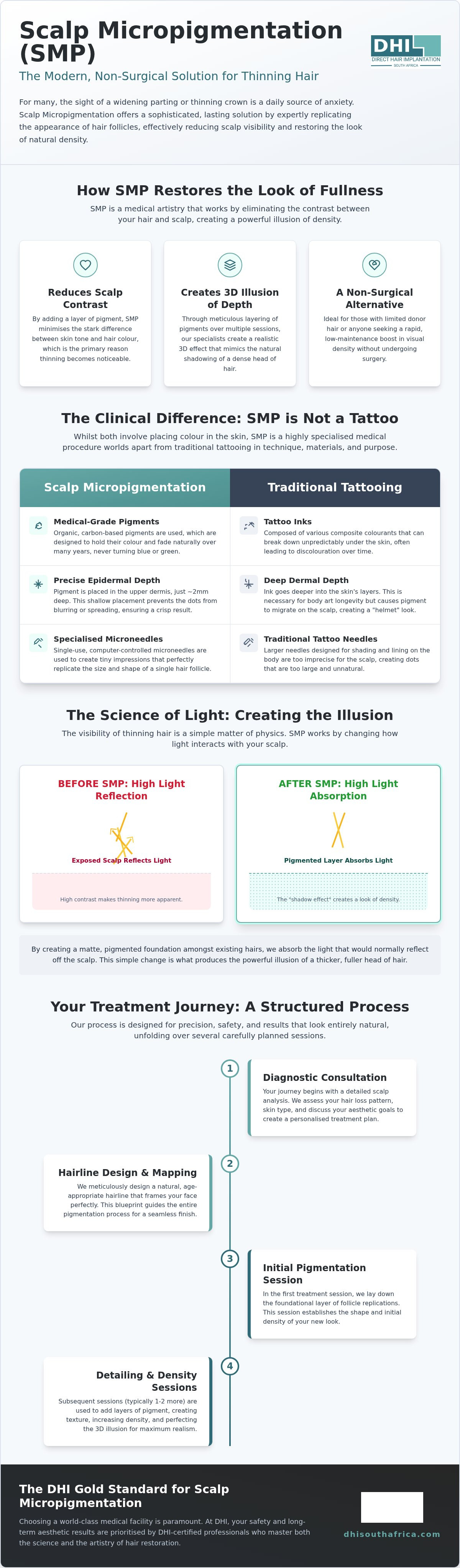
While some might mistake this for a standard tattoo, the two procedures are worlds apart. scalp micropigmentation uses a meticulous dot-work technique to replicate the look of thousands of individual hairs. Each deposit of pigment is carefully calibrated to match your existing follicles, ensuring that the final result looks like a natural shadow rather than a cosmetic addition. It's about creating a soft, believable foundation that works in harmony with your remaining hair.
To help you visualise how this transformation works in practice, watch this helpful overview from a clinical perspective:
The Clinical Difference: Pigment vs Ink
The safety and longevity of your result depend heavily on the materials used. Traditional tattoo inks are often composed of various pigments that can migrate or change hue as they age, sometimes turning a distracting shade of blue or green. We use medical-grade pigments that are designed to stay true to their original shade. These are delivered using specialised, single-use medical instruments that are significantly finer than those found in a tattoo parlour. This clinical approach ensures that the "hairs" we create remain crisp, distinct, and perfectly matched to your natural tones.
Why Depth Matters in Scalp Restoration
Achieving a natural look is a delicate balance of science and artistry, particularly regarding needle depth. We place the pigment precisely in the upper dermis. This is shallower than a standard tattoo, which is vital for preventing the pigment from spreading or "blurring" under the skin. If the depth isn't perfectly consistent, the result can look patchy or unnatural. Our clinicians are trained to maintain this precise depth across the varied contours of the scalp, providing a "safe pair of hands" for your restoration. This level of expertise is what makes smp for thinning hair such a reliable choice for those seeking a seamless, long-lasting boost in visual density. Our team often integrates this with other treatments to ensure a holistic approach to your hair health.
The Science of Scalp Micropigmentation: Creating the Illusion of Density
Achieving a natural look with smp for thinning hair isn't just about applying pigment; it's about mastering the physics of light. The primary reason thinning hair is so noticeable is the reflective nature of the bare scalp. When light hits a pale, exposed scalp, it bounces back, making the hair above it appear even more sparse. We counter this by creating a "shadow effect." By placing thousands of microscopic deposits amongst your existing hairs, we create a matte foundation that absorbs light rather than reflecting it. This simple change in how light interacts with your scalp immediately creates the visual illusion of a much thicker, fuller head of hair.
This approach is particularly effective for those experiencing diffuse thinning, where hairs are still present but the "see-through" effect has become prominent. Unlike a hair transplant which moves physical follicles, SMP works as a high-precision concealer that never washes off. It fills the gaps between your natural hairs with such accuracy that even from a close distance, the eye cannot distinguish between the pigment and the actual hair follicles. If you want to see how this looks in practice, you can view our patient results to see the difference for yourself.
Colour Matching and Natural Pigment Selection
We don't believe in a one-size-fits-all approach to colour. Every treatment begins with a bespoke analysis of your skin undertones and your natural hair shade. It's a highly artistic process. We must account for how your hair looks in different lighting and even how it might change as you age. Our clinicians are trained to blend pigments that will remain harmonious even if your natural hairs begin to turn grey. This ensures that the transition between the treated areas and your natural hair remains seamless and undetectable for years to come.
Layering Techniques for a Three-Dimensional Look
To create a realistic sense of depth, we use a specialised "pointillism" technique. Instead of creating a solid block of colour, which would look flat and artificial, we build density through layers. This is why a complete treatment typically requires two to four sessions. During these sessions, we vary the dot sizes and pigment concentrations to mimic the natural variation of real hair thicknesses. By layering these dots over multiple appointments, we create a 3D effect that mimics the natural density of a healthy scalp. This methodical progression allows the pigment to settle and ensures the final result has the soft, textured look of real hair rather than a printed pattern.
SMP vs Hair Transplants: Which Solution Suits Your Thinning Hair?
Deciding between a surgical transplant and a non-invasive treatment often comes down to your personal goals and the current state of your donor hair. Whilst a hair transplant physically moves follicles to new areas, smp for thinning hair acts as a powerful aesthetic partner that requires no surgery at all. It's particularly useful for those who may not be ideal candidates for surgery due to a limited supply of donor hairs at the back of the head. We often see clients who feel stuck between options, and this is where a clinical consultation helps provide the necessary path forward.
One of the most significant advantages is the timeline of results. Following a hair transplant, you must wait several months for the new hairs to enter the anagen phase, which is the active growth stage, and become visible. In contrast, SMP provides an almost immediate boost to your visual density. There's no downtime, no bandages, and no post-operative recovery period, making it a convenient solution for the modern professional with a busy schedule.
From a cost-perspective, SMP is often more accessible for those who aren't yet ready to commit to a full surgical procedure. It offers a long-term, high-impact result that eliminates the need for daily concealers or temporary fibres that can be messy and unreliable. This makes it a strategic first step for many who want to address their thinning patches without the commitment of surgery. It's about finding the right balance between your desired outcome and your current lifestyle.
When SMP is the Preferred Clinical Choice
For many of our clients, the goal isn't necessarily to change their hairline, but to hide the scalp visible through their existing long hair. This diffuse thinning is where SMP truly shines. It allows you to keep your hair at any length whilst we work amongst the strands to darken the scalp and reduce contrast. It's also a vital option for those with alopecia areata or scalp scarring, where traditional transplanting might not be viable due to the nature of the skin tissue.
The Synergy: Combining SMP with DHI Restoration
We often find that the best results come from a hybrid approach. By combining the physical restoration of Direct Hair Implantation with the underlying shadow of SMP, we can achieve an unparalleled level of visual thickness. This combination is particularly effective for patients with high-contrast hair and skin, as the pigment provides the perfect backdrop for the newly transplanted hairs to thrive. It’s about using every tool in our clinical arsenal to restore your self-assurance and give you the most natural finish possible.
The Treatment Journey: What to Expect During Your SMP Sessions
Embarking on a journey with smp for thinning hair is a methodical process designed to ensure your results are both safe and aesthetically perfect. We don't simply begin applying pigment; we treat the procedure with the same clinical rigour as a surgical intervention. Your journey begins with a detailed preparation phase where we map out your natural hair pattern. This ensures the "shadow" we create aligns perfectly with the direction and density of your existing follicles. We perform this in a sterile, professional clinic environment that far exceeds the hygiene standards of a standard cosmetic studio. This clinical setting is part of our commitment as a global leader in hair restoration, ensuring that every session is as safe as it is effective.
The sensation during the procedure is often described by our clients as a mild discomfort rather than pain. Most compare it to a light scratching or a repetitive tingling sensation on the scalp. Because we use ultra-fine medical needles and work only in the upper layers of the skin, the process is far less invasive than a traditional tattoo. We build your density progressively over two to four sessions. This allows the pigment to settle and the skin to heal between appointments, ensuring the final result has a natural, layered depth. It's a steady, unhurried process that respects the gravity of your transformation.
Your First Clinical Consultation
Before any pigment touches your skin, we perform a digital trichoscopy. This is a high-magnification digital scalp analysis that allows us to examine your scalp health and the exact diameter of your natural hairs. This data is vital for creating a bespoke plan that addresses your specific thinning areas. During this time, we'll discuss your long-term goals and ensure your expectations align with the sophisticated, natural results that medical-grade SMP provides. We want you to feel like you're in a "safe pair of hands" from the very first moment you walk through our doors.
Aftercare and Long-Term Maintenance
The success of your treatment relies heavily on the first 48 hours of aftercare. During this critical window, you must avoid getting your scalp wet or engaging in activities that cause heavy sweating. This prevents the pigment from being diluted or displaced before it has time to stabilise. You may notice the colour looks slightly darker initially, but it will soften into its final, natural shade within a week as the skin heals. We provide a detailed aftercare protocol that includes avoiding direct sun exposure for the first few weeks, as UV rays can break down the pigment particles prematurely.
While the results of smp for thinning hair are long-lasting, they are not permanent. Typically, the pigment remains crisp and vibrant for three to five years before the body's natural processes cause it to fade slightly. At this point, a minor touch-up session is all that's required to restore the original depth and definition. This minimal maintenance is a small trade-off for the daily confidence boost of a consistently dense-looking hairline. Most clients find they can return to their social lives almost immediately, enjoying a renewed sense of self-assurance without the need for temporary concealers.
Why DHI South Africa is the Gold Standard for Scalp Micropigmentation
Choosing the right partner for your hair restoration is a decision that carries significant weight. At DHI South Africa, we distinguish ourselves by operating as a specialised medical clinic rather than a traditional cosmetic or tattoo studio. This distinction is vital for your safety and the quality of your results. When you opt for smp for thinning hair at our facility, your procedure is performed by DHI-certified medical professionals who possess a deep understanding of scalp anatomy and hair growth patterns. We don't just apply pigment; we manage a clinical process designed to restore your self-assurance with the precision of a scientific expert.
Safety is the cornerstone of our practice. We adhere to a strict protocol that includes 18 mandatory safety and hygiene checks for every single session. These clinical safety protocols exceed standard industry requirements, providing you with a "safe pair of hands" throughout your transformation. Our focus remains entirely on delivering natural, undetectable results that resonate with the South African market. We understand the local climate and lifestyle factors that can affect pigment longevity, and we tailor our approach to ensure your new look remains crisp and believable for years to come.
The DHI Total Care System Advantage
As part of a global network of over 75 clinics, we utilise the DHI Total Care System to ensure consistent, world-class quality across all our procedures. This system involves the use of patented instruments designed specifically for the delicate task of hair restoration. These tools allow for a level of precision that standard equipment simply cannot match. By maintaining these rigorous global standards, we ensure that every dot of pigment is placed with absolute accuracy. If you would like to see the visual proof of our success, we invite you to browse our results page to view real patient transformations.
A Holistic Approach to Your Hair Health
We believe that hair restoration should never be a one-dimensional process. Our clinicians often recommend integrating SMP with other medical interventions, such as GFC treatments, to improve overall scalp health and stimulate your existing hairs. This holistic approach ensures that your treatment plan evolves alongside your hair loss, providing a dynamic solution rather than a temporary fix. Whether you are looking for a standalone density boost or a companion to a surgical procedure, we are here to guide you through every step of the journey. Take the first step towards a renewed sense of confidence by reaching out for a professional consultation today.
Reclaim Your Confidence with Clinical Precision
Whilst hair loss can feel like a constant weight on your mind, the path to restoration is clearer than ever. You've seen how medical-grade scalp micropigmentation transcends traditional cosmetic fixes. By choosing smp for thinning hair, you aren't just masking a problem; you're using a sophisticated clinical tool to restore the visual density you thought was lost. As part of the world-leading DHI Global Medical Group, our medically certified specialists provide a level of artistry and safety that has led to a 99% customer satisfaction rate. Whether you're filling thinning gaps or enhancing a transplant, you're in a safe pair of hands with a team that values your long-term aesthetic health.
The journey to self-assurance doesn't have to be surgical or stressful. It's about finding a solution that fits your life and provides the natural, undetectable finish you deserve. We're here to help you navigate these choices with the calm, measured expertise you'd expect from a global leader.
Take the first step towards feeling like yourself again. We look forward to welcoming you to our clinic and helping you achieve the results you've been looking for.
Frequently Asked Questions
Is SMP for thinning hair permanent?
Scalp micropigmentation is considered a semi-permanent solution because the pigment naturally fades over time. You can expect your results to remain vibrant for three to five years before a minor touch-up is required. This gradual fading occurs because we use medical-grade pigments that the body eventually metabolises; this ensures the colour stays natural rather than becoming a permanent, unnatural block of ink.
Does scalp micropigmentation look natural with long hair?
Yes, smp for thinning hair is exceptionally effective for those who wish to keep their hair long. The process works by camouflaging the pale scalp visible between your natural hairs, which immediately reduces the distracting see-through effect. It creates a matte foundation that absorbs light rather than reflecting it, giving the illusion of a much thicker head of hair without changing your current style.
Is the SMP procedure painful for someone with a sensitive scalp?
Most clients describe the sensation as a mild, repetitive scratching or tingling rather than significant pain. Because we only deposit pigment into the upper dermis, the process is far less invasive than a traditional tattoo. If you have a particularly sensitive scalp, our clinicians can adjust the pace of the session to ensure you remain comfortable throughout the procedure whilst maintaining clinical precision.
How many sessions will I need for diffuse thinning?
You will typically require between two and four sessions to achieve a complete, natural-looking result for diffuse thinning. Each session builds upon the previous one, allowing us to layer the pigment dots to create a realistic 3D effect of depth. This progressive approach ensures the density looks believable and prevents the pigment from appearing too dark or artificial in a single sitting.
Can I have SMP if I plan to have a hair transplant later?
You can absolutely undergo SMP if you are considering a future hair transplant. The procedure does not damage existing follicles or affect the scalp's ability to support transplanted hairs later. In fact, many of our patients use smp for thinning hair as a strategic density boost whilst they plan for a more permanent surgical restoration with DHI at a later date.
Will the pigment change colour to blue or green over time?
Our medical-grade pigments are specifically formulated not to change colour to blue or green as they age. This blueing effect typically happens with traditional tattoo inks or when pigment is placed too deep in the skin. By using specialised pigments and maintaining a precise, shallow depth, we ensure your results remain a natural shade that matches your natural hair follicles perfectly.
How long is the recovery time after an SMP session?
Recovery time is minimal, with most clients returning to their normal daily activities immediately after a session. You might experience some slight redness for 24 to 48 hours, which is similar to a mild sunburn. However, there are no bandages or surgical wounds to manage, making it a convenient clinical procedure for those with busy professional schedules who cannot afford downtime.
Can SMP hide scars from previous hair transplant surgeries?
SMP is an excellent clinical tool for camouflaging scars from previous hair transplant surgeries, such as older strip methods. By depositing pigment directly into the scar tissue, we can blend the area with the surrounding hair, making the scar significantly less visible. This is a popular choice for patients who want to wear their hair shorter without revealing visible surgical marks from the past.


Comments