%20(1).jpg)
%20(1).jpg)
What to Expect During a DHI Procedure: A Step-by-Step Clinical Guide
- Dhesan Moodley

- 13 minutes ago
- 12 min read
What if the path to a full head of hair didn't involve scalpels, stitches, or a lengthy recovery? For many, the idea of a transplant triggers a fear of surgical pain or results that look anything but natural. Understanding what to expect during a dhi procedure is the first step toward replacing that anxiety with genuine confidence. At DHI South Africa, we treat hair restoration as a refined clinical art; our patented Choi implanter pen allows for the placement of thousands of hairs with surgical precision but without the traditional trauma.
You deserve a restoration process that is as discreet as it is effective. We know you're likely concerned about downtime and the social visibility of the procedure. This article provides a clear, step-by-step look at the Direct Hair Implantation journey, from the initial digital trichoscopy used to analyse your scalp health to the final, meticulous placement of follicles. We'll show you how our protocols achieve a hair survival rate of over 90 percent, ensuring every hair is positioned for a lifetime of natural growth and seamless density.
Table of Contents
Preparing for Your Transformation: The Pre-Procedure Consultation
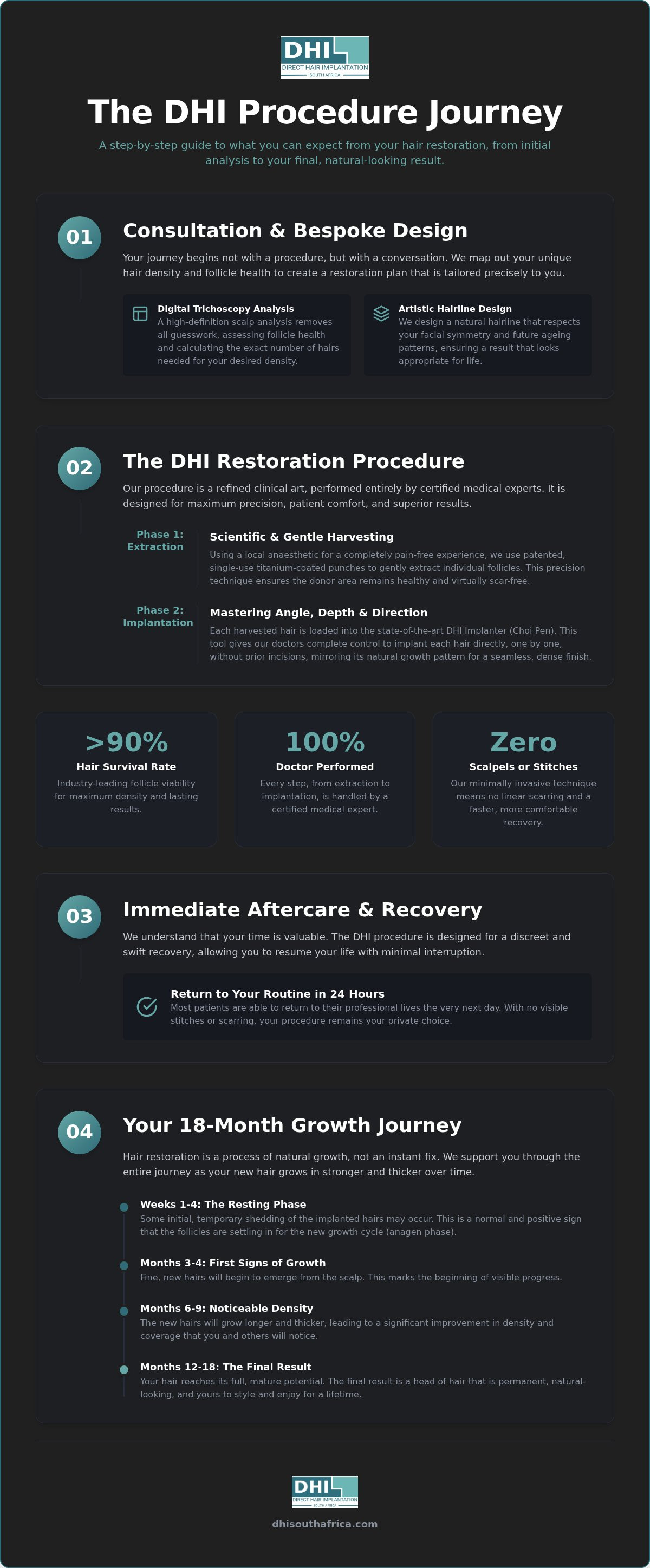
Losing hair is rarely just about aesthetics; it's often a deeply personal struggle that affects how you move through the world. We understand the hesitation and the quiet anxiety that comes with seeking help. Our specialists begin every journey by validating your experience, ensuring your aesthetic goals are heard before a single clinical tool is touched. This initial consultation is the bedrock of your success, where we use digital trichoscopy, a sophisticated digital scalp analysis, to map out your unique hair density and follicle health. This diagnostic depth is essential for anyone wanting to know what to expect during a dhi procedure, as it removes the guesswork from your restoration.
Our "Total Care System" is built on ISO-accredited safety protocols that prioritise your well-being. We don't just look at the area needing more hair; we examine the genetic resistance of your donor follicles to ensure the results aren't just immediate, but permanent. By setting realistic expectations for density and the placement of your new hairs, we create a roadmap that aligns with your vision for a restored hairline.
Clinical Diagnosis and Hairline Design
Designing a hairline is as much about artistry as it is about medical science. We don't believe in a one-size-fits-all approach because your face is unique. Our doctors calculate the precise number of hairs needed to achieve a density that looks natural today and will still look appropriate as you age. This isn't just about filling a gap; it's about respecting your facial symmetry and future ageing patterns. Whilst DHI is a specialised evolution of Follicular Unit Extraction (FUE), our focus remains on the meticulous placement of individual hairs to mirror the way your hair naturally grows. You can learn more about the technical nuances of Direct Hair Implantation to understand how this differs from older, more invasive methods.
The Safety First Protocol
Your peace of mind is our priority, which is why we follow a rigorous safety programme backed by world-class standards. Before your procedure begins, our team completes 18 mandatory clinical safety checks. These ensure that every aspect of your health and the sterile environment meets our high expectations. We'll provide you with clear instructions for the 24 hours leading up to your session. We usually advise patients to enjoy a hearty breakfast but to avoid caffeine and alcohol, as these can affect blood flow and your overall comfort. Our goal is to create a calm, professional environment where you feel like a guest, not just a patient. This structured preparation ensures that when you arrive, you're ready for a stress-free transformation.
The Extraction Phase: Scientific Precision in Harvesting Hairs
Once you are comfortably settled in our clinical suite, the physical transformation begins. A common concern when considering what to expect during a dhi procedure is the sensation of the extraction itself. We address this immediately with a highly effective local anaesthesia. This ensures the entire process is pain-free, allowing you to relax, listen to music, or even catch up on a favourite podcast whilst our specialists work. We don't just harvest follicles; we select them with artistic intent. Understanding what to expect during a dhi procedure helps demystify the science behind the results, turning a medical process into a journey of restoration.
Our doctors use patented, single-use titanium-coated punches. These instruments are designed to be exceptionally sharp and fine, which significantly reduces scalp trauma and ensures faster healing. You might hear other clinics talk about "grafts", but we prefer to discuss "hairs". A graft is simply the clinical term for the tissue containing the follicles, whereas focusing on individual hairs allows us to plan for the exact density and natural appearance you desire. Each hair is carefully organised by its natural grouping, ensuring that when they are later implanted, they mirror your original growth patterns perfectly.
Preserving the Donor Area
Maintaining the integrity of your donor area is a non-negotiable standard for us. We utilise a motorised, low-transection extraction technique that gently releases the hair follicles without damaging the surrounding tissue. This precision is why we can promise a result that is virtually scar-free. Unlike some clinics that rely on technicians, every extraction at DHI South Africa is performed by a certified medical expert. This high level of expertise ensures the back of your head remains full and healthy, even after thousands of hairs have been harvested. If you are comparing techniques, you might find our High Density Hair Transplant South Africa: FUE vs DHI Comparison helpful in understanding these technical advantages.
Graft Viability and Survival
The success of your procedure depends entirely on how many hairs survive the transition. Our protocols achieve a survival rate of over 90 percent, which is significantly higher than the industry standard. This is achieved by keeping the extracted hairs in a specialised, nutrient-rich solution at a controlled temperature. This solution preserves the vitality of the follicles whilst they are outside the body. For a deeper look at the medical standards involved, you can refer to this comprehensive guide to DHI. Every second counts during this phase, and our methodical approach ensures that every hair is primed for successful growth. If you're curious about your own donor potential, you might consider booking a digital scalp analysis with us today.
The Implantation Phase: Mastering Angle, Depth, and Direction
The most common fear we hear from patients is the worry that their results will look "pluggy" or obviously artificial. This is precisely where the artistry of our specialists becomes your greatest advantage. When you're learning what to expect during a dhi procedure, the implantation phase is the moment where science and aesthetics truly merge. Unlike traditional methods that require a doctor to create slits or holes in the scalp beforehand, our technique allows for the placement of hairs with absolute control over their final appearance. This eliminates the guesswork and ensures that your new hairline looks as if it has always been there.
By using the patented DHI Implanter, our doctors can manage the 360-degree exit angle of every single hair. This level of precision is vital because hair doesn't grow straight up; it grows at specific, varying angles across different parts of the scalp. Our goal is to mimic your original growth patterns so perfectly that even a barber wouldn't notice the restoration. This meticulous approach is part of what to expect during a dhi procedure at our clinic, where we prioritise a result that is both dense and completely discreet.
The Patented Single-Step System
The core of our success lies in our single-step system. The DHI Implanter allows the doctor to combine the creation of the site and the implantation of the hair into one fluid motion. This is a significant clinical advantage, as it reduces the time hairs spend outside the body, directly boosting their survival rate. Because there are no pre-made channels, there is less bleeding and significantly less inflammation. This Clinical Study on Direct Hair Transplantation highlights how this method minimises tissue trauma, which is why our patients enjoy such a rapid recovery. This efficiency also allows us to achieve a higher density than traditional methods, often placing up to 70 to 90 hairs per square centimetre.
Artistry in Every Placement
Every hair we place is a deliberate choice made by a certified medical expert. We don't just fill gaps; we reconstruct your confidence. Matching the natural depth of your existing follicles is essential to ensure that the new growth is healthy and permanent. If a hair is placed too deep or too shallow, it won't thrive. Our specialists have the clinical expertise to blend new growth seamlessly with your remaining hair, even in complex areas like the crown or temples. For those who require the utmost discretion, we often recommend an Unshaven Hair Transplant, which allows you to keep your existing hair length whilst we work. This level of detail ensures that your transformation is private, sophisticated, and entirely natural.
Immediate Aftercare: Your Recovery in the First 48 Hours
Many patients are pleasantly surprised by how quickly they can return to their daily routines. Unlike older, more invasive techniques, the DHI method is often described as a "lunch-hour" procedure because of its minimal impact on your schedule. This efficiency is a central part of what to expect during a dhi procedure; our patented tools ensure that the scalp remains largely undisturbed. Most of our patients find they are comfortable enough to return to their professional lives the very next day without anyone noticing they've had a treatment.
We'll provide you with a specialised post-procedure kit and clear instructions on how to wash your hair without disturbing the new follicles. This involves a gentle dabbing motion rather than rubbing, which keeps the area clean whilst protecting the delicate placement of the new hairs. Minor swelling and redness around the forehead or donor area are simply normal physiological responses to the local anaesthesia and the procedure itself. These usually subside within 48 hours, leaving your scalp looking remarkably clear as the healing process accelerates.
The First Evening at Home
Your first night at home is focused on rest and protection. We recommend sleeping with your head slightly elevated, perhaps using an extra pillow or a travel cushion, to manage any potential swelling. You might feel some mild post-anaesthesia discomfort as the local numbing wears off, but this is easily managed with the medication schedule we provide. Because there are no stitches or incisions, your scalp begins to close the tiny extraction points almost immediately. This lack of trauma is a key reason why the healing process is so much faster than traditional methods, allowing for a stress-free first evening.
Professional Monitoring
We don't just complete the procedure and leave you to it; our care continues well after you leave the clinic. Our structured follow-up schedule allows us to track your early healing progress and ensure every hair is thriving. You might notice a phenomenon called "shock loss", where some existing hairs shed temporarily before regrowing stronger. Understanding what to expect during a dhi procedure includes knowing that our South African support team is always a phone call away to answer your immediate questions. This gives you the peace of mind that you're never alone in your restoration journey.
The Long-Term Journey: 18 Months of Support and Growth
Patience is perhaps the most vital component of your restoration journey once you leave our clinic. Whilst the physical procedure is completed in a single day, the biological transformation takes time to unfold. Around the three-week mark, many patients notice that their newly implanted hairs begin to shed. Don't be alarmed; this is a success marker rather than a failure. The hair shaft falls away whilst the living follicle remains securely rooted and enters a resting phase before beginning its permanent growth cycle.
Understanding what to expect during a dhi procedure involves looking beyond the initial healing to the arrival of the anagen phase. This is the active growth stage of the hair cycle, where you'll start to see the first signs of your permanent results. As you move through the months, you'll see why what to expect during a dhi procedure is a long-term clinical partnership rather than a one-off transaction. We document this entire progression through a structured 18-month photographic monitoring series, ensuring your results meet our world-class standards at every milestone.
Supportive Clinical Treatments
We take a 360-degree approach to your hair health, which often includes supportive therapies to maximise the vitality of your new hairs. Growth Factor Concentrate (GFC) treatment is frequently used to boost blood circulation and provide essential proteins directly to the scalp. We also integrate Platelet-Rich Plasma (PRP) and bespoke nutraceuticals to create the healthiest possible environment for growth. You can explore these options further in our Advanced Hair Loss Solutions: A Clinical Guide to Restoration in 2026. By combining topical solutions with medical-grade treatments, we ensure your restoration is supported from every angle.
Celebrating Your Natural Results
The transformation truly begins to take shape at the six-month mark, with significant density improvements visible by month twelve. By 18 months, you'll see the final, polished result of your restoration. These new hairs are harvested from the "permanent zone" at the back of the head, meaning they are genetically resistant to the hormones that cause thinning. This isn't a temporary fix; it's a permanent change to your profile. Reclaiming your confidence is often the most rewarding part of this journey, as the anxiety of hair loss is replaced by the simple, daily reality of a full head of hair. It's a life-changing shift that begins with a single, precise clinical decision.
If you're ready to see what's possible for your unique hair profile, we invite you to take the first step toward a permanent solution.
Your Path to Permanent Confidence
Your journey towards a fuller head of hair is a path defined by precision, safety, and clinical artistry. By choosing Direct Hair Implantation, you've moved past the outdated, painful methods of the past and embraced a sophisticated medical experience. Knowing exactly what to expect during a dhi procedure, from the initial digital trichoscopy to the final growth phases, empowers you to make this life-changing decision with absolute certainty. You're not just choosing a procedure; you're choosing a global standard of care.
With a 99 percent customer satisfaction rate accredited by IMRB and over 250,000 successful procedures performed globally, our expertise is rooted in established excellence. Our patented DHI Implanter technology ensures that every hair is placed with the correct angle and depth, providing a result that is both dense and entirely natural. You don't have to settle for the frustration of hair loss when a permanent, discreet solution is available to restore your self-assurance.
Take the first step towards reclaiming your profile with the guidance of world-class specialists who prioritise your comfort and results. We're here to ensure your transformation is as seamless as it is rewarding.
Frequently Asked Questions
Is the DHI procedure painful during the extraction or implantation phases?
The procedure is virtually pain-free because we use a highly effective local anaesthesia to numb both the donor and recipient areas. You'll likely feel a slight pinch during the initial numbing, but after that, you can relax, watch a film, or listen to music. Our specialists prioritise your comfort throughout the session, ensuring you feel at ease whilst we work with clinical precision and empathetic care.
How long does a typical DHI session take from start to finish?
A typical session usually lasts between four and eight hours, depending on the total number of hairs being placed. We manage the entire process in a single day to respect your schedule. Knowing what to expect during a dhi procedure includes planning for a full day at the clinic, where we provide a comfortable environment and regular breaks to ensure a stress-free experience from start to finish.
Will I have visible scars on the back of my head after the procedure?
You won't have to worry about visible linear scars because we use patented, single-use titanium-coated punches that are less than 1mm in diameter. These tiny extraction points heal incredibly quickly and become virtually invisible once your hair begins to grow back. This is a significant advantage over older strip surgery methods, allowing you to wear your hair short with total confidence and privacy.
Can I go back to work the day after my hair restoration?
Most patients feel comfortable returning to their professional lives the very next day. Because there are no stitches or scalpels involved, the physical recovery is exceptionally rapid. Whilst you'll need to follow specific hygiene instructions for the first few days, there's usually no medical reason to stay home, making it an ideal choice for busy professionals who value their time and a discreet recovery.
What happens if some of the hairs do not grow after the procedure?
We achieve a hair survival rate of over 90 percent by using our patented single-step implantation system that reduces the time hairs spend outside the body. If you follow our structured 18-month aftercare programme, every hair has the best possible chance to thrive. We monitor your progress closely during regular follow-up appointments to ensure your restoration meets our high clinical standards and your personal aesthetic goals.
Do I need to shave my entire head for a DHI hair transplant?
Shaving your entire head isn't mandatory for every patient. We offer a sophisticated "unshaven" DHI option where we only trim a small, discreet area in the donor zone that can be easily hidden by your existing hair. This is particularly popular for those who want to keep their procedure private and avoid any significant change in their appearance during the initial healing and growth phases.
How soon can I see the final natural results of my DHI procedure?
You'll start to see the first signs of permanent growth after the initial shedding phase, usually between three and four months. However, the final natural results are typically achieved between 12 and 18 months. Part of what to expect during a dhi procedure is this steady progression, allowing follicles to move through several growth cycles until they reach the full density and seamless blend you desire.
Are the results of a DHI procedure permanent as I age?
The results are permanent because we harvest hairs from the "permanent zone" at the back and sides of the scalp. These follicles are genetically resistant to the hormones that cause pattern baldness. Once successfully implanted, these hairs will continue to grow naturally for the rest of your life, even as you age, providing a durable and long-term solution to your hair loss concerns.


Comments