%20(1).jpg)
%20(1).jpg)
Beard Transplant for a Patchy Beard: What to Know in 2026

A natural-looking beard starts with careful design, not simply adding as much density as possible. Visible gaps can make it harder to shape your beard the way you want, so it’s understandable to wonder whether a beard transplant for patchy beard growth could help.
In suitable cases, transplantation can add hair to sparse areas, but the plan depends on your individual assessment and thoughtful placement. Genetics are the main influence on beard density, although age, hormonal factors and some medical conditions can also affect growth. Understanding the cause is an important step before deciding on a clinical solution.
This guide covers common reasons for patchiness, what a specialist assessment can involve and how DHI’s Implanter supports control over the angle, depth and direction of each implanted hair. You’ll also find practical points to consider about design, the procedure and recovery. A realistic plan aims to work with your existing beard, rather than promise a particular density or shape. If you’re considering restoration, start by discussing your goals and suitability with a specialist.
Table of Contents
Why does a patchy beard happen, and when might a beard transplant help?
Uneven beard growth can affect your confidence and make it harder to achieve the shape you prefer. It can also be difficult to tell why some areas grow less hair than others. Facial hair is naturally less dense in certain places for many people, while a new or changing pattern may need clinical attention. A beard transplant for patchy beard growth may be considered after a specialist has assessed the pattern, your health context and the areas you’d like to address.
Patchy beard growth describes areas of the face where hair is visibly sparser or absent compared with surrounding areas. It’s a description, not a medical diagnosis. A beard transplant relocates a person’s own hair to selected facial areas following clinical assessment. The aim is to plan placement around your existing growth, rather than assume every gap has the same cause or calls for the same approach.
What can cause uneven beard growth?
Natural variation is one possibility. Facial hair differs in density and distribution from person to person, and an uneven outline doesn’t automatically indicate a health problem. A previous injury may also affect growth in a particular area. These patterns differ from changes that appear unexpectedly or continue to develop, which may need medical assessment before restoration is considered.
Some medical conditions can affect facial hair. Alopecia areata, for example, is an autoimmune condition in which the body’s immune system affects hair follicles and can cause hair loss in patches. Not every bare or sparse area is alopecia areata, and a transplant consultation should not be treated as a diagnosis.
If a patch appears suddenly, expands or comes with symptoms such as irritation, pain or skin changes, seek clinical assessment rather than trying to identify the cause yourself. Make a note of when you first noticed the change and whether it has altered. These details can help you describe the pattern to a specialist.
What can a beard transplant address?
After assessing the cause of patchiness and your suitability, a specialist may consider transplantation to add hair to selected areas. Planning takes account of the surrounding facial hair and the coverage you want. Simply aiming to place more hair doesn’t necessarily create a balanced design, and no particular beard shape or density can be guaranteed.
Transplantation doesn’t establish why hair is missing. If the pattern suggests an underlying medical issue, that needs attention as part of the clinical assessment rather than being assumed to be solved by surgery. This distinction helps set realistic expectations and informs whether a surgical option is appropriate for you.
Hair transplantation involves moving a person’s own hair follicles from one area to another. For a general overview of hair transplantation, including recognised techniques, see the linked reference. DHI South Africa’s hair transplant information explains its broader approach to hair restoration.
If you’re weighing up a beard transplant for patchy beard growth, begin with an individual specialist assessment. You can also explore the beard restoration surgery guide for broader decision-stage guidance.
How DHI beard transplantation supports a considered, natural-looking design
A beard’s appearance depends on more than the amount of hair. The direction in which hairs grow, the transitions between facial areas and your existing pattern all influence how added hair may sit within the overall design. In DHI beard restoration, a specialist uses a DHI Implanter to control the angle, depth and direction of implantation. This supports deliberate placement rather than treating each sparse area as an isolated gap.
Natural-looking beard design depends on controlled placement that respects existing growth, not simply on adding more hairs. This matters around visible transitions, such as where cheek growth meets the moustache or beard line. A placement plan can account for these relationships, while the final design remains individual and cannot guarantee a particular density or appearance.
Why angle and direction matter in beard restoration
Facial hair doesn’t grow in one uniform direction across the face. When planning where and how to place additional hairs, a clinician considers the pattern of your existing growth. If hairs sit at an angle or change direction across an area, those details inform the design and help relate the proposed placement to the surrounding growth.
Density planning should be discussed in terms of hairs and tailored to the facial-hair pattern being treated. The aim isn’t automatically to fill every space to the same level. A specialist considers how the selected area relates to adjacent growth and the coverage you want. Assessment helps clarify what may be achievable for your pattern, without promising exact symmetry or a particular aesthetic result.
What the DHI method means for the procedure
DHI South Africa uses a single-step implantation system and a DHI Implanter. In practical terms, the implanter is the instrument used at the implantation stage to guide the angle, depth and direction of placement. “Implantation” means placing the prepared hair into the selected area; it is distinct from extracting donor hair. The implanter’s role should not be confused with the separate extraction stage, and the extraction method depends on the clinical plan.
Controlled placement makes the design discussion more specific: which areas are being considered, how existing growth runs and how added hairs might relate to nearby facial hair. Those choices depend on specialist assessment, not a standard template. The International Society of Hair Restoration Surgery (ISHRS) provides broader educational information about hair restoration and its terminology.
If you’re considering a beard transplant for patchy beard growth, the implantation technique is only one part of the decision. Your facial-hair pattern and intended coverage shape the plan. Explore DHI South Africa’s hair transplant approach for context, then discuss a personalised beard-restoration assessment and how Direct Hair Implantation may apply to your case.
Beard transplant or non-surgical approaches: how to compare your options
Different approaches serve different purposes. Styling or cosmetic coverage can change how your beard looks for a particular occasion, while transplantation relocates hair to selected areas after clinical assessment. Neither the appearance of a gap nor a preference for fuller coverage alone establishes that surgery is appropriate. A clinician needs to consider the pattern and possible cause of patchiness before discussing a transplant plan.
Use the comparison below as a starting point for a conversation, not as a diagnosis or personalised treatment recommendation. It can help you identify what you want an approach to do and which questions to raise during an assessment.
Beard styling: Trimming or shaping can alter the outline and visual balance of existing facial hair, but won’t add hair to sparse areas. It may suit someone who wants to work with their current growth pattern.
Cosmetic coverage: Products designed to make sparse areas less noticeable can temporarily change their appearance. They don’t relocate hair or establish why a patch is present. If the change in growth is unexplained, raise it with a clinician.
Beard transplantation: Following specialist assessment, transplantation may be considered to add a person’s own hair to selected areas. The plan depends on factors such as the cause of patchiness and donor-hair availability. The procedure can’t guarantee a chosen shape or density.
Other clinical approaches: Whether a non-surgical medical option is relevant depends on the individual and the reason for reduced growth. Discuss this with a clinician rather than assuming one treatment suits every cause.
When a transplant may be worth discussing
A stable, localised gap and a clear idea of the coverage you’d like can be useful topics in a consultation, but they aren’t eligibility rules. A specialist also needs to consider your facial-hair pattern, donor-hair suitability and the possible cause of patchiness. Suitability comes from an individual assessment, not from ticking boxes on a checklist.
If you’re considering a beard transplant for patchy beard growth, bring practical details to the discussion: when you noticed the gaps, whether their appearance has changed and which areas you hope to address. These details can help frame the conversation, but they don’t replace clinical judgement.
What non-surgical and cosmetic options can and cannot do
There’s a useful distinction between changing the appearance of a beard and relocating hair. Grooming and cosmetic coverage may help you manage how sparse areas look, but they don’t fill them with transplanted hair. Medical options are a separate discussion, and their relevance depends on an assessment of your circumstances.
This comparison is intended to inform, not prescribe. If the cause of a patch is uncertain, seek assessment before treating it as an indication for transplantation. A personalised restoration consultation with DHI South Africa can help you discuss your goals and whether beard restoration may be appropriate.
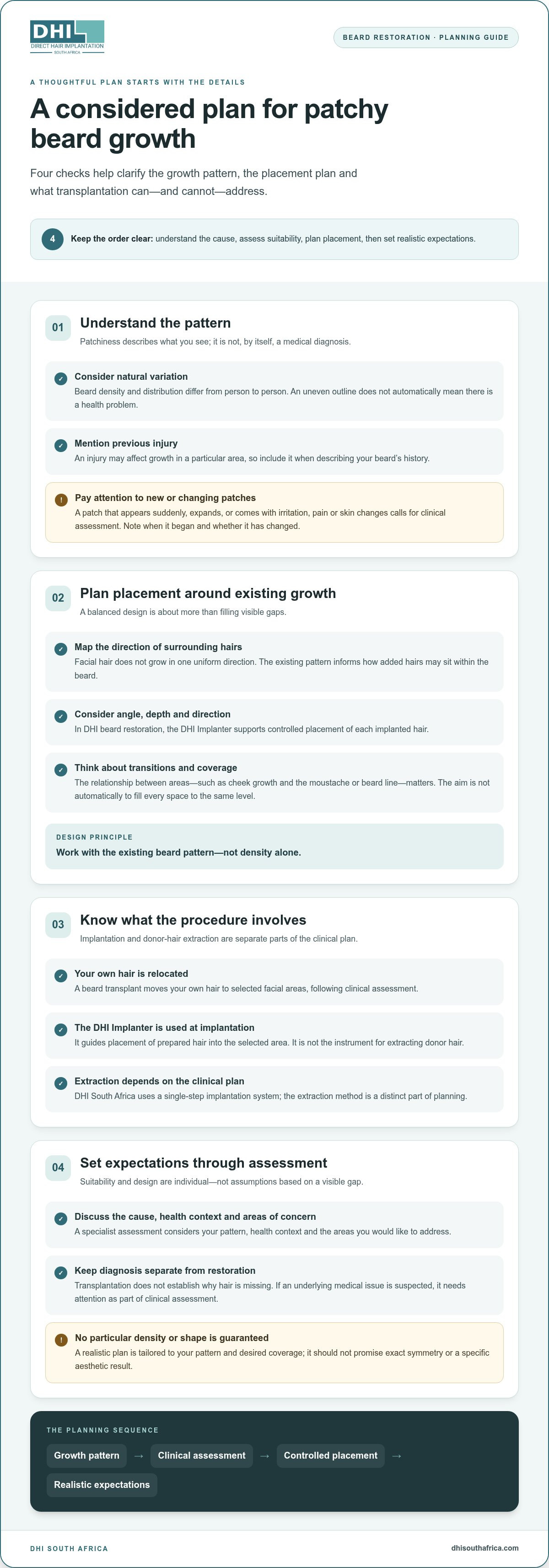
What to assess before deciding on beard transplantation
A useful assessment starts with a clear picture of what has changed and what you hope to achieve. You don’t need to arrive with a diagnosis or a perfectly defined beard design. Accurate observations and thoughtful questions can help a specialist understand your priorities and assess the pattern in context.
Before an appointment, consider making notes under four headings:
Growth history: When did you first notice the sparse areas? Have they stayed much the same, or changed over time?
Health context: Note relevant health conditions, medicines and any skin changes or symptoms. Describe what you’ve observed without trying to diagnose the cause.
Desired coverage: Identify the areas you’d like to address and the beard style you have in mind. Reference photos can help explain your preference, but they don’t determine what’s achievable.
Questions: Write down what you want to understand about suitability, the proposed design, procedure details, aftercare and follow-up.
These notes are a conversation aid, not an eligibility checklist. A specialist can consider your facial-hair pattern, donor-hair suitability and desired coverage together, then discuss a realistic design. DHI South Africa’s DHI hair-transplant approach also involves individual clinical planning, rather than assuming one plan fits everyone.
Questions a personalised assessment should address
Use the consultation to understand what may be contributing to the patchiness and whether it needs further medical evaluation. Ask how a proposed design would relate to your existing facial hair and goals, and what limitations may apply. Clarify which procedure details, aftercare guidance and follow-up are relevant to your individual plan.
If you’ve noticed a recent change, describe when it began, where it appears and whether you’ve experienced any symptoms. Clear observations are more useful than a self-diagnosis and can help the specialist decide what to consider before discussing restoration.
Setting realistic expectations before treatment
Your preferred beard style is an important starting point, but it isn’t a prediction of the final outcome. Hair characteristics, the direction of growth and the distribution of existing facial hair all shape how a design can be planned. A specialist can explain how your goals relate to the areas being assessed without promising a specific shape, symmetry or density.
Before deciding, make sure you understand the proposed plan and its limitations, as well as the procedure-specific aftercare and follow-up guidance. The treating clinical team should explain these details for your circumstances. That clarity can help you weigh the decision at your own pace.
Explore a personalised restoration consultation.
How DHI South Africa approaches beard restoration and your next step
Exploring beard restoration doesn’t commit you to treatment. It gives you a chance to discuss what you’d like to change, understand what an individual plan may involve and make a decision with clearer information. DHI South Africa offers beard restoration using the DHI protocol, with suitability and planning determined through specialist assessment.
The process can be understood in four stages:
Initial discussion: Share your beard goals, concerns and growth history. Mention which areas you’d like to address and whether you’ve noticed changes over time.
Specialist assessment: The specialist considers your facial-hair pattern, health context and donor suitability. This helps establish whether transplantation is suitable to explore and whether anything needs further assessment.
Personalised plan: If appropriate, the proposed design can be discussed in relation to your existing growth and goals. Ask how the DHI approach fits into the plan and what limitations may affect it.
Informed decision: Take time to consider the information, ask questions and decide whether you want to proceed. An assessment should support a considered choice, not pressure you into one.
From first conversation to an individual plan
A useful first discussion is specific to you. You might explain that you want to address sparse areas on your cheeks, or that you’re unsure whether a change in growth is stable. The specialist assessment puts those goals and observations in context. If a plan is proposed, discuss its intended design before deciding whether treatment feels right for you.
For a beard transplant for patchy beard growth, there isn’t a universal plan that can be chosen from a photograph or checklist alone. A clinician’s assessment informs whether transplantation is appropriate and how your individual pattern and donor suitability affect planning.
What makes an informed decision easier
Before deciding, make sure you understand the intended design and its limitations. Ask the treating clinical team to explain the procedure details, possible risks, aftercare and follow-up that apply to your plan. Information about safety, scarring and recovery should be specific to the proposed procedure and your circumstances, rather than assumed from general accounts or another person’s experience.
DHI South Africa’s implantation approach provides a framework for discussing how placement is planned. The key is to leave the conversation understanding both what the plan aims to address and what it cannot promise. A natural-looking result cannot be guaranteed, and a decision to proceed should follow a clear discussion of expectations.
If you’re ready to explore the topic further, start with a personalised conversation and decide on your next step at your own pace.
Take the next step at your own pace
Deciding whether to explore a beard transplant for patchy beard growth doesn’t have to be an immediate or all-or-nothing choice. Take time to consider what you’d like to feel more comfortable with, how a change might fit your everyday preferences and which questions still need answers. A conversation can be useful even if you’re not yet sure whether treatment is right for you.
Bring your priorities and concerns into the discussion. Clear, individual guidance can help you understand the options and think through your decision without pressure to pursue a particular outcome. You don’t need to have every detail worked out before taking that first step.
Whatever you decide, a thoughtful choice starts with understanding what matters to you. Give yourself time and information to move forward with confidence.
Frequently Asked Questions
Can patchy beard growth be caused by a medical condition?
Yes. Some medical conditions can affect beard growth, although patchiness can also reflect natural variation. A clinician can assess changes in context rather than relying on appearance alone. Before an appointment, note when you first noticed the area, whether it has changed and any symptoms or skin changes. This can help guide the discussion and clarify whether further medical evaluation is appropriate before considering a cosmetic procedure.
Is a beard transplant permanent?
No specific long-term outcome can be guaranteed. How transplanted hair behaves over time and how your overall beard may change are matters to discuss with the treating specialist, based on your circumstances. Ask what expectations are reasonable for the proposed plan, what factors may affect the result and what follow-up guidance applies. This helps distinguish the intended outcome from a promise about how your beard will look indefinitely.
How many hairs are needed for a patchy beard transplant?
There’s no standard number of hairs that applies to everyone. The estimate depends on the area being considered, your existing facial hair, donor suitability and the coverage you want to discuss. A specialist can explain the proposed hair count after assessing your pattern. If you’ve seen a number online, treat it as someone else’s plan, not a target or prediction for your face.
Can transplanted beard hair be shaved or trimmed?
Ask your treating clinical team whether and when shaving or trimming is appropriate for your procedure. The answer should be based on your individual plan and the team’s aftercare instructions, not general advice or another person’s experience. Before treatment, clarify when you can resume your usual grooming routine and whether any products or techniques should be avoided during recovery. Follow the guidance given for your care.
Is there an age limit for beard transplantation?
A universal age cutoff can’t be established from the information here. A specialist needs to assess your circumstances, including your beard-growth history, health context and reasons for seeking treatment. If your facial-hair pattern is still changing, mention that during the discussion. Rather than relying on age alone or assuming you’re eligible, ask the treating clinical team how age and individual development are considered in your assessment.
Can a beard transplant be considered after facial surgery or an injury?
This is a topic to raise during an individual specialist assessment, rather than something that can be decided from your history alone. Explain what happened, when it happened, any treatment you received and whether the area has changed since. The clinician can assess the facial area and discuss whether restoration is appropriate, what limitations may apply and whether further evaluation is needed before planning treatment.


Comments